IRC Section 673 – Does the Grantor of Your Trust Have a Reversionary Interest?


In this installation, Peter Harper, the managing director and CEO of Asena Advisors discusses qualifications of a grantor trust and whether or not your foreign trust qualifies.

​​This vlog is for anyone that owns assets in foreign trusts and is moving to the US or facing a liquidity event.

To watch the full video, click play below:

Check out our new blog for a quick guide to everything Grantor Trust: https://asenaadvisors.com/blog/grantor-trust/

Asena advisors. We protect Wealth.

Do you own a Foreign Grantor Trust? How It Impacts an Investment or Liquidity Event.


In this week’s vlog, our Managing Director and CEO, Peter Harper, talks about discretionary trusts, how they can be classified as foreign grantor trusts under US tax law and how they should be utilized as investment vehicles.

​​This vlog is for anyone that owns assets in foreign trusts and is moving to the US or facing a liquidity event.

To watch the video, press play:

Check out our new blog for a quick guide to everything Grantor Trust: https://asenaadvisors.com/blog/grantor-trust/

Asena advisors. We protect Wealth.

Grantor Trust Rules – A Primer


In this week’s vlog, Peter Harper, our Managing Director and CEO, discusses grantor trusts and how the grantor trust rules apply to US persons.

This vlog is for anyone that owns assets in foreign trusts and is moving to the US or facing a liquidity event.

To watch the video, press play:

Check out our new blog for a quick guide to everything Grantor Trust: https://asenaadvisors.com/blog/grantor-trust/

Asena advisors. We protect Wealth.

Why 2021 is not 2020


In this week’s vlog, Peter Harper, our Managing Director & CEO, discusses what makes this upcoming year different than last year. Both economically and mentally, we have been handling the raging pandemic differently than earlier last year and Peter discusses why and how this shift will impact this upcoming fiscal year. Please contact us for more information on how to make the most of opportunities this year.

To watch the vlog, click the link below or just press play:

Asena advisors. We protect Wealth.

When Should Australian Investors Focus on the US?


In this vlog, Peter Harper, our CEO and managing director, discusses the plans for the New Year and how to prepare fiscally for another year in the turbulent world that we live in. If you plan on investing in the US, listen to the video below to learn more about what may happen this year and when to act to make the most of your money. Please contact us to know more about how we can assist.


Asena advisors. We protect Wealth.

Happy Holidays from the Team at Asena!


Thank you for the confidence and trust you have placed in us to advise you on your Australian and US tax matters in 2020. It is a privilege to work with you and assist you in achieving your personal and business objectives through intelligent and strategic tax planning.

Wishing you a happy, safe and healthy holiday season from the Team at Asena! 

Our offices are closed from Thursday, December 24, 2020, and will reopen on Monday, January 4, 2021. We look forward to serving you in the New Year. 

Asena advisors. We protect Wealth.

Estate Planning and Cross Border Issues Seminar

We were delighted to have been invited to present a seminar on cross-border issues in estate planning for the Leo Cussen Institute recently. Renuka Somers of Asena Advisors collaborated with Matthew Burgess of View Legal to present on Australian testamentary trusts and issues that affect testators and beneficiaries specifically in the US-Australia context.
For more information on cross-border estate planning, please contact
Head, US-Australia Tax Desk
Asena advisors. We protect Wealth.

What’s a GRAT? Should you have one?


A “Grantor Retained Annuity Trust”, more commonly known as a “GRAT”, is an irrevocable
trust that can reduce estate tax exposure. GRATs are usually used for large gifts of capital
appreciating assets, as the assets transferred into the GRAT are excluded for estate tax
purposes, making it an attractive option for estate planning in the US for ultra-high net worth
clients with beneficiaries.

GRATs are complex and care needs to be taken when structuring them, and it is imperative
that certain conditions be adhered to.

In summary:

  1. The grantor must receive a “qualified interest” in the trust. Section 2702(b) of the
    US Internal Revenue Code defines a “qualified interest” to be:

    1. “any interest which consists of the right to receive fixed amounts payable not
      less frequently than annually,
    2. any interest which consists of the right to receive amounts which are payable
      not less frequently than annually and are a fixed percentage of the fair market
      value of the property in the trust (determined annually), and
    3. any non-contingent remainder interest if all of the other interests in the trust
      consist of interests described [above]”
  2. The grantor must retain a right to receive the original value of the assets
    contributed to the trust while earning a specified rate of return (of at least 0.4% as
    of November 2020, in accordance with IRC section 7520 – see
    https://www.irs.gov/businesses/small-businesses-self-employed/section-7520-
    interest-rates)
  3. The term of the annuity of the GRAT must be a fixed amount of time equal to
    the life of the annuitant, a specified term of years, or the shorter of those two periods
    (IRC section 2702(c)(3)).

    1. When the GRAT’s term expires, the assets remaining in the GRAT (based on
      any appreciation and the IRS-assumed rate of return), are passed on to the
      grantor’s beneficiaries without any gift tax implications.
    2. If the grantor dies before the GRAT term expires, the assets become part of
      the grantor’s taxable estate for estate tax purposes (in which case, the
      beneficiaries will not receive the remainder of the GRAT assets).

Asena Advisors is the only multi-disciplinary (Accounting and Legal) international CPA firm in the United States that specializes in U.S. -Australia taxation.

Structuring

The gift tax exposure on the transfer of assets to the GRAT can be limited if the actuarial
value of the annuity retained by the grantor is equivalent to the value of the property
transferred (see IRC section 2702).

A GRAT should ideally be structured as a grantor trust (read our prior blog Is your Australian trust a “grantor trust” for US tax purposes?) for both principal and income purposes, so that any future transactions between the GRAT and the grantor are
ignored for US Federal tax purposes.


To find out if a GRAT is right for you, please contact:

Renuka Somers
Head, US-Australia Tax Desk

Prerna Polepally
Intern, US-Australia Tax Desk

Happy Thanksgiving From the Team at Asena


On Thursday we celebrate Thanksgiving Day, an annual national holiday in the United States since 1863 that pays tribute to the harvest and the blessings of the year.

Despite the controversies of its origins, Thanksgiving today has become synonymous with food, family gatherings, Macy’s Thanksgiving Day Parade, American football, and the Black Friday sales that follow. For some, it is a day for reflection and gratitude.

As with many things this year, the Holiday will no doubt, look and feel different, and as the year draws closer to its end, we hope that its travails are behind us. So let’s remind ourselves of what we are thankful for, and that despite the challenges of the year, there is hope.

Here’s what we, at Asena, are thankful for:

Renuka Somers:

  • the amazing people in my life;
  • Gemma, the American Pit Bull x Boxer x St Bernard rescue pup (pictured) who often keeps me company as I work;
  • the lessons of this year;
  • good health;
  • the work I get to do; and
  • my outdoor ‘Bootcamp’ crew who’ve kept me fit and strong this year.

Peter Harper:

  • morning cuddles with my daughters Ophelia and Stella and my wife Gillian;
  • the support of great partners, staff and clients; and
  • personal health and financial health.

Janpriya Rooprai:

  • people around me;
  • home cooked meals;
  • art and dance;
  • clients for giving the opportunity to work with them; and
  • high-speed internet 🙂

Prerna Polepally:

  • my loving family;
  • my amazing friends;
  • hot coffee and good books;
  • baking and the smell of vanilla in the air;
  • my teachers for helping me get into college; and
  • everyone I work with!

What are you thankful for?


Happy Thanksgiving from the Team at Asena! Our offices are closed for the Thanksgiving holiday on Thursday, November 26, and Friday, November 27.

Asena advisors. We protect Wealth.

Mergers & Acquisitions: Interposing an Australian Holding Company – Part 3: the US Anti-Inversion Rules

*The concepts discussed in this blog are complex and require careful consideration to ensure compliance with Australian and US tax laws. Unless otherwise stated, all monetary references are to US dollar amounts, and all legislative references are to the Australian Income Tax Assessment Act (ITAA) 1997 and to the United States’ Internal Revenue Code (IRC).

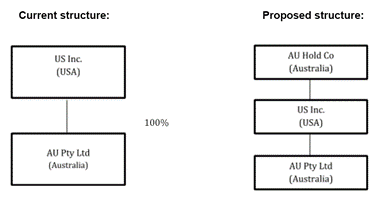
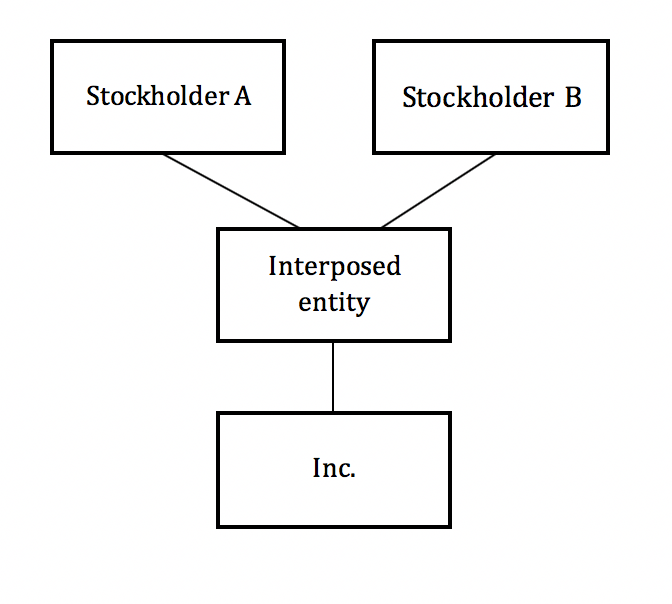
Continuing on from the prior weeks’ blogs Mergers & Acquisitions: Interposing an Australian Holding Company – Part 1: Scrip for Scrip in a Cross-Border Context and Mergers & Acquisitions: Interposing an Australian Holding Company – Part 2: the US Corporate Reorganization Rules, this week we consider the application of the US anti-avoidance rules in the context of interposing an Australian holding company (AU HoldCo) to hold the equity interests in US Inc., with the stockholders of US Inc. exchanging their interests in US Inc. for equivalent interests in AU HoldCo:  

The US nonrecognition rules may not apply where a reorganization results in the transfer of property to a foreign corporation (IRS publication Outbound Transfers of Property to Foreign Corporation – IRC 367 Overview 09/08/2014). Of particular relevance in this context are IRC sections 367 and 7874 discussed in our previous blog Restructuring your US operations – Part 3: Anti-avoidance rules in the Internal Revenue Code.

In this week’s blog, we examine these rules in the specific context of an exchange of shares.


IRC section 367

As noted in Part 2, the exchange could satisfy IRC sections 354 and 361.

IRC section 367(a)(1) applies in relation to an exchange described in sections 332, 351, 354, 356, or 361 such that the foreign corporation is not for the purposes of determining the extent to which the gain shall be recognized, be considered to be a corporation, thereby requiring the US transferor (US Inc.) to recognize the gain in the property transferred (shares in AU Pty Ltd) to the foreign corporation (AU HoldCo). Exceptions to this rule include:

  1. a transfer of stock or securities of a foreign corporation which is a party to the reorganization (IRC section 367(a)(2)). While there is an indirect transfer of foreign corporation stock (AU Pty Ltd) to AU HoldCo through US Inc. shares, it is doubtful that AU Pty Ltd would satisfy the additional requirement of being a “party to the reorganization” as the section 368(b) definition of that term only extends to the exchanging companies, or a company that controls the acquiring company; and
  2. a section 361 reorganization where the transferor corporation is controlled by more than five domestic corporations, with members of an affiliated group being treated as one corporation (IRC section 367(a)(4)). IRC 1504 defines “affiliated group” as one or more chains of includible corporations connected through stock ownership with a common parent, with at least 80% of the stock (by voting power and value) being owned by the parent or by another corporation in the chain.

If ownership of US Inc. does not satisfy the domestic corporation rule for application of IRC 361, then in order for section 367 not to apply in this case, the following would be required:

  1. an IRC section 354 reorganization – exchange of stock or securities;
  2. the transfer of stock or securities of a foreign corporation which is a party to the reorganization (IRC section 367(a)(2)); and
  3. satisfaction of the Treasury Regulations in relation to the COI, COBE and business purposes tests (discussed in Part 2).

This could occur, for example, if AU HoldCo acquires US Inc. stock and US Inc. stockholders acquire AU HoldCo shares so that there is a transfer of a foreign company’s stock. However, the business purpose test in the Treasury Regulations would need to be satisfied – what is the value that AU HoldCo would bring to the group justify a business purpose? What business or assets would AU HoldCo bring to enhance the business of the US Inc. / AU Pty Ltd structure? This is fundamental to overcoming the section 367 exclusion.

We are the only multi-disciplinary international CPA firm in the United States that specializes in U.S.– Australia taxation.

IRC section 7874 anti-inversion rules

Section 367 does not apply if section 7874 applies (Reg. 1.7874-2(j)(3)).

As AU HoldCo is an Australian (“foreign”) corporation, section 7874 must be considered as the exchange would result in a US corporation’s (US Inc.’s) shares or assets being placed under a new foreign holding company (AU HoldCo).
If section 7874 applies, the taxable income of the “expatriated entity” (US Inc, the domestic corporation with respect to which a foreign corporation is a “surrogate foreign corporation” under IRC section 7874 (a)(2)(A)((i)) would include the “inversion gain” from the exchange (IRC section 7874 (a)(1)).
Section 7874 would apply to treat an inverted foreign corporation (AU HoldCo) as a “surrogate foreign corporation” that is classified as a domestic corporation for U.S. income tax purposes, if:

  1. AU HoldCo acquires substantially all of the properties of a domestic corporation (US Inc.). If AU HoldCo was specifically formed for the purpose of making the acquisition, it would be treated as a domestic corporation from its inception (Reg. 1.7874-2(j)); and
  2. the “shareholder continuity” test is satisfied by the shareholders of US Inc. holding 80% or more (by vote or value) of the stock in AU HoldCo after the exchange, due to its prior equity interest in US Inc.

Substantial Business Activities Exception

AU HoldCo would not be treated as a surrogate foreign corporation if it has, directly or through its “expanded affiliated group” (EAG) (as defined in IRC section 1504), substantial business activities (SBA) within its jurisdiction of organization (Australia).
The Treasury Regulations in relation to the SBA exception are strict and in order to qualify for the SBA exception, AU HoldCo (or its EAG) must meet each of the following three tests (Reg. 1.7874-3):

  1. Group employees test: The number of group employees based in Australia must be at least 25% of the total number of all group employees on the “applicable date” (the date of the exchange or the last day of the month immediately preceding the exchange) and the employee compensation incurred with respect to group employees in Australia must be at least 25% of the total employee compensation (wages, salaries, deferred compensation, employee benefits and employer payroll taxes) incurred with respect to all group employees during the “testing period” (being the one-year period preceding the Exchange). Whether individuals are considered “employees” for the purposes of this test would be determined under US federal income tax principles and Australian tax laws.
  2. Group assets test: The value of the group assets (tangible personal property or real property owned or rented by members of the EAG and used or held for use in the active conduct of a trade or business by the EAG) located in Australia must be at least 25% of the total value of all EAG assets on the Exchange date.
  3. Group income test: The EAG’s income derived in Australia (i.e. gross income from transactions occurring in the ordinary course of business with customers that are not related persons, and who are located in Australia) must be at least 25% of the total EAG income during the testing period. Group income must be determined under US federal income tax principles or as reflected in the relevant financial statements, prepared in accordance with US Generally Accepted Accounting Principles or International Financial Reporting Standards.

The Regulations also contain anti-abuse provisions designed to ignore the transfers of assets, employees, or income that are part of a plan with “a principal purpose” of avoiding section 7874.


Consequences:
If the anti-inversion rules apply, AU HoldCo would be subject to US Federal corporate tax, withholding tax (at 30% on dividends paid to its shareholders), and filing and reporting requirements.
Subject to consideration of the global effective tax rate of the flow of funds to stockholders, an exchange as proposed should only be considered if:

  1. the group can satisfy the SBA test for the purposes of IRC section 7874, with at least 25% of its employees and 25% of its assets being located in Australia and 25% of its income being derived from Australia; and
  2. if section 7874 does not apply and section 367 is relevant, only if:
    • the transferor corporation is controlled by more than five domestic corporations;
    • there is a transfer of stock or securities of a foreign corporation which is a party to the reorganization; and
    • the Treasury Regulations in relation to the COI, COBE and business purposes tests can be satisfied.

This blog is part of a 3 part series comprising:

Mergers & Acquisitions: Interposing an Australian Holding Company – Part 1: Scrip for Scrip in a Cross-Border Context

Mergers & Acquisitions: Interposing an Australian Holding Company – Part 2: the US Corporate Reorganization Rules

Mergers & Acquisitions: Interposing an Australian Holding Company – Part 3: the US Anti-Inversion Rules


For more information on US-Australia cross-border M&A, please contact:

Renuka Somers
Head, US-Australia Tax Desk

How Does the Biden Tax Plan Affect US-Australians?

Today, we consider and summarize how President-elect Joe Biden’s tax plan can affect US-Australians.
The plan is detailed at https://joebiden.com/two-tax-policies/.
Some of the key features of the plan include:
  1. repealing some aspects of the US 2017 Tax Cuts and Jobs Act for high-income filers (classified as those with incomes in excess of $400,000), including:
    • changing the highest individual income tax rate for taxable incomes exceeding $400,000 from 37% under the TCJA to the pre-TCJA rate of 39.6%;
    • taxing the long-term capital gains and qualified dividends at the ordinary income tax rate of 39.6% (from 20%) for income exceeding $1 million;
    • removing the “step-up in basis” (cost base) for capital assets;
    • capping the tax benefit of itemized deductions to 28%;
  2. imposing a 12.4% Social Security payroll tax for wages exceeding $400,000, to be split evenly between employers and employees;
  3. increasing the corporate income tax to 28% from 21%;
  4. establishing a corporate minimum tax on book income for corporations whose book profits are $100 million or higher;
  5. doubling the tax rate on Global Intangible Low Tax Income (GILTI) earned by foreign subsidiaries of US firms from 10.5% to 21%; imposing the GILTI rules on a country-by-country basis; and eliminating the GILTI exemption for deemed returns on qualified business asset investment (specified tangible assets used by a taxpayer in trade or business that are depreciable under Section 167 of the IRC);
  6. temporarily increasing the Child Tax Credit and Dependent Credit – from a maximum of $3,000 in qualified expenses to $8,000; increasing the maximum reimbursement rate to 50% (from 35%);
    reestablishing the First-Time Homebuyers’ Tax Credit – up to to $15,000 for first-time homebuyers;
  7. expanding renewable-energy-related tax credits, including for carbon capture, use, and storage, residential energy efficiency, restoring the Energy Investment Tax Credit and the Electric Vehicle Tax Credit, and ending tax subsidies for fossil fuels;
  8. introducing a new advanceable 10% “Made in America” tax credit for business activities that restore production or aim to revalize manufacturing and related employment.

Asena Advisors is the only multi-disciplinary (Accounting and Legal) international CPA firm in the United States that specializes in U.S. -Australia taxation.

The economic impact of these, and other, proposed changes has been forecast by many institutions.
Politics aside, in summary, here’s what we can expect to see for US-Australians, if these changes are enacted:
  1. for individuals with taxable incomes in excess of USD $400,000, increased Federal tax liability at the individual level by 2.9% (from 37% to 39.6%), with a corresponding limitation in some deductions, and an almost doubling of the Federal capital gains tax liability for income in excess of USD $1 million (20% vs 39.6%);
  2. potentially increasing the cost of employment (and earning) in the US of highly skilled and compensated employees, with the Social Security Payroll tax on incomes above $400,000;
  3. potentially increasing the cost of the business in the US with a 7% increase in the corporate income tax rate (from 21% to 28%) – making it broadly equivalent (or in some cases, higher) to the Australian rates, increasing the effective tax rate for cross-border businesses, and potentially impacting the foreign income tax offset and franking credits for Australian shareholders;
  4. potentially creating significant changes to the GILTI rules, if enacted. It is still early to determine the impact on these rules, but this is something that businesses with offshore intangible income should keep in mind; and
  5. potentially creating significant opportunities and tax credits in the renewable-energy and manufacturing sectors – businesses seeking to expand to the US should explore these opportunities.
If the Republicans retain their majority in the Senate (as of the date of this Alert, North Carolina, and Alaska have not been called, and Georgia is subject to a runoff), it may be difficult for the Biden tax plan to be approved in both Houses at least in the next 2 years, prior to the next “off-year election” when one-third of the Senate is up for re-election.


For more information, please contact:

Renuka Somers
Head, US-Australia Tax Desk

Peter Harper
CEO

Mergers & Acquisitions: Interposing an Australian Holding Company – Part 2: the US Corporate Reorganization Rules

* The concepts discussed in this blog are complex and require careful consideration to ensure compliance with Australian and US tax laws. Unless otherwise stated, all monetary references are to US dollar amounts, and all legislative references are to the Australian Income Tax Assessment Act (ITAA) 1997 and to the United States’ Internal Revenue Code (IRC).

Continuing on from last week’s blog Mergers & Acquisitions: Interposing an Australian Holding Company – Part 1: Scrip for Scrip in a Cross-Border Context, this week we consider the US tax implications with interposing an Australian holding company (AU HoldCo) to hold the equity interests in US Inc., with the stockholders of US Inc. exchanging their interests in US Inc. for equivalent interests in AU HoldCo:

US Corporate Reorganization Relief

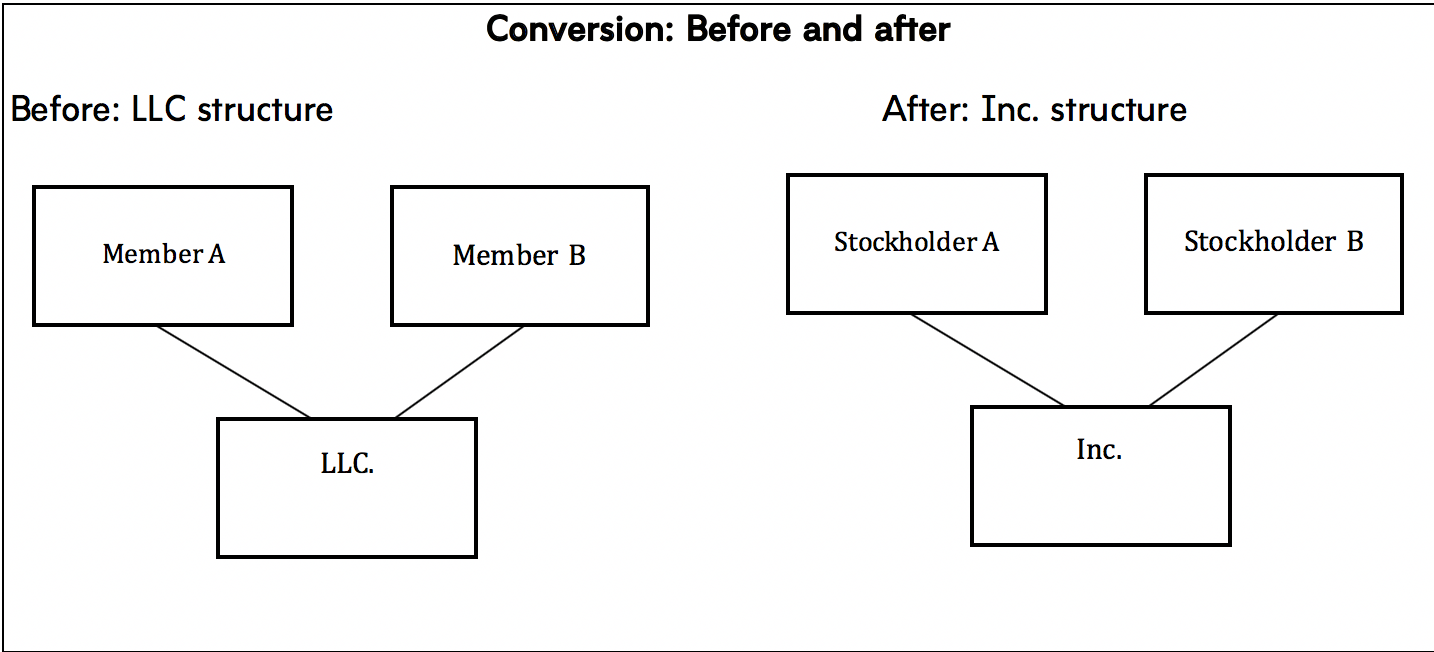
We have previously discussed the corporate reorganization rules in the context of converting an LLC into an Inc. in Restructuring your US operations – Part 2: US corporate reorganization relief
As noted, the IRC provides for tax relief (“nonrecognition”) for corporate “reorganizations” (under IRC sections 354-368).

To qualify for nonrecognition, a restructure must satisfy:

  1. a statutory definition of “reorganization” IRC section 368(a)(i)); and
  2. Treasury Regulation requirements.

“Reorganization”

The definition of “reorganization” in the IRC includes a “scrip for scrip” type restructure – an exchange of stock in once corporation for stock in another, where immediately after the acquisition, the acquiring corporation has “control” of the other corporation (by possessing at least 80% of the total combined voting power and shares of all classes of stock) regardless of whether the acquiring corporation had control immediately before the acquisition (IRC section 368(a)(i)(B)).

Section 354(a)(1) states that no gain or loss shall be recognized if stock or securities in a corporation a party to a reorganization are, in pursuance of the plan of reorganization, exchanged solely for stock or securities in such corporation or in another corporation a party to the reorganization.

Similarly, section 361(a) states that no gain or loss shall be recognized to a corporation if it is a party to a reorganization and exchanges property in pursuance of the plan of reorganization, solely for stock in another corporation, a party to the reorganization. Such property could consist of stock or securities, other property or money (IRC section 361(b)(1))

The restructure can involve one or more “domestic corporations” or a domestic corporation and a “foreign corporation”. “Corporation” is defined to include associations, joint-stock companies, and insurance companies (IRC section 7701(a)(3)). US Inc. would qualify as a “domestic corporation” for US tax purposes as it is created or organized in the US (IRC sections 7701 (a)(4)). AU HoldCo would qualify as a “foreign corporation” as it is not a “domestic corporation”, if registered in Australia (IRC sections 7701 (a)(5)).

An exchange involving AU HoldCo acquiring all of the stock in, and control of, US Inc. in exchange for all of its stock, could qualify as a reorganization under either IRC sections 354 or 361.

We are the only multi-disciplinary international CPA firm in the United States that specializes in U.S.– Australia taxation.

The Treasury Regulations

The Treasury Regulation requirements for a reorganization (Treas Reg. 1. 368-1) consist of 3 requirements – the continuity of interest (COI), continuity of business enterprise (COBE), and business purpose (BP).
The COI requirement stipulates that a substantial part of the value of the proprietary interests in the “target corporation” (US Inc.) be preserved by, for example, an exchange by the “acquiring corporation” (AU HoldCo) for a direct interest in the target corporation (US Inc.) (Reg. 1. 368-1(e)). A proprietary interest in the target is preserved by the acquisition of stock.

The COBE requirement to be satisfied the transactoin “must be an ordinary and necessary incident of the conduct of the enterprise and must provide for a continuation of the enterprise” (Reg. 1. 368-1(c)). This requirement would be satisfied if AU HoldCo continues the historic business of US Inc. or uses a significant portion of US Inc.’s historic business assets in a business (Reg. 1. 368-1(d)). This requirement is generally not satisfied with a foreign holding company. However, a reorganization may qualify as tax-free if in an otherwise qualifying corporate reorganization, the assets and the businesses of the members of a “qualified group of corporations” are treated as assets and businesses of the issuing corporation (Reg. 1. 368-1(d)(4)(i)). A “qualified group of corporations” is a chain of corporations connected through stock ownership, with the issuing corporation (AU HoldCo) owning directly, stock in at least one other corporation (US Inc.) meeting the “control” requirements of section 368(c)).

The “Business purpose” requirement stipulates that the transaction must have a bona fide business purpose – if not, it would not qualify for relief even if all other requirements for a reorganization are satisfied (Regs. 1. 368-1(b),(c), and (g)). This is especially the case where the parties to the transaction are related and a collateral tax benefit may be obtained from the transaction. The IRS has stated that private letter ruling requests in this regard must include “a complete statement of the business reasons for the transaction” with evidence that the transaction is logical from a business standpoint, and those tax considerations are secondary (Rev. Proc. 2019-1, §7.01(1)(d)). For the stockholders of US Inc., the commercial rationale for the exchange is paramount – can the exchange be justified other than for tax purposes? For example, is the exchange a means to separate core business lines by jurisdiction? How will the businesses operate following the exchange? Is it a means of capital raising? What is the global effective tax rate before and after the exchange?

Assuming that the exchange satisfies these requirements above and is not subject to the anti-avoidance provisions (as will be discussed in Part 3), no gain or loss would be recognized by the stockholder if the stock exchange involves stock in a “party to a reorganization” exchanged pursuant to a “plan of reorganization” (IRC section 354(a)(i)).

“Party to a reorganization” includes both the corporation acquiring the stock (i.e., the “Acquirer”, AU HoldCo) and the corporation whose stock is acquired (i.e., the “Target”, US Inc.) (IRC section 368(b)).

A “plan of reorganization” requires written or oral recognition of the reorganization plan and an identification of the constituent transactions (C. T. Inv. Co. v. Commissioner, 88 F.2d 582 (8th Cir. 1937)). Each party must adopt the plan and file IRS statements for the tax year in which the reorganization occurs (Reg. 1.368-3(a)).
The basis (cost base) of each stock received in the exchange is generally the same as that for which it was exchanged (IRC section 358(b)(1); Reg. 1.358-2).
In next week’s blog, we will consider how the US anti-avoidance rules could operate to this exchange.


For more information on US-Australia cross-border M&A, please contact:
Renuka Somers
Head, US-Australia Tax Desk

Mergers & Acquisitions: Interposing an Australian Holding Company – Part 1: Scrip for Scrip in a Cross-Border Context

* The concepts discussed in this blog are complex and require careful consideration to ensure compliance with Australian and US tax laws. Unless otherwise stated, all monetary references are to US dollar amounts, and all legislative references are to the Australian Income Tax Assessment Act (ITAA) 1997 and to the United States’ Internal Revenue Code (IRC).

Clients often consult us about changing the jurisdiction of the holding companies in their corporate groups.

For example, consider the following scenario where US Inc., a US registered “C Corporation” with both US and Australian resident shareholders, holds 100% of the voting shares in AU Pty Ltd. AU Pty Ltd is an Australian resident company, being incorporated in Australia and having its central management and control in Australia. The business (and value) of the group is held in AU Pty Ltd.

It is proposed that a new Australian holding company (AU HoldCo) hold the equity interests in US Inc., with the stockholders of US Inc. exchanging their interests in US Inc. for equivalent interests in AU HoldCo, as follows:

What are the US and Australian tax implications of such an exchange? 


The Australian tax implications

The exchange would trigger capital gains tax (CGT) Event A1 for the Australian resident shareholders of US Inc. and they would be taxable on the difference between the market value of the shares and their cost base in those shares.  

Subdivision 124-M roll-over relief is generally available for a “scrip for scrip” exchange, provided that the legislative requirements are satisfied, specifically: 

1. an exchange of an “original interest” in a company for a “replacement interest” in another company (section 124-780(1))

a) an entity (the original interest holder) exchanges:

(i) a *share (the entity’s original interest) in a company (the original entity) for a share (the holder’s replacement interest) in another company; or

(ii) an option, right or similar interest (also the holder’s original interest) issued by the original entity that gives the holder an entitlement to acquire a share in the original entity for a similar interest (also the holder’s replacement interest) in another company; and

Asena Advisors is the only multi-disciplinary (Accounting and Legal) international CPA firm in the United States that specializes in U.S. -Australia taxation.

This requirement should be satisfied if the US Inc. shareholders acquired interests in AU HoldCo that were similar to their existing US Inc. interests. 

2. “Single arrangement” requirement: this requirement would be satisfied if AU HoldCo acquires 80% or more of the voting shares in US Inc. and provided that the exchange is an arrangement in which all shareholders in US Inc. could participate, and in which participation is available on substantially the same terms for all interest holders in US Inc. (section 124-780(2)(a)(i), (b), and (c)). Careful consideration of the exchange agreement is required in order to ensure that these conditions are satisfied for all interest holders;

3. the required choice and cost base notifications are made to apply the roll-over: this could be done by the shareholders electing to apply the roll-over in the way they prepare their Australian tax returns for the relevant year in which the CGT event occurs (section 103-25);

4. the arm’s length / non-arm’s length rules are satisfied if the Exchange is not undertaken at arm’s length and if US Inc. has less than 300 shareholders, the market value of the shares in AU HoldCo must be substantially the same as that in US Inc. and the AU Hold Co shares must carry the same rights and obligations as those attached to the shareholder’s original interest. (see ATO ID 2004/498 and sections 124-780(4) and (5));

5. the arrangement is not excluded from roll-over relief: Subdivision 124-M roll-over relief is not available for foreign residents unless the replacement interest is taxable Australian property (TAP) (section 124-795(1))). 


However, the disposal by the foreign residents of their shares in US Inc. (a foreign corporation) in exchange for shares in AU HoldCo would not trigger CGT for them as foreign residents of Australia are only subject to Australian CGT on TAP (section 855-10).

TAP consists of taxable Australian real property, an indirect interest in Australian real property, a business asset of a permanent establishment in Australia, on option or right to acquire such an asset, or a CGT asset that is deemed to be TAP where a taxpayer makes an election to treat it as such, on ceasing to be an Australian resident (section 855-15). The US Inc. shares would not be TAP as there is no underlying interest in Australian real property.

The exclusion of the foreign resident shareholders from roll-over relief should not preclude the Australian resident shareholders from accessing the roll-over. There is nothing in Subdivision 124-M requiring all shareholders to access the roll-over being a precondition to its application. In any event, no CGT consequences are triggered for foreign residents if the CGT asset is not TAP (section 855-10).

Further, the Explanatory Memorandum to the New Business Tax System (Miscellaneous) Bill (No.2) 2000 (Act No.89 of 2000) (EM) indicated that the roll-over was originally limited only where both the original company and the acquiring company were non-residents and requiring additional conditions to be satisfied in that event. Paragraph 11.68 of the EM envisages that a non-resident may acquire a replacement interest in an Australian company in a scrip for scrip exchange, stating:

11.68 The note in subsection 124-795(1) of the ITAA 1997 indicates that if a non-resident’s replacement interest is an interest in an Australian resident company or trust, it is treated as having the ‘necessary connection with Australia’. This ensures that the replacement asset is a taxable asset when the non-resident later disposes of it.

In next week’s blog, we will consider how the US corporate reorganization rules could operate to this restructure.


For more information on US-Australia cross-border M&A, please contact:

Renuka Somers

Head, US-Australia Tax Desk  

International Estate Planning: Which US States Have Ratified the “International Will Treaty”?


Between October 16th and 26th of 1973, Washington D.C. held the Diplomatic Convention on Wills to discuss providing a uniform law on the structuring of an International Will. Following three previous conventions – the Hague Convention of October 1st, 1973, the Hague Convention of October 5th, 1961, and the Convention on the Establishment of a Scheme of Registration of Wills in Basel on May 16, 1972 – the Washington Convention strove to agree on a certain form of Will acceptable to the internal law of every country and qualifying jurisdiction.

Organized by the International Institute for the Unification of Private Law (UNIDROIT) and signed or ratified by 20 countries, the Convention providing a Uniform Law on the Form of an International Will (is referred to as the International Wills Treaty, Uniform Wills Recognition Act or the UNIDROIT Wills Treaty) entered into force on February 9th, 1978. For ease of reference, we use the term “Treaty” in this blog.


Summary

The states and countries adopting the Treaty agree to recognize the validity of Wills executed in other states or countries that have adopted the Treaty as well, provided that the Will complies with the requirements of the Treaty.

The Treaty is broken down into 16 articles – which entails the process that the contracting parties (the countries and states) need to undertake – and an Annexure with 15 articles – which describes the requirements of an international will for it to be compliant (the Annex becomes the Uniform Wills Recognition Act). To read more about the requirements of an international will, read our blog “Should you have an “International Will”?”.


The United States

The United States, due to its federal nature, requires each individual state to ratify the Treaty and adopt the Annex into their State Codes. Although the US as a whole has signed the Convention and acts as the Depositary Government (to which the Treaty is entrusted under international law), less than half of the US States have ratified the Treaty or adopted the Annex as law.

We are the only multi-disciplinary international CPA firm in the United States that specializes in U.S.– Australia taxation.

Below is a list (derived from https://www.uniformlaws.org/committees/community-home?CommunityKey=e0a2332d-5263-4fab-880f-1607fc5affba and cross-referenced with multiple US State codes as of 10/20/2020) of all of the US States, Districts, and Territories that have ratified the Treaty and adopted the Annex:

  1. Alaska
  2. California
  3. Colorado
  4. Connecticut
  5. Delaware
  6. Hawaii
  7. Illinois
  8. Maryland
  9. Michigan
  10. Minnesota
  11. Montana
  12. Nevada
  13. New Hampshire
  14. New Mexico
  15. North Dakota
  16. Oklahoma
  17. Oregon
  18. Vermont
  19. Virginia
  20. Wisconsin

+ the Virgin Islands

+ the District of Columbia

*the act has been introduced in Nebraska but has yet to be adopted


Significance

Since the Treaty aims to resolve the need for multiple Wills to cover international assets, it serves to provide testators with assets in the contracting jurisdictions to require only one “International Will” to cover these assets, provided that the Treaty guidelines are strictly adhered to. 

For example, if Jenna lives in California and has assets in Australia and in the UK, Jenna can opt to have a single “International Will” that covers all of her assets, as all three jurisdictions have ratified the Treaty.

On the other hand, if Jenna has assets in Alabama, Australia, the UK, and Spain, she may require multiple wills. As Alabama and Spain are not signatories to the Treaty and have not ratified the Treaty, depending on the nature and value of the assets in each of jurisdictions (and the consequent issues that could arise with obtaining probate in each such jurisdiction), Jenna may require separate Wills for Alabama and Spain, and could also have one international Will for her Australian and UK assets.

International estate planning is complex and you should always have a professional analysis of your assets undertaken to ensure that you Will is appropriately structured. Our whitepaper International Estate Planning for US-Australia cross-border clients provides an in-depth analysis of common international estate planning issues.


For more information on cross-border structuring of assets and Wills, please contact:

Renuka Somers
Head, US-Australia Tax Desk

Prerna Polepally
Intern, US-Australia Tax Desk

The 3 Pillars Podcast: Wealth Education: ‘Philanthropy or Legacy: How to Build Purpose in the Next Gen’


In the eighth episode of the 3 Pillars Podcast, Peter Harper and Andrew Doust discuss wealth education and how establishing personal, family, and business goals can help build a long-lasting family office.

To listen to the full episode, click the link below or just press play:

https://asenaadvisors.podbean.com/e/wealth-education-philanthropy-or-legacy-how-to-build-purpose-in-the-next-gen/?token=80b0e43b98204d61a5a6d1cadaa4dbed

TL;DR

Peter Harper: Andrew, it’s awesome to have you with me today for the Three Pillars podcast. It’s probably been about 18 months since we last caught up and today, I wanted to touch on with you the topic of prepping next gen for material inheritances and how you think about philanthropy versus legacy. One of the things I love about our discussions is just as we were prepping for this, I started putting things out to you and saw it in my memory of things that we’ve discussed in the past and try to why you’re picking me up and saying “No Peter. This is not allnecessarily about philanthropy, it’s the overarching theme of this is purpose. Can you just give the listener listeners, a bit of an overview of your yourself, your background and what it is that makes you tick?


Andrew Doust: Yeah, sure, thanks, Peter. It’s great to catch up with you again. Yeah, I’ve been working with families of oil for 20 years or more, and so I’ve got to see firsthand the challenges they face as they navigate the complexities of wealth. So I work with families to help them navigate that complexity and to flourish as a family, because if they flourish as a family and the relationships are strong, the chances are they’ll be able to manage their resources as well. Conversely, if they don’t get along well, they really can’t make good decisions. Often the relationships break down and eventually the wealth dissipates. So to me, working with families on being healthy relationally is the key to actually ensuring their success and longevity as a family and as a legacy. And so I’m interested in that idea of, well, how do you help families do that? But also how do you help prepare young people in the context of that? Because they grow into these families not knowing what they should do and how they should be. And so the second part of what I do is, is work with a program called KoreVenture and KoreVenture is all about preparing young people from families of wealth to flourish at every stage of their life as they sort of navigate these challenges that we’ll talk about.


Peter Harper: Yeah, and just prior we were touching on this point about this idea that our particular focus in this series is preparing first-gen patriarchs or matriarchs for life post liquidity event, things you have to do to get ready to set up a family office or a multifamily office and how important it is to integrate the rest of the family into that decision making process.


Peter Harper: And you touched on a point that I think was supercritical that related to what folks think a serious liquidity event will be will mean for their other family members, would you mind just touching on that point?


Andrew Doust: Yeah, I mean, again, families I’ve worked with and who I know through the programs who run the liquidity event, you know, will materially change the families, how they live your life. You know, obviously they were already wealthy. But this unlocking of significant wealth creates a whole bunch of questions for the family. What do we do that wealth? What does it mean for our kids? Do we significantly change our lifestyle when it comes to the kids? How much of this do leave them and eventually? What’s healthy to leave them? What do we want to change about our life now because of the wealth that’s being unlocked? The reality for many is that the wealth it created, which was often a byproduct of something they love to do, building a business, usually wealth isn’t the goal. It’s a byproduct of something else. But when it is unlocked and it often is wealth for the benefit of the family. But historically and for many families, it’s not for the benefit of family. It actually destroys a family because it actually unloads a ton of things onto the family for which they are unprepared and for young people in particular, you see you see the impact in very, very damaging ways. Often kids who end up lost in life that fail to launch and they even have substance abuse challenges. So the thing you’ve created, which might seem like a good thing for the family and it could be might actually destroy the family. And so my message to families is, if you’ve created significant wealth and that’s going to be in your family beyond your lifetime or even in your lifetime, make sure you invest in preparing your family for a job they perhaps didn’t want or didn’t choose, but now they’re faced with taking on, which has being responsible for the family’s wealth.


Peter Harper: It’s a really, really great point. I mean, I think anyone, anyone who knows a strong willed entrepreneur whose likely to type A personality because in order to be successful and be driven, they’ve got to have a strong pathway ahead of them, I imagine a lot of those folks initially will have a view or would say things like “Oh I didn’t have to. I had to go through and do all these things. This person has effectively got a silver spoon. My kids don’t have the same challenges that I did” They’re always taking it back to their own experiences. Everyone experiences their own experiences. If a child hasn’t had those challenges but is experiencing a whole bunch of new challenges associated with growing up in significant wealth, which, by the way, the patriarch or the matriarch may not be able to prepare them for because they did not have the same experiences as a child. I mean, I think would it be helpful to understand is what do you do within a family unit? To kind of: one – break down these issues for you first gen family that, when it comes matriarch or patriarch, you have to get them to understand the crux of this issue and then maybe hearing a bit of the processes of how you bring the child or the children into this would be would be helpful also.


Andrew Doust: Yeah, there’s a couple of things that I can unpack there, one of is maybe the work I do with families to help them kind of navigate this challenge. I’m working right now with a family in London and actually the process is actually fairly simple, but it involves a huge amount of the emotional energy. And it starts to understand the individuals in the family because we had this collective future because of the wealth that’s been created. But actually the collective future is only possible if we have strong individuals who are confident themselves and where they’re going and can work with others in the family to then manage collectively the wealth has been created. So we start and said, well, what’s the mystery? Who am I? What’s my identity? What’s my purpose? What are my strengths and gifts and also weaknesses that I want to work on? What are those things? So we go from the me, people understanding themselves, seeing themselves in a new way to the we. Who are we together? I bring them to the we of the family really matters. So how do we strengthen the we. How do we make this this family, which is a functional decision-making body in some form, effective and functional? Keeping in mind that the we is often undermined by the success of the family. You know, we have a great deal of separation now because we’re wealthy, we can do things on our own and we often do.


Andrew Doust: So the we – the tight family unit that you need – is often challenged by the wealth that’s created. So we go from me to we and then we can think about once we’ve got a healthy vehicle, a healthy family, then we can think about where. Where do we want to go together? What do we want to list before? What impact do we want to have in the world? How do we want to use what we have not just for ourselves and our family’s benefit, but for the future? And then finally, we look at how. Well, how do we look at all that? And that’s why obviously governance and and planning and other things is so important. So we got a me, we, where, how journey. It seems weird, but actually the more we spend working on the me and helping every individual in the family understand themselves and see themselves through the eyes of others and growing the emotional intelligence, the better they’ll come together as a family unit, the better they can function as a family unit. The more trust there is, the more effective they’ll be thinking about where they go together and then the more effective they’ll be at designing the how the structures that get them there.


Peter Harper: So when you say to me you’re doing that for each individual family member?


Andrew Doust:  Each individual family member. So it takes a ton of time, one on one with every single family member and then doing that and then having collective times for the whole family. But, you know, there’s no shortcut to that because these individual family members often haven’t been asked the hard questions, often haven’t done the self reflection that’s necessary. And when it comes to the matriarch and patriarch of the family I’m working with, the patriarch is quite unaware of his impact on his adult kids, quite unaware that he’s quite a stifling influence on them. And they’re an age now with their own dreams and visions. And so the work is helping open his eyes to his impact on their lives and helping to build bridge between the two so that that strengthens the we so that they can have a conversation about the where.


Peter Harper: Was that a challenging process to go through with with him? Was he I mean, was he the person that had started this journey or was it some other member of the family that suggested that you come in.


Andrew Doust: Yeah. And, you know, the journey can start in any in a number of places. In this case, it started with his children, his three adult children saying, look, we’re getting really tight as a sibling group and but we don’t think we can engage our father. What do we do? And I knew that getting the father involved too early wouldn’t work. And so with his blessing, they embark on a journey with me to kind of strengthen the me and the we. And in sharing what they were learning the father got interested. He could see the change in them personally and the relationship. And he said, oh, I want some of what you’re doing, tell me what’s going on. And so he’s now joined the journey with a great deal of desire to learn. If he hadn’t joined it that way, he probably would have come with a desire to show that he knew all that they needed to know. And that’s not the case now – he’s coming with a different posture.


Andrew Doust: And so, yeah, I mean, you just have to work with the different founders, different patriarchs, different matriarchs in whatever way brings them in with a posture of learning and not feeling like they have to know all the answers, because, of course, they don’t. And they’re moving into new territory. You know, they’re moving into a territory. They knew how to create wealth and build a business, but actually, the next chapter of life requires very different skills.


Peter Harper:


Peter Harper: I think for a lot of a lot of successful entrepreneurs. They have the ability to learn and change because they wouldn’t have been so successful, right? I mean, if you’re completely not open to it, then you won’t grow and you and that can stifle success. So watching the kids adapt and engage in your process and then take that back to to the entrepreneur, I mean, I think that sounds like it was a great outcome.


Andrew Doust: My first point to parents would be, if you’ve created great wealth and you intend to pass some or much of that onto your kids, as many do, keep in mind that if you pass on wealth without the wisdom and without the values and character necessary to steward, or look after wealth, the chance is you’re handing the kids, poison and it’ll damage them. And the evidence is clear on that. And you don’t have to look far for families with kids that have kind of imploded under the weight of wealth. So invest heavily in their education and their wisdom.


Andrew Doust: And also keep in mind that the things that made you successful are the things you’ve probably lost in your family. And I mean, what I mean by that is you learn the value of struggle. You had to do things tough. You learn how to be resourceful, how to be industrious. You learn to get up when you’re knocked down. These are all skills you had to learn, perhaps when you didn’t have much as you starting out as you’ve had a lot of abundance in your family, your kids probably haven’t learned that They’re used to flying, in a plane on their own or, you know, at the front of the plane and not actually knowing how to navigate the the the jungle of chicken, for example. It’s a common problem – you’d be surprised. Your kids may have had the best given to them because you could afford it. But your job is not to give them this. It’s actually to bring out their best and bringing out the best in them, it’s an internal activation that requires a different approach. And too much of the sort of blessings of wealth can kill the very thing, the very character you wanted to create in the kids to be really intentional about. There’s a whole bunch of stuff we do around that. I just wanna leave that idea in your mind andin the mind of your listeners.

Asena advisors. We protect Wealth.

Peter Harper: That’s a great point. I mean, I think the overarching theme in all of this is education. Right? If any anyone is an avid reader and wants to dig into this area, I mean, there’s there’s a lot of data points that talk about the core component of what you need to do to get families engaged and buy-in and build longevity around family wealth fundamentally is driven in many ways by education. As you said, building purpose and legacy around values, right Kids need to understand why the family is doing what they’re doing and believe it and buy into it. And I think a very good point that you were flagging before if they don’t value or appreciate the wealth, because it’s just always been there, or they’re turned off by it for whatever reason. What I see regularly with a lot of particularly first gen is there might be this obsession with money, right. Whether it’s the entrepreneur or some other part of the family, because they might have come from humble beginnings, that for the next generation can be somewhat of a turnoff. I mean, because there’s this sense that it may be the money or the business or the focus was more important than the family.


Peter Harper: And in often the case, it’s the case that I think that entrepreneurs that are particularly first gen, as they’re creating wealth don’t see that. Right, they’re like, “OK, well, this is so much better. I’ve come from this place where there is abject misery when it comes to being in a position where you’ve got nothing right or you or your poor. And I’ve created something that is truly impressive and has taken the family, elevated the family in all these different ways.” But still, there’s such a major disconnect between the second generation and the wealth creators. Is there a situation where if that’s been left unchecked for such a long period of time, you think it’s hopeless? As a family, how do we bring this purpose back together? Or do you think that those type of issues, all of that stuff can be resolved in time provided everyone’s open to it?


Andrew Doust: I think if we take our first goal to be having strong and flourishing individuals and strong families, if we take that as the overarching purpose, then everything else is up for discussion. And so most of the families I work with, the founder will have loved the business and wealth have created. But if you ask them what’s more important, this is sustaining the family, sustaining the wealth they will generate, say, will actually family matters more. Obviously you want both, but actually that’s preeminent. And so what I would say is that if you are a founder and created a significant wealth, maybe you’ve still got your operating business somewhere there and you’re pretty attached to it. Keep in mind your purpose. You had freedom to pursue what you wanted to do, what you are passionate about doing, what you feel compelled to do, what you really want it to do. You feel free to do that. And you were free. And look what you created. What you’ve now done, if you want your kids to follow in your footsteps, is actually deny them that choice. Because if you say, hey, here’s your purpose, it’s to follow me. And so it’s funny because you enjoy choice and we all do. But if that’s imposed on the next gen, of course, we’re going to kick back and say, well, hang on, what about me? And so what you want to do is create an environment where it’s possible for young adults – and we do this for the KoreVenture program – to think about: well, what am I here to contribute in the world? What’s my purpose? What’s what’s my reason for being? What footprint am I going to leave on this world? Because I want to I want to matter. I want to do something that’s substantial. And I don’t want to be a footnote on my father and mother’s, you know, achievements.


Andrew Doust: Give them freedom to explore that, but also freedom to opt in to taking on the family’s responsibilities if they so wish. From a young adult perspective, we say, listen, there is something has been created that is going to outlive your parents. It’s assets of certain forms that might be, you know, still an operating business, perhaps, and other forms of assets. There is a responsibility you have to honor your parents and to help them think about how that would manage now, but also beyond their lifetime. So don’t turn your back on the family and the needs of you. Lean into it and say, well, how can I still pursue what I think I want to do and want to be? Maybe I need to be an artist or a surgeon or whatever it is you think you can do. It should be or maybe build your own business. Do that, but also recognize and work on how you can play a part in managing the family’s affairs, and that’s why obviously, you know, a whole bunch of models around that governance models where you can still be actively involved but not have to be a slave So I’d say let there be freedom, but also let that be a responsibility.


Peter Harper: I think what you’re saying, if I’m paraphrasing back, is that the collective input of the entire families is important. So even if someone saying this is not my core purpose, I’m going to go off and I’m going to follow my dream, there needs to be a framework with a family supports that. Right. Because as you rightly point out, this is probably the magic or the secret sauce that created the value or the wealth within the family to begin with, because the the patriarch or the matriarch had that, you know, that ability. But strong families still require collective input.


Andrew Doust: And they certainly do. And we talked before about the me – the me is what do I want to do and be? And the we is who do we want to be together and how do we work together well, to make good decisions for the future? Dennis Jaffe, who wrote the book, Borrow from Your Grandchildren. And it’s the culmination, I may have mentioned this before, of a study of businesses around the world of enterprises, families that have lasted more than 100 years. And I said, what are the ingredients that helped them last a 100 years? How is that possible? Because most don’t make it. But one of the things they picked up on is this idea of being the families that make it being generative families. And what I mean by generative is that instead of the first generation sort of creating the wealth and the second sort of building and the third squandering it, because I don’t feel like they have any attachment to what was created, what you want is every generation to see themselves as the first generation, every generation to say, okay, well, this is now ours. How do we build what’s next? Rather than just follow the plans of the, you know, generation one, what do they want? Are we honoring what they wanted? Now, every generation has to work out for themselves together, if they are together, what their contribution is going to be. They need to be industrious and be entrepreneurial. They need to be creative and productive with whatever they have. So that’s what I’d encourage families to do. Make sure you cultivate that dynamic in your family, where you have this creativity that continues to push on beyond whatever you could create.


Peter Harper: Yeah. Now, it’s really, really important advice. I mean, when we we were starting this discussion, you were talking about the me and the we. I don’t think I truly understood the way in which your framework worked together, the way in which you just break it down just now, right? I could see how that could be really powerful. Everyone’s looking at themselves individually. What’s my own purpose? How do I go out and get that? But there still needs to be this understanding – this collective we. Yes. You’re free to pursue whatever you want, but collectively, we need your intellect, we need your input, if the family is going to obviously stay together and grow together. That’s a great insight. And I like the way you framed it. And Andrew, the education piece, again, we’ve talked about this many times is how critical that is


Peter Harper: Before we step off, I did want to jump a little bit into KoreVenture because through my own dealings with individual clients, I could see how having programs such as this could have material impact.


Peter Harper:  I think regardless of what people’s personal view is of this topic, anyone who’s coming at this and experiencing this would agree that education of next gen so that you can get them into a position that they feel they have a purpose and buy into whatever the we is of the family has to be, I think it’s the single most important thing, right? Because if you don’t have kids that are educated, they have the IQ or the emotional intelligence to actually take on the challenges that they’re going to have as they grow into a role within a material family, then you’re almost better off giving up on things before you even get started. Can you talk a little bit about KoreVenture, how it came about and what you’re saying within the program?


Andrew Doust: Sure. Thanks for the question about KoreVenture. KoreVenture kind of grew out of this observation that many families were failing to prepare the young people for a future of wealth failure to thrive. Young people from wealthy go all of the benefits you could ever want, but actually not launching. In some cases I mentioned earlier, actually suffering through substance abuse and those sorts of things. And digging into it I looked in to see, well, what do people do to prepare young people for wealth? And the answer was, well, you know, the banks put on some programs, made lawyers do, and they learn a bit about money and estates and, you know, succession and maybe philanthropy as well. All good stuff and all necessary. But it failed to do with the deep issues that the next-gen I knew were dealing with. And those issues were things like, you know, I feel really isolated. I don’t have any friends I can trust because I can’t really talk about my world with them. And when I do, it just makes me feel very different. And wealth has actually made me feel very different growing up. And I didn’t want to be different growing up. I wanted to be like everybody else. Or, you know, I don’t know if I could ever achieve anything next to my parents. Their achievements are so great. How I could I ever add up and be anything much in this world? And so I feel like I’m starting as a defeated already. Or maybe I got so many options. I could be anything or it could be nothing. And in some ways it doesn’t matter because I’ll still get a roof over my head and probably an income.


Andrew Doust: So all of these questions running around in people’s minds that weren’t being addressed. And I thought what’s happening here is that people, because of the wealth they’re living in, I’ve been confronted with a whole bunch of things that they can’t talk about with others because it’s not the normal experience of most. And parents perhaps don’t see this or don’t recognize because they haven’t lived it. These things are going on, these questions being asked. And so the assumption is if we do send our kids to the best college, give them the best education we can, that’s our job done. But the reality is the job they’re actually already doing, which is living with wealth, they’ve not been prepared for.


Andrew Doust: And so what we want it to do is create something that was beyond the NBA, something that does what no NBA actually really does well. And that is to put people in a peer community of people like them who are wrestling with those sort of questions and helps them process and the complexities of what it means to live with wealth. And actually work it through and find a path through so that they can live a life of great purpose, great meaning, great joy. And actually do that with a focus much more on character and say, look, success isn’t about taking the family’s wealth and multiplying it x fold. Success is much more around who you become. The thing you’ll be celebrated for the end of your life isn’t isn’t your net worth. It’s going to be the impact you had on others. And let’s help you be a person who has a great impact on others and makes a contribution and, you know, based on whatever your gifts.


Andrew Doust: And guess what? If we do that, the chances are when it comes to thinking about wealth, you won’t be one who thinks like I’m just going to squander this wealth or I’m going to consume it or I’m going to pocket and do nothing with it. You’ll be a person who thinks, great, look at this wealth, how can we be impactful with it? How can we building a business? How can we grow the business we’ve got? How can we do good things in a world with all of what we have as well? So this focus on character is really what the program is all about. And so we kind of launched this very intense four month journey over three countries with input from Stanford University, Oxford University, families of wealth, experts in their field, intense coaching. But it’s created an extraordinary impact in the lives of those who have gone through it. And they even a year on, we’re just doing our last batch. We’re doing our follow up phone calls to see how it’s going. They said, look, this has transformed our lives and we are a different person because of what we experienced. This is what real preparation looks like. So, I mean, you know, people can look up the details on KoreVenture.org, but it’s it’s a very intense and highly relational approach to preparing for a future.


Peter Harper: Yeah. I couldn’t recommend it more highly. I mean, when you first mentioned to me, there’s a lot of amazing things you just sort of touched on. But, I shared my own experience with a client , we were talking about purpose and you were going through all the different things that they could do and the response to each of the different items was what I could do that or I could just buy it. The challenge is when you have enough money to buy anything in the world, building purpose can’t be around around money. It needs to be around something else.


Peter Harper: And I think the other thing that some people might find challenging or strange if they’re not necessarily in this world or they’re new to the world is that every single human wants to be better than their parents. It is human nature, Freud write extensively about it. So as a result of that, if the sole way of judging success or whether someone can be more successful than a parent is to make more money, then as you said, the probability of that happening is low and they’re doomed to have challenges from the start.


Peter Harper: So I think this whole notion of building purpose through these other other means – provided it it’s got the buy-in and support of the rest of the family – is such a major thing, and I can see how it would have had a huge impact if you’re getting kids to think like this at the right age in the foundational years


Peter Harper: For anyone that’s listening, I’d recommend you go to the website, check it out. If you’ve got any questions reach out to Andrew or reach out to me, I’ll make sure you get through to the right people, because I think  it is a really, really, really awesome thing that you’re doing.


Peter Harper: Andrew, I just want to thank you very, very much for coming along and being here today. It’s been it’s been a great session. So thanks for joining us,


Andrew Doust: Peter thanks very much. And look forward to catching up again soon.

The 3 Pillars Podcast: Wealth Management – A Liquidity Event is Just an Acceleration of Cashflow


In this week’s episode, our two special guests – Mr. Joshua Luff and Mr. Alex Thompson – discuss liquidity events, cash flow, and the importance of data when strategizing an investment with our host Peter Harper.

Click the link below or just press play to listen to the full episode:

https://asenaadvisors.podbean.com/e/wealth-management-%e2%80%93-a-liquidity-event-is-just-an-acceleration-of-cashflow/?token=361f3033182e883651ba450b9e12dffd

TL;DR

Peter Harper: So today’s topic for the Three Pillars podcast. Is on liquidity events and how they are simply an acceleration of cash flow. So for those entrepreneurs are listening in that are preparing for a significant life changing liquidity event for the very first time, it can be hard for folks to hear this, but for most people, you’re likely going to get to experience this once. Statistically, that’s what the data shows. And the thing that we always like to talk about within our own business is that a liquidity event is simply an acceleration of cash flow, right. So thinking through how capital post a liquidity event is managed and subsequently invested is a really, really critical focal point. So today I’m joined by Josh Luff and Alex Thompson.


Peter Harper: Josh is a portfolio manager for a number of significant family offices and has been a wealth manager in the ultra-high networth space for many years. And Alex is a partner of mine and is the managing partner of Woodpoint Capital. So, Josh and Alex, thanks for being with us today.


Alex Thompson: Thanks man.


Josh Luff: Great to be here.


Peter Harper:  Just as a kickoff, if each of you can separately introduce yourselves and give us a bit of an understanding of your background and what it is that you do.


Alex Thompson:  I’ll kickoff so thanks Peter. I lead Woodpoint capital, which has been set up as a private market investment platform for our family office and private investor clients. So when we were launching the business a few years ago, we really set out to build the business as an institutional grade co-investment platform. And so what really what that means is providing investment grade opportunities through to families that families otherwise wouldn’t be sitting in a structure that is appropriate for how they manage their portfolios. And I think that was the piece that we felt was missing previously: is that the feedback from a lot of our families was there was a real preference to avoid commingled funds, to avoid blind pool structures and really a preference to see single asset deals, to see really strong, high quality. And that’s really what we like to do. Woodpoint’s responsible for assets right across private markets, private equity, real estate, real assets, but across everything we do, we do have a focus around cash flow and we do have a focus around around capital protection. And we aim to do that through understanding the underlying asset base that each of our investments hold, so happy to sort of jump in to that in more detail later. But hopefully that gives a bit of a flavor


Peter Harper: That’s great. And Josh?


Josh Luff: Yeah, so I get my start in the business with a large multinational bank, started in their associate program and quickly found a love for working with business owners in particular and found that I was able to connect with them, started developing a nice group of clients and partnered up with the commercial bank at this large multinational institution. A lot of the commercial bankers subsequently left to go to a regional bank. And I followed. I followed along with them, along with the clients, which was which was nice.


Josh Luff: From there, that business continued to grow and grow significantly and working with these ultra-high networth individuals over a period of years, a few of them came to me and asked and said, hey, you know, we like what you’re doing for us. Would you would you be willing to come and do this directly and work for just our families?


Josh Luff: And so it was interesting. We tried to see if we could set it up as a single family office structure two business partners. Unfortunately, they were not related out to 10 generations. So we have to set up as a multifamily office, which also meant then that we could bring in other families to the mix as well. So I’m very fortunate in the sense that I work with a very small group of families and look over their entire investment portfolios, making sure that we’re tying together the investments, the estate planning, managing and overseeing the cash flow, but bringing everything in from stocks and bonds and mutual funds and ETFs to the private investments, much like with Alex at Woodpoint. And we partner up with them and last but not least tie in that cash flow planning and the estate planning, in particular, to make sure it’s all being done efficient a manner as possible.


Peter Harper: Yeah. And this is the reason why I wanted to have two gents on here together. I mean, any portfolio that should be the right balance of public securities and private market investments, and so I think that having – and particularly for entrepreneurs that might might have had a concentrated investment framework which is the case most first in entrepreneurs – even if they’ve had substantial cash flow in their business. They might have predominantly had a substantial concentration in their operating business, right. So this notion of diversifying and spreading risk across public markets and private markets can be a major mind shift. I I think there’s two things that. That’s kind of struck out to me listening to your introductions, I think both of you guys have a heavy focus around not only growing a capital base through capital appreciation, but cash flow. And I think that that is a critical thing for folks to understand when they’ve gone through a liquidity event and they’re focusing on how do we want to position ourselves on a go forward basis.


Peter Harper: So. Gents, the title of today’s session was around liquidity events and liquidity events being an acceleration of cash flow. It’s been my experience and a lot of entrepreneurs do not actually think like that, I mean, the the the pushing of business to the point where it’s big enough to sell may even just be a mechanical mindshift, a mechanical mindset, right, as to the reason behind why they’re driving a business the way in which they are.


Peter Harper: Why is it important for entrepreneurs, particularly first gen entrepreneurs, to get their heads around the liquidity event being an acceleration of cash flow.


Josh Luff: Well, I can jump in there. The first generation – it’s been the people I’ve worked with the most and again, they think as business owners should and very pragmatically in many respects. But oftentimes I think that they understand their business so well that they look at that as their one asset that they have, rather than saying, hey, if I were to sell, I can accelerate those cash flows and then reinvest those in a different manner. And I’ve seen all sorts of pitfalls along the years to going off and then trying to think you’re going to double down and buy another business and go all in on that one business. And at the same time, I’ve seen lots of success stories, too, where they say, hey, you know what, I don’t need to keep working and I can live a more fulfilling life in whatever terms they deem that to be appropriate. And the simple example is this is a let’s say it’s a business owner, that the business is doing well. It’s throwing off a million dollars in an income to them every year. They say when you add back the depreciation and amortization and say it’s million, a half, they’re able to take and turn and sell that business for, call it seven and a half million dollars so that no large business, no small business, just a nice medium sized business.


Josh Luff: And they say, hey, we can sell it for seven and a half million dollars and have that today rather than waiting year in and year out for that million dollars. It’s like, yeah, that’s an annuity stream of a million dollars that’s coming in. But at the same time, it could take that seven and a half million dollars and we can use it to invest in multiple assets, not just in one and make a decent return. Might not be making a million dollars every single year and into perpetuity, but we can make a significant return and the clients can then live off of that just depends on each situation. I’ve had businesses that have sold for hundreds of millions of dollars and I’ve seen businesses that have sold for five to ten million dollars. 


Josh Luff: And each family is very, very different. A quick example here as well as is you have families that they sell their business for seven and a half million dollars and they’re going to have enough cash flow to survive their lifestyle for the rest of their lives and their next generation, in all likelihood, depending on how their kids spend the money. Flipside is, I had a gentleman that sold his business for one hundred and fifty million dollars and we had to have a very uncomfortable discussion of, hey, you’re spending through this cash at such a rate you will be out of money in the next 10 years and you’re 50 years old. So I saw it was a very interesting conversation in that regard. So long story short, with acceleration of cash flows is there are many, many things to consider, everything from the family dynamics to what can be done, what they want to do. But the bottom line is this is the quickest way to accreting wealth is through a concentrated position, their business. And I could tell them all the time the fastest way to eroding wealth is through a concentrated position. And I have seen in many instances where a business owner takes and then takes that cash flow, tries to reinvest in another business that they don’t truly understand, and they go all in. And suddenly that nest egg that they had that was quite substantial is been eroded to a fraction of what it was initially because they bought into a business that they really didn’t understand.


Peter Harper: And I think that’s a really amazing point, because, as I was talking about this notion of being a serial entrepreneur.  The reason a lot of folks are successful in the first business is because they’ve got their 10000 hours right there. They’ve done the work. They understand the business. They’ve made some gains. Maybe they’ve had a bit of luck. Right. But it is a very specific skill to be able to roll in again and again and again and do it successfully. So, Josh, really appreciate those stories. Alex?


Alex Thompson: Yeah, I mean, I know a lot of what Josh said, I think with the families that we typically deal with tend to fall into one of two buckets. I think the first point is this category we’re talking about families or first generation entrepreneurs who have been through a liquidity event and are now faced with a lump sum and a range of questions and no doubt a range of different ambitions and goals for what to what to do next. But ultimately, when we sit down to chat through with them, how should an investment strategy look for them? It really centers around two things. It’s a direct risk and start to provide and grow a steady cash flow stream.


Alex Thompson: I mean, we the second bucket of families, we deal with second, third and beyond gen families who may be faced with a similar problem where they have a lump sum. But the outcome from an investment strategy perspective is not dissimilar. I mean, it’s the risk and it’s got to be a cash flow that that cash flow is going to afford them flexibility with living expenses, flexibility with future ventures. And so it really is the critical piece, I think, just to to to circle back to this emphasis around cash flow.


Peter Harper: And I mean, Josh, the story you were telling before about the client who had major liquidity event and you thought he was going through one hundred and fifty million in ten years. I mean, I think anyone that’s in this business had some experience with a client like that. I mean, we we’ve gotten to the position where when we’re going through a process and trying to pitch for work with my client, it’s a two way interview And the strong view that we have is if we don’t feel like a client buys into these issues and understands that there is a material change to the life circumstances, i.e. they might have sold the golden goose. And so they have to change their attitudes to how they spend it because they’re spending the capital they have now possibly on cash flow. We won’t necessarily represent them because it might not be a good fit. How do you think about that as well? I mean, if you don’t if you have a client that you think doesn’t have the right headspace when it comes to expense management, would that be your attitude?


Josh Luff: Yes, it’s an interesting thought, you know, it depends on what part of my career I was in first. When you’re younger, the saying goes first, you survive and then you thrive. So you did anything you could for anybody just to stay afloat. But as you get further along in your career, you quickly realize that there are people that fit better and you don’t want to spend all your time putting out fires of messes that you didn’t create.


Josh Luff: So what I found was over the years that the further that somebody deviates from from the way that finances should be managed to a certain degree, again, there’s oftentimes, for ultra-high networth individuals a lot of latitude. That’s that’s what wealth has done for them, is they’ve created lots of options that are available to them and which is fantastic. 


Josh Luff: So I try to always take a step back and look at it and say, OK, is this somebody I can work with that will be also coachable and teachable? Even if they don’t fully subscribe right away? Is that somebody that we could get there over time, through time and education? Again, if it’s a spectrum and we need to be within here and there, way out here, well, then usually we can figure it out pretty quickly that we’re both not a good fit for each other. And in the few circumstances where they’ve still wanted to work with me, you do get to that point, Peter, where you politely turned down to say, hey, this is not going to be the right fit. You know, you’re going to be best served by finding somebody that meets the philosophy and style.

Asena advisors. We protect Wealth.

Josh Luff: One last quick story there. It was very interesting. I had a client about five years ago now, six years ago, something like that. He had sold for forty two million dollars. I had a very different investment philosophy, one that I was just like, hey, that’s just not realistic. They had other advisors that were throwing out some unrealistic expectations, or at least in my opinion, were very unrealistic. Some a year later at a holiday party and he was talking to an attorney and he said to the attorney, hey, this is the only guy that was honest. He did this and that. And he said this. And he goes, Oh, so you’re one of his clients. He goes, No, I went with the other guys. He goes how that work out for you. He goes, it hasn’t worked out well. And so it’s interesting because a couple of years after that, he became a client of ours because it took him some time. He had to unfortunately take the more difficult path. But at the same time, that’s sometimes what it takes. So it’s I think that people do have the ability to change over time, but sometimes it is just not best to take them on right away.


Peter Harper:  If a client’s coming to this for the first time, they’ve got to really understand risk-adjusted return. Right? I mean, like it’s very easy to quote a big number – it’s all relative to the risk you’re taking. So that’s a great story. Alex, do you have anything else you want to add to that?


Alex Thompson: No, no, that’s all for me.


Peter Harper:  Shifting gears slightly, for anyone who’s going through a liquidity event for the first time, maybe they’ve only had a modest amount of money invested in the market, and so let’s say that they’re transitioning from a position where they’ve had seven million to now putting know ten, twenty, fifty million in the market. What would you say to someone who’s interviewing a manager, financial adviser for the first time as they’re going through the process?


Josh Luff: Yeah, so I feel like  the best advisers are the ones that a) you know well and you’ve known for a while. If you’re just starting to have interviews with investment managers at the time of sale, often you’re already starting behind the proverbial eight ball. It’s usually good to have those conversations, you know, a year or two in advance and start getting to know they. Folks, if you know you’re going to be in that 50 to 100 million dollars base, you should have at least a person or two or somebody that, you know, that works with those sorts of clients as well. You don’t want to go to a guy that primarily works with one to five million dollar clients. They’re just not going to be able to serve you.


Josh Luff: And then again, depends on the size of an asset base. But if you’re in the – call it – five to twenty five million dollars space, if you go to somebody that’s a one hundred million dollar person, you’re probably not going to get the time and attention that you’re really going to demand. So it’s also important to get the right type of advice and the type of advisor. And just knowing their clients and the type of person that they work with is important, you don’t want them to be learning on you.


Josh Luff: If I work with hundred million clients all day long, am I willing to go and try to help somebody to the best of my ability that has two or three million dollars? Sure. But the product set is completely different. The advice set is completely different. The things to focus on are completely different. And so while I might be able to do it, I’m not going to be an expert in it. And that’s really a disservice to those sorts of clients. I think too many advisers try to be all things to all people.


Josh Luff: So I’d say, number one, you don’t want them to be learning on you. Another thing is obviously that you want them to be trustworthy. There’s a lot of nice people out there, there’s no question about it. But making sure that they’re also trustworthy. And then I think the last part is somebody that’s truly passionate. Again, I struggle with this because I think there’s passionate people at all in all groups of advisors. But I think there’s a lot of folks that aren’t truly passionate that that can just they watch CNBC a little bit more than their client and therefore they’ll use all the quips that they hear on TV or someplace else, rather than it’s truly passionate and doing the research and trying to find new ways to benefit their clients. I think that bar none is somebody that you’d want to at least seriously considering partnering up with.


Peter Harper: You know, I think you cover off on a lot of really good points. I mean, I think for anyone is coming to this, right. For the first time, getting to know the industry and understand the economic factors that sit under advisors that at the lower end of the market, they’re very heavily commodities and product-driven. Because quite frankly, there’s just not the revenue to sustain highly customized product offerings. Whereas as you go up the J-curve, like in any advisory business, comparing this back to corporate attorneys, you wouldn’t get the guy that’s advising on the Sprint T-Mobile merger to come in and help out with the sale of the five million dollar gas station down the road. Right. It’s like so I think there’s very practical elements of what you’re saying that might make a lot of sense. I love the trust factor is a critical thing. I agree with you as far as timing is when we talk to clients, we were trying to engage with them probably two to three years out from a liquidity event where we’re starting a process with them, getting them to think about if we sell, what is what are the numbers like? What’s my net going to be? What’s going to drive this decision making? And I think any of the guys that are any good in this business, in the business you’re in, are more than happy to spend the time to open the bonnet on what they do in a sort of pony show leading up to a liquidity event. People should absolutely go through that process.


Peter Harper: And the one thing that I think things supercritical is references. Right. Is asking for a number of client references. So if you want to verify and say, OK, listen, how many clients do you have that have this amount of liquidity? I mean, as you said, no one wants to be the largest fish. If someone is used to dealing with five million accounts and you’re walking in and giving someone a 50 million account, you’re going to have challenges, so understanding that that’s critical. Alex, do you have any other comment to make on that?


Alex Thompson: Yeah, I think probably the one thing that we see quite a lot within our, client base is, Josh had touched on it, understanding your thoughts and specialization. So a lot of the families we work with, cross-border private clients, you have families that may be foreign nationals either running a business here in the US or running a business abroad with your family here in the US. So understanding what needs to happen from a structuring taxation perspective can make a meaningful impact to outcomes. And the reality is that cross-border advice in particular, it is highly specialized and it’s chronically underserved. So finding the right advisor, if you do have a specialist situation is critical.


Peter Harper: Yeah, yeah, I agree with that. I mean, the impact on getting the tax base, structure piece wrong can have a completely wipe out the benefits of the portfolio that’s been recommended and can press yields. So having a good team of peoples is absolutely critical. I think that’s one of the amazing things about the US market. There is it is such a large and dynamic market that there is enough business for highly specialized folks to really concentrate their expertise.


Peter Harper: Ok, we’re cracking down to the end of today’s session. One sort of final area that I wanted to talk with you today is about your interaction with your data and your clients. Again, let’s assume a first-gen is going through this process has been through this interview process and has said, Josh and Alex, we want to hire you as a team. Josh, on portfolio management. Alex, we want you to come in and help on building out a portfolio of alternative investments. How important is data to the way in which that you develop and manage investments, which obviously is critical, and then the interaction with the management and presentation of that data back to your client.


Josh Luff: Quick, quick phrase, garbage in, garbage out, right. Better the better the data you have, the better the decision you can make as an adviser to those clients. So, I mean, dovetailing into the conversation that we just had, even about people having liquidity events, that one of the primary reasons why you want to be engaged early as an adviser is to understand what is changing and what all the moving pieces are. I’ve heard business owners say, hey, I don’t want to engage somebody because I don’t want to jinx it or I don’t want to count my chickens before they hatch. And it’s like, well, no, you know, things do change. We understand that. But the more we can understand all the pieces, whether it’s spending, whether it’s lifestyle, whether it’s preferences, whether it is just finances – like the just the pure bank accounts, numbers, assets – the better we can advise, the better we can structure, the better we can say, hey, you know what, let’s take our time, let’s move some of this outside the estate now to freeze it and preserve it, maximize exemptions, gain tax benefits. I mean, there’s so many different reasons, but data is really the key there without good data. You know, I can say, hey, this is the greatest investment in the world. But if you need all this cash flow and I’m going to lock it up through this greatest investment in the world for the next 10 years, what do we do in between there and all? If I’m saying, hey, you’re going to get this great return, but you’ve got to lock it up over 10 years and you’re saying, hey, I need that cash in the next 10 years? Well, it’s not such a great investment anymore. So, again, data data is incredibly important. And then being able to turn that around and and then report on it properly is also extremely important to be able to make future decisions.


Peter Harper: Yeah, that’s one of the biggest things that we try and start an early dialogue with these with our clients that we think could be good multifamily office candidates is thinking through family reporting. And again, going back to the earlier sort of dollar we were having about compression of cash flow, when there’s a lot of money around, a lot of these folks might roughly know how much money they’re spending, but they haven’t ever really thought it through and manage that in a way that’s impactful. And that’s the biggest thing that we and change now, I think for folks who are in the ultra category, where it’s that next level of wealth, where it’s I won’t say there is enough money that you could never spend it, because when there’s a will, there’s a way that it’s more challenging. Right. So, Alex, do you have any thoughts on this?


Alex Thompson: I think that’s right. I mean, particularly for business owners, it’s quite common, they understand the importance of data and the importance of a regular reporting and to quote another throw away, if you can measure it, you can manage it. So in their operating businesses, we find that there are very sharp clients. But when it comes to reporting at the family level and on the personal balance balance sheet, that rigor is just not there necessarily as much.


Peter Harper: Yeah. That’s brilliant. Well, gentlemen, I want to thank you both for joining. This has been a great discussion. I really appreciated the feedback and your thoughts and look forward to catching up with you both next time.


Alex Thompson: Great, thanks. 


Peter Harper: Thanks, guys


Josh Luff: Thanks, Peter.

*The information covered in this VLOG/podcast represents the views and opinions of the guests. It does not necessarily represent the views or opinions of CLP Asset Management. The content has been made available for informational and educational purposes only. No guarantee is made to the completeness or accuracy of this information. The content is not intended to be a substitute for professional investment, legal, or tax advice. CLP Asset Management shall not be responsible for any trading decisions, damages, or other losses resulting from, or related to, the information, data, analyses or opinions contained herein or their use, which do not constitute investment advice, are provided as of the date written, are provided solely for informational purposes, and therefore are not an offer to buy or sell a security. Investments in securities are subject to investment risk, including possible loss of principal. Prices of securities may fluctuate from time to time and may even become valueless. This information has not been tailored to suit any individual. Always seek the advice of your financial advisor or another qualified professional with any questions you may have regarding your business or personal planning. CLP Asset Management is a Registered Investment Advisor with the State of Tennessee. 

Non-Residents of Australia and SMSFs


Today’s blog is an alert on an issue that we are increasingly seeing in practice.

Australians love real estate and running their own self-managed superannuation funds (“SMSFs”). Since the superannuation regulations with respect to SMSF borrowings were “relaxed” in 2011 with the introduction of limited recourse borrowing arrangements, SMSF borrowing to invest in real estate through a properly structured arrangement has been immensely popular with investors.

However, what happens when individual SMSF trustees or the directors of an SMSF corporate trustee become non-residents of Australia?

This is an issue that is often overlooked when the trustees / directors decide to relocate overseas in order to expand their other business interests.

SMSFs are highly regulated under Australian law and in order for the SMSF to remain a complying super fund and be eligible to apply tax concessions, it needs to be an “Australian super fund” at all times during a financial year.

Asena Advisors is the only multi-disciplinary (Accounting and Legal) international CPA firm in the United States that specializes in U.S. -Australia taxation.

This generally requires that the fund satisfy the following three key conditions (see s 295-95(2)(a) to (c) of the Income Tax Assessment Act 1997):

  1. be established in Australia or any asset of the fund be situated in Australia;
  2. have its central management and control in Australia – this requires that the strategic decision making, review, and management of investments for the benefit of its members, and the performance of high-level duties and activities be undertaken in Australia, although a temporary absence period of up to 2 years is allowed (s 295-95(4)); and
  3. have no active members or have active members who are Australian residents and hold at least 50% of either the total market value of the fund’s assets attributable to super interests or the sum of the amounts that would be payable to active members if they decided to leave the fund.

If an SMSF member intends to relocate overseas, strategies to address the residency of the SMSF should be considered as part of their relocation planning. The appropriate strategy would depend on the composition of the assets of the SMSF.

Alternatively, rectification may be required if the two year temporary absence period has lapsed. We can guide you through this process.

A detailed discussion of the taxation of Australian and US retirement super fund contributions, earnings and pensions under the US-Australia Tax Treaty is discussed in Peter Harper’s whitepaper Taxation of Foreign Pensions which is available at: https://asenaadvisors.com/knowledge-centre/whitepapers/taxation-of-foreign-pensions/


For more information, please contact:
Renuka Somers
Head, US-Australia Tax Desk

The 3 Pillars Podcast: Administration – People are More Successful and Happy With Good Support


In the sixth installment of the 3 Pillars Podcast, we’re switching it up!

This week, returning guest Thor Conklin will interview our managing director Peter Harper. Thor and Peter discuss the importance of good advisors and how finding the right fit for you can perpetuate a successful family office and give you time to expand and do what makes you happy.

To listen to the full podcast, click the link below or just press play:

https://asenaadvisors.podbean.com/e/administration-%e2%80%93-people-are-more-successful-and-happy-with-good-support/?token=dcad15be2a2fe41fff6ce2e96bc8b8aa


TL;DR

Peter Harper: Thanks for joining me again for the next episode of the Three Pillars podcast, and today we’re going to talk about a topic that’s very, very dear to my heart because it’s something that is within our business we spend a lot of time on and that is what we like to call complex administration. And in light of this, rather than me running this and interviewing someone else, I’ve asked my friend and partner, to conclude to join, join me again today. Thor was on a previous podcast with us where we were talking about accountability and why it’s such a critical component of a successful family office. And today we’re going to talk about, as I said, complex admin with a key item of more money, more problems. So I Thor, thanks. Thanks for joining us.

Thor Conklin: Peter, thanks for having me. You know, this is an area that you were so passionate about, and I would really like to start with, why do you find this topic so interesting?

Peter Harper: It’s a really, really good question. I think it’s because, you know, I’ve seen many times a situation where a successful entrepreneur is staring down the barrel of a big exit. And I’ve had a discussion – I’ve had a dialogue with with them maybe six months out from a transaction where I’ll try to explain. You know, the level in which their personal life or their family life is going to get increasingly more complex. Yeah. When they sell their business and it’s often the case of that for whatever reason, whether they caught up in the day to day of their business or the or there’s a lot of work going on with the actual, you know, the transaction around selling their business, that they don’t necessarily have the headspace to really figure that out.

Peter Harper: And I think it’s a major risk point. So, you know, what we see is a liquidity event is happening. People all of a sudden, entrepreneurs all of a sudden have a big chunk of cash through accelerated cash flow and throwing the rule book out the window as far as what they should spend money on and not spend money on. And making some very substantial capital purchases post liquidity that not only erodes the capital base of the family, but adds a huge a lot of complexity to how the family needs to manage their assets. So things like planes, boats, second, third, fourth homes. I think the reason why I’ve become so passionate about it is that you may world more trying to be very intentional about everything I do. And I try and talk to my clients about that is just making sure that they’re aware of, “hey listen, if we’re going to take this next step and add all these operational complexity to our family, let’s make sure that we have the right support and right people assisting us to manage it. So it’s not a major compliance headache once that happens.

Thor Conklin: And there is a lot of compliance through it and one of the mistakes that I see is that you’ve got an entrepreneur running an organization and they think, “Hey, once they have more money, once they don’t have to run the business anymore, things are just going to get easier”. They now start to get more complicated and you start to play in an arena that is different than you’ve played in before. What are some of the issues that you see that come up?

Peter Harper: I think the single biggest issue is these folks understanding their risk profile because it changes dramatically, right? I mean, that whole bunch of different facets of their life. And it happens really quickly. Right. So I think the biggest thing is, if you’re someone who’s worth two to five million – so you within America, probably upper middle class/middle class, and then all of a sudden you transition to fifty to one hundred million overnight, you’ve got a lot more to lose So my risk profile when I’m entering a transaction with, no matter what it is or how I’m engaging with folks, is very different for someone at that networth level of two to five than it is for that person at fifty to one hundred. And so I think when we think about these things like hoe do we de-risk that process when you’ve escalated the risk points in your sort of asset base very quickly. If you haven’t necessarily had the time to work out where are all these pressure points or risk points, we try and compress them, whether it’s insurable risk, investment risk, relationship risk, we try and work with folks to get their heads around that as quickly as possible.

Thor Conklin: And what I’ve noticed is as wealth increases, not only the complexity increases, but it seems like things get very easily scattered about. Many clients that I’ve worked with have forgotten about assets, accounts, and various things. You’ve got a bigger area to kind of get your hands around. I know this is one of the reasons why you create it and sort of doing the kind of work that you’re doing. What are some of the things that you found out there with clients that in helping them get their hands around it and manage it? Because that’s really at the core of what you’re doing here.

Peter Harper: Sure. I mean, part of this is not necessarily complex, right? It’s like understanding the size and scale of any issue. So if there’s more assets, there’s more transactions, there’s more stakeholders. So I think that we’ve talked about in the past, when someone transitions from being heavily focused to their business in a business where there might be a whole bunch of stakeholders across the metrics across who is important. When you transition that and compress through a liquidity event where you’re shifting all the capital out of that model into the family unit, all of a sudden you’ve got all these stakeholders that in the storyline that have no connection to the business but are relevant stakeholders was nonetheless right, because there’s been this major transition of capital.

Peter Harper: So I think when we think about why it’s important to get focused around that, it’s really about that.

Thor Conklin: And everything comes down to measuring success. How do you measure success and how do the clients know that they’re getting their needs met? What sort of metrics do put around this?

Peter Harper: We start out again, going from a situation where they might not have been any sort of family order around the family office at the start, know prior to a liquidity event to all of a sudden we’re saying, how are we going to put a whole rulebook around the families? That we start with vision, values, mission statement of the family, governance, and working out what the rules are. And then really like all things modeling it. Is there enough money that exists that no matter how much they spend, they can’t really do any damage to the family legacy? It’s the same approach in business. The more structure you put around things in order to ensure there’s not we’re not taking on substantial risk, right. We’re not exposing the family to some other issue as a result of what we’re doing, whether it’s buying some form of depreciable assets that you’ve had no experience owning in the past and you don’t necessarily have the skills to acquire the asset, manage it to ensure and within the family, make sure that there’s a clear set of rules around how the assets managed. I think they’re points of focus, right And when you’ve got families that expand over multiple generations, that element is even more complex. So we’ve got an asset that might have existed with the family for multiple generations and everyone still wants to utilize the asset. How are those things managed in such a way that the families are being taken advantage of and no one is wasting money?

Thor Conklin: You know, it’s interesting because I see and I would love to have your take on this, do you find when someone has an event, their assets expand, do you find that they spend less attention on it because there’s more out there and it doesn’t matter. The dollars and cents are kind of rounding errors now, or do you find them you get more focused or is it more of a lackadaisical: “Hey, there’s plenty there. I’m not really as focused on the dollars and the cents”.

Peter Harper: I think it really depends on the individual, I think if someone’s being cost-conscious and thrifty their entire life, they’ll get to the liquidity event and they’ll be penny pinching because they’ll be like this is this might be the only event I ever have. And folks that have always been liberal spenders will be probably at risk of spending all the money I think that there is a very much of truth to that. But I think the single most important factor is that a lot of entrepreneurs think they are serial entrepreneurs. Right.

Peter Harper: Because if they’ve had one business that they’ve ideated or they’ve been a founder of, and they’ve continued to grow that successfully, they think “I can sell or liquidy that I can move into something else and do it again”. And it’s just not the case. I mean, in my experience, folks that are serial entrepreneurs that can do it again and again, someone like Elon Musk, across multiple industries, what they’re really, really unique people.

Thor Conklin: Yeah.

Asena advisors. We protect Wealth.

Peter Harper: So we try and have that discussion up front and really get people to own that and say, “Do you think this is your one and only liquidity event?” That’s a factor of a lot of things. Right. What’s your track record in the past? What age are you when you’re selling? And then we try and peel it back from there: you’ve had this acceleration of cash flow. You’ve had this liquidity event. Let’s try and put some rules around buckets of capital. Capital that can be allocated to depreciating assets – we’re going to lose money – capital that we call neutral expenses – we’re sure maybe there is no cash flow being generated, but maybe there’s ability to appreciate value – and then capital that’s actually assigned to grow wealth.

Peter Harper: I think provided they get their head around that, my experience is that they can break a cycle. But I think that’s the biggest thing around this is folks that have been profitable businesses that have been making a lot of money. And they’ve all of a sudden, they’ve taken away the cash flow liquidity events are not always the best outcome for them.

Thor Conklin: You know, really, what I hear you saying is focusing on this and attacking this in the same way you would have business come up with an operating procedure for the entity, for the family, come up with the rules, the regulations, come up with the strategy, come up with the game plan, come up with the budgeting. It’s really like running a business, but forming the family business.

Peter Harper: Yeah, absolutely. I think the admin side, the complex admin, really disputes within the operational bucket.You didn’t break it down into the people – compared to the people bucket of any business. You’ve got the stakeholders within the family are the participants, the direct family participants that are going to benefit from the careful deployment of capital and use of funds. So it’s how do you manage the dynamics?

Peter Harper: I mean, same thing. How do you manage the dynamics within the workforce to ensure that they’re happy and they’re motivated to grow the business and create a good work environment? Same thing within the family. How do you incentivize the family to make sure that they care about retaining capital rather than blowing it on simple things and really respecting the legacy that the original founder may have provided to the rest of the family as far as access to various assets that they may not otherwise have access to or experiences or education that they might otherwise have had access to?

Thor Conklin: It almost sounds like taking the chief operating officer, taking the CFO and general counsel, putting those all together. And that’s really what you’re doing on an outsourced basis for having them remain as the chairman of the board and then really all the operational pieces and the risk management pieces would be offloaded to you.

Peter Harper: I mean, the only difference is you’ve got family dynamics on top of that.

Thor Conklin: And those never end do they?

Peter Harper: No. Which can add a bit of crazy to it. But I think that’s why we actually call it complex admin. Because the complexity can be driven by a number of different factors, whether it’s geographic complexity, because family are scattered around the world or there’s assets around the world. Or it’s complexity, because not only are you trying to execute on a plan, but you’re trying to deal with your family personalities or interactions that that you would not otherwise have to deal with in a business setting.

Thor Conklin: And having the knowledge – this is what I think is so important here – is you’ve been there. You’ve seen these family dynamics. I get to see some of these family dynamics as well with some of my clients. It’s so important that you address some of these things up front so you don’t end up causing a disaster within the family just because you started to add zeros to the networth. And money will accelerate those issues. And if you can deal with them and you have a knowledgeable advisor up front to help you navigate that so you don’t make those mistakes, I think that’s invaluable.

Peter Harper: And I listen, I agree. I mean, I think it takes it takes the transition or the pending transition before people start to understand why this is such a critical component of a successful family of significant means.

Peter Harper: And I think we might have touched on this in the last time we caught up, is that if a lot of folks might sit there and say, “Hey, this is overkill, I don’t need this, I got a strong relationship with the financial adviser or an attorney or whatever else. The entrepreneurial spirit that got me to where I am, I can run my life in the same way with one or two psychics.” I think the biggest push back on I’ve sort of put on that is that it’s true. However, if you want your family and future generations to actually engage in your vision and your legacy and you want your wealth to last more than your lifetime – for a longer period of time, then you need to get your family engaged and they’re not going to get engaged and buy into vision and your mission if you don’t appropriate things where you can include them. And in my experience the only way you can do that is to have a proper experienced team around you that can facilitate a delegation of responsibilities and key tasks within the family unit, family members.

Thor Conklin: And you’ve got one entity that’s tying all those advisers together and making sure that everyone’s reading off the same page. I know in my personal experience, my ex is due to inherit quite a large real estate portfolio. Her and her sister. And her brother happens to run the businesses that are on those those lands. And my ex father in law actually put the properties additional that rents that are going to be charged in the future in the girl’s hands. So now the girls are going to be setting the rates. The brother is going to be the one paying the fare on that. And I said, you’re setting up a family dynamic that is going to cause rifts immediately within that family. These people are going to be at each other’s throats because one is going to want the low rent on the on the land and the others are going to want the highest rent. It’s such a dynamic that’s and knowing the dynamic personally, it’s just going to boil over. Simple little things like that where you think you’re doing a great thing. Boy gets the business, the girls get the land, everybody should be happy. Well, you just turn to the boy’s business, the landlords is his sister.

Peter Harper: And listen there probably was a whole lot of thought put into that dynamic, but then again, it seems a fair but for a cross purpose. And I think that’s why in many ways where you have legacy assets that you’re expecting people to maintain on a go forward basis rather than just liquidity. Liquidity can be managed and produce cash flow, and you can distribute that easily amongst the family and create purpose. But when you’ve got legacy assets, it’s infinitely more complex. It’s often overlooked and broken down purely into “Hey this seems like it’s a fair economic outcome”.

Thor Conklin: So, Peter, how do the listeners address this complex? Because we just touched on a couple of the complexities. This thing goes much, much deeper. I know you have the three pillars. How do they address this complexity? And specifically, what do you do to help address those?

Peter Harper: Well, listen, I think, as I said earlier, it comes with a very clear plan what our preferences are 12 months prior to a liquidity event, be engaging with the family and preparing them for the changes that are about to happen. And what that looks like is building our governance framework for a future family. What is the legal structure look like? What is the rulebook? What has to change and evolve with the estate plan? What has to change and evolve with insurance – insurance needs. And integrating any of these with whoever is going to be the financial adviser for the family. So that we have a very clear framework around what we view as the complex administrative risks to long term achievement of the family’s goal when it comes to their ultimately ultimate objective around legacy. Right, because when you break down the stuff that I’m talking about when it comes to it, it’s the reason why I’m actually so passionate about it.

Peter Harper: This idea, of the administration, operational administration, of a family office ties into pretty much every other part of the family. It has an impact on the financial plan and the annual budgets for the family. It has an impact on how it integrates with the mission of the family and the key integration policies for various family members.

Peter Harper: And so we start with that planning prior to the liquidity event and then we look within the family and say, is there enough liquidity to justify a full C suite? So we are building out a full operational time for the family because I required that. And some families do, depending on size and type of assets, they want to acquire post-liquidity event. Or do we think we can outsource certain components of that? And so some folks will come to us and say, hey, guys, we want you to act as the outsourced CFO for the family outsource general counsel. So we’re managing all the legal negotiations associated with your family assets and sort of control the stuff like bill payment and that type of stuff as well. So making that decision: Are we doing this in-house or are we going to outsource it?

Thor Conklin: And what I really like about your approach to this is it’s a whole family approach. It’s not just going to the leader of the family – person having a liquidity event, but it’s really involving the entire family and doing this as a team, just like you would in an organization or a business. What level of a liquidity event or net worth would people need in order to qualify for these types of services. Where’s the starting point?

Peter Harper: Well, listen, I think that we break down the financial planning side of what we do. I think that can really work for anyone is as little as probably a five million dollar exit. Normally, in my experience, you talk about what’s what’s called a multifamily office, which is someone who hasn’t had a big enough liquidity event where they have a full C suite. When you’ve had a massive liquidity event – so you might be talking, you know, net tax to fifty million up – they might actually say, OK, we’re going to spend the money to have a full six weeks. So, you know, I think really it’s probably as little as five million if you’re just looking for someone to help you with financial support for your family. But if you’re looking for the full suite of services is probably somewhere between 30 and 50 million.

Thor Conklin: Ok, terrific. Well, Peter, I really appreciate you having me on. I appreciate you being here and kind of giving us some insights as to what you’re doing and how it helps the family dynamic. So thank you.

Peter Harper: And Thor, thanks very much for joining me in and running the interview. Really appreciate it.

Thor Conklin: Always my pleasure. Thank you.

Peter Harper: Cheers, buddy, bye.

LLC Series: The US and Australian Tax Implications of Selling an LLC Interest vs Selling Stock in a US Corporation


How should an Australian resident investor hold their interest in a business that has a high potential for capital growth?

How you structure your business can have a tremendous impact on your ability to access income and capital distributions, your tax reporting and payment obligations (and in a cross-border context, the “global” effective tax rate), regulatory obligations, and how you eventually sell your interest in the business.

What are the tax implications for an Australian resident investor of a sale of an LLC interest vs the sale of stock in an US corporation?   

Stock in a US corporation is a capital asset. Similarly, a membership interest in an LLC is usually a capital asset [see LLC Series: Selling or Converting an LLC Interest – the US Tax Implications: Partnerships, “Effectively Connected Income” and the US Non-Recognition Rules].

The US and Australian tax implications of a sale of an LLC interest (classified on capital account) vs stock would usually be the same for an Australian resident individual holding that interest  directly, or who receives a distribution of the gain through an Australian resident discretionary trust. However, the structuring of the interest can have an impact on income flow and effective tax rates [this is discussed in our blog LLC Series: The US and Australian Tax Effect of Holding Membership Interests in an LLC vs Stock in a US Corporation]

Structure can also affect the sale price as for US tax purposes, a purchaser acquiring stock in a corporation takes on the double layer of US corporate tax as the corporation is taxed on profits and the stockholders are taxed on dividends (with no US equivalent of the Australian franking credit). Additionally, a purchaser would have a fair market value tax basis in the shares of the corporation (a non-amortizable asset), but not in the assets of the corporation.  In contrast, if they were to purchase of an LLC interest, they would be able to obtain a fair market value tax basis in the underlying LLC assets and amortize those assets for tax purposes. Therefore, holding US corporate stock could result in a discounting of a future sale price.

Asena Advisors is the only multi-disciplinary (Accounting and Legal) international CPA firm in the United States that specializes in U.S. -Australia taxation.

For the LLC member and for the corporate stockholder (who is an Australian resident individual or who receives the gain as beneficiary of an Australian resident discretionary trust), the numbers on a sale could look like this:

  • Assumptions:
    • AU Tax resident and US nonresident alien
    • $ Values are USD and do not account for FX rates
    • AU 2020-2021 resident tax rates applied
    • Membership interest held by AU resident individual or beneficiary of an AU resident discretionary trust


* This information is of a general nature only and does not take into account other possible structures. It should not be considered a substitute for tax advice specific to your particular circumstances.


For more information, please contact:

Renuka Somers
Head, US-Australia Tax Desk

The 3 Pillars Podcast: The Legal Rule Book and the Role of the Fiduciary


In the fifth installment of the 3 Pillars Podcast, the Managing Director and CEO of Asena Advisors – Peter Harper, and this week’s guest – Andrew Auchincloss discuss the idea of governance and the fiduciary responsibilities in a family bank or family office setting and how they can provide strength for the long term.

To watch or listen to the full podcast, click the link below or just press play:

https://asenaadvisors.podbean.com/e/the-legal-rule-book-and-the-role-of-the-fiduciary/?token=a528a4b431d7a34f9f6ea6a88e64c828


TL;DR

Peter Harper: Any advice that works in the area of private client advisory or wealth management has seen firsthand the impact that poor governance practices can have on significant wealth. It can be mind-boggling to watch a very intelligent person refuse to acknowledge their own mortality and witness the counties that can be left behind, where an individual effectively transfers their issues to their children at death. So I’m joined today by a very good friend of mine, Andrew Auchincloss. Andrew and I have known each other now for close to seven years, worked extensively for various clients. Andrew has practiced almost exclusively in the area of intergenerational wealth transference and tax for most of his career. So, Andrew, would you mind just starting by giving folks a bit of information about yourself and the area of law in which you practice?

Andrew Auchincloss: Yes, Peter, hi. So I graduated from law school in 1989 and I joined big, big law firm in New York City, White & Case [LLP] where I was for 18 years with a high emphasis on private client practice with a big international component. I decided 2007 to go to an investment house, Bernstein [LP], where I was for six years in their wealth planning department and also in their international group. I decided to leave the industry 2013, and I went to Sidley Austin [LLP], another big firm where I was for three years, and now I’m at a boutique firm in New York City. There’s 12 of us at Schlesinger Lazetera & Auchincloss [LLP], and all we do is private client work.

Peter Harper: So, you’ve got experience on the topic, which is which is great. Yeah.

Peter Harper: So. Andrew, I mentioned briefly before we kicked off that this year the purpose of the series is to prepare first-generation, high net worth individuals that have had significant liquidity event that may not have thought through this idea of a family office or governance around material wealth. Right. That the rulebook of how they are managing wealth within their own lives and then and then for future generations. And so the purpose of today’s I wanted to leverage off the depth of your expertise, educate the listeners on some basic concepts, and then maybe dive into a bit more detail into different areas that you think might be relevant. So one of the first. Items that might be a new concept for some folks when they’re thinking through this is when they’re thinking about the idea of governance, is this concept of a fiduciary and fiduciary responsibilities. Can you sort of briefly touch on it as a concept and how we think about it as lawyers and know why folks might want to understand what it is and what it means when it comes to building out a family office or sort of wealth transfer plan?

Andrew Auchincloss: Sure, sure. So, I mean, I guess fiduciary there’s a lot of flavors of fiduciary in the world these days. Fiduciary duties arise in the context of many different relationships. But I think we can summarize them all by basically saying that a fiduciary is someone who is playing with somebody else’s money. And so it is the law of playing with somebody else’s money. Most basic example is the trustee of a family trust, the trustee, whether an individual corporation doesn’t actually – they own the property as a title matter, the trust property, but they’re not the beneficial owners. So there is a division between who the controller is and who the beneficiary is. And in that instance, there’s a lot of law, fiduciary law about what the trustee can and cannot do with that money. In the most basic example for fiduciary duty is that the trustee has a duty of loyalty to the beneficiaries and cannot do things that are conflicted. So, for example, a trustee cannot buy or sell assets on his own balance sheet to the trust: that is a conflict of interest and against the fiduciary duty. So when these families start setting up all the structures, we’re probably going to talk about, there is a huge component of fiduciary law that’s going to apply in these entities. So that’s why it’s important for us.

Peter Harper: Yeah, and I think the reason why I wanted to sort of touch on it is that whenever I’m speaking to folks that you maybe have, they might have in their own career, if there have been a senior executive role or whatever else they might have been familiar with, the idea of fiduciary responsibility to shareholders that are governed by corporations, regulations and all that type of stuff. But when you’re talking about how to prepare for the transfer of significant wealth to future generations, working out, how, what is the law that’s going to assist us as we’re going down that pathway to ensure that if I want to give money away in a certain way, that the person that I’m handing it over to is not going to waste it.

Peter Harper: Right? I mean, they’re all those concerns that I think that folks have, right, when they’re starting to think about these issues. I think that – sort of leading off that – the term family offices thrown around a lot these days, it seems that any any family that has a certain amount of money is sort of classifying themselves as such. What would be helpful, I think, for folks to understand is that putting aside the designation of what a family of offices is, what the sort of legal structures that you would ordinarily expect to see this notion of a family office operate from.

Andrew Auchincloss: Right well, it’s actually hard to generalize as to what’s out there, because families are very, very different about this. You’re absolutely right. The first-generation wealth, it’s often hard to convince them that they need to prepare for what has become an extremely complicated world. Right. I mean, you’ve got taxes. You’ve got all kinds of choices with structures. You’ve got some fundamental questions as to how wealthy you want your kids to be versus what are your philanthropic interests. Sorting through this all on yourself would be extremely difficult. And so the idea is to build a team of professionals and maybe some employees who can help navigate this. The structure that that team takes is actually, in my experience, varies hugely. You see some families who literally get one employee. It’s a very trusted person in this. One person basically runs all of the accountants and all the lawyers and the investment advisers. You see other families set up offices with a hundred people. I’ve dealt with one family, that one hundred person family office that included art curators for their art collection. And so there’s a big, big difference. The key for people listening to this is you need to find the right structure for you and for your goals, because doing it on your own at this point is just too hard. And the world has become too complicated.

Peter Harper: Yeah, I agree with that. And as I talk to folks about how to be focused on longevity or thinking through this and saying, well, when we think about our legacy, whether that’s the maintenance of a multigenerational business, that we want to still be around in 100 years time, or it’s just ensuring that the family can still benefit from the wealth or the capital we’ve got today for multiple generations. A lot of these different folks will touch on the importance of buying through multiple generations and maybe that engagement happening through philanthropy or it’s happening through education. What in your experience, I mean, is there anything that you think’s more powerful – a more powerful tool than if your objective is for something to sustain, to be self-sustaining and exist after a benefactor is passed away? What do you think in your experience of what you’ve witnessed is amazing?

Andrew Auchincloss: Oh, you mean so sort of family that has a business that they want to pass on.

Peter Harper: Or they have had the liquidity event and have sustained it and now they’re saying, OK, we want to put these rules around this to make sure that: One, the wealth is sustained; and Two that the family members are interested in actually being engaged in whatever the family’s up to.

Andrew Auchincloss: Right. Well, so I, I would say that if there’s the liquidity event and the wealth is going down to the next generation “G2” let’s call it and then also then “G3”, depending on what the client wants. My feeling is pretty strong that you want the next generation to have a separated wealth. You don’t want everybody feeding on the same pot because that puts them in each other’s hair in a way that is very, very destructive to their personal relationships. In my experience now, you still I still have clients who say I don’t I want everyone to be together. I want them meeting. I want them investing together. I want my family to stay together. Which case you work with that. But I think if that’s liquid and it’s divisible, the next generation and the third generation will be much happier if they’re dealing amongst themselves with fundamental questions around investment and spending and all of that kind of thing.

Peter Harper: Yeah.

Asena advisors. We protect Wealth.

Andrew Auchincloss: The philanthropy piece might be the component where I try to make the whole family stick together.

Peter Harper: So you might set a foundation or whatever it is. We’ll have everyone in the same strategy long term. But there is going to be assets carved out. Yeah.

Andrew Auchincloss: Right. Now where this is not possible, is if you haven’t had the liquidity event, where you still have the operating business that generated all the wealth is still in the family.

Andrew Auchincloss: And by the way, many families treat that business as one of the children or even more important in some cases than the children. It is the thing and the hope is that generation after generation, the family will work in that business and so forth. So now you can’t really separate it out because you got a single thing. Now you’ve got to be very, very careful about how this thing is going to be governed when the matriarch or patriarch is gone, who can call the shots. And here I try to encourage people to be realistic. Do not kick the can down the road, make some decisions. Usually, this means putting one child in more control than the others. That has a huge number of implications, some of which are good, some of which can be bad depending on who the child is.

Peter Harper: Yeah, I mean, it’s a really, really solid point. I feel like any time that it is pushed out and people don’t want to make the decisions, all you’re doing is taking the decision that you maybe didn’t have the gumption to make yourself – you’re pushing that on the people that may not have the right aptitude or the desire to make it without creating tension.

Andrew Auchincloss: Right. I think we can also say that you want your team, however it’s constructed, you want the generations below you to be steadily educated on how all this complication works. You want them when they deal with the trust to have some sense of it. You want them when the investment advisors come in to have some sense of what they’re talking about. You know, I don’t know how much tax law you have to pick up, but it’s very, very useful for the “G2” and “G3” to have some rudimentary knowledge on this stuff. So hopefully your team is bringing them into discussions earlier rather than later on some of these things.

Peter Harper: I know there is a million different ways that this can be crafted. You know, when I think about a liquidity event, it can be really dramatic, right. For certain people that have never really spent a lot of money with advisers, and when I say a lot of money, because the risk profile for that individual can change very rapidly. Right. So they might think that they can manage the same challenges that I had with one person. But in my experience, the depth of the challenges expand sort of rapidly. So, I mean, do you agree?

Andrew Auchincloss: Back to the point that the world is complicated and it’s too difficult. I believe tycoon’s – the great captains of industry of the turn of the 19th century in the United States. Now, with a single lawyer, I mean, the tax law was nothing.

Peter Harper: Sure

Andrew Auchincloss: With a single lawyer, they could organize their billions of dollars and have it all makes sense. That’s just not possible today with all of the possible tax points, philanthropy. And by the way, the complexity frequently drives the discussion when people get really overwhelmed by the complexity, you find they’re trying to answer questions based on the complex situation. I always encourage people to have a time out here, assume there’s no tax law, there’s nothing. Can you tell me what you would do in a tax-free world? And often you get a very, very illuminating comment as to sort of what the real goal is. And it’s just been distorted by all the complexity. But, yes, you need advisors to help you navigate this. Yes, they seem expensive. But in comparison to the problems avoided, I mean.

Andrew Auchincloss: You know, obviously, you and I are in this business, so we think it’s a very good investment.

Peter Harper: No, no, sure. I mean, I think that’s the biggest thing, right? I mean, the purpose of these podcasts is really to bring forward discussions that folks have never really had to think about, right. So as I think through this, it’s you know, if I go from paper wealth to liquidity, that’s 50 million or more. And prior to that, my cash flow is pretty weak. There’s a whole bunch of different I mean, really liquidity events, just an acceleration of cash flow. So you’re going, okay, well, I’ve got this money. Now what? Right.

Andrew Auchincloss: Yes, and you and I have to deal with international people all the time who, you know, beyond the domestic context, their lives are even more complicated because now they’ve got to figure out where are they going to be, where they’re going to be tax residents. Are they going to change for the liquidity event? Is there any opportunity to? What are the treaties say? So, yeah. So you and I are in a particularly complicated version of this problem.

Peter Harper: It’s great

Peter Harper: I think – I mean, if you’ve had experience that I think would be impactful around family governance structures and folks that are outside of them, that are marrying into the family.

Andrew Auchincloss: Yeah, I was going to say, I mean, in my ideal for a client is for them to have all of the benefits of wealth with as little title to that wealth as possible. because title to the wealth brings with it all kinds of creditor risk. Risk on divorce and other kinds of things where if you had the benefit of the wealth without the title, then a lot of those other questions are minimized or go away. And my happiest client is a very wealthy man who actually owns nothing. So, yes, he is the beneficiary of a very large trust. So for him, it’s very important that he understand very clearly how the trusts work.

Peter Harper: Sure.

Andrew Auchincloss: And what that really means. And so the trust structure I see most often with wealthy American families are these very large trusts. They have to have some cons. There’s some downsides to them in certain circumstances. But for the most part, it is a brilliant solution to a whole host of tax problems and governance problems. They’re very frequently used.

Peter Harper: Let’s say there’s money that’s being sort of doled out around the family or there’s they wish to assist and wish to be some degree of assistance, let’s say a family member, next-gen wants to buy a house or something like that, is it often the case that rather than handing money out, this little money lent out?

Andrew Auchincloss: Oh, yes, we will always be careful. So I call this a lot of people call this asset location. Right. You have the balance sheet of a family and who owns what. The size of the balance sheet is one thing but where things are in the balance sheet is a hugely important matter. So you want to educate the younger kids when they buy houses there should be a discussion around how best to do this, what entity should own it. Are there, you know, just confidentiality and privacy are the reasons to have houses in an LLC or are the reasons for a family trust to try to own them. What are the downsides to that? Yes, but you can achieve a lot of goals for family just by being careful about where things are on the balance sheet.

Peter Harper: And do you find expedient confidentiality? Do you find that has a major benefit because it stops folks from even starting a claim. Like, let’s say there was an opportunity for someone to start a claim and sue someone. Right.

Andrew Auchincloss: I think confidentiality is mostly from making it difficult for people to find things just by Internet searches or database searches. If someone is thinking about suing you and they really want to know where you live, I mean, they can find you and they can watch you go in and out of the house. So it doesn’t really stop the dedicated lawsuit, but it can be very, very useful just to keep certain things out of the public eye.

Peter Harper: So, if you’re focused around asset protection and confidentiality, is there any state in particular that your clients favor over others?

Andrew Auchincloss: Yeah, the states that most practitioners in New York that I know, high-end practitioners, we’re very fond of Delaware as the jurisdiction. The other states you hear about are New Hampshire, South Dakota, Nevada, there’s a few others that are trying to get into this. And these states are having a little bit of a competition as to who can have the most attractive laws for well-heeled clients to do their entities in. The states sell themselves very hard on the fine differences between their laws. I find that those fine differences aren’t so meaningful. I’m mostly interested in how good the court system is in those states because if there’s a blow up, I want it going to competent judges and competent court systems. So Delaware does very well on that. Can’t really comment on the other states on that subject. I know that California practitioners like Nevada very much so. I assume there’s a lot of good experience with Nevada.

Peter Harper: That’s helpful. That’s great. Andrew, thanks very much for joining us.

Andrew Auchincloss: Great! Peter, it is always a pleasure. Always a pleasure. All right. Take care.

Justice Ruth Bader Ginsburg and the Legacy of Perseverance


On September 18th, 2020, US Supreme Court Justice Ruth Bader Ginsburg passed away in her D.C. home due to metastatic pancreas cancer. At 87 years old, Justice Ginsburg served on the Supreme Court for 27 years and was the second woman to do so. Beyond her fiery dissents and passionate decisions, Ginsburg was and continues to be most renowned for her tireless work and fair judgment. Regardless of political opinions, it can be said that the Notorious RBG was perseverant and an icon to people everywhere.


Her Trials
Born on March 15, 1933, in Brooklyn, New York, Joan Ruth Bader was a diligent worker and made the best of the cards she was dealt with. Growing up in a low-income household, she worked her way up to graduate from Cornell University in 1954 summa cum laude as a Phi Beta Kappa and with a degree in government. After marrying Martin Ginsburg – an accredited tax attorney, having her first child – Jane, and moving to Oklahoma for Martin’s military service, Ruth started at Harvard Law school in 1956. As one of nine women at Harvard, Ruth faced discrimination yet excelled academically and became the first female member of the prestigious Harvard Law Review. Martin Ginsburg fell ill with testicular cancer during this time, meaning RBG juggled life as a woman in law school and family obligations – a feat that more and more women face today.

With one year left of law school, Ruth Bader Ginsburg moved to New York City and transferred to Columbia Law. Even after her impeccable grades in law school- graduating summa cum laude – Ginsburg was unable to find a job due to her gender. After some recommendations, she was able to clerk for U.S. District Judge Edmund L. Palmieri which she continued to do for 2 years then joined the Columbia Project on International Civil Procedure and went to Sweden.

Upon her return to the States, she taught at Rutgers University then Columbia University, becoming the first female professor to earn tenure there. By the late 1970s, RBG became a prevalent pursuer of the Women’s Rights movement – even arguing 6 major cases in the Supreme Court.

Asena advisors. We protect Wealth.

Her Justice

A key factor in Ruth Bader Ginsburg’s fight was her wish for true equality, meaning she fought equally for the rights of men and women. This nobility led to her nomination to the U.S. Court of Appeals for the District of Columbia in 1980 by then-President Jimmy Carter. Following 13 years on the bench, former-President Bill Clinton nominated her to the US Supreme Court in 1993. After an outstanding confirmation process in which 93 senators voted in her favor, Justice Ruth B Ginsburg became an Associate Justice in the highest court in the American judiciary. She made history as the second female, the first Jewish female, and the longest-lasting Jewish member of the SCOTUS.

In this seat of power, Justice Ginsburg did not sway in her morals; she was qualified as a liberal but wasn’t afraid to vote outside of predetermined lines if she felt strongly. Still a staunch proponent of gender equality, Ginsburg made reforms through cases like the United States v. Virginia, 518 U.S. 515 (1996) (a case striking down the long-standing male-only admissions of the Virginia Military Academy) through slow and calculated moves. Her views on the Constitution were just that: views based on the Constitution. She, most admirably, refused to let her personal opinions determine her position on a case, instead, using a calculated and steady view of the law.

Throughout the course of her lengthy career as a Supreme Court Justice, RBG was known to be resolute in her views of justice. Not afraid to voice a dissenting opinion or barrage an oral argument with questions, Justice Ginsburg was beyond competent, she was admirably unstoppable.

Until 2018, she had not missed a day of oral arguments when she was undergoing chemotherapy for pancreatic cancer, after surgery for colon cancer, or the day after her husband passed away in 2010. She was quoted saying that she “would remain a member of the Court as long as I can do the job full steam” and claimed to be able to do so in July 2020 – while dealing with her 5th battle with cancer.


Her Legacy

Chief Justice John Roberts said “Our nation has lost a jurist of historic stature. We at the Supreme Court have lost a cherished colleague. Today we mourn, but with confidence, that future generations will remember Ruth Bader Ginsburg as we knew her — a tireless and resolute champion of justice.”

And “historic stature” is putting it mildly; even after her passing, she continues to make rifts in the world, even beyond politics.

The biggest takeaway from the late Justice is to keep going. She didn’t let discrimination stop her. She didn’t let cancer stop her. She didn’t let familial issues stop her. And she sure didn’t let the opinions of others stop her.

Irregard of political ideals, Justice Ruth Bader Ginsburg is admirable for her sheer grit and determination. If all of us had even a fraction of the perseverance she did, our lives, families, and businesses would flourish. Her work and work ethic left behind a legacy beyond case law: she has inspired millions of men, women, and children to do what they think is just. Even post-mortem, she makes headlines for her work, not just the political impact of her passing.

That’s the most important thing: doing your best to leave a legacy behind for your loved ones to follow. Whether this is passing down values, educating your family, or planning for your financial future, leaving something meaningful behind for your family to continue is the best thing we can do.

“I would like to be remembered as someone who used whatever talent she had to do her work to the very best of her ability.”

~ Justice Ruth Bader Ginsburg

Here’s a tribute to the wonderful woman that was Justice Ruth Bader Ginsburg. May her mind, body, and soul rest in peace, and may her legacy live to inspire others for centuries to come.


Written by:
Prerna Polepally
Intern
US-Australia Tax Desk

The 3 Pillars Podcast: How Do you Protect the Downside? – Building a Family Bank


In the fourth installment of the 3 Pillars Podcast, Peter Harper, the Managing Director and CEO of Asena Advisors and special guest Mike Abel discuss how building a family bank to protect your capital can perpetuate a successful family office especially in the case of liabilities.

To watch or listen to the full podcast, click the link below or just press play:

https://asenaadvisors.podbean.com/e/how-do-you-protect-the-downside-%e2%80%93-building-a-family-bank/?token=25916253a177ac524b856c22d45fded1

TL; DR

Peter Harper: So, folks, once again, welcome to the Three Pillars Podcast. Today I want to cover the folks that have a material excess and wish to do things to help their family. This can be as little as paying for education or as meaningful as funding business endeavors or the purpose of the home. How then should first gen families approach asset protection when it comes to distributing capital among their family?

Peter Harper: I’m always focused on downside protection. What do we need to do in this scenario to ensure my client has the same or more capital than they had yesterday? How do we protect, protect against marital misadventure or children? Today, I want to talk about the idea of a family bank and how capital should be deployed around a family group to ensure that the loans that are left to the family are protected from outside creditors. I’m joined today by Mike Abel, who is my partner in us, sit up, and he regularly advises foreign families on US structure and protection issues. Welcome, Mike.

Mike Abel: Thank you, Peter. I’m glad to be here.

Peter Harper: So, Mike, can you please tell the listeners what asset protection is why it’s so important in the US?

Mike Abel: Yeah, especially in the US, as you know, we are one of the most litigious countries out there. And I always tell people that they jumped the gun a lot of time ago to estate planning for asset protection, because to be blunt, if you don’t protect your assets, you’re never going to have an estate to worry about. So when we look to protect assets in America, we do a lot of different things. You have to look at the types of assets that they have now. And I was talking earlier about how is the asset that you’re looking to protect an active asset or is it a passive asset? And what the difference is between those so you can get to know how to identify them. An active asset, I always think of is nothing to do with taxation, but that it creates risk. It can create a judgment. Think about your rental unit. I always tell everybody, if you have a rental unit or you have different rental units, you’re crazy if you own them in your own name. Then you look at other ones – Cars for example. These types of assets create liability in themselves. So with those, we need to make sure they’re all in an LLC, etc. Then we have passive assets and that’s something we’re going to use a lot with family banks. A passive asset – think of it as cash – cash equivalent, stock, mutual funds. You know, we’ve never had a mutual fund in a car accident, as far as I know. So it can’t create a liability. And we need to make sure that all of these assets are segregated. You’ll never mix an active asset with a passive asset. And we make sure that each active assets basically in a separate LLC. So these are some of the things that we do in the US when we’re looking at protecting assets. And we can go ahead and get into more with putting in holding companies and stuff like that. And if you want, I can go on to explain a little bit of why we use an LLC over a corporation.

Peter Harper: Well, I mean, I think the thing that’s kind of important baseline to understand is – I like that you talked about segregated assets and active vs. passive. That’s one thing I think that folks need to understand is generally practically what happens if there’s some form of liability. So something happens with a tort or something contractually. Right. with respect to an active asset where there is real risk. So someone sues you, they get a default judgment or they get there successfully getting a judgment against – whether it’s you personally or the entity that that liability sits with and then they are able to look to enforce that judgment against you personally or the entity that relates to. The reason why I’m asking about segregation is because if someone is actually successful with a client, right. Then they can only enforce that against the assets that are owned by that same entity.

Peter Harper: So in the perfect world, you would have every single asset you own sitting in its own entity. Right, so that the risk is only limited to the asset that you own. But depending on the value of entities, it can get quite expensive for people. So a bare minimum, right, as you’ve talked about, you should be segregating assets and saying, OK, active assets where there’s a lot of risk sitting in one bucket, definitely not in my own name. Passive assets sitting in another bucket, again, definitely not in my own name.

Mike Abel: Exactly. And that’s what we always structure when we’re looking at asset protection to make sure. You never mix an active asset with any type of passive asset because you’re put them all at risk if you do and you have a risk of losing everything.

Peter Harper: Now, that’s great, I mean, I think this leads into this great topic. For a lot of entrepreneurs that are going through this process of selling a business and realizing a significant amount of capital, I know from firsthand experience that they are thinking of ways in which they can sprinkle or deploy capital around the family. It’s largely for personal use reasons, but maybe to fund them into other businesses or ventures and we’ve had a bit of experience with forming and managing family banks for high net worth and ultra high net worth families. Mike, can you please give the listeners a bit of an overview of this concept? What does it mean by a family bank? Is it licensed? Is it lending to people outside the family or within the family only?

Mike Abel: Yeah, sure, no problem when we set up family banks for individuals or couples or whatever for their family use, we go ahead and use the LLC or could be owned by their trust or irrevocable trust in anyways. We have the family bank set up. It’s a non licensed entity and we don’t use force. We put capital in it and then within it’s business purpose. It states that it is to be used only to make loans to family members – blood family members. You can spell out how you want to define that. And then by doing so, the owner of the bank, you, can go ahead and assist their children or grandchildren, brothers, sisters, whoever it might be in the family in bettering their own life, so that we don’t need to go to a bank and they have to worry about all the banking processes, etc. The family bank can go ahead and decide that, yes, I want to give my granddaughter two hundred fifty thousand to help start her business.

Mike Abel: And the beautiful thing is by using your own family bank, we can preserve capital. And what I mean by that is when we operated the family back, we make loans to our family members. Those loans are secured just as if we were a bank. If they borrowed real estate, we secured against a real estate mortgage deed of trust. If it’s any type of chattel we use UCC filed, we create liens just as if we’re a bank. And by doing so, we are protecting the money that we give them from their creditors. So if something would occur in their life, that would go ahead and cause in the event of duress for them that they were going to lose money, we as a friendly creditor, can come in and take over the assets. We can foreclose, we can preserve our capital that can then be redeployed to anyone else in the family, them or another family member. So it’s a real nice concept. If family members want to help other family members succeed in life, give them a leg up. Use your wisdom and experience along with some of your money to give them a shot to hopefully and eventually start their own family bank or even become a partner in yours.

Peter Harper: You know, I love it as a concept. I mean, I think that know, particularly in the area where various family members stop to get married. I mean, the thing is, when you starting to talk about children and inherited money versus folks that may not have come from the same same background and you want to ensure that not only your own capital is protected, but that of your your is putting them in a position where you know that they can they can have you know, they can have assets such as a first home and or second home you provided by the family without putting that at risk if they were to get married. I think it is a is a major asset.

Peter Harper: And Mike, you know, when we were touching on this before, one of the things is, you know, we were talking about the ability to charge interest vs. not charge interest. I wanna do two things I want to tie this back to the conversation we’ve just been having when we talk about structural options and the benefits of charging interest. But I also want to talk about why debt, when it comes to asset protection, why debt is superior.

Mike Abel: Yeah, debts are superior to equity, because you’re first in line to get paid, if I loan you to purchase real estate and you’re going to buy an LLC and build an apartment complex. If I say give me equity and I’m sitting there with equity and all of a sudden somebody gets hurt in the apartment complex or they find lead poisoning or whatever it might be and the apartment complex gets sued, my investment is at risk. Everything that I put into it is gone if they get a judgment. However, if I use debt, then my liens get paid back prior to any other claimant. That’s because my money would be the purchase money mortgage or else it would be invested prior to the event that caused the liability occurred. So by sheer priority, I get paid back. And if you work it out like I do with one gentleman that loans a lot of money, just family members, we have all sorts of default interest rates and everything worked in with the obligatory instruments. So that is any event of duress occurs within his kids, his interest rate goes up from four percent to twenty four percent as a way to try to claw back more money within to the family bank. So it’s an ingenious play.

Peter Harper: Yeah. And in those top provisions, I think when people are listening, hearing this for the first time, go, How did the mechanics of that work? I mean, that’s no different from from when you think about a default rate with the bank. I mean, if your credit rating is going from good to bad. Right. Or you’re late paying, it’s no different to how a credit card company might treat you or how a bank might treat you. Right. If you’ve got some form of variable rate or or, you know, any of these forms of default just trigger the provision which has to be repaid immediately. So, you know, I think I think when folks get their head around the concept and how valuable this can be to a broader family, the way I like to think about it, it’s like you’re putting this sort of shield, this shielded umbrella out over all of your family and they’re out there operating in the world.

Peter Harper: You may not be seeing what they’re doing, but you’ve put in place this mechanism that to the extent they get themselves in any form of trouble, whether it’s through, as I said before, to some form of tort or to some form of negligence and claim resulting in an economic claim or its contract, some form of contract dispute resulting in an economic climate, there’s an ability for the capital to be protected. And one of the things that we always like to focus on within our business, we talk about downside protection all the time, all the time. How do we ensure our clients have more tomorrow than they had today? And I think as substantial capital, who is not focused on the dispersement and management of their capital within their family unit in this way, is missing a massive opportunity.

Peter Harper: And I think that the another point that I’d sort of just put on this is that I think often is overlooked, a lot of people out there with go, oh, why would I worry about any of this stuff? I’ve got insurance.

Asena advisors. We protect Wealth.

Peter Harper: Insurance policy are written to not be paid. Right. I mean, if I thought of the insurer, I’m trying to do whatever I can to scale down. The ability for someone to actually call on the payment of the policy in, you know, if clients actually spent the time and energy to actually look through their policies, I mean, it might give them some form of comfort. Right. But the majority of policies out there aren’t worth the paper they’re written on.

Mike Abel: Well, I’ll give you a I’ll give you a prime example of one of my clients when I was in Ohio. They owned an up down duplex, you know, you walk up the first floor, one room, you walk up steps onto a landing, second duplex or unit is up there. Well, he had it rented – luckily we have it into an LLC, its own LLC and everything – but they had a Christmas party at the up unit. And during the Christmas party, a bunch of them went outside to smoke and one of the guys leaned against the railing. They left, the railing broke, and he’s a paraplegic. They, of course, sued my guy who had an LLC. We thought he had insurance, too, except for they went to the tenant and started asking him about the accident. And the tenant informed the insurance company that “I told that landlord months ago about that loose railing and he never fixed it”. The mere fact that the landlord did not fix it negated all his insurance coverage. They refused to pay because under the policy, if you have a known defect that you do not fix within a reasonable time, that defect becomes an exclusion. If we didn’t have his property into an LLC and it was in his personal name, he would lost everything. So insurance companies number one job is to not pay claims. So I used to work at one. I know the title insurance. That was the first thing we did is not pay claims.

Peter Harper: Sure, sure. I mean, that’s the one big thing. You know, it’s funny. Like whenever anyone comes to me, you know, we talk about asset protection and it seems like we were either overengineering the entities, you know how much because it’s going to cost and what’s the ongoing compliance. And I say OK, work out that number, let’s look at your insurance costs and then let’s compare – let’s actually look at the risk we’re quantifying. And we know, right, provided you’re complying with your performance, you’ve actually got a proper insurance policy around that to compare the two. And, you know, I can tell you every day of the week that that is going to result in a better outcome than than the money that he’s spending on insurance. I’m not saying, folks, don’t get insurance. I mean, you should have everyone should have insurance. But believing that insurance is going to solve your problems solely is is crazy.

Mike Abel: Right. And I tell people to, as I say, always get your insurance, get your umbrella policy. However, don’t count on them. Let’s set it up that if something happens, you’re going to be safe.

Mike Abel: One thing I to bring about your family bank to that is important with any asset protection, because I was just thinking about it because of being like you one time in California and stuff, you have to look to the state where you want to form the family bank and hopefully have some roots there.

Mike Abel: And the reason why I say that is every state in America has different laws concerning with piercing of corporate veils and stuff like that. And I always advise people, especially if they’re out of the country and they don’t really live here. We pick a state such as Ohio, Arizona, Wyoming, Florida that has great L.L.C. laws that you can’t pierce them or anything rather than putting something in California that can be pierced. And where that would come into play is say, I started my family bank and I have ten million dollars that I’m loaning to my kids and I go out and get to a horrific car accident. If I live in California, they sue me, they get a judgment they can actually go into and pierce my assets and take my money out of my LLC. If I lived in Ohio or Arizona, they could not do that. So it’s all depends on where you live and where your LLCs are at

Peter Harper: But what about if I live in California and they set up in Ohio?

Mike Abel: We have to look at where the incident occurred and if it still occurred in California, then a lot of times California courts will determine that we don’t care about Ohio law. We’re going to use our law. However, if we did proper layering with different policies and maybe I have the family bank its own out of out of Arizona, it’s own to Ohio and it’s back to California, that extra layers and that being protected. What it does is it makes a settlement very, very more attractive to creditors.

Mike Abel: What if a creditor comes after you or your attorney? What we are looking at is what can we put in our pocket? And we look at the expenditure of time and effort it’s going to take to put it in our pocket. And when we see somebody that going to take millions of dollars just to try to get that service in the state or to bring them under our corporate umbrella, then to pierce viels, everything. Suddenly a judgment of five hundred thousand dollars becomes worth one hundred and twenty five thousand dollars because we’re not going to spend the time to go after it. And that’s why I would tell a lot of people that that’s what a proper asset protection plan does is. It puts a big deterrent out there to say, do you really want to go after my asset? And so many times people don’t. We used to make a joke of it back when I did do litigation in Ohio that when somebody came in and talked to us, the first thing we did is search for assets to the person we’re going to sue. And then if we find that it’s a complicated plan or everything, we refer them to an attorney that we do not like. So they waste their time. So it’s just that’s one of the reasons why we do all this.

Peter Harper: But the great thing about this discussion is that it also highlights the value of using, you know, using non US locations as capital. Well, provided they’re sort of tax neutral. Right. I mean, this level of protection, if you want to talk about someone getting a judgment and enforcing it, ratchets up to an even higher level. If you’re storing cash or assets in foreign jurisdictions that have a lot of protection rules as well.

Peter Harper: Yeah. So some Mike, They say nothing’s more certain than death and taxes to the law. Well, I should say death, taxes and divorce and so the last topic I wanted to talk about is how that folks should be thinking about this concept of the family bank when it comes to a family member who’s going through a divorce. You know what happens to the asset and what’s the value of having this type of security in place of somebody that’s happened.

Mike Abel: Yeah, let’s assume that they didn’t do any preplanning when it started, so it’s either considered under the state law, community property or joint property. Well, the spouse is going to be awarded part of that or else they’ll get awarded a comparable amount in some other asset. However, if we have that loan on there, then at least the money that you gave your child or your family member is not going to go to their soon to be ex-spouse. So we can go ahead and preserve that and make sure that it stays separate property.

Mike Abel: I do know on some of these loans that we’ve made, our lender has required the spouse, no matter how long they’ve been married, to sign off on the property, especially on community property jurisdictions, to make its own separate property of their direct family members. That way, if something did occur like that, it stays that family member’s property. So all depends on the structure you do up front that you do have to guard against that, because like I say with my wife, I tell her all the time something happens between us and she can have everything. I don’t care, but she better never, if she gets remarried, give that person a dime because I didn’t work this hard for that. So you can do some of that with a family bank and it makes it good.

Peter Harper: I mean, that’s the thing that I think about. I mean, there’s a lot of information out there about prenups. You know, they’re more common in America than they are in a lot of other jurisdictions that they’re gaining – yeah, they were gaining popularity in outside, you know, in certain other countries. But there’s hotter issues as far as, you know, enforcement.

Peter Harper: But I think that when you talk about intergenerational wealth, when you’re talking about a situation where you’ve established your bank, you put capital in it, you’ve lent that to family members, to children, if that is managed correctly, to me, that’s far more powerful than a prenup, right. Because it’s clearly established that it’s a family asset. And there’s big security over the asset. Right. So if something happens, I mean, prenups have their place. And it’s obviously when if you got children that are inheriting, you know, substantial wealth, they should still be going through and putting that in place. But I think the combination of the two is a really powerful tool.

Mike Abel: There’s an additional thing that you can do that we use in some transactions dealing with to protect against this when we use debt instruments or even if, say, like you said earlier, about getting equity in the property, you know, the difference in debt and equity, we will do our obligation document will be a note with what’s called an equity kicker. What that says is that, hey, this is the note. You owe me everything back on a note, but a due on sale clause, anything triggers in there that requires you to pay it back. You also owe me as an additional to what we gave you, a percentage of the growth of the company that you have. So we get part of the equity back. So you can even use that to say that one spouse is not really too happy with signing off anything, then just put an equity kicker in there to at least the family bank can save your family, your child or grandchild, an additional 25 to 50 percent interest in the equity in the property. So you retain wealth that way. Sounds like a dirty trick on the other side, but I drafted it for families.

Peter Harper: Now, listen, I think the thing is that what we’re talking about is capital that’s being created by our generation and it’s looking to be provided to the next generation for their benefit. And the family members benefit while those people are in the family if they’re if they play the gigs up and that’s the rule or the purpose of the bank. I mean, how much experience do you have with prenups and what I mean, how important are they?

Mike Abel: They’re very important. We’re a little bit hybrid here in Arizona where a resident now we do pre and postnups. And as long as you go ahead and you’re there up front, you provide them with a detailed list of your assets and everybody goes in wide open, eyes wide open. They generally hold up. Other jurisdictions, they’re not as you know, the courts don’t like them as much. They’ll give reasons for allowing one spouse out of it or not if they deem it to be too harsh or the time frames everything. So it’s very state-specific. In Arizona, I can say they work a lot better than they do for the state compared to California, for example.

Peter Harper: Let’s say you do the prenup in a state like Arizona where it’s more preferable than in California. Right. So you married in Arizona, but then you go to California. Is California still going to overlay California’s rules over everything that they’re going to say? Well, no, this was done in Arizona. Therefore, you can rely on Arizona law.

Mike Abel: Well, I wish I could say one hundred percent, because they should as a choice of law, because we put choice of law provisions within the agreement, we apply Arizona law. But I’ve seen California courts go do whatever they want. You know, we are you know, I always joke that, you know, we in Arizona are the independent country of Arizona. California is the same way. They’re the independent country of California.

Peter Harper: I think California is on the fringe of everything. They do what they want and when it comes to law and the reason why I think when it comes to asset protection, specifically we talked earlier about US being a litigious country, California is probably the origin of most of the scary stories that foreign families have heard about, right, because it’s it has a tendency to not necessarily always accept the terms of the contract and overrule it on the basic principles of equity or other forms of statute. Right.

Peter Harper: Whenever I’m talking to folks about asset protection, you know, I always start the dollar where I’m looking at this and say, you know, because this is the big thing with asset protection is that: You have to be willing to go through a process and let the client run its course, right? So someone goes in to get they get a judgment, right. Look to enforce it. And then there’s a question of the location where the assets, can we enforce it. Right. And as you talked about, it’s part strategic, part practical, part law. Right. It’s the combination of these three things. And at the end of the day, you’ve got to look at what is what I think what is it about an asset protection strategy that’s driving it? I mean, what is your objective for me? And this is the way we always like to talk to our clients. It’s about capital protection for your family, insuring your more capital tomorrow than you had today. And if you’re that focused, then asset protection is going to be all part of any wealth planning strategy. Right. And it’s like, okay, well, what are the different layers of protection that, you know, that that you’ve got? And it’s either going to be regional. So you’re looking at regional options or opportunities within the US or you’re saying, OK, we want to make this a belt and braces approach, that we’re going to stick this up and move this to another country

Mike Abel: That’s all dependent on your wealth, what your wealth is.

Peter Harper: Correct. It’s got to be material. I mean, this stuff and these structures and information and stuff can get expensive. So you’ve got to be able to justify, right But it’s as I said at the start of this, is like, you know, what would it cost to insure your risk Assuming you could go and get insurance to cover the risk that you have. Right. What would that cost? So if you can do that, back to the napkin math and say ok, the cost of this structuring is less expensive. More of the same costs is what an insurance would cost if I could cover it, then I think you’re ahead of the game.

Mike Abel: Absolutely. Way ahead of the game, and I always tell them also what would be the cost of a loss. So what are you comfortable losing? Because One, you lose one of your properties you can live with, you lose 10. You can’t.

Peter Harper: Yeah.

Mike Abel: So you have to look at compared to your asset, what percentage of them are you willing to give up to ensure that you’re going to keep the remainder? If I could go ahead and say I’ll give you five percent of my net worth today, Peter, to guarantee that I’m going to have 95 percent of it and all the growth it does over the next 20 years. I’d write you a check.

Peter Harper: You know, it’s it’s fantastic. Well, Mike, it’s been a great, great session, I really enjoyed it.

Peter Harper: I think it’s an area that a lot of folks can overlook until it’s too late. Right. Because they like all that stuff is never going to happen to me. But I know the big thing I would leave with everyone is I would go I would look at all your assets and quantify your risk, the risk that exists in your life today. Right And then say, okay, this these are three questions.

Peter Harper: What assets to I own? And then what risk is associated with that assets?

Peter Harper: Can I get insurance? Do I have insurance?

Peter Harper: And then thirdly, is the insurance sufficient, legally sufficient, the way it’s been drafted. Right. To cover any perceived risk.

Peter Harper: And if you can’t get to a comfortable answer when you’re really trying to address those three questions or areas, then you really need to spend the time and money to focus on a proper strategy.

Peter Harper: OK, Mike, thanks again for dailing in and I look forward to catch up with you next time.

Mike Abel: All right, thanks, Peter. Talk to you later.

LLC Series: The US and Australian Tax Effect of Holding Membership Interests in an LLC vs Stock in a US Corporation


How should an Australian resident investor hold their interest in a business that has high turnover and potential for significant income distributions? What does the cross border flow of funds look like?

How you structure your business can have a tremendous impact on your ability to access income and capital distributions, your tax reporting and payment obligations (and in a cross-border context, the “global” effective tax rate), regulatory obligations, and how you eventually sell your interest in the business.

An LLC provides a “flow through” structure to the members, with no additional tax disclosure or reporting obligations in the US (if the LLC has not elected to be taxed as a corporation).  For Australian tax purposes, income from an LLC is generally treated as partnership income and disclosed accordingly (see our previous blog: LLC Series: LLCs – US and Australia Classification and Tax Considerations).

A US corporation is treated as a separate entity for tax purposes, and is subject to tax at both the entity level, and the stockholder level. There are additional IRS disclosure and reporting obligations both at the entity level and the stockholder level, due to the double layer of corporate taxation. Unlike in Australia, dividends paid to stockholders are not subject to franking credits and are subject to US withholding taxes.

We are the only multi-disciplinary international CPA firm in the United States that specializes in U.S.– Australia taxation.

The table below indicates that for an Australian resident individual, it is more tax effective to hold an LLC membership interest personally or through an Australian resident discretionary trust. Holding a C-Corp interest can result in a tax leak due to the double layer of US corporate tax. The most tax inefficient result would be for an Australian resident company to hold a C-Corp interest, with the loss of the foreign income tax offset and the application of Subdivision 768-A resulting in the foreign sourced dividend being non-assessable non-exempt income.

The flow of funds in each scenario could look like this:

Assumptions:

Shareholders are AU Tax residents
$ Values are USD and do not account for FX rates
AU 2020-2021 resident tax rates applied
US Federal and NY State 2020 tax rate applied

For more information, please contact:

Renuka Somers
Head, US-Australia Tax Desk

The 3 Pillars Podcast: Tax – How does a Liquidity Event Change the Risk Profile of a Taxpayer?


In the third installment of the 3 Pillars Podcast, Peter Harper, our Managing Director and CEO discusses with a special guest the value of tax planning and consideration of risks prior to a liquidity event.

Peter and special guest Steve Martini, discuss how optimizing your taxes, risk management, and careful planning of a liquidity event can perpetuate a successful family office when you have a trusted advisor.

To watch or listen to the full podcast, click the link below or just press play:

https://asenaadvisors.podbean.com/e/tax-optimizing-taxes-can-make-you-wealthier-and-reduce-your-risks/?token=149f0e6aae8be818f9287786fbecd1e3

TL;DR

Peter Harper: [00:00:22] Steve Martini, thank you for joining me here today on the Three Pillars podcast. Today, I want to talk about taxes as part of the value operational pillars. So for folks that are dialing in for the first time, the podcast is focused around the pillars that we think are essential to the idea of a multi-family office or as Stephen and I were just talking about a multi-advisor family office, which we think is probably more apt description for a lot of folks. And within that category: How people should be thinking about the risk weighting when it comes to their approach to sort of tax planning and taxes in general. So Steve, do you mind giving everyone a bit of an introduction about yourself and your business?

Steve Martini: [00:01:31] Yeah, sure. Martini Akpovi Partners is a 50 person Encino, California based accounting firm, full-service firm serving people have already had liquidity events, small middle market companies, trusts in the state. We also have an M&A practice. So some of the issues you’re raising are a very common occurrence for us because we’ve gone through clients with 5 million dollar liquidity events. We’ve gone through clients with 100 million dollar plus liquidity events. Most are in the 5 to 50 million dollar size. And so this is a common discussion that we’re having with our clients.

Peter Harper: [00:02:20] Yeah, I mean, it’s one of the things that we see regularly as far as a challenge is just getting folks. If they’re going through a substantial life of event or substantial liquidity then, their approach to risk has to change dramatically, I find, because at one point maybe their life has had a whole lot less complexity than it does today as a result of the transaction. How Steve have you seen those challenges around risk impact bonds? And how do you try and encourage them to think about them and deal with them?

Steve Martini: [00:03:12] Well, you know, there’s two different kinds of situations, you know: the hope for situation, which is they’ve engaged somebody like you or myself. Early, you know, a couple of three years out from the expected liquidity event, because then it gives us time to work with them, put certain processes in place and help prepare them for what they hope is going to be coming in a couple of three years. Doesn’t always happen that way. Sometimes we get brought in three months prior to liquidity and then it’s a lot harder.

Asena advisors. We protect Wealth.

Steve Martini: [00:03:48] One of the terms I use a lot in this is there’s you’re going through two phases. One, when you’re operating, you’ve been successful, but you haven’t established large, certainly liquid net worth. And that requires a different type of planning and risk-taking because you want to put things and structures in place, but you don’t want to put anything in place too radical that would possibly affect the upcoming liquidity event. So you don’t want to get anything. You want tax efficiency, but you want for the buyer to be able to come in and understand what you’re doing. That’s step one. And the expression I always use there is on an aggressiveness scale at that place, you probably want to be somewhere around or five or six aggressiveness. You don’t need much more than that. And you don’t want to take the risk and make things too complex for yourself.

Steve Martini: [00:04:47] Once you’ve had the liquidity event, I think us as a firm, we’re still relatively conservative. But I think at that point, because the tax dollars are so much more material because now you’ve built your team – for sure – of multiple advisers, you can be a little more aggressive. Again, the tax benefits are more material. At that point, I still tell people to step ii up maybe to a seven or an eight because I think nine or 10 is not comfortable for a audit risk and not comfortable as far as the risk-reward. So we always tell people that point seven to eight aggressive, be prudent, think about the impact still and the risk involved. But at that point, again, dollars more material. You probably want to step it up a little bit and get, you know, get a little more creative.

Peter Harper: [00:05:44] You mentioned audit risk. How do you find that some of these choices can impact two things. One, valuation, right, being overly aggressive strategies implemented in a business priot to liquidity. It would be interesting to understand. And then audit risk. What role does that play in a client’s world?

Steve Martini: [00:06:16] Well, I think what happens and the couple the stumbling blocks I’ve seen is one, you want to be aggressive in your compliance. Here in the states, the state nexus issue is a big deal. Companies are very, very engaged and involved. Companies might not necessarily always want to know. They’re based in California. But, you know, you have to file in New York City because of A, B or C, and sometimes they won’t. And we’ve seen that become a hindrance in deals because the buy-side always wants to know your compliance is spot on. Then we’ve seen situations with offshore captive insurance. There’s some really aggressive, you know, positions you can take. But, you know, depending on who the buyer is, a lot of times they’re not going to like that. And then in due diligence and will be an ad back and will negatively affect the deal, the buyer might escrow more money to protect them for a couple of years post transaction. So that’s kind of the line where I say again that five or six, now’s not the time to do the micro captive, which, by the way, the IRS has published that they want to come out and audit it.

Steve Martini: [00:07:42] You attach a very, very ugly form to your return to say you’re participating in a micro captive and you create a tremendous audit risk for yourself. And if you’re worried about it, you can only imagine what the buyer is going to be worried about if once they acquire this company and what’s going to happen to them two years out. So that’s what I think.

Peter Harper: [00:08:05] Have you ever see an audit or any of this stuff like impact deal to the point where the deal hasn’t happened or is it always just been an impact evaluation rather than someone saying “Hey, listen this is too much”

Steve Martini: [00:08:19] The main thing I’ve seen it is in reps and warranties. I’ve seen it affect the valuation and for sure I’ve seen it affect the escrow hold on a standard deal. The escrow account might be five to 10 percent. I’ve seen it pumped up materially because of certain risk factors. I’ve seen the buyers put in a position where they can take less cash off the table and they have to do a more rollover equity. And one of my pet expressions from my clients, when we represent them on the sell side, is “whatever you get in cash, make sure you’re happy with because you should really go into this deal, assuming this is all you’re getting” because anything on an earn-out or rollover equity is totally on the comp. And that number certainly increase is dependent on things like structure, audit, risk, etc..

Peter Harper: [00:09:15] Sure, I mean, it’s really interesting, you know. I’ve been working a couple of deals recently where there’s a lot of weighting that’s been put around certain sort of growth factors and revenue and EBITDA growth. And, you know, a lot of times these things might be counted as a business plan that is being pushed forward by an acquirer.

Peter Harper: [00:09:40] But I think one thing that I think about is that you don’t actually know how much, really, the buyers think that they’re going to pay for something. Right. And a lot of that stuff can be baked into the back end. Right. So they’re thinking, as you said, you should be happy with what you’re getting up front, because that may be what it’s what the buyer thinks they’re going to pay.

Steve Martini: [00:10:07] And the other thing is, obviously, we’re in a challenging environment deal wise now anyway with covid. So you’re seeing a lot of deals, more backend geared. You’re seeing some valuations, let’s say, for most of the industries or the multiples got a little softer, some it’s gone higher. But for the most part, they’re a little softer and just a lot more on the earn-out side. So if you take that environment, I don’t think and I don’t think you want to add to it, at least at this point.

Peter Harper: [00:10:40] Yeah, that’s great.

Peter Harper: [00:12:23] So, Steve. We were just touching on the four. The importance of building out a strong adviser team for a multi adviser family office.Can you talk about ways in which you’ve seen that work really, really well for folks that have just had a major life change, major liquidity event and also the role of a controller and that sort of in that team for family that may not have had that support previously.

Steve Martini: [00:13:03] Well, I think those are those are two great things to highlight. I think the value of the team may be a little more obvious, but a good team of trusted advisers, the CPA, corporate council, Trusts and estate council, investment advisor, insurance adviser; they’re are working together.

Steve Martini: [00:13:25] It’s not, let’s say, quote unquote, a family office where it’s all in-house, but good experienced teams, especially teams like that that have worked together before. Offline, they’re bounce ideas off each other. You know, they’re kicking things around. They all have experience not just with the client, but with each other. And so it’s so much stuff goes on behind the scenes that they’ll bounce ideas, they’ll check each other and they’ll help put together a plan, one cohesive plan that makes sense and really kind of ties the family with a path going forward. And then the nice thing, assuming there’s enough net worth there of having that internal could be a controller – could be an accounting manager, is you have somebody with that financial expertise to help them execute on it, to make sure, “Yeah, we’ve put this trust and estate and we have these insurance policies tied to these trusts. And yes, these policies need to be paid with separate property funds, depending on what state”. And all these things a lot of times are beyond the reach of the most entrepreneurs who, quite frankly, in my experience, usually not the financial people. They’re the idea people. They’re the salespeople, they’re that person. They’re usually not the accountant of the family. Having that internal component, especially once you’ve had the liquidity event, just really helps the trusted advisor team and the family execute on the advice. So that’s really, really valuable. Having those two components is wonderful.

Peter Harper: [00:15:06] And you think it reduces risks? I mean, I think we were talking about this earlier. I think that, you know, I find that when you’ve got that key person involved, it’s more likely that the family has a proper grasp of things that they’re taking on.

Steve Martini: [00:15:27] Yeah, because, you know, that’s somebody that they can talk to every day. They’re not going to be talking to me or you necessarily every day. But they need somebody there because they’re that internal financial person is also going to follow up and explain. “And this is why we have to do it this way. And we have this entity and this second and third homes, and they’re an LLC”. That’s going to get, you know, not even for the one hundred million plus family, but for the 15 to 50 million. There’s some complexities involved to be efficient, reduce audit risk by making sure funds flow is proper. These are all things that are helpful to execute on. And even if it’s not a full-time in-house controller, there are groups you and I work with that can kind of take on that responsibility for these families. And then that becomes part of the team.

Peter Harper: [00:16:24] Awesome. A great answer. Well, Steve, thanks very much for dropping by. Really appreciate it. It’s great talking to you.

Steve Martini: [00:16:31] You too, buddy. Great catching up. Thank you.

Peter Harper: [00:16:31] Bye Bye

International Estate Planning: Estate Structuring for Australians who are US Citizens or Green Card Holders


Consider this scenario: 

  • You and your spouse are Australians with US citizenship or green cards, and intend to live in the US indefinitely.
  • Your children are dual US and Australian citizens.
  • The majority of your assets are now held in the US, either in your own name or in a US revocable trust – real estate, 401(k) and/or IRA accounts, stock, stock options, RSUs, other investments.
  • You hold some assets in Australia (most commonly, superannuation, real estate and bank accounts). 
  • You are the beneficiary of an Australian discretionary trust controlled by your extended family members.
  • Your extended family is located in Australia.


How should your estate be structured in this case?

The answers would depend on the following considerations:

  1. What is the value of the estate? Is it below the estate tax threshold?(See our blog on International Estate Planning: What is the US Estate Tax Rate?)
  2. Can estate taxes be deferred? 
    1. How are the assets held (personally, jointly, or in a US revocable trust)?
    2. Is the surviving spouse to inherit the estate of the testator, absolutely?
    3. Is the ‘marital deduction’ available – are both spouses US citizens? (See our blog on International Estate Planning: US Citizens with Non-US Citizen Spouses)
  3. Would the surviving spouse remain in the US?
  4. What precautions / limitations are to be imposed to protect the inheritance for the children in the event that the surviving spouse remarries?
  5. What would happen on the death of the surviving spouse during the minority of the children? 
    1. Where does the nominated testamentary Guardian reside? 
    2. Are the children likely to have to relocate to Australia? 
    3. Is the income from the Australian and US assets sufficient to cover the children’s living expenses?
    4. Would assets need to be liquidated and proceeds transferred cross-border? If so, from which jurisdiction?

These considerations in turn, require framing in the following context:

  1. US domiciliaries are subject to US estate tax, both at the Federal level and (in some cases) State level. (See our blog on International Estate Planning: Which U.S. States Impose Estate and Inheritance Taxes?)
  2. US Citizens and green card holders are subject to US tax filing and disclosure obligations regardless of where they live.
  3. Australian tax residents are subject to tax on their worldwide income.
  4. Consequently, a US Citizen or green card holder who is also an Australian tax resident needs to apply the US-Australia income tax treaty when determining which jurisdiction has primary taxing rights and what and how the foreign tax credits (US) / foreign income tax offsets (Australia) apply. (See our blog on International Estate Planning: The US-Australia Estate Tax Treaty Explained)
  5. Beneficiaries of both inter vivos and testamentary trusts who are nonresidents of Australia for tax purposes, are:
    1. subject to higher tax rates on distributions of income;
    2. subject to capital gains tax (CGT) even on the distribution of gains from non “taxable Australian property” such as shares (See our blog on Capital Gains and Non-resident Beneficiaries – Trustee deemed assessable: Greensill confirms the ATO’s position); and
    3. unable to access the CGT general 50% discount that would otherwise apply to reduce capital gains by 50% where an asset has been held for more than 12 months.
  6. If these beneficiaries are US citizens or green card holders, they are also exposed to:
    1. US tax on distributions of trust income; and
    2. additional tax and disclosure obligations under the US “foreign grantor trust rules” if they are considered to “own” or “control” the Australian trust, and even if they do not receive any distributions from the trust. (See our blog on Is your Australian trust a “grantor trust” for US tax purposes?)

These considerations are comprehensively addressed in our whitepaper.

Asena Advisors is the only multi-disciplinary (Accounting and Legal) international CPA firm in the United States that specializes in U.S. -Australia taxation.

The focus of this blog will therefore be on the structuring considerations relevant to the death of the surviving spouse and the minor children needing to relocate to Australia to live with their Guardian (such as an Australian resident family member). 

In order to cover such a contingency, we generally advise our clients to have an Australian Will covering their Australian assets (this is in addition to their US revocable trust and US Will). As the children would be Australian tax residents (at least during their minority), the Australian Will could establish one or more testamentary trusts for the benefit of the children. An Australian testamentary trust(s) should only be set up:

  1. under the terms of the Australian Will; and
  2. on the death of the surviving spouse (or if the surviving spouse intends to relocate to Australia) while the children are minors; and 
  3. if the children are required to relocate to Australia to be taken care of by their Guardian during their minority.

The assets of the Australian testamentary trusts could consist of:

  1. the Australian assets of the testator (for example, superannuation proceeds, bank accounts, real estate); and 
  2. any assets located in Australia which the testator may have inherited and which are held in the testator’s own name.

The rationale with this structuring is that:

  1. Australian testamentary trusts have tax advantages in Australia for minor children – If the children were Australian tax residents, they could each access trust income of AUD $18,200 (at 2020 tax rates) tax free each year.
  2. The income generated from the Australian testamentary trusts and the US trust(s) and distributed to the children (their Guardian) could be sufficient to fund the children’s living expenses while in Australia. 
  3. It may not be necessary to transfer assets from the US trusts to the Australian trusts. 
  4. However, it would be good for the trustee(s) of the US trusts to have the discretion and the power to do so, if deemed necessary. 
  5. If an asset transfer is to occur to fund the Australian trusts, then the transfer should be to new Australian inter vivos trusts. This is specifically so that assets held in an existing inter vivos US trust are not added to the trust funds of the Australian testamentary trusts, as later additions to the trust funds of Australian testamentary trusts that are outside of the testator’s estate can taint the “excepted trust income” (tax advantaged status) of the Australian testamentary trusts (section 102AG(2) Income Tax Assessment Act (Cth) 1936).
  6. As it is possible that the children may decide to return to the US, it would be good to have the US trusts continue (at least) until they are each old enough to make that decision. 
  7. If the children decide to return to live in the US, the Australian trusts should be liquidated and the cash proceeds could then be transferred to the US trusts. 
  8. The Australian trusts could be vested if the children do not continue to live in Australia – this would avoid the unfavorable non-resident tax issues for the children (depending on the nature of the assets in the Australian trusts) discussed above.


For more information on US-Australia tax and estate planning considerations, please contact:
Renuka Somers
Head, US-Australia Tax Desk 

The 3 Pillars Podcast: Accountability – You Get What You Measure


In the second installment of Asena Advisors’ new podcast, our Managing Director and CEO: Peter Harper discusses with a special guest the value of a family office and wealth education in taking accountability.

Peter and special guest Thor Conklin, discuss how accountability, goal setting, and education can perpetuate a successful family office when combined with data.

To watch or listen to the full podcast, click the link below or just press play:

https://asenaadvisors.podbean.com

TL;DR

Peter Harper: [00:00:33] So welcome, everyone.


Peter Harper: [00:00:39] We’re here for the next installment of Three Pillars podcast where we are focusing on items that I view as critical success factors, pillars to a successful family office, and one of the topics – last week we talked about the legacy and the impact that it has to the values of a family and purpose of a family – Today, I wanted to focus on accountability and how a strong value system, measured and connected with a strong system of accountability, can make family strive.


Peter Harper: [00:01:30] So I’m joined today by my partner in Asena Consulting: Thor Conklin, and Thor has been assisting entrepreneurs with accountability for over 20 years, and I’ve used Thor to help myself with various aspects within my business when it came to accountability and I found the way he thinks is super impactful. So I’m excited to have you here with me today. Thanks for joining Thor.


Thor Conklin: [00:01:58] Well, hey, thanks for having me.


Peter Harper: [00:02:01] So, buddy, would you mind just giving everyone a bit of background about yourself and how you came to do what you do?


Thor Conklin: [00:02:07] Yeah, so in the early part of my career, I was in New York working with private equity firms, helping them with their deal transactions, entering and exiting and the risk management of those programs and those portfolio companies. And then I turned in to become an entrepreneur about twenty one years ago and about five years ago, really drove into the coaching and the accountability piece. Because what I found, Peter, was on the surface, so many entrepreneurs seemed to have everything all together. It looked great and shiny on the outside. And you lift up the hood and you very quickly started to uncover some things that were going to bring the house down or potentially bring the house down. And all they needed to do was to make some shifts. And if they were able to make these shifts, they were able to shore up that foundation. So I wanted not only to have entrepreneurs that look good on the outside, but also work well on the inside.


Peter Harper: [00:03:02] And that’s awesome. And actually, one big thing that you focus on is profitability. How do you think that notion of profitability really delve back to accountability and to determine if we’re going to successful sort of family dynamics?


Thor Conklin: [00:03:22] Well, yeah. You know, it goes back to everyone seems to like this shiny exterior. And when you get around some friends at the country club, you start talking. How’s business going? What’s everyone talking about? Oh, we had 10 percent top line growth this year; yeah we’re expected to close this big deal. Very rarely is the discussion about the profitability. But at the end of the day, that’s really what it’s all about. What sort of profits can you bring to the bottom line? Because there’s only one reason why a business goes out of business, and that’s because of lack of cash, lack of cash as a result of poor profitability. And what really drove me into this area, Peter, was after several successful exits of other businesses, I found myself – I purchased the manufacturing company – and found myself deep in the mire of a business that it was very difficult. It was kind of like a roller coaster. And at the end of the day, we just weren’t able to produce the profits that we were able to. And through that lesson, that painful lesson, I realized that there were so many other entrepreneurs out there that were having difficulty figuring out how to, quite frankly, make a sizeable profit. And it’s something that I wanted to change.


Peter Harper: [00:04:39] And it’s actually it’s interesting, you know, when we first connected and we started to talk about this in a lot of depth, we’ve both been members of EO. The thing that kind of intrigued me about that organization was a lot of folks in there are obsessed with this idea of this big exit without spending the time and effort to really plan on one of the fundamental economic changes when it makes my business and my lifestyle to make that happen. And the thing I always love to talk about is, is that an exit is just an acceleration of cash flow. Right. If you take away cash flow from this side and you’ve got to preserve it on the other side, then that doesn’t necessarily seem very exciting to me and that’s actually what drove me into this idea of helping families with family office planning is one: making them really pull back and understand decisions that have been made historically around that were sort of, that were driving economic outcomes and really being focused on what their actual needs are.


Peter Harper: [00:05:54] And I think that’s one thing that that you do will when you bring back the accountability, it’s like, okay, what’s this all about? Why we why are we doing this? And I think we’ve talked about this a lot: Is the impact of accountability to the family unit. Regardless of the best-slated plans, if everyone doesn’t buy into buying what the family stands for, whether it’s financially motivated or not, and I do not hold each other accountable to those decisions, then you find yourself where you’ve got folks that are at cross purposes. And I mean, I imagine at a very simple level, people don’t ever seem to have don’t seem to have these issues when they’re talking about holding people accountable with their own business. But when it gets to the family dynamic, that that can that can change dramatically. Would you mind just sharing your thoughts and stories around seeing that kind of play out?


Thor Conklin: [00:07:10] Yeah, you know, one of the misconceptions I think a lot is, is that accountability is for those that haven’t made it yet. You know, you look at Fortune 500 CEOs, what do they have? They have accountability with their chairman. You take the best in sports. Michael Jordan, he had accountability to his other teammates and he had accountability with his coaches. They’re always having someone advisors around them that are holding them to the highest standard. You know, very few of us. Don’t know what to do, not what to do. We all know what to do, but we don’t do what we already know. Why is that? What does that change? Why aren’t we doing those things that we know we should be doing? Yeah, look, good health. It’s pretty easy, right? Great diet, exercise, we don’t need another diet book or an exercise book, but we need someone that’s going to hold us accountable and drive us towards those ultimate visions and those goals that we set for ourselves. And what I find is – it’s come up. I’m blessed to deal with and work with clients that have networks from ten to a quarter billion dollars. And what’s interesting is, is that very few of them have a plan of what they’re doing, why they’re doing what they’re doing, and very few are involving their family and their spouses and their kids. And I just had a client that I onboarded this morning, a matter of fact, that is basically inherited – his dad passed away – and inherited a very prominent Atlanta family business that’s been going on for one hundred years. And he found himself just kind of thrown into this position. It’s like here you have to now run this. And he’s like, I didn’t really dad never talk to me about running the business. I wasn’t involved in the business. Now he’s hiring me to help him become a business leader because there was no mentoring, there was no plan, there was no handoff. The death was not – there was a sickness and illness – so it wasn’t like a sudden event.


Thor Conklin: [00:09:23] But families that have substantial wealth need to have a plan. There needs to be a succession of, OK, why are you building this wealth, managing that wealth, and then advising and bringing the entire family in on the process?


Peter Harper: [00:09:43] Yeah, that’s a great story. On the last podcast, we had a gentleman Rick Harig, and he’s a legacy strategist and he talks about this concept of this arc – this story arc of an entrepreneur. Right. And so the challenge that he says a lot of children have with their parents is that they don’t buy in and understand the story arc.


Peter Harper: [00:10:18] And the reason for that is that a lot of parents are very bad at telling the really painful stories right now. In fact, it’s through the pain, if it’s through sharing the painful stories with the children that they can get to understand the challenges, that they start to feel empathy and maybe that they’re some common cause that they can get motivated around. I mean, that’s great.


Peter Harper: [00:10:40] I mean, one of the things that we’ve talked about and this is the cornerstone, I think, of what we’re we’re trying to collaborate with on together, is that when it comes to folks that are sitting in the ultra wealth category, it’s this notion of, well, I’ve got enough money to weather the storm and maybe I don’t care about the buying them on children because it’s just I’m going to live forever. That’s not something that’s front of mind or the buying of my spouse.


Peter Harper: [00:11:18] And so, you know, as you’ve talked about just now with this story, there’s a situation where they get to the latter part of their life and they’re trying to retrofit purpose in a very short period of time. Right. And I think the thing that we talk about that’s very impactful is that if you if the family builds a robust governance framework, they get each other to engage whether it’s through storytelling or shared experiences with the shared vision and then can build accountability frameworks around this. And this is like a business. This is a journey we’re trying to go on and this is the direction we’re hoping to go in, what success means to the family, then people a lot more willing to be accountable to that. I mean, is that your experience?


Thor Conklin: [00:12:17] Yeah, look, wealth building, wealth preservation, you know, think about it. Let’s look at it as a company. Let’s look at the family unit as a company, could you imagine running the company as the CEO or chairman and not involving anyone else in the organization about how things are done, where things are? I can’t tell you the number of clients that literally don’t know where everything is. It’s spread out all over the place. The client uncovered ten million dollars. He’s like, “I think I’ve got 10 million in a bank in London. Yeah, I think I’ve almost forgot about that account”. Like, it might be good to know where all your stuff is, the data is all over the place and you’ve got it in my mind.


Thor Conklin: [00:13:08] If you’re running a successful organization and a family is nothing more than an organization, what do you do with your organization? You bring people in. Your family is obviously already in, but you advise them: This is how we do business. This is what we stand for. This is where we’re going. This is our mission. These are the assets that we have. This is how we do what we do. And when it comes to the family unit, so often it’s the matriarch of that family that doesn’t share with the rest. And a big concern with a lot of clients is: “I’m going to be leaving my kids an awful lot of money. I don’t know who they’re going to be and what they’re going to do and are they prepared to be in that position to get this windfall? And who are they going to turn out to as individuals? How is this going to affect their lives? How is this going to affect the lives of my grandkids?”. These things need to be discussed, there needs to be a plan now.


Peter Harper: [00:14:07] I mean, it’s a really, really interesting point. I mean, I was having this exact discussion with a group of entrepreneurs about four to six weeks back, and we’re stepping to reach these things. We were talking about, you know, we were actually talking about the psychology of wealth. And, you know, some of the folks there were very motivated by money outwardly. And then others who had been in family environments where people were outwardly motivated by money were adversely impacted by that experience with like no money. They had this motivation to be more philanthropic in their their nature. I mean, I think the biggest thing that I think that’s consistently overlooked is that: You may not want to think that they are having an impact on the financial decisions of their children because they’re not discussing money, they absolutely are molding their children in a way. It might be – it might be by accident,


Thor Conklin: [00:15:15] Most times it is

Asena advisors. We protect Wealth.

Peter Harper: [00:15:15] Yes, most times it is by accident. So, you know, that’s a big, big thing. It’s like everyone who has this big fear that the kid’s going to blow the money. It’s probably a pretty good chance they are going to blow the money because those people have not invested the time in being intentional in the way in which they should educate the kids and how they should be carrying on the legacy for the next generation.


Thor Conklin: [00:15:39] Yeah, and what most people don’t understand that they don’t have considerable wealth is that things don’t get easier as you get wealthier. Yes, you have more means, but there’s a lot more responsibility and burden that that comes with that. And one of the biggest issues that I have with my wealthiest client is they spend nothing. It’s almost that. Going back to the mindset, what is your mindset around money? What is it? What’s it used for? What’s the mindset? How is it established? What do you think about spending money? I got a client that is worth hundreds of millions that will never, has never – I don’t know never – but will not fly business because his whole mindset is, well, if the coach ticket to Europe is a thousand and the business class ticket is six thousand, that’s a five thousand dollar swing. Five thousand dollars invested for the next ten years at a 12 percent IRR is going to produce ____. I can’t do that.


Thor Conklin: [00:16:47] So they’ve lived their entire life. Their mindset around money has created the wealth. But now that they have it, it’s continuing and they’re miserable because they’re caught in this scarcity model. They have more than enough, and in this particular case, they spend three percent of their annual income, which is fine. So my next question to this individual was: “Why are you doing this? Are you trying to build up as much wealth as possible so you can give it to your kids? Fine. You want to give it away?” No answer. Not a clue, not a clue, but it was things that he picked up in his childhood, the things that he saw from his parents, he adopted their blueprint and it worked very successfully.


Thor Conklin: [00:17:42] But there comes a time in life where you might want to pull out the blueprint, Apple, Apple phone, right, great product. They all update their software generally 12 to 13 times a year. Why? Because the old model, the old blueprint was great for then, but now it needs to be updated. And most people haven’t looked at their financial blueprint and people that really should be living amazing, happy, successful, fulfilled lives, almost see wealth as a burden sometimes.


Peter Harper: [00:18:18] It’s really fascinating because this was actually another topic that came up recently where we had another colleague of mine and we were talking about purpose-driven minds. And I think a lot of a challenge for folks – everyone in the mine has an idea of what success looks like, and most of the time when folks get there, it’s what’s next for them. And so for people that adapt to this. Bill Gates, a great example of this. Right. He’s like “Okay. In order to still be driven by purpose, you need to find something that’s not attainable. So I’m going to get everyone who’s wealthy to give their money away.” I’m like, that’s a huge bag. Might not be able to achieve it, but he’s got a purpose – he’s got real purpose around that.


Peter Harper: [00:19:09] Where folks don’t make that next leap, right, They tend to look inward and tend to put their arms around their money and become quite protectionist in the way they live their lives. Because in many cases., they’ve hit their objective, they’ve hit their purpose, but they haven’t been able to reshape what their next steps look like.


Thor Conklin: [00:19:32] They live in fear.


Peter Harper: [00:19:33] Yeah, and, you know, I think I think the biggest thing I want folks to sort of take away from today is to say: “okay, it is wise to accept that everyone has some predetermined psychology that’s probably being developed in their childhood around money, right, and around accountability associated with it. That if you have children, there’s probably a pretty good chance that your children are going to have some – maybe carry some of the same issues you have if you don’t address it. And then, you know, financial habits for children will exist, whether you’re intentional about it or whether you do it by way of accident, right.”


Peter Harper: [00:20:31] So, again, the thing that when we first – when I first met you, we started doing the thing that was super impactful in the way in which you sort of drive accountability is, one, understanding the baseline for your existing blueprint: is it working or is the broken and then what does accountability have to look like for yourself in the broader family?


Thor Conklin: [00:20:58] Yeah.


Peter Harper: [00:21:00] So, Thor, the final sort of thing, I wanted to step through, question for you.


Peter Harper: [00:21:16] What are the three things, for folks that don’t have their accountability locked down and whether it’s fiscal accountability or some other part of their life that they’re not happy with, what would be the three things that you would suggest that they should focus on?


Thor Conklin: [00:21:32] Number one is you got to understand your approach to money. What is it? What has it been? What is it now and what does it need to be in order to achieve the vision that you have set and if you don’t have a vision? Well, we’ve got to start there. Where are you going? Where are you now? Where you’re going? What’s been your mindset for the money and what does it need to be? Does it need to change? Sometimes it doesn’t have to change. I’m always after – I believe success is happiness and fulfillment and wealth is a piece of it. But it’s a piece. And if you have the wealth piece but you don’t have the happiness and fulfillment piece, something needs to shift.


Thor Conklin: [00:22:11] Next is you’ve got to really understand the numbers. You’ve got to understand the data. You need to have a system where everything is captured in one place and you’re looking at this at a minimum of once a month. Once a month, you’ve got to be looking at everything, where are things, where are they going? What has been the performance? You’ve got a track and you’ve got to measure. And then based on that track and the measuring, you can start to make the adjustments. Most people don’t know what to do and what changes to make because they don’t understand the data.


Thor Conklin: [00:22:46] A client, a matter of fact, saying on Thursday, is he thought he was going broke. I was like, all right, well, let’s go through the numbers. So we did a best-case scenario, a normal case, and a worst-case. I said here’s basically what has to happen for you to go broke: You’re going to have to quadruple your spending; The housing market is going to have to go down by seventy five percent and remain there; Commercial assets have to go down at least seventy-five percent and remain there for the next 20 years; You’re going to have to make some bad investments; You’re probably going to lose all of your capital in a couple investments. And even when you’re done with all of that, you’re still not going to go broke. So. I’m not quite frankly, I don’t know how to make you go broke, if you wanted to go, but if your goal was: how do I end up losing all my money? I don’t know how to get you there. But he couldn’t sleep. He’s like, the world is ending and I’m going to go broke. It’s like – I can’t see it. I can’t come up with a scenario.


Thor Conklin: [00:23:51] And then finally is, and we talked about this earlier, is you’ve got to involve a family. Approach this as a family. What’s been interesting in the last probably 18 months, I’ve gotten engaged more than I would have thought to work with family members, work with college students, work with kids that are going getting ready to go to college. Because so often our educational system doesn’t train these kids, young adults, for the next phase of their life, who’s teaching them? Who is teaching them money management? They can’t even balance a checkbook.


Thor Conklin: [00:24:30] I said that to somebody recently. It was a millennial that is a very successful millennial. And she’s like, “I’ve never balance a checkbook”. She’s worth probably 20 million dollars. And she goes, “I did one”. And she’s trying to come up with a course to teach grammar school, middle school, high school and college students life skills and part of those life skills is financial management because they don’t get it and they’re not getting it’s not part of the school curriculum. So if you’re not getting in school, they’ve got to get it somewhere. And like you said before, they’re seeing what you’re doing as the leader of a family and they’re going to emulate that style, whatever that is. And it’s not what you say, it’s what you do.


Peter Harper: [00:25:20] Yeah, that’s fantastic. That’s great advice. And I couldn’t agree more with you. It’s all about data and getting what you measure mean. And you know, I think, when families who are intentional and focus on strong education for their children – teach them fiscal and life skills rather than saying, “Hey, this is a something that they have to worry about when they’re adults or whenever adulthood is these days”. I think those guys are the families that thrive. And win. 


Peter Harper: [00:25:55] And so Thor, thank you very, very much for joining us. It’s been an absolute pleasure to have you on, as always. I really enjoyed discussing this topic with you and looking forward to see you next time.


Thor Conklin: [00:26:08] Peter, I really appreciate it. As you can tell, I’m really passionate about this. It is such an important topic. And I just wish that more people would pay attention to it because it sets the direction for their kids. And as far as a parent, I think that’s so important.


Thor Conklin: [00:26:30] I tell a quick story and will sign off here. When my daughter was a senior in high school, she wanted to buy a car. And I said, well, I’m not the kind of dad that just buys cars and gives them to kids. I said, you can work for she goes, “Well, I’m in school. I’m supposed to be working doing that”. I said, “Fine, I’m going to hire you and I want you to do a P&L and a balance sheet every month, and I’ll pay you a salary to prevent that from her babysitting and all of the other jobs”. She hated it. She despised. And I said, “If you’re more than five days late, you don’t get your salary for the month before. And then if you don’t pay the car note, then the car gets repossessed”. And I actually even charged her 10 percent. My wife hated that idea. I’m like, “Look, this is real life, right? You know, banks don’t loan even money for no credit.” So now they almost loan it to you for nothing.


Thor Conklin: [00:27:21] But I’m like, I want to teach my kids life lessons. And she hated it. Even my wife hated that I was doing this. But she came to me – she was probably about twenty-three, twenty four. And she said “Dad, that was the best lesson ever” because she realized that she was spending too much money on Starbucks and she’s like, “you know, in the course of a year I spent seven hundred dollars on Starbucks, I could have taken that and I could have gone on vacation, I could have done something else with it.”


Thor Conklin: [00:27:50] So it wasn’t about her spending the money, it was about the realization of where it was going. And she started to understand. How many kids are senior in high school, and understand what a P&L and balance sheet are? Not many.


Peter Harper: [00:28:03] That’s fantastic. Really, really great stories, Thor. Thanks for being on.


Thor Conklin: [00:28:08] Thank you.


Peter Harper: [00:28:09] Bye


Thor Conklin: [00:28:09] Bye

Capital Gains and Non-Resident Beneficiaries: It’s Bad News Again as Martin Holdings Confirms Greensill


On August 18th, 2020, the Federal Court of Australia handed down its decision in N & M Martin Holdings Pty Ltd v Commissioner of Taxation [2020] FCA 1186, confirming the position taken by the Court in Peter Greensill Family Co Pty Ltd v Commissioner of Taxation [2020] FCA 559, that a non-resident is liable to capital gains tax on non-taxable Australian property, where the distribution of the underlying gain is via an Australian resident discretionary trust. 

You can read more on Greensill in our previous blog Capital Gains and Non-resident Beneficiaries – Trustee deemed assessable: Greensill confirms the ATO’s position.


Facts of the Case:

In Martin Holdings, the trustee for the Martin Family Trust (hereafter referred to as the “Trust”), sold its Altium Limited shares in 2013 and 2014, and distributed the capital gains to Mr. Martin, “a discretionary object of the Trust”. At the time, Mr. Marin was living in China and was a non-resident for Australian income tax purposes. The Altium shares were non-Taxable Australian Property (TAP).

The Commissioner claimed, under s. 115-215(3) of the ITAA 1997 (which includes a capital gain directly in the assessable income of the beneficiary presently entitled to that gain), that Mr. Martin had made capital gains in both years; and that the trustee, was liable to pay the tax on that gain pursuant to s. 98(3) of the ITAA 1936 and s. 115-220 of the ITAA 1997

Mr. Martin and the trustee argued that the capital gains assessed to Mr. Martin should have been disregarded under s. 855-10(1) ITAA 1997 which states that a non-resident (Mr. Martin) may disregard a capital gain or loss from a CGT event that happens in relation to a CGT asset that is not TAP (Altium shares).

We are the only multi-disciplinary international CPA firm in the United States that specializes in U.S.– Australia taxation.

The Decision:

His Honor, Steward J, acknowledged that if Mr. Martin had held the Altium shares himself, as opposed to being a discretionary object of a trust that held the shares, any capital gains made by him from the disposal of those shares would have been disregarded, and Mr. Martin would not have been liable to pay any Australian income tax on those gains. His Honor then stated that the legal argument that the gains should be disregarded under section 855-10 in this case, had already been considered and rejected by Thawley J in Greensill and that Greensill should be followed unless His Honor was satisfied that it was wrong.


The Issue at Hand:

The draftings of Divisions 855 and 115 of the ITAA 1997 have created discrepancies in the application of the CGT provisions to non-residents who are assessable to the gain directly and to those who are assessable as beneficiaries of discretionary or “non-fixed” trusts.

Section 855-40 states that a non-resident beneficiary of a “fixed trust” (such as a unit trust in which unitholders have fixed interests) may disregard a capital gain made in respect of their interest in that trust they were a non-resident when making the gain, and the gain is attributable to a CGT event happening (directly or indirectly) to a CGT asset of that trust.

Steward J drew a distinction between sections 855-10 and 855-40, stating that the [statutory] context includes contrasting the word “from” in s. 855-10 with the phrase “attributable to a CGT event” in s. 855-40:

“Section 855-40 refers to a capital gain “attributable to a CGT event” rather than to a gain “from” a CGT event precisely because the section was addressing, perhaps amongst other things, the extra gain taxable to a beneficiary under s. 115-215. That gain is not the product of a CGT event which happens to a beneficiary….. Rather, the extra capital gain created by s. 115-215(3) is the product of or “attributable to” another CGT event which has happened to a trustee. These considerations supported, in Thawley J.’s view, a construction of the word “from” which connoted a “direct connection” between the capital gain and the CGT event.  Thus, his Honour said at [63]:

‘Capital gains made by a beneficiary of a fixed trust might be disregarded under s 855-40. The language employed by that provision provides support for the understanding of s 855-10(1) earlier referred to. It applies to a capital gain “you make in respect of your interest in a fixed trust” where, amongst other matters, the gain “is attributable to a CGT event happening to a CGT asset of a trust”. This language is quite different to the language of s 855-10 which requires the capital gain to be “from” a CGT event. The note to s 855-40(2) indicates that the provision operates with respect to the capital gain taken to have been made by a beneficiary under s 115-215 of the ITAA 1997. Section 855-10, which does not contain such a note, operates differently. Section 855-10 does not provide for the disregarding of capital gains attributed to the beneficiary of a non-fixed trust under Subdiv 115-C.’

Such statutory interpretation means that capital gains attributable to non-TAP are taxable to a non-resident where they are a beneficiary of a discretionary trust, and they would not otherwise be assessable on that gain if the non-TAP assets were held by them directly or through a fixed trust. Both Thawley J in Greensill and Steward J in Martin Holdings were reluctant to depart from such a statutory construction to adopt a more purposeful approach. As Steward J stated in Martin Holdings, “….one should not construe a provision based upon some pre-existing a priori assumption about the content of the law.” 

Clearly this position is untenable due to the inconsistent outcomes that occur for non-residents, based on how the ownership of assets is structured. 

In the absence of legislative change to address the deficiencies in Divisions 855 and 115, the Federal Court will continue to be bound to follow the judgements in Greensill and Martin Holdings, and non-residents will need to review how they continue to hold Australian assets.


For further information on how this decision may impact you, please contact:

Renuka Somers
Head, U.S. Australia Tax Desk

Prerna Polepally
Intern, U.S Australia Tax Desk

The 3 Pillars Podcast: Values – What are your Family Values and Why are They Important?


Asena Advisors is launching “The 3 Pillars Podcast”, where our Managing Director and CEO Peter Harper discusses with a special guest the value of a family office. We shine a light on how a well-managed family office can perpetuate wealth creation, preservation, and education; and the value of being purpose-driven.

Today, Peter and special guest Rick Harig, discuss family values and how education and creating a narrative can enhance the longevity of your family office.

To watch or listen to the full podcast, click the link below or just press play:

https://asenaadvisors.podbean.com

TL;DR

Peter: [00:00:20] Folks, thanks for dialing in today, I’m here today with Rick Harig, the legacy strategist. I’ve known Rick now for probably close to six years.


Peter: [00:00:38] And when I first met Rick and he started to talk to me about what it was that he did, I don’t think I had a very true appreciation for the depth of experience and knowledge that he needed to do that.


Peter: [00:00:56] He needed to have to really add value in the way that he deals with clients. Until more recently and prior to kicking off, I was just talking to Rick about the journey that I’ve been on with a number of clients where I’ve been. Looking at the value of legacy and how it plays into the way in which families conduct themselves and grow. And the importance of values, so you know, what Rick and I are going to talk today is just that the importance of family values. And why it’s really, really key is that families have a clear understanding of how they want to conduct themselves as early as possible. So, Rick, thanks for joining us today.


Rick: [00:01:52] It’s my pleasure and I’m happy to be with you.


Peter: [00:01:56] Rick, just for the viewers, would you mind just giving us a brief background a bit about yourself and what it is that you do?


Rick: [00:02:03] Happy to. Thank you. I’m a legacy strategist, as you indicated. That’s a trademark I was able to secure when I returned from my third sojourn in Europe. It was during that time that I started thinking critically about legacy. I had the opportunity to hear the last living heir to the Hapsburg Empire speak, and he spoke in grand fashion about his thousand year family line, which is not something I, as a U.S. citizen, ever dreamed of ever hearing about. He was also the president of the Pan European Union and cast a vision for us in nineteen seventy three sorry, seventy five for what would become the European Union. So quite a visionary, quite a moment. And that secured the word legacy in my mind’s eye and in my heart to mean something far more than I ever thought before. So when I returned to the States in ninety four, I decided that I would seek to do something different than the traditional financial adviser. I would create a new category and trade market that became the legacy strategist. So beyond the important work that I do as a financial planner, I seek to help people think about the larger existential questions of wealth. Namely, what do you want it to mean? What do you want your wealth to impact? And if you could leave a legacy of significance, what might that look like for you? So I created a process to take an individual or a couple through this and on a journey really of the heart and with a reflection of the shaping forces of their life.


Peter: [00:04:00] And that’s a really good I mean, it’s a great synopsis. Thanks for sharing that. I mean, the thing that as I tried to add a few words down here to try and summarize what I thought, the legacy the idea of legacy means for me, I mean and to me, I think it’s a common values, bring alignment and create trust.


Peter: [00:04:22] Trust creates engagement and belief. Engagement develops into purpose and common purpose creates a legacy. Legacy does not develop in an environment where a shared purpose does not exist. Without common values, it is likely that your wealth will be destroyed after you die. And legacy can take many forms, but it needs to exist around a common and shared purpose. And I think, you know, it’s that point that, again, as I’ve been on this design journey of myself to try and really understand what you’ve devoted your consulting career to. You know, when a lot of people hear about legacy today, I think there’s there can be a lot of, sometimes, pressure around philanthropy, and I think that legacy can take many forms. Right. Rick, do you what do you think? When you think about legacy in the sense of a family that has significant means and thinking about how to instill common values and ensure that the wealth and use over time. How would you say that you would help your clients kind of guide them across a path to determine what legacy means to them?


Rick: [00:05:58] What I’ve learned and seen that works well is to take them on a journey of the heart and to reflect and have them reflect on the place where they’ve come from, where they want to go and what decisions need to be made. And when I refer to this notion of where you come from, I’m interested in learning about the shaping forces that have made them – have made us the people we are.


Rick: [00:06:34] So this includes the people in our lives, the places, the events, the times we’ve lived through; So my clients who have gone to war, Vietnam veterans, powerful shaping force. While my own son, who served in Afghanistan as an interpreter, has lived through something that will impact – and has already impacted – the rest of his life.


Rick: [00:07:08] So the times we live through are shaping force. Our education is a factor, a shaping force. The media can be a shaping force, certainly that we live in the Internet age. So social media as a shaping force and not always to the positive. 


Rick: [00:07:35] These things and the experiences in our lives combine to make us who we are. Hopefully, along the way, those who have influenced us have also extended unconditional love and forgiveness because that can moderate that the tough temper, the tough blows that we’ve taken, and have helped us grow in depth and in meaningful ways that everyone has the benefit of experiencing.


Rick: [00:08:15] So many factors go into it.


Rick: [00:08:17] And what I like to do is to help and facilitate a reflection on these personal narratives and invariably out of one’s personal narrative flows, something that is worth digging deeper on, worth examining at a level that left alone that might not have otherwise done.


Rick: [00:08:47] And this is something that’s really rich. And so what I find is that it’s difficult for each of us as subjective individuals to be objective about our subjective self.


Peter: [00:09:04] I’m sure


Rick: [00:09:04] But in facilitation, with somebody who’s willing to listen in and to ponder with us our personal journey, great things, surface


Peter: [00:09:21] And it’s amazing you say that, because one thing that really stuck out to me is you were talking was the narrative What I wanted to do today is to value systems. And I suspect you cannot define a clear value system unless you understand your own narrative. And you can peel out the things that maybe adversely impacted your narrative and positively impacted your narrative and then mold them into a system that the next generation can actually understand.


Peter: [00:10:01] I mean, How do you work with your families Is that something that evolves through that process? because I imagine that’s a really powerful thing for the individual.


Peter: [00:10:14] But how do you take that and use that as a meaningful structure that can then be impactful for another member of the family that maybe didn’t have the same experiences as a parent?


Rick: [00:10:27] Well, so what I find is it’s not uncommon for the husband to hear from the wife or vice versa as they’re reflecting on their lives this statement: Honey, you’ve never told me that before. And often it’s only in this context that the moments come alive and we reflect on those things that we may have set aside believing the time has passed when we can do anything about this or that issue. We’re resigned to go forward without having really cured something that needed attention or have discovered anew that it’s not only a nice to have, but it’s really a need to have and you become vitally alive to pursue something that absolutely must be redeemed or must be captured. And so I found in this work both things come alive and what the parents seem keen to do is to capture this. And so we work on this together, a written narrative of the shaping forces and then the family financial philosophy about the accumulation, preservation, use, and distribution of their wealth.


Rick: [00:12:22] And these, what I’ll call rational handles, help solidify emotional inclinations for what really matters. And the way I use that think about values since values are our preferences and they can even be goals, but they’re really subjective to who we are. That’s why a reflection upon the arc of our lives can be so valuable. And then once we have what I like to refer to as enhanced clarity about what matters most, we have a new orientation for what needs to happen next. And a narrative, so these stories, become moments that we want to share with our family members. Frequently, someone will share something that is so powerful and I’ll ask, do your children know about this? And they often say no, and I would suggest, do you think that might be a missed opportunity? And they say, yes, absolutely.


Peter: [00:13:43]  It’s fascinating you say that. I mean, this is the personal my own experience: I had a father who grew up being with not much and would walk to school each day being barefoot, and in a very rural part of Australia and has been successful financially.


Peter: [00:14:05] And I didn’t hear about these stories, about the challenges that he had a child until he was in his mid to late 60s, through my mother.


Peter: [00:14:17] Right. And they were extremely impactful to me. And it could have been something that could have easily been shared at an earlier point in time. And I’m sure it would’ve had a dramatic impact in the way I would have engaged and understood what he was about. The discussion in the framework, I’ve never actually heard this put like this as far as the values being subjective, and absent stories, really, what are they and I think that’s absolutely right. Because if you don’t have Buy-In from the children, the parents can have these values all day long but if their children don’t believe that these values are the right values or something that they should adhere to, I’m sure, then, that once the parents pass, maybe, there’s not going to be an adherence with value system.


Peter: [00:15:20] So it seems to me that what you’re saying is the narrative of these collective stories that are really the building blocks of your client’s value system really are a very, very powerful tool to get in the next gen engaged in this concept of legacy.


Rick: [00:15:46] I believe soAnd out of these stories often emerge traditions that can beand practiced and relished and repeated that reinforce the lessons learned at a time in the past. And the other aspect that I think is so important, are experiences. And Malcolm Gladwell, who’s just a brilliant author, has put this in words far better than I could so I pulled this out for our discussion today and he believes “You can’t share values with others until you share meaningful experiences with them. It is through these meaningful experiences that you come to know what their values are, those who agree with us and those who don’t. But the relationship, trust and friendship has been forged through experiences first.”

Asena advisors. We protect Wealth.

Rick: [00:16:53] Now, I don’t know if he had the family unit in mind when he wrote this, but I really have seen it apply. So one of the things I encourage is the repetition of those experiences that were really marvelous for everybody in the family. And if there are too many of those that come to mind, all families are different; they’re all in a different arc, then I work with them to create moments. And I think life and experiences really boil down to moments, moments when we engage at a very deep level so that we experience one another in ways that talking about our golf game or the last rugby match may get us started, but may not be as consequent to what’s really going on and challenging in life. And to have the kind of interconnectedness where we’re coming together to solve problems is the best of all worlds.


Peter: [00:18:08]  Would you mind giving the listeners maybe example of one of the type of experiences that you’ve seen?  Clearly it’s very personal to find the arc of a particular client and narrative, but an example of an experience maybe where you’ve seen a family do something that’s been tremendously impactful to them.


Rick: [00:18:34] So a father and son were not speaking really, and this was troubling to dad, and so we discussed it at length and it turned out that son was in his 12th year of graduate school. He was just not able to finish. He was stalled. He was stuck, if you will. And so Dad and I hatched an idea that could get them instead of doing one of these, could get them walking side by side in something.


Rick: [00:19:20] And I said, what is it about which you both have a deep interest and might even be something you cannot not do that you could do together?


Rick: [00:19:35] And he said there is a challenge with our seacoast area here – they lived on the coast in Florida – and my son, frankly, would love to hear that I was as interested in this ecological challenge as he is. And I said, what do you think?


Rick: [00:19:58] Let’s figure this out. You know, and the dad got excited. And just as we were ready to tie a ribbon around it, he was getting on a plane and go see his son and tell him about it. He said to me, Rick, there’s probably something else you need to know.


Rick: [00:20:17] And I said, what’s that? He said. I never finished graduate school either. I said, does your son know that? He said he does. And I paused for a moment and He said, Rick, I’m not going back to graduate school, the man was in his sixties.


Rick: [00:20:40] I said I actually wasn’t going to go there.


Rick: [00:20:43] And I said, but I’m wondering, is there something else that your son may know about that you wanted to do and might get inspired to actually do or complete? And then he started shaking his head and he said, yes, there is. And I said, what’s that? He said, I’ve been writing a book for almost as long as my son’s been in graduate school and I didn’t say a word. He said, Do you think you think maybe I should complete it? And I asked him, what do you think? And he said, pounding his fists on the table, I’m going to do it. He wrote three chapters and then he got on the plane to see his son and it broke everything open. The son got his nose to the grindstone to finish his thesis for his degree. They worked on this ecological project together and they were walking in lockstep with one another for a common cause that gripped them both.


Peter: [00:21:52] That’s really cool.


Rick: [00:21:54] I believe these things are possible in every family.


Peter: [00:21:57] Yeah, that’s fantastic, really, really great story, Rick.


Peter: [00:22:03] Well, I wanted to just  switch gears slightly, and I mentioned before this at the start when I was talking about this idea of, you know, of legacy being maybe hinged around the family business and philanthropic means and there’s a book I’ve been reading recently, which has been brilliant. It’s written by a gentleman named James Hughes the book’s called “Family Wealth”. And I don’t know whether you’ve read it, but he’s a very, very experienced estate and legacy attorney in New York.


Peter: [00:22:56] And in that book, he’s talking about the context of making wealth last for a hundred years, this idea of perpetual wealth. And what struck me is interesting about the concept is that in order to have wealth be sustained for such a long period of time, yeah, there needs to be a strong focus around this idea of legacy within the family, right? And it starts with this idea of – someone starts with this idea of values and goes through the process with you.


Peter: [00:23:39] But then there’s got to be a process for that them being pushed down through multiple generations and getting folks to buy in, that may not necessarily be able to be directly delivered from the patriarch to a direct descendant. And what was interesting to me is that as I read more and more about this I think my view of the idea of perpetual wealth, maybe giving money away.Is evolving in the sense that it is very much a personal journey, right.


Peter: [00:24:21] What is it about the original, the entrepreneur or family that is driving the decision making to want to make wealth survive? I just think you’ve started this journey yourself and since you’ve been this consulting this industry for a long time, has your view of the legacy changed overtime? And in your experience, what role does philanthropy have as sort of a bedrock? If you look at the success of where families have been more successful than others, what role do you think philanthropy plays in that?


Rick: [00:25:05] Right, so philanthropy is fundamentally and in my view about being others-centered and seeing in the world things that need change. Philanthropy is about change. Something is going to change, either through our personal agency or through our resources or both.


Rick: [00:25:34] And one of the best things that can happen to an estate owner and something that I look to facilitate is they catch a vision for something that is greater than their capacity to fund it.


Rick: [00:25:55] The problem I’ve seen with the estate owners who built significant wealth, and that means different things to different people, but if it gets to a point that they have more wealth maybe than they ever imagined, gates often go up. There’s concern about people no longer wanting them, but really wanting their stuff or wanting their influence or wanting access to their networks but not wanting them. And this creates a fortress mentality for them. And then they hire people to ensure their safety. And it’s a troubled situation in my experience.


Rick: [00:26:45] But at the moment, you have a vision that exceeds your capacity to fund it and it has a driving purpose in your life, you suddenly need people again, you need others. And so my poster child for this story, if you’ll excuse the expression, is Melinda and Bill Gates.


Rick: [00:27:07] Their vision is so, so expansive, so profound that Warren Buffett comes alongside them and says, here, let me help. You’re better at this than I am. Lend a hand. And frankly, Peter, I believe all of us can have that kind of vision, regardless of what our wealth is. We just need to be caught up in something that’s larger than ourselves and with the enthusiasm and the spirit that if I and we don’t do this together, the pages of history will not be written as they should, which is a kind of immense exaggeration at one level. But with that kind of drive, people come together and important things get done.


Rick: [00:27:58] So I am keen to further this kind of thinking with clients, and that creates a legacy of values that inspires for some legacy is about the money they leave behind. For some, it’s about the legacy of purpose. I live in the land of Lincoln. That’s the model for Illinois. And it’s not because Lincoln left a fortune to the state. It’s because he left a life of inspiration and grit and of perseverance and of coming back from failure after failure. And so there are different kinds of legacies. And I think it’s important to further that understanding and thinking that regardless of where you are, there’s something that is important for you to do. We’re all here for a purpose. And sometimes I work with individuals to help them discover what that next purpose is.


Peter: [00:29:12] It’s actually brilliant. I mean, the point that I love and I think is I think any entrepreneur can actually listen to this is think bigger than you can imagine. Bigger and bigger than your capacity to spend. Right. And I mean, because I think when anyone, if they have an idea where they think they want to go and if they make their objective most entrepreneurs, when I get that, I feel a level of dissatisfaction, right, because a lot of their focus has been around achieving the goal, not necessarily the destination.


Peter: [00:29:54] Right. And so this idea that you’re trying to bite off something bigger than what you have the means to actually physically you spend money on, I think is really, really impactful and critical.


Peter: [00:30:08] It’s also all of the things you’re saying. I mean, I think that does apply across any anyone whether you’re thinking about legacy in the context of an extended family or philanthropy. 


Peter: [00:30:24] And one of the things that a gentleman in a concept I got introduced through Rick and I want to get Rick to talk about this briefly, because he’s recently been  a prominent president of the organizationthat I find really neatly ties into this whole concept is that, you know, this idea that you can for  family members, it may not ever have the ability to reach the goals or the heights that their parents did financially. I think it’s very natural in life that any anyone wants to better their parents or it’s just human nature. It’s it’s the way we were designed.


Peter: [00:31:19] Mr. Freud talked about it regularly and when that feels like an insurmountable, insurmountable odds of achieving that, how do we encourage next generation kids to be motivated to think: hey, listen, I might not be able to match my parents in creating money, in stacking up coins, but maybe through philanthropy or through these other measures, I can find a purpose that in a very different way is maybe bigger than the purpose that my parents set out to achieve.


Peter: [00:31:56] Do you do you mind? Quickly talking about Core, and maybe now you see that the idea, of causes are there in interacting within the construct of what you’ve been talking about.


Rick: [00:32:12] Thank you, I would love to. So Core Venture is a unique program. As far as I know, it’s the only immersive program there is. It extends over four and a half months and with three residential in three countries.


Rick: [00:32:30] And what we are keen to do is to help young inheritors think about their identity apart from their parents balance sheet, apart from the parents name, apart from the parents companies, and because they have, in our estimation, infinite value. Without any connection to those three items I just named, and to come alive with the knowledge and with the belief that they’re here for a purpose and that because they have infinite value, they have something to contribute to their families and their lives. They find their own voice in engaging with their parents and their siblings. And in the best of all worlds, they become interdependent.


Rick: [00:33:30] As parents, we want our children to grow and be independent of us. But with wealthy families, that independence can mean isolation. And what is of great concern to families of significant wealth and frankly, to their children is what they’re experiencing in terms of isolation. Do my friends want to be with me because of who I am or because of what I can do for them?


Peter: [00:34:01] Well, and that point’s really fascinating because you talked before about the fortress mentality of an entrepreneur. I think the challenging thing for a child is a place for an entrepreneur, for if they’ve made the money first-gen they’ve had that time when they didn’t have it. So they still know how to properly manage the leeches that live off us, as I like to call them, whereas I find if the next-gen they don’t have any of the core tools necessarily equipped to manage that.


Peter: [00:34:34] And if you’ve only ever experienced one factor where it’s people wanting you just for your money or for who you are and you’ve never had the experience of someone wanting you, just wanting you for you, it’s a very, very it’s an extremely challenging issue for kids to deal with.


Rick: [00:34:53] In my experience, it’s in mine, too, and we see this in our young adults who are part of our Core family, if you will. And so what we want to do is to create peer communities, and we do, we create peer communities where they can explore these very personal issues, very sensitive, very tender issues with each other. Other young adults who have come from families – who are from families of significant wealth – they may not be facing that issue, per say, but it may be one of resilience. How do you bounce back when you take a blow in life?


Rick: [00:35:40] What about the expectations of parents in terms of their children following in their footsteps in the family business? What if you weren’t made to follow in the footsteps – your father’s footsteps in the family business? Because you see your calling your purpose as being something very different from that. Your inclinations may take you left alone in a different direction.


Rick: [00:36:10] We want to serve this audience in core and we bring the best of the best academics from Stanford, academics from Oxford, and we help in the creative imagining of designing the life and its powerful.


Peter: [00:36:31]  I can imagine that, that it would be I mean, it’s you know, when I first heard about the program and it’s great to see you involved. I’ve been watching it very closely because I think it’s something that’s sorely needed.


Peter: [00:36:49] And I think for people that aren’t necessarily familiar and have familiarity with the issues, it’s very easy to say, oh, well, you know, listen, these children are being born into extreme wealth: They’ve got a lot and what a lot of these challenges are very real challenges.


Peter: [00:37:09] And it’s great to see that these programs like this that are that are being put forward to try and deal with them.


Rick: [00:37:21] And the community that they form once they go through our our curriculum is powerful. I attended a celebratory dinner last November when all of the members of the cohort from the previous summer gathered after a three month hiatus. And I was talking to a couple of them and then a couple of their peers entered the room. And you might as well I might as well have just disappeared because I didn’t exist as far as the rest of them were concerned. They were hugging and high five-ing and enjoying the moment when they could see each other again because of what they had been through. And so by building close knit communities where you don’t have to fear judgment, where you don’t have to fear being who you are and having experienced what you did. Safe communities, really, this is what we all need. It’s just hard to find when you are coming from significant wealth. None of those in our cohort.


Peter: [00:38:36] There’s not a phone book or secret line that you can call to draw and join the club.  I think the big thing is that


Peter: [00:38:47]  I hope everyone’s taking is is the overarching sort of way of thinking. As we’ve been talking, is that values start with this narrative or this arc from the parents. But as far as engagement with latter generations and buy into that, it’s really critical that the stories that have been that have impact parents are communicated to the next generation.


Peter: [00:39:21] And then secondly, that the appropriate tools to properly educate these kids about the challenges they’re going to have are given, because I think the single most important factor that I’ve sort of through my experience I’ve learned, is that the education piece of it. If you have an idea around legacy, that you think you want to want to commit to and you want your family to engage in, it really starts with educating the next generation and being as a family, committing to that and saying now this is all about education. It’s the most critical factor.Is that something that you agree with?


Rick: [00:40:03] Well, of course, education is is a big item. And along with that are the moments when we have the opportunity to solve problems together, whether the subject is about education or whether it’s about the mechanics of the estate or whether it’s about, you know, coming home with a with a black eye because somebody threw a fist while you were at school that day: inculcating wisdom to make wise choices where the war rules just don’t address these issues.


Rick: [00:40:52] The day will come when somebody is going to lose something that means a great deal to them. How do we respond? What does resilience look like in that context? And these are things that grow out the insights and the fortitude that difficult times require grow out of small experiences that serve to anchor us when the winds really blow. So it’s critical that there’s intentionality at a level maybe that most parents can’t imagine.


Rick: [00:41:27] So let me give you an example of the so I attended a fraternity in the here in the States where Prince Albert, soon to be the reigning monarch of Monaco, was a member of the fraternity. Now, he was in a different year than I was. But when he would talk about the way he was trained, the intentionality of having his own headmaster says he grew up handlers, if you will, to make sure that he was wired to what was coming was profound. Now, most of us don’t grow up in families with that level of intentionality, but who among us would say that our children are not worthy of it?


Peter: [00:42:18] You’re in the middle of a tough place. I mean, I think the thing is that, you know, in those families that have been around for extraordinary lengths of time and they have seen real trauma that’s been distributed through different minds that they recognize if this is about survival and ensuring that future generations can possibly avoid some of the challenges we’ve had in the past, we need to be intentional. I mean, that’s a great story.


Peter: [00:42:50] Well Rick, we might leave it there. It’s been an absolute pleasure to have you with this. Thoroughly enjoyed it. And it’s always great, great to talk about this stuff with you, with your depth of knowledge and again, I’m really grateful that you joined us today.


Rick: [00:43:13] It’s been my pleasure. I wish you all the best in your work. And we’ll do it again sometime if you like.


Peter: [00:43:21] Thanks, Rick. Bye.


Rick: [00:43:23] Bye.

Structuring Australian Inheritances for US Citizens and Green Card Holders – Testator Considerations


How should your estate be structured if one of your children lives in the US and intends to do so indefinitely? 

This is an issue that we are often asked to resolve by Australian families with significant wealth and non-Australian resident children. Testators who hold their wealth in inter vivos trusts, self-managed superannuation funds and in their personal names, are particularly concerned about the international tax implications associated with the succession of control and distribution of assets to their children.

It is important to keep in mind that non-resident beneficiaries of both inter vivos and testamentary trusts are:

  • For Australian tax purposes:
    1. subject to higher tax rates on annual distributions of income from such trust(s);
    2. subject to capital gains tax (CGT) even on the distribution of gains attributable to non “taxable Australian property” such as shares, due to the more aggressive stance that the ATO has been adopting and which the Federal Court has now accepted in the decision in Greensill (read more in our blog Capital Gains and Non-resident Beneficiaries – Trustee deemed assessable: Greensill confirms the ATO’s positions)
    3. unable to access the CGT general 50% discount that would otherwise apply to reduce capital gains by 50% where an asset has been held for more than 12 months; and
  • For US tax purposes:
    1. exposed to tax on distributions of foreign trust income; and
    2. potentially exposed to additional tax and disclosure obligations under the US foreign grantor trust rules if they are considered to “own” or “control” the trust, and even if they do not receive any distributions from the trust (see our blog “Is your Australian trust a “grantor trust” for US tax purposes?“)

Consequently, it is important to appropriately structure the inheritances of such beneficiaries. 


Here are some of the considerations relevant to determining what works best for testators in this situation:

  1. What assets do they hold personally (in their own name)? 
  2. Would super fund proceeds form part of the estate? This is generally the case in the absence of a surviving spouse or minor children for whose benefit a Binding Death Benefit Nomination may have been prepared.
  3. What assets are held in inter vivos trusts?
  4. What proportion of assets is held in entities and what proportion is held personally? Can these proportions be readily equalized? 
  5. What is the value of Australian real estate holdings vs. other (more liquid) assets such as shares and cash? 
  6. Are there pre-CGT assets (i.e. those acquired prior to 21 September 1985)? 
  7. Which children intend to live overseas, and for how long? What is their residency and citizenship status?

Generally, we suggest that if a beneficiary of an estate intends to remain in the US indefinitely, then their share of the Australian testator’s estate (i.e. assets personally held by the testator), or the proceeds from the disposal of the underlying assets attributable to that share, be distributed to them personally, or to an inter vivos US revocable trust nominated by the beneficiary, as an alternative to the establishment of an Australian testamentary trust. 

  • The inheritance would not be subject to gift tax in the US (if the testator is not a US citizen or resident).
  • As an inheritance, this would be “separate property” for the purposes of US State community property laws, and would remain the individual beneficiary’s in the event of a divorce, unless the beneficiary subsequently chooses to co-mingle that property. However, a co-mingling may occur if the inheritance is made to an existing US trust that the beneficiary and their spouse are the grantors of. Therefore, while the trust would provide protection from third parties, the inheritance would be marital property in the event of a divorce. 
  • The alternatives would be :
    • for the individual beneficiary to hold the inherited assets themselves (but there would be no protection against third parties); or
    • for the beneficiary’s share of the estate to be distributed in cash, and for the beneficiary to then transfer the cash to a new US revocable trust (so that there is protection both from third parties and in the event of divorce). 

The transfer of assets in specie by the beneficiary (once they receive this distribution from the estate) to a new US trust could trigger Australian CGT (depending on the nature and value of the assets).

We are the only multi-disciplinary international CPA firm in the United States that specializes in U.S.– Australia taxation.

Testamentary trusts

Provision could be included in the testator’s Will for the establishment of testamentary trusts for the benefit of the non-resident beneficiary’s children (based on the same asset allocation as that for their parent) if that beneficiary (and their spouse) were to pass away during the minority of their children and the children were to return to Australia. If the children were Australian tax residents, they could each access trust income of AUD $18,200 (at 2020 tax rates) tax free each year. The continuation of the testamentary trusts would require review once the children reach adulthood and if they were to return to the US. 


Inter vivos trusts

If the value of the assets held by the testator personally is less than that held in inter vivos trusts, and an equalisation of personally held assets is not feasible, then the non-resident beneficiary could continue to have an interest in the inter vivos trust in order to create an equitable division of assets.

  • The non-resident beneficiary could continue to have an interest in the capital and income of the trust fund and could receive distributions of income and capital from the trust (subject to the understanding that such distributions would be taxed at higher rates in Australia). 
  • For the purposes of the US grantor trust rules, in the absence of an independent Appointor, any “control” that beneficiary is perceived to have could be limited by distributing no more than 50% of the voting shares in any corporate trustee to that beneficiary, and requiring that the decisions of the directors and the shareholders of the trustee and the Appointors of the Trust be unanimous. The remaining 50% interest should be held by an Australian resident beneficiary (or independent) as Appointor / trustee (or director of the corporate trustee).
  • If this approach is chosen, consideration should be given to how this arrangement would work if the Australian resident Appointor / trustee (or director of the corporate trustee) predeceases the testator, or in the event of their death in the future after assuming roles in relation to the Trust. 
  • A successor should be nominated for the Australian resident beneficiary so that the non-resident beneficiary is at no time, the sole Appointor of the trust or sole director and sole shareholder of the trustee. That successor should be an Australian resident so that the control of the trust is not perceived to be outside of Australia.


For more information on US-Australia estate planning, please contact:
Renuka Somers
Head, US-Australia Tax Desk  

LLC Series: Selling or Converting an LLC interest – the Australian Tax Implications: Hybrid Entities, Subdivision 122-B, and the Impact of Burton


For Australian tax purposes, an LLC is a “foreign hybrid company” and treated as a partnership for Australian tax purposes if it satisfies the requirements of section 830-15 ITAA 1997 (see our prior blog on “LLCs – US and Australian Classification and Tax Considerations”).


Sale

A sale of an LLC interest, or a conversion of that interest to stock in a US corporation by an Australian resident member, would trigger capital gains tax (CGT) event A1 on the difference between the market value of the member’s interests in the LLC and the cost base of that interest. 

If the member has held the LLC interest for more than 12 months, then they could apply the CGT general 50% discount to a sale or a conversion.

The CGT roll-over relief would not be available under Subdivision 122-B ITAA 1997 for a sale of the interest.

Where the gain is subject to tax in the US (as with a sale – see “LLC Series: Selling or Converting an LLC Interest – the US Tax Implications: Partnerships, “Effectively Connected Income” and the US Non-Recognition Rules”) for Australian tax law purposes, it would be treated as being subject to foreign tax at that time, allowing for the application of the foreign income tax offset (FITO) in Australia (subject to the considerations in Burton v. Commissioner of Taxation [2019] FCAFC 141 that Australian taxpayers, to whom the 50% CGT discount applies are only entitled to a FITO in respect of half of the US tax paid in respect of gain, with Article 22(3) of the Australia-US tax treaty not operating to alter this result). Watch more about Burton v. Commission here.

Asena Advisors is the only multi-disciplinary (Accounting and Legal) international CPA firm in the United States that specializes in U.S. -Australia taxation.

Conversion

The conversion of an LLC interest to stock in a US corporation by an Australian resident member would trigger CGT event A1 on the difference between the market value of the member’s interests in the LLC and the cost base of that interest. 

The CGT roll-over under Subdivision 122-B ITAA may be applied for a conversion if it involved a “rollover” from a partnership to a company, where the partners’ interests in all the assets of a business carried on by the partnership are disposed of to a company (in which they own all of the shares), for stock in that company with equivalent market value to the interests disposed of. For this to occur, the conversion of the LLC would need to be undertaken (for US tax purposes) as an “asset over” transfer to a corporation controlled by all of the members of the LLC.

The cost base and holding period rules (for application of the CGT 50% general discount) would be preserved with a Subdivision 122-B rollover. 

If the gain is not taxed in the US (as with a conversion for which the US non-recognition rules applied) it would be taxable in Australia, with no applicable FITO.


If you are considering selling or restructuring your LLC interest, please contact: 

Renuka Somers
Head, US-Australia Tax Desk

LLC Series: Selling or Converting an LLC Interest – the US Tax Implications: Partnerships, “Effectively Connected Income” and the US Non-Recognition Rules


An LLC is a popular entity for Australians investing, or carrying on business, in the US. What happens if your business has matured and you sell your interest in the LLC? What happens if you convert the LLC structure to a US corporate structure to do so? What are the US tax implications of doing so?


For US tax purposes, a sale could be subject to both capital gains and income tax, depending on the composition of the adjusted basis in the LLC interest.

Under the default classification rules for US tax purposes, an LLC is generally classified as a partnership in the absence of an election to be classified as a corporation.

A membership interest in an LLC is a capital asset. A sale of the interest would trigger a gain or loss on the difference between the amount received and the “adjusted basis” of the interest. Any resulting gain would be taxable at the long term capital gains tax rate (20%) if the interest was held for a period of more than one year prior to the Sale.  To the extent the gain is attributable to inventory items and “unrealized receivables” (receivables that have not yet been included in income if accounted for on a cash basis) and recaptured depreciation of the LLC, it would be recognized as ordinary income instead of a capital gain. 

The amount received includes cash, fair market value of property received, and the liabilities of the seller that are assumed or relieved.

The adjusted basis consists of the acquisition cost of the LLC interest adjusted for the member’s distributions from the LLC, contributions to the LLC, losses of the LLC, and debt and other allocable liabilities.  

For an LLC member who is a non-resident alien for US tax purposes, your gain on the sale of your LLC interest would be “effectively connected income” of a “foreign Partner” and the Purchaser may have to withhold tax on the amount realized on the sale for that partnership interest if the partnership is engaged in a trade or business in the US. 

The LLC operating agreement should be reviewed in order to determine the terms and conditions for selling a percentage interest in the LLC to ensure that any pre-emptive or approval rights of existing LLC members are appropriately addressed.

Asena advisors. We protect Wealth.

Transfer / Conversion

The process of converting an LLC interest was discussed in our previous blog on Restructuring Your US Operations: Why and How You Would Convert and LLC to an INC

A conversion would trigger similar capital gains tax implications in the US (as that of a sale).

However, if the IRC section 351 non-recognition rules for transfers to a corporation controlled by the transferor are satisfied, an LLC member would not recognize a gain or loss on the conversion. Further, the basis in the stock received would equal the basis of the property transferred and the holding period of the property transferred would carry over to the stock received, allowing the member to access the US Federal long term capital gains tax rate (20%) if the stock is subsequently sold.

If a conversion otherwise qualifies for non-recognition under IRC section 351, it would not be taxed in the US, even if the member is a nonresident alien (Treasury Regulations provide that the IRC provisions that tax the “effectively connected income of a non-resident alien does not override the non-recognition provisions of the IRC).

In order for the IRC section 351 non-recognition rules to apply, a conversion would need to satisfy the US anti-avoidance rules – see our prior blogs on Restructuring Your US Operations: Corporate Reorganization on Relief and Restructuring Your US Operations: Anti-Avoidance Rules in the Internal Revenue Code.

Further, if a conversion occurs as part of a broader restructure or planned sale of corporate stock, then, it is possible that it could be treated by the IRS / US courts as a taxable transaction under the “Step Transaction Doctrine” where a series of transactions designed to achieve an intended result could be viewed as a whole.  


State Taxes

State taxes could also apply to a sale and conversion of an LLC interest if the business derives income sourced in that State.


If you are considering selling or restructuring your LLC interest, please contact:

Renuka Somers
Head, US-Australia Tax Desk

LLC Australia

LLC Australia

With ties and clients in Australia, we here at Asena Family Office often get questions about how to set up an LLC there, including if there are differences that one should know about between Australia and the U.S. Today, we will be going over what an Australian LLC looks like, operates, and the people behind it.

What does LLC Company mean?

In the U.S., you can set up an LLC, which is short for a Limited Liability Company. However, in Australia, it is a company that is primarily called either a Proprietary Limited Company or a Private Proprietary Company.

What is Limited Liability Company in Simple Words?

It is the Australian equivalent of a US LLC, a Proprietary Limited Company, or a Private Proprietary Company.

What are the Characteristics of an LLC in Australia

Some of the most essential requirements for both public and private limited companies in Australia are:

    • Shares – Private companies can privately issue shares, while public companies can offer their shares to the public if the company operates as a listed company;
    • Directors – Public companies must have three or more company directors, and two must be Australian residents, while private companies must have one or more directors who are Australian residents;
    • Corporate meetings – Also known as annual meetings;
    • Taxes – The rates for two corporate incomes are considered applicable as 30% and 27.5% for small companies, but beginning in 2021, the reduced corporate tax has been charged at a lower rate. 

Why Would A Company Be An LLC?

Australia does not have a check-the-box regime (CTB rules) as the U.S. does. 

For Australian purposes, an LLC is incorporated as per the Corporations Act; investors can incorporate a private or a public company when the company first goes into operation. There is no separate definition or election for tax purposes in Australia.  

Is An LLC The Same As A Company?

It is similar to a US LLC to limit the business owner’s risks. However, for Australian purposes, it is a Company called either a Proprietary Limited Company or a Private Proprietary Company in Australia.

Can An LLC Be A Private Company?

Absolutely. With various options, please speak with one of our advisors about which option will be the best for you.

What is the Difference Between LLC and LTD Company?

To simply put, there is no difference. An LTD Company is a type of LLC, and when registering an LLC in Australia, it is registered as a company. On the other hand, an LTD Company is a type of LLC in Australia, which is a public limited company, and shares are open to the public. 

What is an S Corporation in Australia?

Australia does not have the option to elect your company as an S Corporation as the U.S. does for federal tax purposes. There are no CTB regimes in Australia as there are in the U.S. 

What is the Difference between PTY LTD and LTD?

Some key points to note when understanding the differences between these two forms of company are:

  • Shares – a private company can privately issue shares, while a public company can provide its shares to the public if the company decides to operate as a listed company; and
  • Directors – the public company is required to have at least three, preferably more, company directors, with two required to be Australian residents. Meanwhile, the private company must preferably have one or more directors who are also residents;
Is PTY LTD a Limited Liability Company?

Yes. A Limited Liability Company is often incorporated according to the Corporations Act, and when registering the company, investors can either incorporate a private or a public company. 

What is a PTY LTD Company in Australia?

Pty Ltd is a Private Limited Liability Company and is the most common company used by business owners in Australia. It is often considered restricted by current and future entrepreneurs as it is not allowed to have more than 50 non-employee shareholders. A Pty Ltd is also limited by one or more shares, as it is usually incorporated along with a share capital that is made up of shares claimed by each initial member upon the company’s incorporation. Members are also legally liable only to the point of any unpaid amounts that are on their shares. That is, their personal assets are not at risk in the event of the company being wound up. And it’s prohibited from offering shares to anyone other than existing company shareholders, employees, or a subsidiary company.

Why Do Companies Have PTY LTD?

A proprietary company with a limited liability decreases the risks of doing business because it is regarded as wholly independent from the company’s founders and members, and liability limits its share capital. 

Asena advisors. We protect Wealth.

Can You Make An LLC in Australia?

The short and direct answer is yes. A Limited Liability Company is to be incorporated according to and under the Corporations Act. When first starting the company, investors can include private or public companies. There is no need to subscribe to a minimum paid-up company for either business form. However, there are specific provisions: the public company cannot have a maximum number of specified shareholders. However, the private one must have a maximum of fifty shareholders who are under employment within the company. For both Australian LLCs, the minimum number of shareholders is one.

What Is A Limited Liability Company Australia?

It is a company that is incorporated in terms of the Corporations Act 2001, and when first opening the company, investors can either incorporate a private or a public company

What are the Basic Steps for Company Incorporation in Australia?

Typically, your first step to forming an Australian company is choosing your business type. Suppose you’ve decided to start a Proprietary Limited Company (LLC) in Australia. In that case, the next steps are as follows: 

  • Reserve your company and/or business name;
  • Appointing a Company Director and other statutory officeholders;
  • Drafting and signing any bylaws for your LLC in Australia;
  • Registering your Proprietary Limited Company (LLC) in Australia;
  • Get your business and tax identification numbers and
  • Open a corporate bank account.

What Are The Bylaws of an Australian Limited Liability Company?

There’s more than one way to choose the kind of governance of your Australian Proprietary Limited Company (LLC) will have. To do this, you can choose to either:

  • Operate your company under the replaceable rules that are listed under the Corporations Act;
  • Create a unique constitution or incorporate elements from the replaceable rules and include your own; and
  • Appoint a sole director to your Proprietary Limited Company who is also a single shareholder and doesn’t need a formal internal governance system.

Opening an LLC in Australia

Each initial startup steps are unique for every Australian. Below are common courses of action to consider unless there is another that would be the most beneficial for you and the structure of your business.

Requirements for an LLC in Australia

When starting a Proprietary Limited Company or Private Proprietary Company in Australia, the minimum requirements include the following:

    • Zero minimum share capital;
    • One shareholder;
    • One company director; and
    • One resident director.

Once you have the proceeding, you’ll need to produce annual financial statements. However, you won’t need to register for a GST (Goods and Service Tax) unless your sales exceed A.U. $75,000 in the year.

What Licenses Are Necessary To Open A LLC In Australia

Standard Australian licenses and permits for any business either:

    • Give approval to your business to do an activity; or
    • Protect your business and employees with additional legal security.

Licensing and permit requirements will often vary by local laws, state, and industry; what you’ll need depends on your business type, business activities, and location.

What are the Main Steps in Registering an LLC in Australia?

Once you have selected the LLC type (either the public or the private one), you need to consider conserving a suitable trading name. Just like within other jurisdictions around the world, the Australian company’s trade name that is soon to go onto the market has to be unique nationwide. When deciding on a trading name, verifying if the chosen name has not already been activated or if it is already registered as a trademark in Australia is compulsory. You can always find experts at Asena Family Office for cases concerning intellectual property regulations.  

Another critical step is to prepare the company’s statutory documents. It is required that the documents are to be processed through which the legal entity will inherit a legal personality, being a separate entity from its founders. It is also vital to choose directors, followed by registering with the local institutions for tax purposes, per the law’s regulations. Another legal obligation to check off your list is to have an official business address, including your company’s headquarters and the development of its activities. This is a critical step for all companies registered in Australia, not only for LLCs. 

One thing to note about LLCs is that they are suitable for most of Australia’s development of economic activities, including importing and exporting raw materials and other goods. Regarding its taxation, investors must know that your company will be liable for all corporate taxes applied under your local tax law and benefits from the treaties signed to avoid double taxation. 

An Australian Private Limited Liability Company is not always required to finalize and turn in an audit. When drafting any statutory documents, you will be required to add provisions concerning the internal management rules of the company, its shareholding structure, and the rights and obligations of any parties that are involved with or in the company, such as shareholders and directors.

How Do I Form an LLC in Australia?

I like to recommend the following six checkboxes for clients when beginning the process of starting a Proprietary Limited Company or a Private Proprietary Company.

Reserve Your Company and/or Business Name

Each company in Australia must have its unique company name that does not infringe on another. 

If you don’t decide on a company name when forming your Australian LLC, the Australian Company Number (ACN) will be your company name during the formation process.

It is important to note that Business names don’t create new, separate entities, and your business name is your trading name.

Draft and sign bylaws for your LLC in Australia

Following the name selection, you need to make a decision on the governance of your Proprietary Limited Company (Australian LLC). Multiple courses of action are available, as you can choose to:

    • Operate your company under the replaceable rules that are listed under the Corporations Act;
    • Design a unique constitution;
    • Add elements of the replaceable rules and include your own; and
    • Select a Proprietary Limited Company with a sole director (who also acts a single shareholder) and doesn’t need a formal internal governance system.
Appoint a Company Director and Other Statutory Officeholders

First and foremost, you’ll need to hire on a legal representative currently residing in Australia to create your LLC. Usually, another name for their role in Australian entity formation is the Company Director, with every proprietary company requiring at least one for initial and long-term needs. The reason why is that the Company Director, as the resident legal representative, is responsible for overseeing the affairs of the new local company.

Foreign companies can also appoint a Nominee Director. They are an external legal expert hired onto the company but are authorized, similar to the Company Director, to make legal decisions on its behalf. Both directors are responsible for ensuring the company fully complies with all Corporations Act obligations.

Register your Proprietary Limited Company (LLC) in Australia

It’s possible to register your company either on paper or online, with Australia’s Business Registration Services providing an online portal for application completion if you are unable to be at their office in person. 

There are, however, certain cases where a company can’t register online. 

Once it is approved, your Proprietary Limited Company will be sent its Australian Company Number (ACN), Australian Business Number, registration certificate, and a corporate key to securely update your company information.

Get Your Business and Tax Identification Numbers

Following your initial registration, you will need to file for the appropriate taxes for your Australian LLC. One example is that every business must have a tax file number (TFN) to start tax filing, which is automatically produced when you obtain your Australian Business Number (also known as ABN for short).

The ABN is a distinctive 11-digit number that is used to identify your business to not only the government but your local community, too. Done on paper at the office, the process can also be completed over the Internet through the Business Registration Service website.

Depending on your circumstances and industry, you may be required by the BRS to register for any goods and services (GST) withholding, income, and fringe benefits taxes. 

Open a Corporate Bank Account

Once the above steps are completed and your company has been registered, you can get started on setting up a corporate bank account. 

Australia’s Anti-Money Laundering and Counter-Terrorism Financing Act in 2006 has set up rigid regulations for banks to undertake their due diligence with new applicants. For this reason, you can expect to provide a wide range of documentation confirming information, identification, and details of your newly-registered company.

Important Things to Know When Setting Up an LLC in Australia

Your Australian LLC (Proprietary Limited Company or Private Proprietary Company) will need an official business building or office, such as a registered address where it is to have a physical place of business for meetings (most often optional) and receive all official documents. 

This is part of the registration process; all Australian LLCs are required to have a physical address that can be used for business purposes and activities. During the registration, all institutions involved with the procedure will be required to provide information and all evidence that confirms where your company’s headquarters will be. 

The official business address can be any location that works best for your structure, such as an apartment, an office building, or another type of premises. Your final decision will depend on the needs of the business, such as necessary space and the type of activity carried out, whether administrative or otherwise. One can also build an office if one finds it necessary and more affordable than buying or renting a space. 

Asena Advisors focuses on strategic advice that sets us apart from most wealth management businesses. We protect wealth.

How Much Is A Business License In Australia?

It will depend on the type of industry you are categorized in, with some starting at AUD $300. 

What are the Registration Costs for a Company in Australia?

The most common cost often ranges from AUD $443 to AUD $538. Your final amount will be dependent on the type of company you register. 

How Much Does an LLC Cost in Australia?

Same as above and will be dependent on the type of company and industry. 

How Much Does a PTY LTD Cost?

Pty Ltd costs are similar to the typical company numbers for registration. However, there are cases where it can go at a lower number, such as AUD $400 to AUD $500.

Australia – Classification and Tax Considerations

Reviewing your thoughts on what we’ve discussed and how it may factor into your company, there are additional base notes to understand Australia’s tax and classification system and expectations before coming to a conclusion.

What are the Main Taxes for a Limited Liability Company in Australia

A crucial consideration for companies in Australia is the country’s taxation system that applies to them. Companies often recognized as corporate structures, including an L.L., whether private or public, will be taxed following the Australian corporate tax system. 

If the company has an annual turnover that is above AUD $75,000, it is crucial to obtain an Australian Business Number (ABN).

How is an LLC taxed in Australia? 

If the company has an income below a certain threshold in a financial year, it will be taxed using a 27.5% corporate tax rate, representing a corporate tax that has been reduced.

However, for the last year (2021 as of this posting), the lower tax rate has been reduced to only 26%. It is predicted to further reduce in the next financial year (2022 as of this posting) to 25%, as according to the Australian Taxation Office, as the standard corporate tax rate charged to Australian companies is 30%. And in 2017-2018, the threshold in which the reduced corporate tax rate had been applied summed up to a total of AUD $25 million. However, beginning in 2018-2019, the threshold increased to a total of AUD $50 million.  

Please take into consideration that the Australian financial year is different from the standard financial year in other countries (from 1st January to 31st December). In Australia, the financial year begins on 1st July and ends on 30th June, but companies can decide to follow the worldwide financial period. 

Is An LLC Company Good?

An LLC in Australia is a company type suitable for those who want to form a small or medium-sized entity. For those interested in a public limited company, it is vital to find out that the legal entity can be listed on the Stock Exchange. 

Contact the Experts to Form Your LLC in Australia

Our experts at Asena Family Office have extensive experience advising entrepreneurs and setting up businesses in Australia that suit their needs. Please do not hesitate to contact us if you require assistance.


Connect with us in the righthand column to learn how to get started on your own LLC in Australia.

Shaun Eastman

Peter Harper

LLC Series: LLCs – US and Australian Classification and Tax Considerations


An LLC, also known as a Limited Liability Company, is a form of a private limited company specific to the US, which combines the pass-through taxation characteristics of a sole proprietorship or partnership with the restricted personal liability afforded by a corporation. It also offers greater flexibility under State laws than corporations, allowing for its operating agreement to specify its own rules and regulations.


US – Classification and Tax Considerations

In the US, an LLC may be classified as:

  1. a disregarded entity/sole proprietorship;
  2. a partnership; or
  3. a corporation.

Disregarded entity/sole proprietorship

An LLC owned by one US person is classified under IRS as a disregarded entity and is treated as a sole proprietorship for federal income tax purposes. The LLC is treated as an entity disregarded as separate from its owner, unless it files Form 8832, Entity Classification Election (allowing for an LLC’s member to change the classification) and elects to be treated as a corporation. This means that, as a pass-through entity the LLC itself does not pay income taxes and does not have to file a return with the IRS – its income, deductions, gains, losses, and credits are allocated to, and reported in, the member’s income tax return. However, for the purposes of employment taxes and certain excise taxes, a single member LLC is still considered a separate entity. Since a member of an LLC is an “owner” and not an “employee”, they must pay self-employment tax, similar to a sole proprietorship.

Partnership

A domestic LLC with at least two members is classified as a partnership for federal income tax purposes unless it files Form 8832, electing to be treated as a corporation. Each partner pays taxes separately based on their operating agreement. Most agreements prefer to have the taxes in proportion to the membership interest. This means that each LLC member must pay taxes on their share of the profits of the LLC whether or not they receive their share of profits from the LLC. Unlike a corporation, even if the members need to leave profits in their LLC, they are liable for income tax on their proportionate share of the LLC’s income. However, the LLC classified as a partnership needs to file Form 1065, U.S. Return of Partnership Income with the IRS, provide their members with “Schedule K-1” (a breakdown of each member’s profits & losses), and are subject to the same filing and reporting requirements as partnerships.

Corporation

Alternatively, an LLC can elect to be classified as an association taxable as a C-corporation (Form 8832) or as an S-corporation (Form 2553). LLCs tend to be classified as corporations if they make a substantial profit each month and need to retain a significant portion of their profits. Corporations generally file either a Form 1120 or a Form 1120-S with the IRS. If the LLC is classified as a corporation, it must file a corporation income tax return. If it is a C-corporation, it is taxed on its taxable income and a double layer of taxation occurs as dividends paid from the C-Corporation to its stockholders are also subject to taxation at the stockholder level. If it is an S-Corporation, the corporation generally not does not pay any income tax and the income, deductions, gains, losses, and credits of the corporation are attributed to the members. S-Corporations cannot be owned by nonresident aliens of the US (i.e. someone who is not a US citizen or green card holder who lives outside of the US). 

Asena Advisors is the only multi-disciplinary (Accounting and Legal) international CPA firm in the United States that specializes in U.S. -Australia taxation.

US State Taxes

Due to the nature of an LLC’s operating agreement, each State may use different tax regulations for an LLC, and income derived by the LLC and attributed to the members may be taxed at the State level if derived or sourced from that State.


Australia – Classification and Tax Considerations

In Australia, an LLC is considered a “foreign hybrid company” and is treated as a partnership and subject to the ordinary rules for partnership if it satisfies the requirements of section 830-15 ITAA 1997. The requirements are as follows:

  1. it is formed in the US and treated as a partnership for US tax purposes;
  2. it is (itself) not treated as a resident for the purposes of the tax laws of any foreign country;
  3. it is not an Australian resident at any time during an income year. This means that the LLC must not carry on business or have either its central management and control in Australia or its voting power controlled by members who are residents of Australia for the year; and
  4. the LLC is a ‘Controlled Foreign Company’ (CFC) in which an Australian resident member is an “attributable taxpayer” (i.e. an Australian resident individual holding 20% of the membership interests in the LLC).

An entity may be an attributable taxpayer in relation to a CFC, if it is an “Australian entity” whose “associate inclusive control interest” (the total direct and indirect control interests held by the taxpayer and their associates/partners) in the CFC is at least 10%. 

A company is classified as a CFC, if:

    • five or fewer Australian residents (each of which has at least a 1% control interest) that have or are entitled to acquire at least a 50% associate inclusive control interest in the company;
    • a single Australian entity (and its associates) has at least a 40% control interest in the foreign company; or
    • a group of five or fewer Australian entities (either alone or together with associates) has actual control of the company, irrespective of the interests in a foreign company.

Read more about CFCs in our previous blog: “The “Controlled Foreign Corporation” Regime: What is a CFC Anyway?”

If a US LLC satisfies these conditions, it is treated as a partnership for Australian tax purposes and is subject to the ordinary rules for partnerships, such that:

  • an Australian resident LLC member / partner is taxed on their proportionate share of the profits of the partnership and are entitled to a deduction for their share of the losses incurred by the partnership; and
  • a sale of the LLC/partnership interest would trigger Australian capital gains tax (CGT) for that member / partner on the difference between the market value of member’s interests in the LLC and their cost base. However, if the gain is subject to tax in the US, in Australia, it would be treated as being subject to foreign tax at that time, with an application of 50% of the foreign income tax offset (FITO) if the gain as been discounted in Australia (in accordance with the decision in Burton (see our vlog: Time to review your structure: Foreign tax credits cut in half! and our blog: Double Tax on U.S sourced Capital Gains))

If the gain is not taxed in the US (due to the application of the US non recognition rules)  it would still be subject to tax in Australia without the application of FITO.

These tax issues are explored further in upcoming editions in this series.


If you are interested in establishing an LLC or hold an LLC interest as a non-US resident, please contact:

Renuka Somers

Head, US-Australia Tax Desk


Prerna Polepally

Intern, US-Australia Tax Desk

Selling Your Business is An Acceleration of Cashflow – Are You Prepared?


In this vlog, Peter Harper, our CEO and managing director discusses a topic that is a core focus of our multi-family clients – wealth management and understanding how to grow wealth in a family unit. If you are a family office or business owner who is in need of financial and tax planning, please contact us to know more about how we can assist.

Asena advisors. We protect Wealth.

Mergers & Acquisitions: “Restructuring” and Demergers: The ATO finalizes its position in TD 2020/6


The ATO has finalized its position on “restructuring” in demergers overnight, with the release of Taxation Determination TD 2020/6 confirming its position in Draft TD 2019/D1.

Demerger relief consists of:

  1. Capital Gains Tax relief – where shareholders in the head entity of a demerger group can obtain CGT “roll-over” relief, thus deferring the taxing point (Div 125 of the Income Tax Assessment Act (ITAA) 1997), or where the demerger group is itself not subject to CGT on the disposal of the demerged group, with capital gains or capital losses made by the demerging entity being disregarded  Subdivision 125-C of the ITAA 1997); and
  2. Dividend relief: where the dividend component of a demerger distribution is not treated as either assessable income or exempt income if the dividend constitutes a “demerger dividend” and certain other requirements are satisfied (section 44 ITAA 1936).

For demerger relief to be available, there must be a ‘demerger’ as defined in section 125-70(1) ITAA 1997 – this requires that there be a “restructuring” of the demerger group under which (in the most common scenarios) members of the group dispose of at least 80% of their total ownership interests in another member of the group to owners of original interests in the head entity of the group or at least 80% of the total ownership interests of members of the group in another member of the group end and new interests are issued to owners of original interests in the head entity (section 125-70(1)(b)). Under the restructuring, a CGT event must happen to an original interest owned by a taxpayer in the head entity of the group and the taxpayer must acquire a new interest and “nothing else” (section 125-70(1)(c)).

The position adopted by the ATO is to narrow the scope of demergers where, in the context of a “restructure” of a group, what happens before or after the demerger can be critical to the tax outcome, and demerger relief is unlikely to be available except in the most “vanilla” internal group restructure.

In a cross-border context, a common situation that could arise is where a post-demerger sale of an Australian entity may not be seen to not be legally and commercially independent of the demerger. The demerger may be perceived to occur in preparation for, or as a condition of, a subsequent sale of that entity to a third party purchaser, especially if negotiations were undertaken prior to the demerger (see Example 3 in TD 2002/6). If however, the sale of the entity post-demerger was unplanned, and legally and commercially independent of the demerger, there may be scope for the restructure to qualify for demerger relief (see Example 4 in TD 2002/6)

We are the only multi-disciplinary international CPA firm in the United States that specializes in U.S.– Australia taxation.

The ATO states in TD 2020/6 that:

  1. ….. What constitutes a particular restructuring is essentially a question of fact. However, all the steps which occur under a single plan of reorganisation will usually constitute the restructuring. The restructuring of a demerger group is not necessarily confined to the steps or transactions under paragraph 125-70(1)(b) that deliver the ownership interests in an entity to the owners of the head entity of the demerger group, but may include previous and/or subsequent transactions in a sequence of transactions
  2. Transactions that are to occur under a plan for the reorganisation of the demerger group may constitute parts of the restructuring of the demerger group even though those transactions are legally independent of each other, contingent on different events, or may not all occur. For example, if a transaction or step is subject to a separate decision-making process (such as separate votes by shareholders of the company that is the head entity of the demerger group) from the steps taken to separate an entity, it may still be part of the restructuring. Thus the planned transfer of interests in the separated entity by all the owners of those interests to a particular acquiring entity would generally be considered to form part of the restructuring where commercially the transfer of the interests would be understood to be a step in a plan for the owners to transfer their interests in the separated entity to the acquiring entity. ………………..
  3. In determining the scope of the plan (and hence the restructuring), the Commissioner will look at all the facts and circumstances, including contracts and deeds executed by or affecting the relevant entities …. statements in documents filed with regulators, commercial factors, internal deliberations by a company’s directors or the directors of a trustee company, statements by directors or influential owners and announcements to any relevant securities exchange. …. 
  4. …. the scope of the restructuring (including when it begins and ends) is also relevant to the ‘nothing else’ condition…. and the proportionate ownership test and proportionate market value test in subsection 125-70(2). 
  5. The purpose or object of the conditions in subsections 125-70(1) and (2) is to determine whether the identified restructuring has resulted in a change to the economic position of the owners of original interests in the head entity of the relevant demerger group. 
  6. The fact that transactions or steps are separated by several months does not automatically mean that they cannot form part of the same restructuring. Temporal proximity is a relevant factor, but is not decisive on its own when establishing the objectively inferred plan for the reorganisation of a demerger group…. 

If you are looking to restructure your ownership in an Australian corporate group and you are considering the demerger rules contact us today to discuss whether such an approach is sensible.

For more information, please reach out to:

Renuka Somers

Head, US-Australia Tax Desk

Take a breath!

This week we are taking a break from our usual technical tax blogs, to pause and breathe. It seems we need this now, more than ever.
The extended US 2019 tax filing and payment deadline was yesterday, July 15. For US tax professionals, it’s been weeks of intense work.


In Australia, it’s week two of a new financial year amidst tightened restrictions following a surge in COVID-19. Melbourne’s back in lockdown and I am told by a friend  that Aussie kids may be back to online schooling for Term 3.


Here in the US, the nation’s three biggest states, California, Texas and Florida, have experienced a sharp rise in COVID-19 and account for 20% of the new reported cases worldwide. Wills schools even reopen in the Fall?


For many it’s meant months of isolation, financial uncertainty with job cuts and volatile markets, trying to ensure our families are safe and healthy and that our children continue to have some semblance of an education, all while continuing to juggle work and being unable to travel to visit family and friends even in times of sickness and death.


It’s been tough. I think that sums it up.


The world, as we have known it, has indeed changed. What will the coming months bring? There seems to be an underlying sense of uncertainty and loss of control, anxiety and stress.


What can we do to regain our sense of wellbeing and control?


Take a deep breath, literally, and then another one.
Keep yourself and your family healthy and safe – eat well, sleep, exercise and socially distance. Consistently. The basics, really.


Maybe try my personal favourites:
• Laugh! 30 Rock, anyone?
• Hug your kids (even if you have to chase after them to do so) – especially those preteens and teens who think it’s way uncool and cringeworthy. They need it. And so do you.
• Get your hiking boots on and hit the trails. It’s incredibly restorative, being   outdoors amongst the trees or by a river.
• Clean your home and declutter. I am no psychologist or Marie Kondo, but doing this always creates a sense of clarity and calm for me.. and it feels wonderful to have fresh linen… plus, there’s something strangely appealing about the smell of Lysol (but perhaps that’s just me).

Asena Advisors is the only multi-disciplinary (Accounting and Legal) international CPA firm in the United States that specializes in U.S. -Australia taxation.

Then get serious. Take stock.


It’s your job to take care of yourself, your family and your business.


It’s a new tax year in Australia and the second half of the 2020 US tax year. What can you do to plan ahead and thrive?
Have you taken care of your personal and business affairs? Do you have a Will and personal and corporate Powers of Attorney?
Are you adequately insured?
What’s your personal and business cash flow and liquidity like? Can you ride this out? For how long? What can you do to improve the numbers?
What’s happening in your business?
What are the opportunities in this new environment?
Have you availed yourself of available government incentives?
Where can you cut costs if necessary? In a new “virtual’ world, do you really need that expensive office space or can the funds be redirected elsewhere or used to offset any decline in revenue?
What are the restructuring, buying and selling opportunities? Can these be undertaken tax effectively?


Speak to people who can help you – your financial planner, lawyer, accountant and tax advisor.


My boots await.  Until next week..


Head, US-Australia Tax Desk

Double Taxation and invoking the Mutual Agreement Procedure


What is the Mutual Agreement Procedure?

As our economy globalizes, it is common today for individuals and families residing around the world to be subject to taxation on their income in more than one jurisdiction. As a result, the risk of double taxation is a genuine consideration for many global families. Tax Treaties between countries provide a means of resolving the potential for double taxation by the allocating taxing rights between countries based on agreed principles. However, not all issues are addressed in the Treaties.

In cases where the Treaty is not clear on which country has primary taxing rights, a resident of a jurisdiction to which the Treaty applies can invoke the Mutual Agreement Procedure (MAP). The MAP is essentially a negotiation process between the relevant tax authorities (“Competent Authority”) to resolve double taxation issues and Treaty related issues.

When can you invoke it?

In the US-Australia cross-border context, the MAP could potentially be invoked where there is uncertainty as to the application of the Tax Treaties and allocation of taxing rights in the following contexts:

Example 1: Foreign tax credits

In an M&A context, if the US anti-inversion rules apply in a cross-border restructure – for example in a “scrip for scrip” exchange which results in a US entity’s business activities being placed under the control of a foreign entity – an Australian holding company could be subject to US Federal corporate tax and withholding tax (on dividends paid to its shareholders), and filing and reporting requirements.

This then raises the following considerations:

  1. The US imposes a 30% withholding tax (unless reduced by a treaty) on dividends paid to foreign investors for US sourced income that is not effectively connected with the conduct of a US trade or business (IRC section 881). Dividends are generally considered US sourced income if paid by a US domestic corporation (IRC section 861).
  2. Consequently, the effect of the anti-inversion rules could be that dividends paid by the Australian holding company are characterized as US sourced income and subject to the 30% withholding tax in the US.
  3. Australia would impose corporate tax at 30% on the taxable income of the Australian holding company (and grant a franking credit to its shareholders on the franked dividends paid).
  4. It is unclear whether foreign tax credits would be available in Australia in respect of US federal corporate taxes and withholding tax payments triggered by the anti-inversion rules – this would depend on how the US-Australia Tax Treaty is applied. If the Treaty is interpreted unfavorably, this would result in the double taxation of both corporate profits and dividends.

Article 1(1) of the US-Australia Tax Treaty states that the treaty’s benefits “shall apply to persons who are residents of one or both of the Contracting States” (i.e. the US and Australia). A corporation that is treated as a corporation for US tax purposes is specifically excluded from the definition of US resident (Article 4(1)(b)(iii) and Article 2(g)(i)). However, the definition of Australian resident includes an Australian corporation (Article 4(1)(a)(i)).

Asena Advisors is the only multi-disciplinary (Accounting and Legal) international CPA firm in the United States that specializes in U.S. -Australia taxation.

The Treaty states at Article 22:

“(2) Subject to paragraph (4), United States tax paid under the law of the United States and in accordance with this Convention… in respect of income derived from sources in the United States by a person who, under Australian law relating to Australian tax, is a resident of Australia shall be allowed as a credit against Australian tax payable in respect of the income. The credit shall not exceed the amount of Australian tax payable on the income or any class thereof or on income from sources outside Australia. Subject to these general principles, the credit shall be in accordance with the provisions and subject to the limitations of the law of Australia as that law may be in force from time to time.”

It is unclear whether the Treaty relief that is available “in respect of income derived from sources in the United States” would be available in respect of taxes paid as a result of the application of anti-avoidance rules. The Australian Holding Company would need to invoke the MAP by submitting its case to the ATO.

Example 2: The taxation of foreign beneficiaries of Australian resident non-fixed trusts on capital gains which do not have an Australian source

This is a situation that can arise following the release of the ATO’s draft Taxation Determinations TD 2019/D6 and TD 2019/D7, discussed in our blog and Structuring cross-border transactions: part 1 white paper on this topic.

Generally, where income has the potential to be taxed both in Australia and in the US, treaty relief may be provided by the country of residence crediting the tax paid or payable in the source country against the tax payable in the country of residence (Article 22 of the US-Australia Tax Treaty). How do the taxing rights apply if Australia is technically not the “source country” of the capital gain and the only connection to Australia is via the Australian residency, and (non-fixed) form of the trust from which the income was distributed? The likelihood of the US providing a foreign tax credit in respect of the income attributed to the (US resident) beneficiary could then be limited by this technicality. The beneficiary may need to invoke the MAP to remedy this situation and would need to prove that the tax imposed on income attributed to them results, or would result, in taxation not in accordance with the provisions of the treaty (Article 24(1)(a) of the Tax Treaty. As a US resident, the beneficiary would need to submit their case to the IRS (Article 24(1)(b)). This issues is discussed in detail in our Structuring cross-border transactions: part 2 white paper.

What does the MAP process entail?

The ATO identifies two double taxation situations that allow for the MAP process to be invoked:

  1. Juridical: Where a taxpayer is subjected to tax on the same income in two jurisdictions. This can arise when the taxpayer is a resident of two jurisdictions or when the taxpayer earns income from another jurisdiction.
  1. Economic: Where two different taxpayers are subjected to tax on the same income in different jurisdictions. This arises when a taxpayer’s taxable income is adjusted according to the arms-length rule/transfer pricing adjustment.

Double taxation issues must first be attempted to be resolved by applying any foreign source income exemptions or offsets, foreign tax credits, residency tie breaker rules and exclusive taxing rights before the MAP process can be invoked.

A MAP request can be made by a taxpayer to the ATO when there is a probability of being taxed in a manner that is not in accordance with the provisions of the applicable Tax Treaty or if the taxpayer has, in good faith, initiated an adjustment to their tax return. The request must be submitted to the relevant authorities and must contain all information relevant to the case including, any supporting documentation along with information regarding MAP requests to other taxing authorities. The ATO limits the timeframe for the MAP request to be within three years of a taxpayer having knowledge of the likelihood of the tax discrepancy.

Stages of a MAP case (Article 24(1) of the US-Australia Tax Treaty):

  1. the taxpayer submits their case to the relevant Competent Authority;
  2. the Competent Authority determines whether the case is justified and whether a unilateral solution can be imposed; and
  3. if a unilateral solution is not possible, negotiations take place between the relevant Competent Authorities during which they attempt to reach a mutual agreement for the resolution of the case.

While independent and binding arbitration for issues that remain unresolved after two years under the MAP is provided for in some Australian tax treaties, (or will be provided for by modification by Part VI of the OECD Multilateral Convention to Implement Tax Treaty Related Measures to Prevent Base Erosion and Profit Shifting), this is not yet the case with the US-Australia Tax Treaty. So, for some taxpayers, these issues may go unresolved.


For more information please contact:

Renuka Somers- Head, US-Australia Tax Desk

Zara Arsiwalla- Associate, US-Australia Tax Desk


Does the US Net Investment Income Tax apply to you?


The NIIT is a 3.8% tax that is applied on certain investment income, effective from January 1, 2013, and was brought into effect by section 1411 of the Internal Revenue Code.

The NIIT is applied to the lesser of the individual’s:

  • Total net investment income; or
  • their “modified adjusted gross income” (MAGI) that exceeds the following thresholds, (based on their tax filing status):
  • Single: USD $200,000
  • Married Filing Jointly: USD $250,000
  • Married Filing Separately: USD $125,000

MAGI includes a taxpayer’s ‘Adjusted Gross Income’ (included at line 37 of your US income tax return), increased by the difference between the taxpayer’s foreign earned income (defined in IRC section 911(a)(1) as any amount received by an individual from sources within a foreign country attributable to services performed by such individual) and any deductions or exclusions.

Based on the IRC definitions, “net investment income” is essentially passive income such as:

  • income from interests, dividends, annuities, royalties and rents;
  • net gains attributable to the disposition of property (including residential property as well as gains from the sale of partnerships and S-corps) other than property held in trade of business; and
  • income derived from trade or business by passive activity or trading financial instruments or commodities.

We are the only multi-disciplinary international CPA firm in the United States that specializes in U.S.– Australia taxation.

Points to note:

  • The NIIT does not apply to any portion of a gain that is excluded from regular income tax. Therefore, gains from sale of a principal residence are excluded from the NIIT unless the gain exceeds the principal residence exclusion amount of $250,000 (for a single filer) or $500,000 (if married filing jointly), as applicable.
  • Non-resident Aliens (NRAs) – individuals that are neither US citizens nor US residents – are not subject to the NIIT  . The US Treasury Regulations state that in the case of a US citizen or resident who is married to a nonresident alien individual, the spouses will be treated as married filing separately for purposes of section 1411 (the NIIT provision of the Internal Revenue Code). The US citizen or resident spouse will be subject to the threshold amount for a married taxpayer filing a separate return, and the nonresident alien spouse will not be subject to the NIIT.
  • Foreign tax credits may not be used to reduce NIIT exposure in the US as they are only allowed to offset a tax liability on regular income tax – foreign tax credits are only allowed against taxes imposed by IRC Chapter 1. Cf. NIIT is included under IRC Chapter 2A).
  • If the NRA is an Australian tax resident with US citizenship (and therefore liable to pay NIIT), then a foreign income tax offset (FITO) may be claimed in Australia as the income is included in assessable income in Australia (ass Australian tax residents are taxed on worldwide income), the NIIT is a “foreign income tax” for the purposes of the FITO rules, and the US-Australia income tax treaty applies to all US Federal income taxes imposed by the IRC (Art 2(1)(a) of the Treaty). However, this is subject to the FITO limit in section 770-75 of the Income Tax Assessment Act 1997 and the fact that only half of the foreign tax would be allowed as an offset if the capital gains tax 50% discount applies (Burton v Commissioner of Taxation [2019] FCAFC 141).

The table below applies the NIIT rules to a few common scenarios:


Scenario 1: US citizen/ green card holder residing in the US selling a vacation property outside of the US

–       The gain from the sale of the property is subject to NIIT.


Scenario 3: Resident alien sells interest in a foreign partnership


–       NIIT applies if the partnership interest is not held in a trade or business.

Scenario 2: US citizen/green card holder (single filing status) sells primary residence in the US, with a cost basis of $700,000 for $1,000,000


–       The NIIT applies to the portion of the gain that is included in regular income tax – $50,000 (being the proceeds $1 million less cost basis $700,000 less principal residence exclusion $250,000).

Scenario 4: NRA sells property in the US


–       NIIT would not apply, unless the NRA is married to a US citizen or resident, and elects to file as ‘married filing jointly’ status.


For more information please contact:


Renuka Somers

Senior Tax Advisor


Zara Arsiwalla

Associate


US-Australia Tax Desk


End of Financial Year Review: Foreign Sourced Capital Gains in Australian Trusts


.
In this vlog, Peter Harper, our CEO and managing director, discusses two key cases (Burton V. Commissioner of Taxation & Peter Greensill Family Co Pty Ltd. V. Commissioner of Taxation) as they are relevant to Australian trusts that generate any foreign or US source capital gains.

If you require tax planning or a review of your trust, please contact us on asenaadvisors.com/contact-us.

We are the only multi-disciplinary international CPA firm in the United States that specializes in U.S.– Australia taxation.

Digesting Alphabet Soup: How Should Investors Navigate The Recovery?


Many investors have been left baffled over the last few weeks, as seemingly negative news caused by the COVID crisis has somehow pushed equity markets higher. It appears as though economic data and company earnings have completely decoupled from stock prices.

There are plenty of signals that the economy is struggling. For instance, according to the US Bureau of Labor Statistics, unemployment has reached 14.7% with the economy shedding 20.5 million jobs in April. Meanwhile, GDP shrank by an annualized -4.8 percent in the first quarter of 2020.

However, these alarming indicators come as equities rally to exceed their 2019 levels, reflecting valuations 16x 2021 consensus earnings. Do aggressive government stimulus, cheap oil and low interest rates justify these levels?

In this paper we explore what may be required for the economy to achieve what the stock market is pricing in, and how investors can position themselves to make the most of the crisis.

Did you know? Since March 23, $SPX forward 12M EPS has declined by 16.2% while $SPX price has increased by 28.8%.


Source: FactSet, 2020

Sickly or surging: How will the market recover from its COVID ailments?

There are three main assumptions implicit in the market recovery:
1. Infection second waves, if they occur, will not overburden healthcare systems to the point that governors reimpose lockdowns.
2. If lockdowns persist, additional Federal and state assistance will be forthcoming to offset household incomes and delinquency rates.
3. The employment and consumer spending “elasticity” to reopening will be high

Understanding the consumer will be critical in navigating the recovery. GDP is the standard macroeconomic measure of overall economic health, but recessions are felt at the household level. Household solvency (i.e., whether monthly income meets monthly obligations) drives recessionary ripple effects.

Asena advisors. We protect Wealth.

Some light amidst the darkness: the consumer perspective

Encouragingly, consumers are starting from a strong position:
 Delinquency rates are at record lows.
 Levels of home equity soared to all-time highs of $6.3 trillion in mid-2019, which is 25% higher than the 2006 peak.
 The current low-interest rate environment eases debt service, such that income required for household solvency is even less.

Did you know? Consumer debt as a portion of household income has decreased 27% since the 2007-2009 financial crisis.[1]

  2009 2018
Average Income $38,213 $50,413
Average Total Debt $94,442 $90,460

The amount of government relief has been greater and delivered much faster than prior recessions, which has had a meaningful impact on household solvency. In fact, the CARES Act provides weekly unemployment benefits that are 156% greater than the nationwide average[2].

Some US workers will earn more in unemployment benefits then they did in their jobs pre-COVID-19.

Finally, consumers are also behaving more conservatively than in previous recessions, decreasing spending on everyday expenses, and spending record-low amounts on discretionary items. Such a significant change in spending is akin to forced savings by consumers.

Motor Vehicles & Parts (-33.2%) Restaurants & Bars (-60%)
Food Services (-29.7%) Airlines (-92.1%)
Transportation (-29.2%) Hotels (-84.8%)[3]


But will US consumers spend once states reopen?

JP Morgan has been tracking the impact on consumer spending using information provided by Chase Card Services.  As shown in the chart below, there are already signs of a revived economic pulse at a national level.


Source: JPMAM, 2020

Volatility in the equity markets: passive exposure an unnecessary risk?

It is encouraging to see that US consumers are well positioned. Coupled with strong policy response and a banking system with high capital buffers, we may avoid the ‘L’ shaped recovery or deep depression proposed by some commentators.

Amid the competing efforts to predict the shape of the recovery, our view is that growth will pick up in 2021 following a gradual reopening of the economy in the second half of 2020.

In the meantime, we will likely experience high levels of volatility across markets, with more near-term risk to the downside for equity markets. Investors may choose to maintain high levels of liquidity as S&P 500 valuations remain elevated.

Shiller P/E: 26.6
Shiller P/E is 56.5% higher than the historical mean of 17
Implied 10-year future annual return: 0.3%
Source: Multpl, 2020

Unsurprisingly, S&P 500 valuations and corporate earnings vary widely across sectors. To date job losses have been highly concentrated in travel and hospitality. Earnings consequences are concentrated as well. Earnings for Tech, Internet Retail and Media are expected to hold up better than other sectors. The damage seems focused in cyclicals and financials, which represent almost a third of S&P 500.

How will private markets perform in a recession?

Market dislocations present interesting challenges and opportunities for investors.  As private market investors, we believe that investing in essential services, supported by sustainable cashflows and quality asset backing, will provide superior returns, particularly during a difficult operating environment.

Historical data shows that private equity’s outperformance actually increases during distressed periods.  Recent reports by Cliffwater[4], which examined long-term private equity investment programs, showed private equity returns were most noticeable during downturns, outperforming public markets considerably.

At WoodPoint Capital, we have targeted “COVID-agnostic” opportunities, working with operators whose business models are either well immunized from disruption, or well placed to rebound strongly in the recovery.  Certain operating real estate assets have performed well, including data centers, cell towers and storage, to name a few.  Demand has remained firm in these sectors and long-term contracts provide strong visibility on earnings.  In particular, we are interested in opportunities with Tier 1 counterparties and proven operators who can deliver against short-term business plans.

We’ve also been focused on various secondary market opportunities; providing liquidity to unlock value.  One additional upside of the recent market volatility is that pricing levels in the secondary market are expected to potentially adjust downward, leading to a more attractive buying opportunity for secondary investors.  This enables discounted access to private equity funds paired with shorter duration and faster return of capital.

Considerable macro risk will remain until an effective vaccine is developed.  For investors keen not to waste this crisis, private markets can provide an opportunity to capture meaningful growth, while protecting capital.  We believe that by investing in essential services and essential infrastructure, which secures exposure to stable and growing cashflows, complemented by a high-quality asset base, we can unlock significant opportunities for investors.


[1] Experian, “Debt reaches new highs in 2019 but credit stays strong”, 2020

[2] Wall Street Journal, “Coronavirus Relief Often Pays Workers More Than Work”, 2020

[3] Annualized decline as at 4/4/20 vs 4/4/2019 Verisk Financial, “Consumer Spending Data by Industry”, 2020

[4] Cliffwater, “An Examination of Private Equity Performance among State Pensions, 2002-2017,” updated May 2018.

Capital Gains and Non-resident Beneficiaries – Trustee deemed assessable: Greensill confirms the ATO’s position


Capital gains and non-resident beneficiaries – trustee deemed assessable: Greensill confirms the ATO’s position

This week’s Federal Court decision in Peter Greensill Family Co Pty Ltd (trustee) v Commissioner of Taxation [2020] FCA 559 , has essentially confirmed the ATO’s controversial position in draft Taxation Determination TD 2019/D6 – that the distribution of almost $60 million in capital gains of an Australian resident discretionary trust, derived from the disposal of shares which were non “taxable Australian property” (TAP), to a non-resident beneficiary were deemed to be capital gains of the beneficiary, and assessable to the trustee.

This is a result based on strict statutory interpretation which seems unreasonable when considering that such an assessment would not have arisen if the shares had been held by the beneficiary directly, or by the trustee of an Australian resident fixed trust, or a foreign trust. 

Asena Advisors is the only multi-disciplinary (Accounting and Legal) international CPA firm in the United States that specializes in U.S. -Australia taxation.

In our whitepaper “Structuring cross-border transactions: part 1” published in the April 2020 Taxation in Australia journal we discussed the disconnect between the policy intent with respect to non-resident beneficiaries and the interpretation of the relevant legislative provisions accorded in TD 2019/D6. The decision in Greensill clearly illustrates the adverse tax consequences of this disconnect for non-resident beneficiaries of Australian discretionary trusts and the need for legislative change to remedy this position. In the absence of such change Australian entrepreneurs who are beneficiaries of discretionary trusts should review their position prior to a change of residency, or should seek alternative options for structuring non-TAP assets. For a US-based beneficiary of an Australian discretionary trust, it could mean the difference between a global effective tax rate of 37.1% or 62.1% (assuming the allowance of an foreign tax credit in the US).  We discuss these numbers and alternative structures in “Structuring cross-border transactions: part 2” (to be published in the May 2020 Taxation in Australia journal).

In the meantime, what we have is a clear judicial recognition of the disconnect and an adherence to strict statutory interpretation.

The relevant facts in Greensill were: Alexander Greensill (a UK resident who was not an Australian tax resident) was a beneficiary of an Australian resident discretionary trust (The Peter Greensill Family Trust) which derived capital gains from the sale of shares in an Australian company which held shares in Australian and UK companies which were non TAP assets (TAP generally being direct or indirect interests in, or rights to, Australian real estate). Mr Greensill argued that the capital gains could be disregarded pursuant to section 855-10 of the Income Tax Assessment Act (ITAA) 1997, which provides for capital gains (or capital losses) from a capital gains tax (CGT) event to be disregarded by foreign residents or foreign trusts, or if the CGT event happened in relation to an asset that is not TAP.

Thawley J rejected this argument, concluding that section 855-10(1) does not apply to disregard the capital gains of a resident trust estate, or the amount which is the product of any calculation made under Subdiv 115-C. The amount calculated under s 115-220 is added to the trustee’s assessment under s 98 of the ITAA 1936 – this amount is not a capital gain as such to which s 855-10(1) could apply, but rather an amount which is calculated by reference to CGT events which occurred in respect of CGT assets of a trust. His Honour stated further, that: “…a danger to be avoided in construing a statute is making an a priori assumption about a statute’s purpose and construing the statute to coincide with the assumption. The correct process is the inverse: the purpose is to be derived from what the legislation says, not from an assumption about the desired or desirable operation of the provisions…”

Legislative change is clearly required.


If you have any questions, please contact:

Renuka Somers
Senior Tax Advisor
U.S. Australia Tax Desk

Cross-border tax announcements on residency and PE determination by the U.S. IRS amid COVID-19 emergency


COVID-19 emergency has lead governments to close their borders and apply travel restrictions.  Governments and international organization, like Organisation for Economic Co-operation and Development (OECD), are issuing guidance on cross-border tax issues (like tax residency and permanent establishment (PE) determination) in addition to tax administrative procedures.  

The guidance published by the OECD is covered in our blog OECD addresses recommendations concerning creation of permanent establishments, place of effective management and cross-border workers amid COVID-19Today’s blog covers the recent cross-border tax announcements by the Treasury Department and the Internal Revenue Service (IRS) in news release IR 2020-77 on 21 April 2020.  

The U.S. Treasury Department and the IRS issued a guidance providing relief to certain individuals and businesses affected by travel and related disruptions arising from the COVID-19 emergency.  This guidance has been published in the form of revenue procedures (Rev. Proc. 2020-20 and Rev. Proc. 2020-27) and a set of Frequently Asked Questions (FAQs).   

Revenue Procedure 2020-20
Applies to An alien individual who is either:

  • non-U.S. resident for the 2019 calendar year; 
  • not a lawful permanent resident (green cardholder) at any point during the 2020 calendar year; 
  • physically present in the U.S. up to 60 consecutive calendar as selected by an individual starting on or after 1 February 2020 and on or after 1 April 2020 (Emergency period); or
  • do not become U.S. tax resident for the 2020 calendar year due to his or her presence in the U.S. during the Emergency period.
Relief Above alien individual can exclude the Emergency period under the substantial presence test (SPT) for determining tax residence in the U.S. for the 2020 calendar year.  

The relief is provided under the Medical Condition Travel Exception.  This exception provides that above alien individuals are not to be treated as present in the U.S. on the days when they ought to have left the U.S. but were unable to do so because of a medical condition that arose while they were present in the U.S.  No relief is available under this exception where an alien individual is present in the U.S. if the condition or problem existed before he or she arrived in the U.S. and was unaware of the condition or problem.  This exception can be claimed in addition to other exceptions under SPT.

Consistent with the above exception, where an alien individual is unable to timely leave the U.S. due to illness, then such extended stay has to be excluded for determining tax treaty benefits.  

Filing Above alien individuals must file Form 8843 (Statement for Exempt Individuals and Individuals With a Medical Condition), by the due date (including extensions) for filing Form 1040-NR regardless of whether they are required to file a Form 1040-NR.

To claim exemption from withholding on income from dependent personnel services under the tax treaty, non-U.S. residents should provide their employer or withholding agent with Form 8233, Exemption From Withholding on Compensation for Independent (and Certain Dependent) Personal Services of a Nonresident Alien Individual, certifying that the income is exempt. 

Asena advisors. We protect Wealth.

Revenue Procedure 2020-27
Applies to An individual who is either:

  • a U.S. citizen (and a tax resident of a foreign country); or 
  • a U.S. green cardholder (and is present in a foreign country for at least 330 days during any period of 12 consecutive months); and 
  • a bonafide resident of a foreign country if such individual establishes with a reasonable expectation that he or she would have met the above requirements with respect to residency in a foreign country before the specified date; and
  • has failed to depart to a foreign country on or after the specified date.

Specified date: For an individual who left:

  • China, Specified date will be on or after 1 December 2019; or 
  • another foreign country, Specified date will be on or after February 1, 2020.

The period covered under this revenue procedure ends on 15 July 2020, unless an extension is announced by the IRS. 

Relief  A waiver of time requirement is available to the above individuals for the 2019 or 2020 calendar year.  

Consequent to the satisfaction of the individual’s qualifying to be a resident of a foreign country, such individual can elect to exclude foreign earned income and housing cost from gross income. 

Filing To compute the foreign earned income and exclusion, use the Foreign Earned Income Tax Worksheet in the Form 1040.


FAQs: Information for nonresident aliens and foreign businesses impacted by COVID-19 travel disruptions
Applies to A non-U.S. resident alien, foreign corporation or a partnership employing such alien individual (Affected person) to perform services or other activities in the U.S.  An Affected person may choose an uninterrupted period of up to 60 calendar days, beginning on or after February 1, 2020, and on or before April 1, 2020 (Emergency period).
Relief  In general, where an Affected person performs services or other activities in the U.S., then it may be considered as a U.S. trade or business and taxable as business income.  However, where performance of services or other activities by such Affected person was temporary in nature solely due to travel restrictions placed by government in response to COVID-19 emergency, then it will not be counted for up to 60 consecutive calendar days in determining whether such Affected person is engaged in a U.S. trade or business or has a U.S. PE.  It is to be noted that such exclusion applies only if those activities would not have been conducted in the U.S. but for travel disruptions arising from the COVID-19 emergency.
Filing The Affected person should retain contemporaneous documentation to establish the period chosen as the Emergency period and that the relevant business activities conducted by such alien individual.  

A non-U.S. resident alien, a foreign corporation or a partnership may make protective filings of their annual U.S. tax returns, even if they believe they are not required to file for the 2020 calendar year because they were not engaged in a U.S. trade or business.


Residence determination is a critical to ascertain a person’s tax exposure and compliance in a country. The above revenue procedures and FAQs are welcoming to assure non-U.S. resident aliens and foreign entities with respect to their temporary residency and PE determination in the U.S. during the COVID-19 emergency, subject to proper documentation.  However, the impact of the above guidance may depend as to how fast the current emergency is contained to lift travel restrictions.

If you are an individual or foreign entity who has employed such individual who falls in any of the above category who is unable to leave the U.S. due to COVID-19 emergency and wants to know if the above guidance may apply to you, please contact us or your tax advisor.  In an event you are determined to be a U.S. resident in addition to a resident of a foreign country, then a further determination of your country of residence can be made if there is a tax treaty between the U.S. and foreign country of which you are a resident.  


For more information, please contact:
Head of US-India Tax Desk

Are You Preparing to Sell or Restructure A US Asset? Now Is the Time To Act!


Our U.S-Australia Tax desk recently published a paper in the Tax Institute’s Blue journal (Structuring cross-border transactions- Part 1) discussing the draft Tax determinations published by the ATO. In today’s vlog, Peter Harper, our managing director and CEO, discusses key considerations in structuring of U.S investments held in Australian Trusts. If you are an Australian entrepreneur or family office, now is an opportune time to restructure your holdings in the U.S.

Asena advisors. We protect Wealth.

Psychology of Crisis Recovery


In his last vlog, Peter Harper, our CEO and managing director, discussed some of the relief programs by the SBA in relation to small businesses. In today’s video, he explores what the recovery from the financial and economic implications of COVID-19 may look like. He compares the current crisis to the 2008 Financial crisis.

Asena advisors. We protect Wealth.

OECD addresses recommendations concerning creation of permanent establishments, place of effective management and cross-border workers amid COVID-19


On 3 April 2020, the Organization of Economic Cooperation and Development (OECD) Secretariat at the request of concerned countries has published an analysis of the tax treaties to address certain cross-border issues arising intermittently amid COVID-19 crisis (current situation).

The United Kingdom, Australia and Ireland have already clarified their tax residency position pursuant to travel restriction and other government directives because of the current situation.  As other countries are following the lead to review the OECD analysis to announce the clarifications, it is important for global businesses, its senior executives and other employees who have been dislocated during the current situation, to consider the implications under the domestic federal and state tax laws vis-à-vis application of tax treaty in order to determine the tax and compliance exposures in the home and host countries.

Concerns related to the creation of permanent establishments

A relocation of the employees from their usual place of work to their home or in certain cases to a different country has raised a concern for businesses if they have tax exposure on being considered as a permanent establishment (PE) in a country where their employee is currently working from or an agent is closing contracts on their behalf.

The OECD recommends that it is unlikely that the current situation would create any changes in PE determination due to:

  • home office: a temporary and exceptional change of the employees’ location to exercise their employment because of the current situation should not create new PEs for the employer as the home office of an employees:
    • are not available at the disposal of the employer in order to be considered as a fixed place of its business;
    • are not a continuous basis for carrying on business by the employer;
    • are only a place from where an employee had to continue working as a result of government directive (force majeure) unless it is adopted as a norm to conduct employer’s business;
    • agency PE: the activities of a person temporarily working from home for a non-resident employer or enterprise could not be considered as a dependent agent PE unless an employee or person habitually concludes contracts on behalf of such employer.

An employee is unlikely to habitually concludes a contract on behalf of an employer or enterprise if she is only working at home for a short period because of government directives that extraordinarily impacts her normal routine (force majeure) which has no certain degree of permanency and is purely temporary or transitory.

However, where an employer or person habitually concluded contracts on behalf of a non-resident employer or enterprise in her home country before the current situation, then the above may not apply.

  • construction site PE: a temporary interruption of activities on the construction sites by the current situation would not be considered as it ceases to exist.

However, attention is invited to below triggering aspects:

  • corporate income tax and other registrations based on presence threshold pursuant to the application of the domestic law (including state/provincial legislation);
  • state and local tax exposure as these taxes are not covered under the tax treaty; and
  • domestic filing requirements may add burdensome compliance requirements.

Concerns related to the residence status of a company: place of effective management (POEM)

A company is generally a resident of a country where it has its POEM as determined under the country’ domestic tax law.  Pursuant to relocation of the chief executive officers or other senior executives, there is a concern that applying current POEM provisions would result in change of a company’s current residence and consequently affect the country where a company is regarded as a resident for tax treaty purposes.

OECD recommends that a temporary dislocation of chief and other senior executives under the current situation is unlikely to create any changes to a company’s residence under a tax treaty because such change is an extraordinary and temporary due to the current situation and should not trigger a change in residency, especially on the application of the tie breaker rule under tax treaties.  For example, Ireland’s tax authority has issued guidance to disregard the presence of an individual in Ireland (and where relevant, in another jurisdiction) for a company in relation to which the individual is a director, if such presence is shown to result from travel restrictions related to the current situation.  Indian Government has already issued a corporate relief measure to waive the requirement of an Indian resident director (i.e. unable to meet the minimum number of days in India because of the current situation).  But a tax relief measure on a similar aspect is still awaited.

In case of a dual-resident company, the tie-breaker rules require the competent authorities of the countries to consider all relevant facts and circumstances in order to determine a company’s country of residence.  For example, board of directors or equivalent body usually hold their meetings, the chief executive officer and other senior executives usually carry on their activities, the senior day-to-day management of the company is carried on and the location of headquarters of the company, etc.

Asena advisors. We protect Wealth.

Concerns related to cross border workers

OCED considered below two scenarios to address the concern of a person being a resident of a country other than her home country:


Scenario 1:

A person is temporarily away from her home and gets stranded in the host country by reason of the current situation and attains domestic law residence there

OECD recommends that a temporary dislocation may not create residence in the country where a person is temporarily staying because:

–       a person may not be stay for the minimum number of days in order to be a resident of such country. For example, in countries like India and the U.S., a person is required to be present in a country for a minimum 183 days in order to be resident;

–       there may be exceptional / extraordinary circumstances that can exclude a person to be resident under the domestic tax law of a country.  For example, Ireland’s guidance provides for force majeure circumstances including travel restrictions prohibiting a person to leave the country;

–       even if a person is considered a resident of the country where she is temporarily visiting, the application of tie-breaker test under the tax treaty provisions may hold the person to be a non-resident of the country where she is temporarily visiting. For example, the application of the tie-breaker rule is hierarchal.  It applies on the basis of the permanent home, center of vital interest,  place of habitual abode and nationality.  It is likely at if a person does or does not have a permanent home in both the countries, the center of vital interest would clearly suggest the country of residence.

Scenario 2:

A person is working in a country and have acquired residence status there, but she temporarily returns to her “previous home country” because of the current situation.

Under this scenario, a person may either:

–       never lost her status as resident of her previous home country under its domestic legislation; or

–       she may regain residence status on her return.

OECD recommends that a temporary dislocation may not create a residence in the previous home country because the application of a tax treaty. For example, applying the tie-breaker rule, the center of vital interest would clearly suggest the country of residence.  The OECD’s analysis draws attention to explain ‘habitual abode’ to include the frequency, duration and regularity of stays and must cover for a sufficient length of time to ascertain as part of the settled routine of a person’s life. Simple determination of the period of stay does not determine habitual abode.


The governments around the world are issuing stimulus packages, announcing relief measures and attending to easing administrative compliance to contain the economic impact during the current situation.  Post the OECD recommendations, Indian authorities are reviewing the same in order to announce requisite clarification to end the dilemma for the businesses and employees.

The global business and its senior executives and other employees should be careful if the country where they are staying during the current situation exposes them to tax residency rules under the federal, state or local laws of the country and if it could consequently require them to comply with tax and filing requirements.  There should be no haste and a timely analysis would help you to be aware of the possible exposure.


For more information, please contact:
Head of US-India Tax Desk

Myths Busted! Non Immigrant Visa Holders Can Access Small Business Relief in US!


There has been much confusion whether small businesses own by non-immigrant visa holders have access to the disaster relief program or the payroll protection program. In this video, Peter Harper, our managing director and CEO decodes this myth.

If you are a small business that is unsure about their eligibility, please reach out to us on our contact form at https://asenaadvisors.com/contact-us/.

Asena advisors. We protect Wealth.

Aussies in America: Estate Planning Essentials


An interview by The Australian Community, a 501 C-3 public charity, with Peter Harper, our CEO and managing director, and Renuka Somers, our senior tax advisor.

We are the only multi-disciplinary international CPA firm in the United States that specializes in U.S.– Australia taxation.

Subsequent modifications to Indian tax residency rules


In view of the outbreak of COVID-19 pandemic, the Finance Minister of India presented several statutory and regulatory relief measures last week.  One of the corporate relief measures relaxed the requirement of an Indian resident director onboard of an Indian company (the requirement is to have atleast one Indian resident director of an Indian company i.e. residing in India for atleast 182 days).  It is to be noted that while India is inclined to move towards citizenship-based taxation, the first set of economic reforms do not address any clarification with respect to individuals out numbering their stay in or out of India as a result of pandemic.  The tax relief measures announced are primarily in relation to tax compliance.  

Today’s blog discusses Indian tax residency rules as residency determines the tax exposure a person has in a country.  

An individual is considered as an Indian tax resident, not ordinarily tax resident (RNOR) or nonresident for a financial year (from April to March).  Refer our blog Individual: Indian residence rules’ to understand these terms from Indian tax law perspective.  In the original Finance Bill, 2020, the Finance Minister has presented proposals to amend the current tax residency rules.  Refer our blog ‘Modification of Indian tax residency rules for details’.   

On March 21, 2020, the Finance Minister has proposed subsequent amendments (Subsequent Proposal) in relation to tax residency rules.  The key tax residency proposals under the Subsequent Proposal are:

  • An Indian citizen or person of Indian origin (PIOs):  The current residency rules state that an Indian citizen or PIO can be an Indian tax resident if he visits India for 182 days or more during a financial year.  

The original Finance Bill, 2020 proposed to reduce the number to 120 days.  But, the Subsequent Proposal stipulates below conditions with respect an Indian citizen or PIO:

    • stays in India for 182 days or more during the current financial year; or
    • stays in India for 120 days or more during the current financial year and has stayed in India for 365 days or more in the four years prior to the current financial year. 
  • Deemed Indian tax residency for an Indian citizen:  The current residency rules do not tax an individual on the basis of holding Indian citizenship.  

Asena advisors. We protect Wealth.

Finance Bill, 2020, proposed to tax an Indian citizen (having Indian sourced income of more than INR 1.5 million i.e. approx. USD 21,500, during a financial year) who is not taxable in any other country by reason of either his domicile or residency.  The Subsequent Proposal clarifies that this provision does not apply to foreign citizens who hold overseas citizen of India card. Further, an Indian citizen earning income outside India with no income derived from Indian business or profession is also not taxable in India, per a separate clarification issued by the Indian tax authority, CBDT.  

  • Amending RNOR test:  The current residency rules state that an individual is a RNOR if either he has been a nonresident of India for 9 out of 10 financial years preceding the current financial year or he has been in India for 729 days or less for 7 years preceding the current financial year.  

The original Finance Bill, 2020 proposed to determine an individual as NROR if he has been a nonresident of India for 7 out of 10 financial years preceding the current financial year.  But the Subsequent Proposal override the original Finance Bill, 2020 to stipulate that a nonresident will be considered as a RNOR if he:

    • stays in India for 120 days or more and less than 182 days during a financial year; and 
    • has stayed for 365 days or more during the preceding four financial years. 

The scope of taxation is primarily dependent on the individual’s tax residency.  However, an individual who is a nonresident Indian may still be required to file an Indian tax return if he earns any Indian sourced income.  An individual who is a dual resident of two countries may determine his country of residence if the countries in which he is considered to be a resident have entered into a double taxation avoidance agreement.  This is generally examined keeping in mind where the permanent home, central of vital interest, habitual abode or nationality of an individual.   

While the economic task force set up to address economic relief measures amid COVID-19 pandemic is still reviewing provisions that need to be addressed but an individual residing in or out of India should be aware of the possible tax consequences if he or she is determined to be an Indian tax resident or nonresident.  


For more information, please contact:
Head of US-India Tax Desk

Sail your business through COVID-19 with the right attitude


COVID-19 pandemic is expected to be infect close to 30% of the Americans with 0.5% mortality rate, if immediate testing and medical facilities are not available. The numbers in India and other parts of the world are also alarming. Consequent to a range of measures adopted by countries around the world like travel restrictions, social distancing, lockdown, trade and commerce are affected and add to the economic risk for global and local businesses to survive. In this blog, I am discussing below questions for business owners from the U.S. and India perspective:

  • what is the current economic reality? and
  • what aspects should you address to survive your business?

What is the current economic reality? 

Mainstream financial firms like J.P. Morgan, Goldman Sachs, Morgan Stanley and McKinsey & Company foresee a sharp recession in the U.S. economy in the second quarter which may be short-lived and growth in the third and fourth quarter.  This economic reality cannot be outweighed and as the governments around the world are ensuring health as a priority, they are coming up with economic measures to address the downturn. Below is a snapshot of the economic measures undertaken in the U.S. and India:

      • The U.S. plans to spend around 10% of its gross domestic product (GDP) to provide relief measures.  Resources to support flow of credit and liquidity in the market to different types of business have been made through commercial paper funding facility, primary dealer credit facility, money market mutual fund liquidity facility, primary market corporate credit facility and asset backed securities loan facility.  There has been relaxation for tax compliance and payment for certain taxpayers by 90 days from the original date of filing.
      • India plans to spend 1% of its GDP for undertaking relief measures. A special COVID-19 economic task force headed by the Finance Minister of India has been set up to deal with economic challenges.  On 24 March 2020, first set of statutory and compliance relief under the income tax, goods and services tax, financial services, corporate affairs, commerce and fisheries sectors were announced. The direct and indirect tax compliance deadlines have been extended to 30 June 2020, with no penalty but a reduced interest of 9 percent for a delay in payments of taxes is levied in specific cases.  Relaxation for certain corporate compliances (holding meetings or minimum days of presence of a resident director), and insolvency and bankruptcy. Detailed circulars and procedures are still to be issued by the Ministry of Commerce. While India is introducing credit and liquidity measures to address internal matters, foreign exchange market has been provided with liquidity facility with a foreign exchange swap of $2 billion for next 6 months through multiple price-based auction.

Asena advisors. We protect Wealth.

With the current economic reality and above measures taken by the governments, it is important for a business owner to undertake a financial health checkup for his or her business.  It will help to assess the liquidity position of your business and if there is a need to change your business plan. Before making any decision to furlough your staff, check your expense sheet, hold on to your discretionary expenses and identify a credit facility extended by the government that addresses your situation.  For example, small businesses in the U.S. have been extended credit facility at reduced interest rates. Similarly, State Bank of India (an Indian public sector bank) has announced emergency credit line for businesses in India.  

For global businesses affected by the lockdown and either intend to restructure or dispose a profitable division or business, should plan it now.  The economic viability to address this situation to either enter new markets or windup businesses is perfect. The tax laws in India and the U.S. provide tax free mergers and acquisitions, provided the specific conditions are satisfied.  Additionally, regulatory aspects to investment out of India need to be aligned to guidelines issued by the Reserve Bank of India under the Overseas Direct Investment or Liberalized Investment Scheme. 

We are considerate that your positive attitude to sustain or grow your business brings along the best time and opportunity your way to just do it.  We are here during the COVID-19 pandemic to professionally assist you.


For more information, please contact:
Head of US-India Tax Desk

Equity markets are pricing in a worse than average US recession. The VIX is at 80. Have we seen the worst?


Look at history – present volatility suggests peak panic will create a bottom in stock prices.

VIX peaked in October 2008. S&P500 price bottom in March 2009.

Source: Finviz, 19 March 2020

Peak panic is not a floor but does indicate early signs of bottoming process beginning. That said, market technical’s are still horrible – we have broken through every cyclical support line and secular support for the bull market trend.

However, less than 1% of stocks are trading above their 50 day moving average. That usually occurs at peak panic and precedes the bottom of stocks by about 30 days.

Source: Finviz, 19 March 2020

Investors should note that the VIX is simply a coincidental indicator; a measure of current volatility with little or no predictive or indicative value regarding the course of the market. Albeit coincidently, after peak panic moments, twelve-month equity returns are usually positive (and usually positive by double digits).

Asena advisors. We protect Wealth.

Conviction on fundamentals?

There are questions as to where earnings are headed. We are in an information vacuum with respect to the fundamental outlook. That’s going to continue to weigh on confidence and sentiment. But there are very reliable indicators and lessons that we can get from the market itself to give us some guide.

Valuation is critical. The current US equities price/earnings ratio (S&P500 PE) is 15. The last three recessions P/E’s were between 10 and 13. Most investors use forward earnings multiple as most indicative of the environment, and where we’re going to bottom. The trouble with looking at that multiple in the environment we’re in right now is that we truly have no indication of where earnings are headed in the next twelve months. Guidance has dried up.

We’re not likely to get an accurate understanding until first quarter earnings season.

The trailing multiple can be more indicative of where pricing is in equities. It’s more fallen below 15 for the first time since 2013. We’ve seen considerable re-pricing. What’s an appropriate multiple? Given extent of the balance sheet movement by the fed and rate reduction to zero, a multiple of 19x is appropriate. Will investors pay 19x with questionable earnings right now? Probably not. Markets are pricing in 22% decline in earnings next twelve months. This suggests that there is more support to the equity market than what is currently imbedded in prices.

There will undoubtedly be opportunities for investors to capture the rally but please try to avoid the falling knife!

*Most recent data at the time of writing (03/18/2020)

Disclaimer: The information in this article and the links provided are for general information only and should not be taken as constituting professional advice from WoodPoint Capital LLC (“WPC”). This is not a solicitation of an offer to buy, you should consider seeking independent legal, financial, taxation or other advice to check how the information relates to your unique circumstances. WPC is not liable for any loss caused, whether due to negligence or otherwise arising from the use of, or reliance on, the information provided directly or indirectly, by use of this article

The Ground is Moving – Focus on What You Can Control!


There are 4 stages to the psychological impact of epidemics. As entrepreneurs we need to push the dialogue from panic and fear to rational response. In this VLOG I discuss dialogue I have been having in the last 48 hours with my own team and some of the world’s top leaders in the finance community and what I think we need to do today in our own businesses to stabilize the situation. This VLOG is for anyone who wants to take back control of their own mental wellbeing.

Asena advisors. We protect Wealth.

Opportunities amidst the chaos: protecting your family and your business


People becoming ill, a falling stock market, borders being closed, businesses being shut or operating on a lower capacity, business valuations declining, lower liquidity…. This is real, and it’s raw. What can you do to take care of yourself, your loved ones, and your business, right now? These are the questions that our clients are asking us every single day. So today, we bring you the honest answers that we give our clients: Plan ahead. Stay positive, but take practical and defensive action in a calm and measured way… and look for the opportunities.

If you are unable to travel and operate your business, or in the event of illness, or if you have aging parents (those most vulnerable to health risks) it is important that you have a plan that encompasses the following:

1. Can your personal and financial affairs be taken care of, both where you live, and overseas?

Being able to act and manage your affairs in a cross-border context is crucial. Ensure that you have valid Powers of Attorney in each country in which you hold assets or conduct business – this is crucial for protecting your family and your business and enabling access to assets and liquidity, especially if you are unable to act personally.

If you have aging parents, ensure that they too have valid Powers of Attorney so that their personal and financial affairs can be managed appropriately (see our blog International estate planning: Incapacity in a cross-border context – who would manage your interests in two (or more) countries?).

2. Do you have a valid Will? Does it align with your wishes and current circumstances?

Does it cover assets in other jurisdictions? Have you updated it for significant life events such as marriage, children, divorce, relocation? Have you nominated Guardians for your minor children? Would your family have access to cash if you pass away? Protect your family and your wealth. by ensuring that you have a valid Will that is appropriate for your circumstances. If you have aging parents, ensure that they too have valid Wills. Protect your inheritance.

3. Are you insured?

Do you have adequate life insurance for your family? Do you have sufficient “key man” business insurance to enable your business to continue in the short term without you? Do you have income protection insurance to cover you if you are unable to work for 3 months or more? Ensure that you do.

Asena Advisors is the only multi-disciplinary (Accounting and Legal) international CPA firm in the United States that specializes in U.S. -Australia taxation.

4. Do you have sufficient liquidity?

What are your personal and business cash reserves? How long will they last you for? How, and where, can you free up cash? A financial review of your business and personal assets can help you to reduce your discretionary expenses and ascertain the real-time solutions that are advantageous, both to your team and business. Maximise your liquidity.

5. Are your assets protected?

How are your assets held – personally, in a trust or a company? Where are your assets held? Do you plan to receive funds from family members who are residents of a jurisdiction that places regulatory restrictions on funds being transferred as gifts, or by will or inheritance? How is your business, and you personally, exposed to potential claims from creditors? Have you provided guarantees, security, cross-collateral? What can you do to limit your exposure? In uncertain times, this is crucial – it can mean the difference between bankruptcy or the survival of your business and the protection of your wealth.

6. How do you fund a cross-border business?

Are there any outstanding payments due to your business that you can capitalize with debt or equity? Are you contributing to the capital of a new entity or funding an exisiting business by venturing shares wholly or partially? Are you or your entity’s required to satisfy certain regulatory conditions or restrict offshore funding to overseas businesses under the laws of your “home” jurisdiction? Ensure that your risks are managed.

7. Should you restructure your business?

Yes. In an uncertain economy, if you are adjusting your business operations or restructuring either your supply chain or relocating your business to a different jurisdiction, it can impact your operational and tax costs. A business’ valuation can plummet in an economic slowdown. For a seller, this provides the perfect timing for proceeding with a restructure that could otherwise have triggered a substantially larger capital gain. For a buyer, this provides an opportunity to purchase a solid and otherwise well performing business at a substantially discounted rate. Look for opportunities.


For more information, please contact:
Head of US-India Tax Desk

CPA’s and the importance of an advisor-led relationship.


For our third vlog, Peter Harper, CEO and managing director of Asena Advisors, discusses the importance of choosing a CPA that has the ability to deal with strategic tax issues that come up throughout the year. If you are an individual that runs a business, is moving to, or investing in the US, you need to choose a CPA that has the means to advise and deal with complex tax issues that require a quick turnaround or can offer an alternative solution to resolving them.

Asena advisors. We protect Wealth.

How to choose a U.S CPA…The importance of hyper-specialization.


Choosing a CPA that is specialized in terms of the services it offers, geographical base and client persona is the key to getting the product quality that you are looking for. Peter Harper explains why Asena’s’ services are independently branded to be hyper-specialized. A brand that is focused on a specific market base and service offering tends to be proficient in the way they communicate to their clients, manage their expectations, and deliver a product of quality.

Before you engage with a CPA, make sure to ask them:

1) Do they have the right technical skills?

2) Are they are best-in-class in the service you need?

3) Do you fall within their target persona category?

Asena advisors. We protect Wealth.

Top 4 Tips for choosing a CPA advisor


To kick of the upcoming tax season, we are excited to introduce Peter Harper our CEO and managing director. For his first ever vlog, he gives you his top 4 tips that he thinks are important when evaluating whether a certain CPA is a good fit for you.

Please visit our website to find our more about us! https://asenaadvisors.com/

Asena advisors. We protect Wealth.

Time to review your structure: Foreign tax credits cut in half!


Burton v Commissioner of Taxations (2019) FCAFC 141 was the biggest tax case to impact U.S Australian tax in 15 years. It cut the foreign tax credits associated with U.S sourced capital gains in half! If you are in individual, family office, or funds management business and you are generating U.S sources capital gains this vlog is for you.

To learn more about how to proactively deal with this change of law please contact us.

Asena advisors. We protect Wealth.

Woodpoint Letter (Q1 2020): Correction or recession?

Market volatility reminds investors to understand risk

In our last investment letter, we examined the macro environment moving into 2020 and discussed key factors that investors should consider in a changing business cycle. We also debated the likelihood of a global recession in the wake of an inverted yield curve and the outlook for various asset classes.

Since then, there have been some significant developments including supply and demand shocks driven by the coronavirus (COVID-19), oil prices selling off and a spike in volatility across most global financial markets. In this investment letter, we will continue to assess the market cycle and explore the leading indicators useful in forecasting recession. This includes an in-depth review of private markets in this evolving environment.

At WoodPoint Capital, we aim to realize potential in private markets by financing and developing sustainable companies, sought-after real estate, and essential infrastructure. Understanding the risk of recession is crucially important to help us deliver a stable income profile and growing asset base to our investors. Despite concerns that a bear market is upon us, which could mean the potential deterioration of public market valuations, private investments with strong asset backing and high cash flow can be resilient through the cycle.

The economy is considered in recession after two consecutive quarters of negative GDP growth, and as such there is talk of the global economy already being in a ‘technical recession’. GDP is a lagging indicator, however financial markets typically move 12-18 months ahead of economic data. So, what should we be watching?

Two of the biggest challenges in fighting a recession are: (a) knowing when you’re in one; and, (b) deciding what to do next.  Let’s take a look at the current recession signals, before turning to investment options in the current environment.

Timing a recession in real time: The Sahm Rule

One of the recessionary signals that economists usually look to is the unemployment rate, based on the fact that the unemployment rate has risen steeply during each previous recession.

A Federal Reserve economist has developed a simple formula to determine the beginning of a recession, known as the ‘Sahm Rule’. If the three-month moving average of the national unemployment rate rises a half-percentage point or more above its low point over the previous year, the economy is likely in a recession.

Source: Federal Reserve Bank of St Louis

The formula is employed to assist the timing of fiscal policy decisions in response to deteriorating economic conditions. This is particularly meaningful at a time when the Federal Reserve may be handicapped, with rates already near zero.

The formula would have accurately called every recession since 1970 within two to four months of when it started.

For the time being, the Sahm Rule indicates that the economy is slowing but not yet in recession.

What can debt markets tell us?

What are financial markets telling us that job data may not be (yet)? Investors often look to debt markets for insight, specifically using the yield curve.

Historically, an inverted yield curve has been viewed as an indicator of a pending economic recession. When short-term interest rates exceed long-term rates, market sentiment suggests that the long-term outlook is poor and that the yields offered by long-term fixed income will continue to fall. This recession signal was flashing last year, although the curve quickly normalized following successive Fed rate cuts. The 10yr-2yr Treasury spread is currently +0.26%.

A yield-curve inversion has preceded every US recession since 1950 because of its very practical application. The yield curve has a real-world impact on the banking system. Tighter lending conditions are rarely positive for the economy. There’s also a market feedback loop, which can prevent decision-making by executives and discourage new investments.

10-2 Year Treasury Yield Spread: +0.26% (as at March 10, 2020)

While the Federal Reserve has been quick to cut rates following the COVID-19 outbreak, the “whatever it takes” approach may not be enough to restore economic activity. A coronavirus pandemic is causing a supply shock, although it is expected to be temporary, unlike, for instance, an increase in energy prices. A COVID-19 pandemic will likely have adverse effects on imports of raw materials, other intermediate materials and capital goods, reducing productivity and earnings. The actual cost of financial disruption will be difficult, if not impossible, to accurately estimate and may not even be a possibility for many months or years. Targeted fiscal policy as well as broader monetary policy may be required to have meaningful impact.

Keeping an eye on corporate earnings

The US yield curve also typically leads the earnings cycle by approximately 12 months. Pictet Asset Management suggests that consensus estimates will need to be reduced significantly following business disruptions from COVID-19.

Source: Pictet Asset Management

It’s important for investors to remember that the benchmark index S&P 500 gained approximately 30% in 2019. Curiously, however, the market also finished the year having pushed another indicator into recession territory.

Research from FactSet explains that S&P 500 companies experienced -2% fourth quarter earnings declines from the prior-year period. This followed year-over-year earnings per share declines in Q1, Q2, and Q3. The last time investors witnessed a four-quarter stretch of earnings stagnation in the S&P 500, the benchmark index underwent two corrections and essentially remained flat for the year.

Asena advisors. We protect Wealth.

Has the recent sell-off improved valuations in public markets?

Turning now to options in the current market, the obvious question is whether the sell down in public markets has created investment opportunities.

The S&P 500 Shiller CAPE Ratio is defined as the S&P500’s current price divided by the 10-year moving average of inflation-adjusted earnings. It is a commonly used equity market valuation metric. At the start of 2020, according to the measure, equities were significantly overvalued. After the recent sell-off, equities continue to be overvalued.


Source: Multpl

At its current reading of 26.03, it will take 26.03 years of earnings for the S&P500 to repay investors their initial investment. This current valuation suggests that investors deploying capital today will receive an annual return of -0.10% p.a. for the next ten years.

Shiller P/E: 26.03

Shiller P/E is 54.8% higher than the historical mean of 17

Implied 10-year future annual return: -0.1%pa

Recession won’t change many investors’ insatiable search for yield, but it may change the availability of quality yield. Low rates may go lower, and volatility could become more prevalent in risk assets. Some investors may fail to meet their return objectives if they cannot find a source of stable cash-flow. Private markets can deliver a stable source of yield, particularly for opportunities providing essential services backed by long-term contracts or offtake agreements.

Private markets; risks and opportunities

As described in our last investment letter, we have been mindful of a recession for some time. We believe that recent market events will not result in a financial crisis. Rather, a serious price correction (at the time of writing this, the S&P500 has officially entered bear market territory), and investors should expect ongoing volatility and a global economic slowdown. It is important for investors to remain focused on their investment strategy. We believe our thesis which focuses on essential services and essential infrastructure in private markets will prove successful throughout this period. Private equity portfolios can diversify investors’ equity allocation when constructed properly. We believe that the fundamental differences in the private and public equity investment models will remain, implying that the diversification benefits of investing in private equity will persist in the future.

Private markets offer a number of significant advantages, including opportunities for operational and financial improvements, and often specialized experience which can provide competitive advantages.

Private equity can offer capital growth, yet in an environment of high valuation, it is important for investors to remain disciplined in their investment selection. Valuations remain high from a historical basis, with EV to EBITDA multiples of buyouts in the US at an all-time high of 10.6x, being two standard deviations above long-term averages.

In the current environment, real assets and infrastructure can be a strong source of reliable cashflow for the right projects. The US has significant capital gaps from aging, underserved and underfunded infrastructure assets. There is a need to create value through construction, capital improvement and/or de-risking assets. In this regard, we also see opportunity for value add in various operating real estate sectors. Cap rates in the US for core assets were roughly 4.5% in 2019. As the real estate cycle matures, it will be important to work with operators who can drive earnings in these assets and take advantage of special situations.

WoodPoint aims to provide investors sustainable long-term value by targeting investments in essential services and essential infrastructure. We are broadly sector-agnostic, although we have a strong preference for non-discretionary opportunities which will be resilient through an economic cycle.


*Most recent data at the time of writing (03/11/2020)


Disclaimer: The information in this article and the links provided are for general information only and should not be taken as constituting professional advice from WoodPoint Capital LLC (“WPC”). This is not a solicitation of an offer to buy, you should consider seeking independent legal, financial, taxation or other advice to check how the information relates to your unique circumstances. WPC is not liable for any loss caused, whether due to negligence or otherwise arising from the use of, or reliance on, the information provided directly or indirectly, by use of this article.

Indian entities and U.S. taxation: Controlled foreign corporations – defining key terms


In 1960s the concept of controlled foreign corporation (CFC) was introduced in the U.S. tax code to tax the U.S. taxpayer’s share of certain income in foreign entities irrespective of its actual distribution.  We have often observed that U.S. citizens or green card holders who are Indian tax residents owning Indian entities may have U.S. tax exposure applying the CFC rules even if such entities do not operate in the U.S.  Even if there are no profits or earnings in such Indian businesses, there are reporting obligations and failure to file timely information returns can have penalty exposures. It is, therefore, important for owners of Indian entities to understand if CFC provisions may apply.

Before we see the implications of CFCs vis-à-vis Indian entities and U.S. taxation, lets first understand the key terms that are generally used while discussing the CFC provisions.

Controlled foreign corporations 

CFCs are generally foreign corporations that are owned by U.S. shareholders with total combined 50% or more of their stake either in value or vote, on any day during the tax year.  The ownership may be directly or indirectly.

Asena advisors. We protect Wealth.

U.S. shareholders

U.S. shareholders are U.S. persons who directly, indirectly or constructively own 10% or more of the total voting power or value of all classes of stocks in the foreign corporation. 

U.S. Persons

A U.S. Person means any U.S. citizen or an individual alien admitted for permanent residence in the U.S. under the immigration laws of the U.S., any corporation, partnership or other entity organized or incorporated under the U.S. laws.

Constructive ownership

Where the U.S. shareholders do not directly own stock in foreign corporations, such foreign corporations may still be considered as CFC by applying construction ownership, that is, stock owned by related persons (including entities).   A corporation, partnership, trust or estate that owns more than 50% of stock of a foreign corporation is considered to own 100% of the stock of such corporation. 


For more information, please contact:
Head of US-India Tax Desk

Why should you choose a CPA firm that is growth-oriented?


In this vlog, Peter Harper, managing director and CEO of Asena Advisors, introduces us to Steve Martini, a partner of the firm from MAP international. Peter and Steve discuss why it is important for clients to be with a growing firm as they add more expertise that is tailored to the firm.

Asena advisors. We protect Wealth.

International Estate Planning: Issues with Jointly Held Assets


A “U.S. person” (citizen or green card holder) is subject to estate and gift taxes on their worldwide assets – i.e. regardless of whether the assets are situated within, or outside, the United States (see Internal Revenue Code, section 2001). Different considerations apply for a non-U.S. person – the asses included in their estate depend on type of property, location, applicable international estate tax treaties, and domicile. A non-resident alien (NRA) (i.e. someone living outside of the U.S. who is not a “U.S. Person”) is subject to estate taxes only on assets that are real and personal property located in the U.S., property transferred to a revocable trust within three years of the date of death, and stock in U.S. corporations (Internal Revenue Code, section 2104).

How are the assets that are jointly held by a U.S. person, or included in the estate of an NRA, treated for U.S. estate and tax purposes?

Assets that are jointly held with a right of survivorship will bypass probate, with the survivor automatically inheriting the asset.

If assets are jointly held by married couples, 50% of the value of the asset will be included in the estate of the first spouse who dies, without the need to prove that the surviving spouse contributed to the purchase of the property.

Asena Advisors is the only multi-disciplinary (Accounting and Legal) international CPA firm in the United States that specializes in U.S. -Australia taxation.

However, there are issues specific to jointly held assets that require consideration:

  1. where unmarried persons jointly hold assets, the estate of the first to die must prove a contribution towards the purchasing of the property in order to only have half the value of the asset included in their estate for estate tax purposes;
  2. jointly holding an asset may be contrary to the manner in which the asset is intended to pass under the terms of a decedent’s Will – the decedent may intend that the asset pass to Beneficiary A on the decedent’s death. However, if the decedent is the first joint tenant to die, the asset will bypass the decedent’s estate and form part of the estate of the surviving joint tenant, rather than being passed to Beneficiary A;
  3. further, as estate tax is paid out of a decedent’s residuary estate, the decedent joint tenant’s estate will bear the tax liability on the decedent’s share of the jointly held asset even though that share of the asset does not form part of the estate that is available for distribution to the beneficiaries under the terms of the decedent’s Will.

Our whitepaper International Estate Planning for U.S.-Australia cross-border clients provides an in-depth analysis of international estate planning issues.


If you have any questions, please contact:
Renuka Somers
Head, U.S. Australia Tax Desk

Decedent’s Domicile


The concept of “domicile” is critical in determining U.S. estate tax liability upon a decedent’s death since property located outside of the U.S. and owned by a non-resident, non-US citizen is not subject to U.S. gift and estate taxes. 

How to Determine a Decedent’s Domicile

A decedent can be “domiciled” in the U.S. for estate and gift tax purposes if they lived in the U.S. and had no present intention of leaving. However, a decedent may have been a tax resident of a jurisdiction without being domiciled there – they may have lived and worked in Jurisdiction B for a period of time, intending to eventually return to their “home country,” Jurisdiction A. The U.S. Treasury Regulation 20.0-1(b)(1) addresses this, stating:

A person acquires a domicile in a place by living there, for even a brief period of time, with no definite present intention of later removing therefrom. Residence without the requisite intention to remain indefinitely will not suffice to constitute domicile, nor will intention to change domicile effect such a change unless accompanied by actual removal….”

Evidence Used to Determine Domicile

The following factors have been identified in U.S. case law as being relevant to determining domicile and require careful consideration when selecting a decedent’s domicile:

  • place of birth and citizenship
  • green card status
  • intention to live permanently in the U.S.
  • time spent in the U.S.
  • family ties
    • i.e., surviving spouse and/or children
  • statements in legal documents (such as wills and trusts and power of attorney)
  • location of residential property or any real estate
  • location of assets a creditor may have access to
  • ties to other countries
  • location of business interests
  • the address listed on the decedent’s tax return
  • whether their tax returns were filed as a resident or non-resident
    location of clubs, church affiliations, bank accounts, and pets
  • the address used for voter registration, car registration, driver licenses, newspaper subscriptions

Asena advisors. We protect Wealth.

How to Create an Affidavit of Domicile

While it may be unpleasant to consider such topics while one is alive, when conducting the estate planning process, it may be helpful to create an affidavit of domicile sooner rather than waiting until the decedent’s time of death to avoid dying intestate. The affidavit of domicile is a brief legal document that establishes one’s domicile and helps the probate court distribute your property to your heirs or beneficiaries. In a typical affidavit of domicile, there will be detail such as:

  1. The decedent’s information and their personal representative, 
  2. The affiant’s information, 
  3. Real property, 
    1. Which “includes the physical property of the real estate, but it expands its definition to include a bundle of ownership and usage rights”
  4. Details on stocks and bonds, bank accounts, and other holdings, and 
  5. Instructions on how to execute the affidavit of domicile.

Where Are You Domiciled and How Does This Affect Your Estate?

For estate tax purposes, whether the deceased person or decedent was a “resident” of the U.S. will be determined based on their domicile rather than by reference to the definition of “resident” (in Internal Revenue Code section 7701(b)) that is used for income tax purposes. Also, for the purposes of discussing domicile, it is important to distinguish between inheritance tax and estate tax, as the two are often used interchangeably but are different since estate taxes are paid by the estate of the decent, whereas inheritance taxes are often paid by beneficiaries.

In any case, for estate tax purposes, the U.S. Treasury Regulation section 20.0-1(b)(1) defines “domicile” as “living within a country with no definite present intent of leaving. Determining domicile for estate and gift tax purposes is fact specific. Once a non-citizen establishes the United States as their domicile, they remain a United States domiciliary until a new domicile is established. If there is doubt as to the location of domicile, there is a rebuttable presumption that the decedent was domiciled within the country where [they] resided.”

Where Not to Domicile

Ultimately, your state of domicile is a decision unique to you. It is easy just to tell someone not to be domiciled in a certain country, such as the United States, Japan, or Germany, but everyone’s situation is different, and they may have assets dispersed in different countries, a spouse who is a non-U.S. resident, and other situations which require the broad-based expertise and planning of a firm well-versed in these matters. 

Asena advisors. We protect Wealth.

What Is the Relevance of Domicile in Estate Administration?

Once the IRS has established a decedent’s domicile (and, in turn, their residency), the IRS can then determine the decedent’s estate tax liability by reference to any applicable international estate tax treaty.

For more information on this topic, our whitepaper International Estate Planning for U.S.-Australia cross-border clients provides an in-depth analysis of international estate planning issues.

 Contact Asena Family Office for a detailed understanding of how to plan your estate.

Arin Vahanian

Renuka Somers

Peter Harper

What is the Generation-Skipping Transfer Tax (GSTT)?


The Generation-Skipping Transfer Tax (GSTT) is imposed by the Internal Revenue Code (sections 2601 to 2664) at the Federal level as an estate tax anti-avoidance measure when there is a transfer of property by gift or inheritance to a beneficiary other than a US citizen spouse (the “skip person”) who is at least 37½ years younger than the transferor, and the transferred amount exceeds the estate tax exclusion threshold. GSTT is imposed at a flat rate of 40%.

The GSTT applies to transfers by “US persons” for US transfer tax purposes (being US citizens and US domiciliaries) and non-US persons who hold certain US situs property (such as real estate located in the US or stock in a US corporation).

GSTT can apply in a number of scenarios:

Example 1 – Direct Skip: Miriam transfers cash and assets valued at of $13.5 million to a U.S. irrevocable trust established for the benefit of her grandchildren, Bob and Mary (“skip persons”). Miriam must report this transfer and pay tax on $1.92 million (being the amount in excess of the lifetime GSTT exclusion of $11.58 million in 2020), at the rate of 40%.

Example 2 – Indirect Skip (taxable termination): Miriam transfers the cash and other assets referred to in Example 1, to a U.S. irrevocable trust established for the benefit of her son, John (“non-skip person”), during his lifetime. The terms of the trust agreement state that the property to pass to John’s children, Bob and Mary (“skip persons”) upon John’s death. The assets transferred to Bob and Mary on John’s death would be subject to GSTT at that time.

Asena Advisors is the only multi-disciplinary (Accounting and Legal) international CPA firm in the United States that specializes in U.S. -Australia taxation.

Example 3 – Indirect Skip (taxable distribution):
Miriam transfers the cash and other assets referred to in Example 1, to a U.S. irrevocable trust established for the benefit of her grandchildren, Bob and Mary (“skip persons”). If no estate or gift taxes applied for the transfer from Miriam to the trust, then the distributions from the trust to Bob and Mary would be subject to GSTT, and payable by Bob and Mary.

GSTT is not imposed where an irrevocable “dynasty trust” is established:

Example 4 – Dynasty trust:
Miriam transfers $11 million in cash and other assets to a U.S. irrevocable “dynasty trust”, and appoints “USA Bank” as the independent trustee to control the trust. The trust agreement specifies Miriam’s children John and Jenny as the immediate beneficiaries of the trust. Following the death of the survivor of John and Jenny, each of their children is to become an eligible beneficiary of the trust. The initial trust fund ($11 million) and any accretion to it, would be excluded from the value of Miriam’s taxable estate. The trust fund is also afforded asset protection from third party claims as the beneficiaries do not control the trust.

Our whitepaper International Estate Planning for U.S.-Australia cross-border clients provides an in-depth analysis of international estate planning issues.

For more information, please contact:
Renuka Somers
Head, US-Australia Tax Desk

Which U.S. States Impose Estate and Inheritance Taxes?


Some U.S. States impose their own estate and inheritance taxes. It is important to note that these taxes apply in addition to any Federal estate tax that may be imposed on an Estate. Further, the State estate tax exclusion threshold may be lower than that imposed at the current Federal exclusion threshold, and a decedent’s estate may have a State estate tax liability even if there is no Federal estate tax liability. Additionally, some States still impose an Inheritance Tax.

The following table lists those States that imposed an estate tax and inheritance tax and the applicable 2020 exclusion threshold.

We are the only multi-disciplinary international CPA firm in the United States that specializes in U.S.– Australia taxation.

Table: 2020 State Estate Tax and Inheritance Tax

Our whitepaper International Estate Planning for U.S.-Australia cross-border clients provides an in-depth analysis of international estate planning issues.

If you have any questions, please contact:
Renuka Somers
Senior Tax Advisor
U.S. Australia Tax Desk

U.S. Tax Implications with Australian Inter Vivos and Testamentary Trusts


It is common for Australian estate planning purposes, to plan for the succession of control of an inter vivos trust either by Will or by deed, and to have a testamentary trust established by Will. Often, it is the testator’s children who are the specified primary beneficiaries and the succeeding trustees and/or appointors of such trusts. This is an effective planning mechanism for Australian trust law and tax law purposes, as it can provide for asset protection and tax efficient distributions of income to beneficiaries.

Such structures do however require review for both U.S. and Australian tax purposes where a beneficiary is a non-tax resident of Australia / or a “U.S. Person” (a U.S. citizen or green card holder).

1. For Australian tax purposes, if the trust holds an asset portfolio of Australian and foreign investments, this could trigger unfavorable tax outcomes for a beneficiary living outside of Australia, as foreign beneficiaries are now taxable in Australia on income from all sources (and not just Australian sourced income) following the recent release of ATO draft Tax Determinations TD 2019/D6 and TD 2019/D7. These draft Tax Determinations discuss the taxation of capital gains attributed to a foreign resident beneficiary of an Australian resident trust (for further information see our blog CGT and foreign resident beneficiaries: TD 2019/D6 and TD 2019/D7)

2. For U.S. tax purposes, a Primary Beneficiary / trustee / appointor who is a U.S. Person is taxable in the U.S. on a worldwide basis. If they are a beneficiary of a foreign trust, they are also taxable if they:
a. derive income from the foreign trust; or
b. are the “grantor” of that trust; or
c. are otherwise regarded as an “owner” of that trust.

A “grantor” of a trust is essentially the settlor or notional settlor of the trust. Additionally, if a person (other than the grantor) has a power exercisable solely by themselves to vest the income or capital of any portion of the trust in themselves, they will be treated as the owner of that portion of the trust. The income and assets of the trust may then be attributed to that beneficiary and reportable in the US under the “foreign grantor trust rules” (see our blog Is your Australian trust a “grantor trust” for US tax purposes?)

Asena Advisors is the only multi-disciplinary (Accounting and Legal) international CPA firm in the United States that specializes in U.S. -Australia taxation.

Careful consideration of an estate plan is required therefore in order to achieve a cohesive cross-border outcome.

Depending on a testator’s personal circumstances, alternative options that could be considered include:

1. marking deliberate decisions as to the income and capital distributions of the trust and avoiding default distributions;
2. making direct bequests to individuals;
3. appointing independent appointors and trustees;
4. removing U.S. persons from the decision making process, or alternatively, requiring appointors and trustees to made decisions jointly; and
5. severing any clauses in the trust deed that could otherwise treat the trust as being a grantor trust or as being owned by a U.S. Person pursuant to the terms of the Internal Revenue Code.

Our whitepaper International Estate Planning for U.S.-Australia cross-border clients provides an in-depth analysis of international estate planning issues.

If you have any questions, please contact:
Renuka Somers
Senior Tax Advisor
U.S. Australia Tax Desk

U.S. Citizens with Non-U.S. Citizen Spouses


It is not uncommon for a U.S. citizen to have a non-U.S. citizen spouse. However, U.S. tax law treats non-U.S. citizen spouses (even if they have a green card) less favorably, as non-citizen spouse are not eligible for the “marital deduction”. This means that the tax liability that could otherwise be deferred is brought forward if the U.S. citizen spouse dies first.

Key estate planning considerations for such couples include:

1. Planning for gift taxes: unlimited tax-free gifts may be made to a U.S. citizen spouse each year. However, the annual marital gift tax exclusion is capped at US $157,000 a year (2020 rate), where the recipient is a non-U.S. citizen spouse;

2. Planning for U.S. Federal (and State) Estate taxes: in 2020, the lifetime estate and gift tax exclusion amount is US $11.58 million for an individual, and US $23.16 million for a married couple if both spouses are U.S. citizens and the “marital deduction” is elected on the death of the first spouse. The marital deduction allows an individual to defer estate taxes if their assets are transferred to a surviving spouse on their death. From January 1, 2026, the estate tax exclusions are to revert to the 2017 rates of US $5.49 million (single) and US $10.98 million (spouses), indexed for inflation; and

We are the only multi-disciplinary international CPA firm in the United States that specializes in U.S.– Australia taxation.

3. Using alternative means of transferring assets on death, including:

a. joint ownership of assets with a right of survivorship (this approach does however require careful consideration – see our blog Issues with Jointly Held Assets);

b. using a Qualified Domestic Trust (QDOT) for the deferral of estate taxes by the distribution of assets to the decedent U.S. citizen spouse’s beneficiaries on the death of the non-U.S. citizen spouse; or

c. using an irrevocable life insurance trust to pay the estate tax liability upon the death of the U.S. citizen spouse.

Our whitepaper International Estate Planning for U.S.-Australia cross-border clients provides an in-depth analysis of international estate planning issues.

If you have any questions, please contact:
Renuka Somers
Senior Tax Advisor
U.S. Australia Tax Desk

Intestacy in a Cross-Border Context – How would your Estate be Distributed?


“Intestacy’ refers to the circumstances when a person dies without a valid Will.
In a cross-border context, this could occur where:

1. a person dies leaving a personal estate (i.e. assets held personally, outside of trusts or controlled corporations) that is not covered under the terms of a Will; or

2. there is a “deemed intestacy” such as when a Will prepared later in time has inadvertently revoked the terms of an earlier Will in respect of another jurisdiction; or

3. the Will has not been validly prepared, executed and witnessed in accordance with the required formalities for an International Will or a valid Will in the relevant jurisdiction(s) in which that person held assets.

Asena Advisors is the only multi-disciplinary (Accounting and Legal) international CPA firm in the United States that specializes in U.S. -Australia taxation.

The consequences of an intestacy can be significant as:

1. in the U.S. it means applying to the relevant State Probate Court for the distribution of assets of the decedent, and in Australia, to the relevant State Supreme Court. This can be time-consuming and costly;

2. State intestacy succession laws generally mandate the distribution of assets to the decedent’s next-of-kin – being the surviving spouse (or a registered domestic partner), surviving children, and other blood relatives. In the absence of living relatives, the estate would be distributed to the State;

3. a de facto spouse will usually get nothing. Many States in the U.S. do not recognize common law or de facto marriages. So, unless a de facto wife or husband is specifically provided for through a valid Will, the distribution of a decedent’s assets in an intestacy (or deemed intestacy) in accordance with intestacy succession laws would bypass a de facto spouse, contrary to what may have been the true intentions of the decedent; and

4. specific gifts and donations that a decedent may have intended to make, would be ignored under intestacy succession laws.

To avoid this happening, ensure that you have a valid Will, either in each jurisdiction that you hold assets in, or an International Will that covers most, or all, of these jurisdictions (see our blog Should you have an “International Will”?).

Our whitepaper International Estate Planning for U.S.-Australia cross-border clients provides an in-depth analysis of international estate planning issues.

If you have any questions, please contact:
Renuka Somers
Senior Tax Advisor
U.S. Australia Tax Desk

Should you have an “International Will”?


If you have assets in two or more jurisdictions, an “International Will” could make your estate planning simpler as it would extend to the assets you hold in each jurisdiction that is a party to the UNIDROIT Convention, including Australia and the U.S.

To be an “International Will” the Will must satisfy the formal requirements specified in the UNIDROIT Convention. In summary, these require a single, written Will to be made by the testator, with each page to be numbered, and signed by the testator in the presence of two witnesses and a person authorized to act in connection with international Wills (and signed and dated by them), with their signatures to be placed at the end of the Will, each page, and a certificate attached to the end of the Will, signed by the authorized person, verifying satisfaction of the procedural requirements for the drafting and execution of the Will as an international Will.

Failing to comply with any of these requirements could negate the Will’s effectiveness as an “International Will” and could result in a deemed intestacy in each jurisdiction that you hold assets in, with unintended (and adverse) consequences (see our blog Intestacy in a Cross-Border Context – How would your Estate be Distributed?).

Asena Advisors is the only multi-disciplinary (Accounting and Legal) international CPA firm in the United States that specializes in U.S. -Australia taxation.

As an alternative to an International Will, having a Will in each jurisdiction in which you hold assets (“Jurisdictionally Specific Wills”) may allow for a more efficient administration of your estate in each of those jurisdictions, and a more speedy means of obtaining probate. However, this approach requires careful consideration and that each Will be appropriately drafted. For example:

• care needs to be taken to ensure that a Will that is prepared later in time for another jurisdiction (Jurisdiction B) does not inadvertently revoke an earlier Will for another jurisdiction (Jurisdiction A), while not covering the assets in Jurisdiction A, as this, in turn, could result in a deemed intestacy with respect to the assets in Jurisdiction A; and

• each Will should extend to all assets located in that jurisdiction as at the date of death, including assets that may have been acquired or disposed of after the execution of the Will specific to that jurisdiction.

Our whitepaper International Estate Planning for U.S.-Australia cross-border clients provides an in-depth analysis of international estate planning issues.

If you have any questions, please contact:
Renuka Somers
Senior Tax Advisor
U.S. Australia Tax Desk

Incapacity – Who would Manage your Interests in Two (or more) Countries?


If you are mentally incapacitated and unable to make decisions for yourself, or if you are unable to attend to decision making and document signing in person, who will manage your interests? This is a question that first, requires careful consideration by you, and second, requires you to choose and appoint, one or more trusted persons to act on your behalf under an “Enduring” Power of Attorney (EPOA). An EPOA is a Power of Attorney which remains effective even if you are incapacitated.

Ideally, if you hold assets in two (or more) countries, you should have an EPOA prepared in each country, and if you hold assets in more than one State in the U.S., then in each of those States. This would enable the persons you have appointed (your “attorneys in fact”) to easily effect transactions on your behalf without undue delays and costs.

This is important because many jurisdictions do not recognize a power of attorney that has not been prepared and witnessed in accordance with their specific legal requirements. Some States in the U.S. will not allow next-of-kin to act in the absence of an effective EPOA or alternatively, a court order.

We are the only multi-disciplinary international CPA firm in the United States that specializes in U.S.– Australia taxation.

The requirements for having an EPOA that has been prepared in one jurisdiction (for example, in Victoria, Australia) to be used in another jurisdiction (USA) that need to be satisfied can be time-consuming and burdensome, and generally entail:

1. a lawyer in the U.S. reviewing the Victorian EPOA;

2. a lawyer in Victoria confirming that:

a. the EPOA is valid in Victoria;

b. the EPOA is sufficient in Victoria to effect the type of transaction that is sought to be effected in the U.S. – the EPOA must allow the attorneys in fact to act and achieve the same objective in Victoria as is sought to be achieved in the U.S. For example, if the attorneys in fact are seeking to sell or transfer a property in the U.S., they must be authorized under the Victorian EPOA to sell or transfer a property in Victoria; and

c. the principal under the EPOA is still living;

3. if the attorneys in fact are seeking to sell or transfer a property in the U.S., the EPOA would need to be recorded along with the property title / deed at the Register of Deeds office in the county in which the property is located in the U.S; and

4. identification and contact information of the Principal and attorneys in fact.

Our whitepaper International Estate Planning for U.S.-Australia cross-border clients provides an in-depth analysis of international estate planning issues.

If you have any questions, please contact:
Renuka Somers
Senior Tax Advisor
U.S. Australia Tax Desk

Are you Tax Compliant, and if not, what does this mean for Your Estate?


Did you know? Obtaining probate (i.e. the process of having a decedent’s Will recognized by the courts and the appointment of the executor or personal representative to administer the estate and distribute assets to beneficiaries) in the U.S. requires that the decedent has been compliant with all U.S. Federal and State individual and estate tax filing and reporting obligations.

So, if you hold assets in the U.S. that are subject to probate upon your death (see table below), the probate process cannot be finalized and your estate closed until a tax clearance letter has been issued by the IRS. The tax clearance letter confirms that the federal estate tax return has been filed and accepted by the IRS. A State tax clearance letter may also be required if assets are held in that State.

Asena Advisors is the only multi-disciplinary (Accounting and Legal) international CPA firm in the United States that specializes in U.S. -Australia taxation.

Any delinquency with tax filings will, therefore, delay probate (and the distribution of your estate in accordance with the terms of the decedent’s Will), and could result in the imposition of tax penalties and interest (with tax debts ranking in priority over other debts) and, in turn, decrease the net estate distributable to your beneficiaries.

Our whitepaper International Estate Planning for U.S.-Australia cross-border clients provides an in-depth analysis of international estate planning issues.

If you have any questions, please contact:

Renuka Somers
Senior Tax Advisor
U.S. Australia Tax Desk

The U.S.- Australia Estate Tax Treaty Explained


Australia no longer imposes any estate or inheritance taxes (death duties having been abolished in 1979).

The U.S. imposes Federal gift and estate taxes on “U.S. persons” (U.S. citizens and “green card” holders) regardless of where they live. So, if you are a U.S. citizen or green card holder, the gifts you make during your lifetime, and on your death, your estate, are subject to tax in the U.S. if the collective value of the gift(s) or the estate exceeds the exclusion threshold. In 2020, the applicable exclusion amount is US $11.58 million (individual), or US $23.16 million (married spouses). These rates are set to decrease in 2026 to the 2017 rates of US $5.49 million (single) and US $10.98 million (married spouses), indexed for inflation. In addition, estate, gift, and inheritance taxes may also be imposed by the individual States, depending on the location of the property or the deceased’s residency or domicile.

For a non-resident alien, the U.S. Federal estate tax exclusion threshold is presently just US $60,000 (see our blog What are the U.S. Estate Tax Implications for Non-Resident Aliens Holding U.S. Assets? ).

We are the only multi-disciplinary international CPA firm in the United States that specializes in U.S.– Australia taxation.

The U.S. and Australia entered into a bilateral estate tax treaty in 1953. Whilst the purpose of the treaty initially was to establish the framework for the imposition of estate taxes by each country, its main purpose now is to:

1. Stipulate, in Article III of the treaty, the taxing rights of each jurisdiction based on the location of the decedent’s assets. In summary, these are:

2. Extend, under Article IV of the treaty, the estate tax threshold to Australians who are non-resident aliens of the U.S., the same threshold that would have applied had they been domiciled in the U.S., excluding the value of property located outside of the U.S. Therefore, based on the treaty, the estate tax exclusion for an Australian resident (who is a not a citizen or resident of the U.S.) who holds relevant assets in the U.S. will be extended from US $60,000 to US $11.58 million (at present rates).

Our whitepaper International Estate Planning for U.S.-Australia cross-border clients provides an in-depth analysis of international estate planning issues.

If you have any questions, please contact:
Renuka Somers
Senior Tax Advisor
U.S. Australia Tax Desk

Indian entities and U.S. taxation: U.S. shareholders of Indian corporations


In our blog series on the U.S. taxation of Indian entities, we have discussed how Indian corporations are generally taxed in the U.S. A quick recap, U.S. taxes foreign corporations on their effectively connected income (ECI) with the U.S. trade or business and certain fixed or determinable annual or periodical (FDAP) income that may not be ECI. The taxation of Indian corporations in the U.S. may seem to be limited in comparison to the taxation of a U.S. shareholder owning shares in an Indian corporation.

This blog addresses how U.S. taxes its citizens, residents or domestic corporations that own interest in Indian corporations.

Taxation of profits that are distributed as dividends

In India, dividend distribution is currently tax free for shareholders of Indian domestic corporations. Indian corporations are required to pay dividend distribution tax (DDT) at an effective rate of 20.36 percent. In the recent Indian Budget 2020-21, the abolition of DDT has been tabled which means that shareholders of Indian corporations would have to pay tax. It further implies that Indian corporations would have to withhold tax on distribution of dividends to its U.S. shareholders.

In the U.S., dividends received from Indian corporations is taxable. However, U.S. corporations receiving dividends can claim deduction. Foreign tax credit is available to avoid double taxation of dividends for U.S. citizens or residents.

Asena advisors. We protect Wealth.

Taxation of profits irrespective of actual distribution

The U.S. taxes profits of Indian corporations (irrespective of actual distribution of such profits) through its shareholders who are U.S. citizens, residents or U.S. corporations under various tax provisions. These provisions include, taxation of profits or income earned by U.S. shareholders for holding prescribed interest or voting right in an Indian corporation that may be considered as a foreign personal holding company, controlled foreign corporation or passive foreign investment company, and thus, the sub part F income or global intangible low-taxed income is taxable. There are reporting and disclosure requirements even if there are no taxable profits.

The U.S. taxation provides an anti-deferral taxation framework on profits of foreign corporations. The imposition of tax may further depend on the characterization of Indian corporations for U.S. tax purposes. For example, profits of an Indian corporation flow-through to the U.S. shareholder where a check-the-box election has been made for U.S. tax purposes. U.S. shareholders of Indian corporations should be mindful of the reporting obligations that apply even if there is no taxable income. In addition to taxation of dividends, U.S. shareholders should be aware of the capital gains tax implications that adds to the cost of holding investments in foreign structures.


For more information, please contact:
Head of US-India Tax Desk

What is the U.S. Estate Tax Rate?


For the 2020 tax year, the U.S. Federal Estate Tax threshold is US $11.58 million (up from US $11.4 million in 2019) per individual, and US $23.16 million (up from US $22.8 million in 2019) for a married couple, provided that both spouses are U.S. citizens and the “marital deduction” has been elected on the death of the first spouse.

The Estate Tax exclusion threshold was doubled in the U.S. from the 2018 tax year onwards following the passing of the Tax Cuts and Jobs Act (TCJA) in December 2017, which increased the “Basic Exclusion Amount” in the Internal Revenue Code from US $5 million to US $10 million (as adjusted for inflation). It is important to note that the increased threshold only applies to the 2018 to 2025 U.S. tax years, and that from January 1, 2026 onwards, the exclusion is to revert to the pre-2018 threshold of US $5 million (single) and US $10 million (married couple), indexed for inflation .

Asena Advisors is the only multi-disciplinary (Accounting and Legal) international CPA firm in the United States that specializes in U.S. -Australia taxation.

If the gross value of an Estate exceeds the exclusion threshold, estate tax is payable on the excess, at rates of between 18% to 40% depending on which tier the taxable amount of the Estate falls into.

Our whitepaper International Estate Planning for U.S.-Australia cross-border clients provides an in-depth analysis of international estate planning issues.

If you have any questions, please contact:
Renuka Somers
Senior Tax Advisor
U.S. Australia Tax Desk

What are the U.S. Estate Tax Implications for Non-Resident Aliens Holding U.S. Assets?


It is possible for a “non-resident alien” (i.e. a person who does not live in the U.S. and who is not a U.S. citizen, or U.S. permanent resident “green card holder”) to have a U.S. estate that is exposed to estate tax in the U.S., depending on the nature, location, and value of the assets held by them.

The types of assets that are exposed to estate tax include real estate located in the U.S., stock in a U.S. corporation, tangible personal property (e.g., collectibles) that are located in the U.S., and certain bank/deposit accounts.

For a non-resident alien, in the absence of an extension of the threshold under an applicable estate tax treaty between the U.S. and their country of residence, the exclusion threshold is just $60,000 USD (see our blog What is the U.S. Estate Tax rate?), whereas the 2020 threshold for U.S. persons is $11.58 million USD per individual, or $23.16 million USD for a married couple (where both spouses are U.S. citizens and where the “marital deduction” has been elected on the death of the first spouse).

Asena Advisors is the only multi-disciplinary (Accounting and Legal) international CPA firm in the United States that specializes in U.S. -Australia taxation.

If you are a non-resident alien with U.S. assets, you should address the distribution of your U.S. assets in your estate plan, either by dealing with them in your existing Will or in a separate U.S. Will. There are pros and cons associated with each approach, depending on your specific residency, citizenship, and family circumstances.

Our whitepaper International Estate Planning for U.S.-Australia cross-border clients provides an in-depth analysis of international estate planning issues.

If you have any questions, please contact:
Renuka Somers
Senior Tax Advisor
U.S. Australia Tax Desk

Indian entities and U.S. taxation: Income not effectively connected to the U.S.


U.S. federal tax law categorizes income earned by foreign corporations in the U.S.:

– effectively connected income (ECI) with U.S. trade or business; and

– certain fixed or determinable annual or periodical (FDAP) income that may not be effectively connected to U.S. trade or business.

The key difference between the above categories is that the first one (i.e. ECI) is taxable at corporate tax rate on net basis, while the second one (i.e. FDAP) is taxable at a fixed rate on gross basis. We have covered the U.S. taxation of ECI for Indian or foreign corporations in our blog ‘Indian entities and U.S. taxation: Effectively connected U.S. income’. In this blog, we will focus on the U.S. taxation of second category i.e. FDAP.

Generally, FDAP income includes interest, dividends, rents, salaries, wages, premiums, annuities, compensations, remunerations, emoluments, and other gains, profits and income. While categorization of an income as FDAP is quite broad and there is no exhaustive list, but capital gains on sale of a property is specifically excluded.

Certain income that are generally categorized as FDAP are:

– U.S. sourced interest excluding interest received on an eligible bank deposit or portfolio debts;

– Dividend distribution classified as non ECI and does not include return on capital;

– Royalty and other income from the use of intangible property in the U.S. excluding gains on sale of intangible property unless it is from contingent upon the use, productivity or sale of the property;

– Distributions by an estate or trust or partnership that is non ECI.

Asena advisors. We protect Wealth.

It should be noted that the fixed tax rate of 30 percent is applied on gross basis on FDAP income under the U.S. domestic tax code. This domestic tax rate can be further reduced in terms of a tax treaty between the U.S. and home jurisdiction of a foreign corporation. For example, 15 percent tax rate applies in relation to non-portfolio dividends received by an Indian corporation that owns at least 10 percent or more of the voting stock in a U.S. corporation, under the terms of tax treaty between India and the U.S. Certain tax treaties reduce this percentage to zero but specify conditions to be fulfilled in determining their eligibility for a lower tax rate to apply.

The nature and sector in which a foreign corporation invests may add or reduce the tax cost on the investment. For example, rental income from a property in the U.S. is generally classified as FDAP and taxable on gross basis. However, where a foreign corporation elects to treat rental income as ECI, then it would be taxable on net basis.

Foreign investors should therefore think through the U.S. tax considerations in classifying income as ECI or FDAP, while structuring investment in the U.S. in addition to home country regulatory and tax framework.


For more information, please contact:
Head of US-India Tax Desk

Key considerations for U.S. investors on abolition of dividend distribution tax in India


The memorandum to Indian Union Budget 2020-21 (Budget 2020) states that the present-day dividend distribution tax (DDT) was introduced to ease collection of tax at a single point, i.e. the corporate level, but it is “ iniquitous and regressive”. And so, Budget 2020 aims to align with the international practice and reinforce erstwhile provisions to levy tax at the level of investors rather than corporation.

This blog discusses DDT provisions that applies as of today, and what is in store for foreign investors post abolition of DDT as proposed under Budget 2020.

Currently, India is the only country where corporations pay DDT in addition to corporate taxes. DDT is levied at an effective rate of 20.35 percent of the aggregate dividend declared, distributed or paid during a tax year. Investors are exempt to tax on their dividend earnings in India. But foreign investors may still have tax exposures in their home jurisdictions, specifically where India has a tax treaty with such jurisdiction and the treaty does not treat DDT paid by Indian corporation akin to paid by the investor for allowing a tax credit.

Budget 2020 is aiming to align with the international practice by taxing the investors rather than corporations for dividends in India. Albeit, this change would be welcoming for the foreign investors as it eases the process to claim tax credit in their home jurisdictions. But this could result in higher effective tax rates for individual investors, as they would be taxable at progressive tax rates that may further increase with a levy of surcharge and cess in India. It is, therefore, important for global entrepreneurs, specifically high net worth individuals (HNIs), to be aware of their cost of investment in Indian corporations versus their return on equity.

Asena advisors. We protect Wealth.

For the purposes of U.S. taxation, while an individual U.S. investor can claim tax credit in the U.S. on dividend earnings from an Indian corporation under the tax treaty between India and the U.S., but a corporate U.S. investor may not be able to do the same. For example, where a U.S. corporation receives dividend from its Indian subsidiary corporation (that has not been elected to be treated as pass through for U.S. tax purposes), a 100 percent deduction is allowed for such dividend. As a result, the tax paid in India adds to the effective tax rate of the global structure, and this may inadvertently reduce the take home share for the U.S. investors.

Accordingly, investment strategies in Indian corporations may need to be thought through keeping in mind the interaction of domestic tax laws between the host and home jurisdiction and its global impact on its investors.


For more information, please contact:
Janpriya Rooprai,
Head of US-India Tax Desk

Modification of Indian Tax Residency Rules


The global movement of Indians from India to other countries has finally caught the eye of the Indian administration. India seems to be following the footsteps to introduce citizenship-based taxation akin to the manner in which United States (U.S.) did in the 1890s, which is still part of its present tax system.

The memorandum to the India’s Union Budget 2020-21 (Budget 2020) highlights that Indian citizens, including high net worth individuals (HNIs), may have been taking advantage of the current tax residency rules and avoid paying taxes in any jurisdiction during a tax year. On this basis, the Budget proposes to introduce citizenship-based taxation for Indian citizens who are not taxed in any jurisdiction.

This blog discusses a brief history on the U.S. citizenship-based taxation followed by the present and proposed Indian tax residency rules.

Brief history on the U.S. citizenship-based taxation

The U.S. enacted income tax in 1890s post the Civil War and adopted citizenship-based taxation. The lawmakers added it as part of the tax code with a reasoning that the U.S. citizens cannot escape the U.S. tax system and avoid paying taxes when they go abroad. This tax treatment was focused to bring equity i.e. all the U.S. citizens are not taxed distinctively. The current tax system continues to include citizenship based taxation.

Asena advisors. We protect Wealth.

Indian tax residency rules – as it stands today

Indian tax residency rules are based on the number of days an individual stays in India. In principal the fundamental residence rules are:

1. An individual is an Indian tax resident if he resides in India:

– for 182 days or more during the current tax year; or
– for 60 days or more in India during the current tax year and for 365 days or more during 4 tax years preceding
the current tax year. The period of 60 days is replaced by 182 days where an Indian citizen or a person of Indian origin (i.e., a person who’s either parents or grand-parents were born in undivided India) comes on a visit to India, but not for a permanent stay.

2. An individual is a ‘not ordinarily resident’ in India if he:

– has been a nonresident in India for 9 out of 10 tax years preceding the current tax year; or
– has been in India for 729 days or less during 7 years preceding the current tax year.

3. An individual is a non-resident Indian if he does not satisfy any of the above requirements during the tax year.

Modification of the residency rules

The Budget proposes below provisions for determining Indian tax residency with effect from tax year beginning April 1, 2021:

1. An Indian citizen who is not tax resident of any other country or territory would be deemed to be an Indian tax resident for the relevant tax year;

2. An Indian citizen or a person of Indian origin who is visiting India would be an Indian tax resident if he stays in India for 120 days or more during the relevant tax year.

3. An individual shall be a “not ordinarily resident” in India for a relevant tax year, if he has been a non-resident in India in 7 out of 10 previous years preceding the relevant tax year. This new condition would replace the existing conditions.

The Budget is targeting to include non-resident Indians if they have avoided being part of Indian tax system. The citizenship-based taxation is in alignment with the U.S. tax law but more clarification with respect to its application would be helpful. Albeit the lower number of days threshold makes it easier for nonresidents to determine their residency on each tax year basis unlike earlier where added conditions would have preempted their tax status. A change in the tax residency rules may directly impact a jurisdiction’s right to tax an income or list the reporting obligations for tax residents. But it should be equally supported by strong administrative procedures and support by the tax authorities.


For more information, please contact:
Head of US-India Tax Desk

Indian entities and U.S. taxation: U.S. partnerships


The flow through framework for partnerships in the U.S. means that the taxes are applied to partners rather than a partnership entity. It is in contrast to the concept of partnership under Indian tax law where taxes apply at partnership entity level than the partners. Indian investors or entities should be mindful of the form or constitution of the entity they choose to do business in the U.S. as the federal and state tax treatment under the U.S. tax law is different from Indian tax law.

Federal taxation

If a partnership conducts trade or business in the U.S., the federal tax law presumes that the partners are doing such business in the U.S. and casts a responsibility on the partners for any U.S. tax compliance or reporting.

Care must be exercised with respect to the manner in which foreign entities are constituted in the home (i.e. India) versus host (U.S.) jurisdictions. For example, an Indian partnership firm having partners with unlimited liabilities may be treated as a partnership for the U.S. tax purposes. However, an Indian limited liability partnership as the name suggests that partners have limited liability, is treated as a corporation for U.S. tax purposes. This characterization of foreign entities for the U.S. tax purposes changes the tax compliance and reporting obligations in the U.S.

Further, any capital asset like real estate held by a partnership may be construed as held by the foreign partners in the U.S., and a sale of such asset or interest in the partnership by a foreign partner results in meeting U.S. tax compliance and reporting. We have covered this in further detail in our blog: “Is a Nonresident Alien’s Sale of a Partnership Interest a U.S. Trade or Business?”.

Asena advisors. We protect Wealth.

State taxation

For most of the states in the U.S., partnerships are not taxed at entity level akin to the federal tax treatment of flow through entities. However, there are states like Rhode Island offering to allow a flow through entity to elect to be taxed at entity level and its members can claim state tax credit.

The federal and state tax compliance and reporting for partnerships / flow through entities is indirectly met by its partners / members. It is therefore important for business owners to be mindful of their costs in choosing between a partnership or a corporation that is tax efficient and capable to achieve both short and long-term objectives of doing business in the U.S.


For more information, please contact:
Janpriya Rooprai,
Head of US-India Tax Desk

Restructuring your US operations – Part 3: Anti-avoidance rules in the Internal Revenue Code


Where a corporate reorganization results in a transfer of property to a foreign corporation (such as an Australian registered company), the normal nonrecognition rules in the IRC (see Restructuring your US operations – Part 2: US corporate reorganization relief ) may not apply.

If the transferor is a US domestic corporation whose assets are transferred to a foreign corporation pursuant to a reorganization, the reorganization exception generally would not apply unless the transferor is controlled by five or fewer domestic corporations (see IRC section 367). If section 367 applies, the gain on the transfer would be taxable under the US tax laws (i.e. the difference between the fair market value of the asset(s) transferred and its basis).

IRC section 367 does not apply if the “anti-inversion” rules in IRC section 7874 apply. If the anti-inversion rules apply, the taxable income of the “expatriated entity” (being the targeted US domestic corporation (“Target”) which is controlled by the “foreign” (Australian) holding company (“Parent”) post-restructure) would include the “inversion gain”. The term “inversion gain” refers to the income or gain recognized on the transfer of the stock or other property of the Target, and any income attributable to a license of property by the Target to the Parent.

The anti-inversion rules therefore apply to tax any indirect transfer of assets by a controlled foreign company to its parent.

The anti-inversion rules could apply to treat the Parent as a domestic corporation for US income tax purposes, if:

1. it acquires substantially all of the property of the Target – this requirement would be satisfied by an indirect acquisition of property through the stock holding in the Target. If the Parent was formed for the purpose of making the acquisition, it would be treated as a domestic corporation from its date of incorporation;

2. the “shareholder continuity” test is satisfied by the former shareholders of the Target holding 80% or more (by vote or value) of the stock of the Parent after the restructure, due to having previously held stock in the Target; and

3. the Parent and its “expanded affiliated group” (related entities with a common ownership) not having substantial business activities in Australia relative to its worldwide business activities. The substantial business activities test would be satisfied if the Parent is a tax resident of Australia and at least 25% of its employees and 25% of its assets, are located in Australia, and 25% of its income is derived from, Australia.

Asena advisors. We protect Wealth.

The application of the anti-inversion rules can have hugely detrimental consequences and can (depending on the a group’s structure), result in considerably higher global effective tax rates as they have the potential to subject the Parent to US Federal corporate tax and withholding tax (as well as filing and reporting requirements).

Dividends paid by the Parent to its shareholders would be characterized as US sourced income and subjected to the 30% withholding tax in the US. Additionally, Australia would impose corporate tax at 30% on the taxable income of the Parent (and grant a franking credit to its shareholders on the franked dividends paid).

It is unclear whether foreign tax credits would be available in Australia in respect of US federal corporate taxes and withholding tax payments triggered by the anti-inversion rules – this would depend on how the US-Australia Tax Treaty is interpreted and applied. It is unclear whether the Treaty relief that is available “in respect of income derived from sources in the United States” (Article 22) would be available in respect of taxes paid as a result of the application of the anti-avoidance rules. Clarity on this issue is required from the ATO.

The concepts discussed in this blog are complex and require careful consideration to ensure compliance with Australian and US tax laws.

This blog is part of a 3 part series comprising:
Restructuring your US operations – Part 1: why, and how you would convert an LLC to an Inc.
Restructuring your US operations – Part 2: US corporate reorganization relief
Restructuring your US operations – Part 3: Anti-avoidance rules in the Internal Revenue Code

For more information, contact:
Renuka Somers
Senior Tax Advisor
U.S. Australia Tax Desk

Restructuring your US operations – Part 2: US corporate reorganization relief


As with the Income Tax Assessments Acts, the Internal Revenue Code (IRC) provides for tax relief (“nonrecognition”) for corporate reorganizations (under sections 354-368).

To qualify for nonrecognition, a restructure must satisfy:

1. one of the statutory definitions of “reorganization”; and

2. other requirements in the Treasury Regulations which restate the judicial tests.

The definition of “reorganization” includes a “scrip for scrip” type restructure – the acquisition by one corporation, in exchange solely for all or a part of its voting stock, stock of another corporation – where immediately after the acquisition, the acquiring corporation has “control” of the other corporation (by possessing at least 80% of the total combined voting power and shares of all classes of stock).

The restructure can involve one or more “domestic corporations” (i.e. if they are created or organized in the United States or under the laws of the United States, or any of its states), a domestic corporation and a “foreign corporation” (i.e. a company registered in Australia).

A LLC would not qualify for corporate reorganization relief and may need to be converted to an Inc. first ( See Restructuring your US operations – Part 1: why, and how you would convert an LLC to an Inc.).

A restructure could therefore look like this, if (for example), it involves the interposition of a new entity:

The Treasury Regulation requirements for a reorganization (included in Reg. 1. 368-1) are:

1. the “continuity of interest” (COI) requirement which stipulates that a substantial part of the value of the proprietary interests in the “target corporation” be preserved though an exchange for an equivalent interest in the “acquiring corporation”;

2. the “continuity of business enterprise” (COBE) requirement which stipulates that a reorganization transaction “must be an ordinary and necessary incident of the conduct of the enterprise and must provide for a continuation of the enterprise. This requirement is broadly satisfied if the issuing corporation continues the target’s historic business or uses a signification portion of the target’s business assets in a business; and

3. the “business purpose” requirement which stipulates that the transaction have a bona fide business purpose, especially where the parties are related and a collateral tax benefit may be obtained from the transaction.

Asena Advisors is the only multi-disciplinary (Accounting and Legal) international CPA firm in the United States that specializes in U.S. -Australia taxation.

Assuming that these requirements are satisfied, a restructure may be undertaken tax-free, as generally no gain or loss is recognized if stock (or securities) in a corporation that is a “party to a reorganization” is, in pursuance of the “plan of reorganization”, “exchanged solely for stock or securities” in that corporation or in another corporation that is a party to the reorganization. Similarly, no gain or loss is recognized if a corporation is a party to a reorganization and exchanges property, in pursuance of the plan of reorganization, solely for stock or securities in another corporation that is a party to the reorganization.
A “plan of reorganization” requires formal recognition (either written or oral) of the reorganization plan and an identification of the transactions which are treated as part of the reorganization – this can be evidenced through discussions and negotiations. Each party to the reorganization must adopt the plan and file IRS statements for the tax year in which the reorganization occurs.

The “basis” (cost base) of each share of stock received in an exchange to which the reorganization relief applies is generally the same as the basis of the share(s) of stock for which it was exchanged. If a shareholder has different bases in different shares of stock, the basis of each share of stock received in the acquiring corporation will be traced through to the basis of each original share of stock in the target corporation.

If the restructure involves a “foreign corporation” such as an Australian company, the anti-avoidance rules in the IRC require careful review and consideration (see Restructuring your US operations – Part 3: Anti-avoidance rules in the Internal Revenue Code).

The concepts discussed in this blog are complex and require careful consideration to ensure compliance with Australian and US tax laws.

This blog is part of a 3 part series comprising:
Restructuring your US operations – Part 1: why, and how you would convert an LLC to an Inc.
Restructuring your US operations – Part 2: US corporate reorganization relief
Restructuring your US operations – Part 3: Anti-avoidance rules in the Internal Revenue Code

For more information, contact:
Renuka Somers
Senior Tax Advisor
U.S. Australia Tax Desk

Restructuring your US operations – Part 1: why, and how you would convert an LLC to an Inc.


Many Australian business owners often fund their initial expansion into the US market through a limited liability corporation or “LLC”. An LLC is a business structure that provides the limited liability of a corporation, with “pass-through” taxation. A single member LLC is essentially treated as a sole proprietorship, and if there are two of more members, the LLC is treated as a partnership for tax purposes.

After an initial start-up phase, business owners often consider converting the LLC to an “Inc.” or “C corporation” to attract investors through the issue of stock or to offer employees stock options, neither of which can be done through the LLC structure. The conversion may also be part of a broader restructure of the US operations (see Restructuring your US operations – Part 2: US corporate reorganization relief and Restructuring your US operations – Part 3: Anti-avoidance rules in the Internal Revenue Code).

A conversion does have its drawbacks, especially as it results in a change to the underlying tax structure. Only members are taxed in an LLC structure. However, with a C corporation, there are two levels of taxation – first, at the corporate level, and then at the stock holder level, with the “dividend received deduction” only available to other C corporations, with the deduction percentage varying accordingly to the ownership percentage.

The process of conversion can also be complex depending on the State in which the LLC was formed, and whether the Inc. is to be formed in a different State. For example, consider an LLC formed in Delaware (a State which offers tax benefits and an established body of corporate law) which is to be converted to a California Inc. The Delaware LLC would be a “foreign other business entity” for conversion purposes under the California Corporations Code, as it is a business entity organized under the laws of another State. Under California law, it can only convert to a California corporation if the conversion is permitted under Delaware law. As the Delaware Corporations Code allows a Delaware LLC to convert to a Delaware Inc. a Delaware LLC can convert to a California Inc.

We are the only multi-disciplinary international CPA firm in the United States that specializes in U.S.– Australia taxation.

There are a number of ways of undertaking a conversion, with simplest form of conversion being an “assets-over” (“statutory”) conversion, with:

1. the LLC transferring all of its assets and liabilities to the Inc. in exchange for all of the stock in the Inc.; and

2. the LLC distributing all of the Inc. stock to the LLC members and terminating.
Certain procedural aspects of conversion also need to be complied with, including:

1. filing new articles of incorporation – i.e. registering the Inc.;

2. obtaining a new EIN (“employer identification number”) from the IRS

3. creating “corporate bylaws” for the Inc. – i.e. this is essentially the corporate constitution
for the Inc.

4. electing directors and officers;

5. scheduling meetings of board members and shareholders;

6. issuing stock certificates; and

7. the LLC partners filing a “short tax year” return and paying any outstanding tax liabilities to the IRS within three and a half months of conversion.

A conversion would qualify for tax relief in the US with no gain or loss being recognized to the transferors, if (under the Internal Revenue Code section 351):

1. the property is exchanged only for “qualified” stock (i.e. stock that cannot be redeemed or bought back by the issuer and for which the dividend rate can vary);

2. all of the transferor’s rights to make, use, and sell the property are conveyed to the Inc.; and

3. immediately after the exchange, the transferors are in “control” of the Inc, holding 80% or more of the stock and total combined voting power of all classes of stock.

If the LLC has liabilities in excess of its tax basis in its assets, the LLC’s owners may recognize income on the conversion to the extent that the liabilities exceed the tax basis.

The concepts discussed in this blog are complex and require careful consideration to ensure compliance with Australian and US tax laws.

This blog is part of a 3 part series comprising:
Restructuring your US operations – Part 1: why, and how you would convert an LLC to an Inc.
Restructuring your US operations – Part 2: US corporate reorganization relief
Restructuring your US operations – Part 3: Anti-avoidance rules in the Internal Revenue Code

For more information, contact:
Renuka Somers
Senior Tax Advisor
U.S. Australia Tax Desk

Indian entities and U.S. taxation: Operating in the U.S. as a branch or subsidiary


The business activities of an Indian entity operating in the U.S. may or may not create a physical presence.  Before expanding your Indian operations in the U.S., a commercial objective taking into consideration your long-term and short-term goals can help your advisor to evaluate the best subsidiary structure options for you.  

An Indian entity can operate its business in the U.S. either through a branch or by setting up a subsidiary in the U.S.  The extent of the U.S. entity’s liability, banking or other business operations conducted in the U.S. helps in deciding between a branch or a subsidiary. 

In general, the tax implication for a U.S. branch falls on its owner.  In certain situations, a second level branch tax for any remittances and interest payments are levied.  It is simpler to set up a branch in comparison to a corporate subsidiary. Please note that there are certain instances when an Indian entity having a U.S. branch may not be taxable at federal level but may be taxable at state level.

Asena advisors. We protect Wealth.

A U.S. subsidiary corporation may be the most advisable corporate structure to establish where on ground presence in the U.S. is required for conducting business as it provides ease of administration and less on-going compliance costs than a branch. However, a close monitoring of its activities is required to ensure that there are no inadvertent tax consequences.  The tax implications for a U.S. subsidiary corporation falls on the entity itself, i.e. a subsidiary corporations pays U.S. federal and state taxes on its net taxable income. 

In addition to branch vs. subsidiary, an Indian entity has an option to operate through partnership in the U.S.  The U.S. tax law also provides flexibility of entity election that can change the classification of treating an entity for U.S. tax purposes.  The forms of each entity are distinct and there are specific tax and reporting compliances in India and the U.S. The interaction of tax laws can also add tax implications to the business structure, for example, a U.S. subsidiary incorporated in the U.S. may be subject to taxes in India if it is presumed to have a place of effective management in India in addition of doing business in the U.S.


For more information, please contact:
Head of US-India Tax Desk

Indian Entities and U.S. Taxation – Part II


Indian entities generating revenue from conducting trade or business within the U.S. have effectively connected income (ECI) and taxable in the U.S.  Broadly, ECI may include income, gain or loss:

  • derived from the capital assets used, or held for, or activities that are material for conducting sale or exchange of capital assets that have been accounted for through the U.S. trade or business;
  • derived from sources within the U.S.;
  • from sale or exchange of certain partnership interest;
  • attributable to an Indian entity that has an office or other fixed place of business within the United States and consists of:
    • rent or royalties for use of or privilege of using patents, copyrights, secret processes and formulas, goodwill, trademarks, trade brands, franchises, and similar properties; 
    • dividends, interest, or amounts received for the provision of guarantees of indebtedness, and is either derived in the active conduct of a banking, financing, or similar business within the U.S. or is received by a corporation the principal business of which is trading in stocks or securities for its own account; 
    • sale or exchange of inventory outside the U.S. through a U.S. office’s that materially participated in the sale activities.  

Asena advisors. We protect Wealth.

There is no bright-line test under the U.S. code or regulations to define terms, ECI or ‘trade or business in the United States’, and therefore, the determination of whether you or your Indian entity has U.S. sourced income is on case to case basis.  Please note that the above list is inclusive and other sections need should be analyzed to see if the income generated in the U.S. is effectively connected from conducting U.S. trade or business or not.  For example, agency contracts between Indian entities and a U.S. agent require additional analysis of the agency relationship to assign an income as U.S. sourced or not. 


For more information, please contact:
Head of US-India Tax Desk

Indian entities and U.S. taxation – Effectively connected U.S. income


An Indian entity doing business in the U.S., unlike a U.S. incorporated entity, is generally taxable in the U.S. ‘on its taxable income which is effectively connected with the conduct of a trade or business within the United States’ on net basis. Income from additional U.S. sourced income such as interest or certain gains are taxable at flat tax rates.

In our blog series on the taxation of Indian entities in the U.S., we would be presenting the U.S. federal and state tax implications for doing business in the U.S. Before we deep dive into the details lets step back to first understand when an Indian entity can conduct ‘trade or business within the United States’ that can effectively connect its income to the U.S. taxation.

Trade or business within the U.S.

In general, the trade or business that an Indian entity may engage within the U.S. is a factual determination as there is no clear guidance under the U.S. tax code or regulations except in case of personal services or trading securities or commodities within the U.S. at any time during the tax year.

A few examples of the U.S. activities carried out by a foreign entity are treated as ‘trade of business within the United States’ or otherwise are:

– U.S. activities that have been classified as U.S. trade or business:

o activities with a profit motive, be regular and considerable economic activities having a significant degree of presence in the U.S.;
o activities carried by personnel or dependent agents of a foreign entity acting exclusively or almost exclusively for such foreign entity in the U.S.;
o substantial sales through a U.S. distributor on behalf of a foreign entity were attributable to such U.S. distributor.

– Activities that have not been classified as U.S. trade or business:

o mere managerial or clerical activities may be excluded as these activities do not advance the purpose for which the Indian corporation may be formed;
o where the relationship between the U.S. entity and the foreign supplier entity was one of purchaser-seller rather than principal-agent.

Asena advisors. We protect Wealth.

Indian corporations should be conscious if and when their U.S. activities may constitute ‘trade or business within the United States’ as the threshold to determine it is factual and interpreted by courts on case to case basis. A preliminary analysis by a tax advisor before conducting business in the U.S. would help you to negotiate the contractual terms and clarify what part of your activities may expose to U.S. taxation.


For more information, please contact:
Head of US-India Tax Desk

The Australian Bushfires – how you can help support Australia while ensuring that donations are tax deductible in the United States.


The bushfires are having disastrous consequences across Australia. It is with great sadness that each day we witness, from afar, the destruction of land, homes, wildlife, and people’s livelihoods. Yet it is heartening to see the true blue Aussie spirit of generosity and mateship extended by the Australian community here in the United States, through the sheer volume of donations being raised by, and on behalf of, various bushfire relief organizations. Give, and give generously, to aid in rebuilding Australia!

If you wish to ensure that your donation is deductible in the US, or if you have established, or are collecting donations on behalf of, a bushfire relief fund, here are some guidelines to assist:

1. First, confirm that the organization has “501(c)(3)” status. Donations to private charitable foundations are deductible if the organization is tax-exempt under section 501(c)(3) of the Internal Revenue Code. These organizations are highly regulated and must meet requirements similar to those imposed by the ATO and ACNC for deductible gift recipient and registered charity status in Australia.
• In order to have qualified as a 501(c)(3) organization, the organization must have first filed Form 1023 with the IRS, describing its structure, governance and past, present, and planned activities, by reference to its governing documents.
• The organization’s purposes and activities must be clearly articulated in its mission statement included in its governing documents, and be limited to one or more exempt purposes (generally, charitable, religious, educational, and/or scientific purposes), in which it engages exclusively. Upon its dissolution, the organization’s remaining assets must be used / distributed exclusively for the exempt purposes;
• If the organization is newly established, ensure that Form 1023 is filed within 27 months of formation.

2. Second, confirm that the organization has maintained tax-exempt status. In order to maintain its tax-exempt status, it must adhere to annual Federal and (with the exception of a few States) State compliance requirements, and file an annual report, IRS Form 990, and State charitable solicitations registration and renewal documentation.

3. Third, confirm that the organization can actually distribute funds to foreign (and specifically, Australian) organizations and for the purposes of natural disaster relief. If a charitable foundation / relief fund established in the US intends to make a distribution to a bushfire or other relief organization in Australia, then the foreign organization’s details should have been clearly specified in item 14 of Part VIII of Form 1023 at the time of registration, in order to make such contributions within the scope of its activities. This is an important requirement as Item 44e of Form 1023 specifically asks whether the organization has, or will make, pre-grant inquiries about the recipient organization, including as to the recipient’s financial status, its tax-exempt status under the Internal Revenue Code, its ability to accomplish the purpose for which the resources are provided, and other relevant information. Item 44f also asks whether any additional procedures will be used to ensure that distributions to foreign organizations are used in furtherance of the organization’s exempt purposes, and if so, requires a description of these procedures, including site visits and compliance checks by impartial experts, to verify that grant funds are being used appropriately.

We are the only multi-disciplinary international CPA firm in the United States that specializes in U.S.– Australia taxation.

Therefore, even if an organization claims to have 501(c)(3) status, it is important to clarify that:

1. The organization is empowered under its governing documents and Form 1023 narrative to provide funds to foreign (Australian) organizations; and
2. the funds may be provided for the purpose of natural disaster relief; and
3. this purpose aligns with, and is in furtherance of, the organization’s own exempt purposes.

If not, this could affect the deductibility of donations made to Australian bushfire relief organizations in the US.

For more information, contact:
Renuka Somers
Senior Tax Advisor
U.S. Australia Tax Desk

Photo credit: This photo was published in The Guardian: https://www.theguardian.com/australia-news/2019/dec/09/nsw-fires-so-destructive-thousands-of-koala-bodies-may-never-be-found-ecologist-says

Woodpoint Capital: 2020 Investment Letter


The recession debate:

A recession occurs on average every seven years. But in the US, the bull market is roaring into its 11th consecutive year. Are we overdue for a downtown, or can the bull market continue its momentum?

In this investment letter, we examine the current macro environment and discuss key factors that investors should consider in a changing business cycle. This includes a review of fixed income and public equity markets, private equity, real estate and real assets. At WoodPoint Capital, we aim to realize potential in private markets by financing and developing great companies, sought-after real estate and essential infrastructure. Understanding the risk of recession is crucially important to help us deliver a stable income profile and growing asset base to our investors.

Mixed signals: The significance of the un-inverted yield curve:

Many investors look to the yield curve as an indicator of impending recession. An inverted yield curve occurs when long-term interest rates are lower than short-term interest rates. Under these circumstances, companies can find it more expensive to fund their operations, and executives tend to moderate or defer investments. Consumer borrowing costs also rise and consumer spending slows. The inverted yield curve has consistently predicted every recession in the past five decades.

Most look at the inversion as the signal, but in reality, the inversion is the ‘amber light’. The subsequent steepening of the curve, coupled with other key indicators, generally confirm that recession is around the corner. In August 2019, the yield curve briefly inverted. The Fed has since walked back on planned interest rate increases and bond markets have begun to normalize. This is causing tightening that has translated into the yield curve steepening. Despite this, equity markets have continued to rally, whilst at the same time, regional Fed Surveys, the OECD LEI and other indicators are still falling. Some market participants claim that the combination of easing monetary policy and lower taxes in the US justify a continued bull run. Others say that equity investors don’t appreciate the real and meaningful risk of potential recession.

Item 1: The yield curve over the past five decades

Sources: Bloomberg data, NBER

Asena advisors. We protect Wealth.

Low profit margins, high chance of recession:

Looking beyond the rates markets, corporate profit margins are also indicative of the ebbs and flows of the broader business cycle. Narrowing corporate profit margins often lead to declines in capital investment and hiring. This can potentially result in higher unemployment, lower consumer spending, decelerating economic growth – and ultimately, recession.

U.S. corporate profit margins are in the midst of sharp declines. The potential for further margin compression and downward earnings revisions are risks for equities.

Item 2: U.S. corporate profits over the business cycle, 1965-2019

Sources: BlackRock Investment Institute, with data from the U.S. Bureau of Economic Analysis (BEA), U.S. National Bureau of Economic Research (NBER) and Refinitiv, December 2019

Margin deterioration should be taken seriously. It is often a precursor to layoffs and ultimately recession. Companies often cut labor expense in order to preserve earnings growth. However, the statistics are bucking the trend, and this scenario doesn’t seem to be playing through to the US labor market, which remains resilient, reflected in strong jobs data. The unemployment rate fell to 3.5% in September, its lowest rate since 1969.

It should strike investors as curious that markets appear to have dismissed the earnings recession which has been building during the year. An earnings recession is defined as two quarters or more of consecutive year-over-year declines. At the time of writing, earnings of the S&P500 are expected to decline year-over-year in all four quarters of 2019. “Earnings in the S&P 500 index are now projected to decline 1.51% in the fourth quarter from the year before,” according to FactSet.

Recession indicators

– Yield Curve (10/2 spread) = 0.29
– Unemployment rate = 3.50%
– US Corporate Profit QoQ = -4.10%

It is important to note, however, that these declining earnings are primarily focused in energy, consumer discretionary and material sectors. Some sectors are showing strong profit growth for the year, including communication services, financials, real estate and utilities.

Is there value in the equities market?

We all know the old adage that investment returns are determined when you buy, not when you sell. This highlights the importance of buying well, which requires an understanding of valuation. One of the bell-weather metrics for valuing equities is the Shiller CAPE ratio. The S&P 500 Shiller CAPE Ratio, also known as the Cyclically Adjusted Price-Earnings ratio, is defined as the ratio the S&P500’s current price divided by the 10-year moving average of inflation-adjusted earnings.

Item 3: S&P500 Shiller CAPE Ratio

Source: Multpl

At its current reading of 30.88, it will take 30.88 years of earnings for the S&P500 to repay investors their initial investment – longer than a mortgage! Needless to say, the current Shiller P/E implies that US equities are currently overvalued. This current valuation suggests that investors deploying capital today will receive an annual return of -2.10% p.a. for the next ten years.

An overvalued equities market

Shiller P/E: 30.88%
Shiller P/E is 78% higher than the historical mean of 17
Implied future annual return: -2.10%

However, despite these gloomy indicators, many market commentators have highlighted the shortcomings of the Shiller PE, suggesting that as rates are held low, equities are reasonably priced, particularly on a relative basis. As discussed earlier, investors should closely monitor both movements in interest rates and corporate earnings, although equity markets have a habit of reminding us about how mean reversion works.

What can private markets tell us?

WoodPoint Capital is particularly interested in valuation in private markets. Interestingly, some private market valuations have become even more expensive than public markets. 2019 may be best remembered for the failed IPO of many high-profile firms. Public markets could not justify the carrying value of these private companies.
It is particularly important to note that the economy moved into recession after the previous two periods when private market valuations exceeded public.

Is a recession just around the corner?

So, are we bulls or are we bears? Although we don’t believe a recession is imminent, we do believe that we have entered the late stage of this economic cycle. We will continue to be selective on the sectors and assets which we pursue.

“After the previous two periods when private market valuations exceeded public, the economy moved into recession.”

What next for private markets? We are positive, but selective, on private assets, given the current market outlook. We believe our philosophy of investing in essential services, underpinned by quality earnings and tangible assets will deliver superior returns in a low-rate, low-growth environment. US operational real estate looks particularly compelling, and has historically offered resilience against inflation. In particular, we are interested in real estate opportunities which can be structured with low levels of debt, and which can deliver against a short-term business plan. We believe that if we can secure exposure to stable and growing cashflows supported by a high-quality asset base, we will achieve the right outcome for investors, even through a difficult operating environment.

*Most recent data at the time of writing (12/23/2019)

Disclaimer: The information in this article and the links provided are for general information only and should not be taken as constituting professional advice from WoodPoint Capital LLC (“WPC”). You should consider seeking independent legal, financial, taxation or other advice to check how the information relates to your unique circumstances. WPC is not liable for any loss caused, whether due to negligence or otherwise arising from the use of, or reliance on, the information provided directly or indirectly, by use of this article.

Is your Australian related party loan “debt” or “equity” for US tax purposes?


If you are attempting to determine how your related party loan could characterized for US tax purposes, there are a number of considerations you need to take into account. The following discussion is based on an Australian shareholder company funding its US expansion through an LLC.

1. Is the loan instrument valid for US purposes?

The validity of the instrument (and whether it is legally binding on the parties) will be questionable for both US and Australian purposes if there are deficiencies in its execution.

For Australian purposes, section 127 of the Corporations Act 2001 (Cth) provides that a company may execute a document without using a common seal if the document is signed by:
a. two directors; or
b. a director and a company secretary; or
c. for a proprietary company with a sole director who is also the sole secretary, that sole director/ sole secretary.

For US purposes, individual State laws generally permit an LLC’s members to bind LLCs to legal contracts. The terms of the LLC’s Operating Agreement would need to be considered in order to determine who would have the authority to execute agreements on the LLC’s behalf as a representative of the member, or as the “manager” appointed to administer its operations.

2. Classification of the Loan – Debt vs Equity

Assuming that the Loan Agreement is legally binding on the parties, its classification as either debt or equity, has implications for US tax purposes. The US courts and the IRS take the position that “debt” involves an unconditional obligation to repayment of an advance, whereas an “equity” interest subjects the shareholder to the risk of losing it investment if the business fails (Elec. Modules Corp. v. United States, 695 F.2d 1367 (Fed. Cir. 1982).

Asena Advisors is the only multi-disciplinary (Accounting and Legal) international CPA firm in the United States that specializes in U.S. -Australia taxation.

The characterization of a “loan” instrument requires consideration of all of the facts and the application of the multi-factor test developed by the US Courts and the IRS, along with Treasury Regulation 1.385-2. The leading US tax case in this regard is PepsiCo Puerto Rico, Inc. v. Commissioner T.C. Memo 2012-269, which concerned the characterization of an instrument which the taxpayer claimed to have features that made it equity under U.S. tax law, and debt under Dutch law. The Tax Court applied the multi-factor test to conclude that the advance was equity for US tax purposes. The factors considered were:

a. the names or labels included in an instrument – what does the instrument, even if superficially, evince an intention to be characterized as? How has the “loan’ been disclosed in the borrower’s and the lender’s financial statements?

b. the presence or absence of a fixed maturity date – a fixed maturity date could be indicative of a fixed obligation to repay the advance – a characteristic of a debt obligation;

c. the source of payments – if repayment is conditional on financial performance, this could be a debt characteristic;

d. the right to enforce payments – the right to enforce the payment of interest is one of the requisites of a genuine debt;

e. participation in management as a result of the advances – if the advance gives the lender a right to participate in the decisions of the borrower, this could indicate equity;

f. subordination to other creditors – if the instrument provides for the advance to be secured and to rank ahead of other creditors, this could indicate a genuine debt;

g. the intent of the parties to create a debt – did the parties intend to create a genuine debt, or is repayment subject to the borrower’s speculative foray into the US market?

h. the extent of the creditor’s ownership interest – if the borrower is wholly-owned by the lender, this could indicate an equity arrangement;

i. “thin” or adequate capitalization – if the borrower is thinly capitalized (with a high debt to equity ratio), repayment of the advance may be indicative of a venture capital arrangement rather than a loan;

j. ability to obtain credit from outside sources – would a reasonable outside lender in an arm’s-length transaction have made advances to the borrower on similar terms? This factor requires consideration of the financial condition and business prospects of the borrower. If the borrower is a new entity or thinly capitalized, and the business risks are substantial (making the likelihood of repayment speculative), the advance could be characterized as equity, whereas an advance to an established, adequately capitalized business is more likely to be characterized as debt;

k. the use of the advance – where the advance is used to acquire capital assets, it is more likely to be characterized as equity, whereas its use in meeting daily operating needs may be indicative of indebtedness;

l. the debtor’s failure to repay – repayment of an advance may support its characterization as debt; and

m. the risk involved in making advances – the key consideration here is whether the funds were advanced with reasonable expectation of repayment regardless of the success of the venture or were placed at the risk of the business;

Ensure that your related party funding arrangements appropriately reflect the intentions of the parties, as getting it wrong could create adverse tax consequences that affect the viability of the funding arrangement.

For more information, contact:
Renuka Somers
Senior Tax Advisor
U.S. Australia Tax Desk

Is your Australian trust a “grantor trust” for US tax purposes?


The US taxes a “United States Person” (defined to include a ‘US resident’ or a citizen) on a worldwide basis, whereas non-US persons are taxed on US sourced income only. An individual will be a “US resident” if they are a green card holder.

The US taxes a US Person who is a beneficiary of a foreign trust if that beneficiary derives income from the foreign trust or is the “grantor” of that trust.

The “grantor” is the person who retains the power to control or direct the trust’s income or assets. The “grantor” can also be any person who creates a trust or directly or indirectly makes a gratuitous transfer of property to a trust. If a person creates or funds a trust on behalf of another person, they are both treated as the grantors of the trust.”

A “grantor trust” is taxed under the provisions of sections 671-679 of the Internal Revenue Code as if it is owned in whole or in part by the “grantor”, with the income of the trust being attributed to the grantor to the extent to which the grantor is considered to “own” the trust.

With an Australian trust, the IRS will generally consider the settlor, an individual trustee (or the directors or a corporate trustee), Appointor, Primary Beneficiary, and a notional settlor to be the potential grantor/s and owners of the trust – if you (as a US person, and the “grantor”) are seen to have the power to vest trust income and assets f in yourself. You are then required to report your share of trust income, deductions and credits, as if those items were received or paid directly by you.

The following “control” factors could characterize the Australian trust as a foreign grantor trust wher you:

1. transfer property to the trust (except to the extent that the transfer is for fair market value), regardless of whether you retain any power over the trust;

2. are the Appointor of the trust with the power to replace the trustee and vest trust assets in yourself;

3. have the beneficial enjoyment of the capital or the income of the trust if the power of disposition is exercisable by you without the approval or consent of any other party;

4. have the power to borrow trust income or capital, directly or indirectly without providing interest or security;

5. fail to repay a trust loan and interest;

6. have the power to control the investment of the trust funds;

7. (or your spouse) have the power to vest the title to the trust assets in yourselves, including, any power “to revoke, to terminate, to alter or amend, or to appoint”;

8. have the power to acquire trust assets for less than fair market value;

9. have the power to control trust distributions by paying principal to yourself instead of to other beneficiaries;

10. can distribute or accumulate trust income for your benefit (or that of your spouse).

We are the only multi-disciplinary international CPA firm in the United States that specializes in U.S.– Australia taxation.

Generally, grantor trust status is not triggered where there is an independent trustee or appointor. However, a “grantor” or who can influence the decisions of an “independent” trustee may negate their independent status and cause the trust to not qualify for this exception. Therefore, whether the presence of the “independent” person could limit the ownership and control would depend on how effectively the “independent” Appointor clause was drafted. For example, if the trustee has the power to vary the trust deed without the approval of the Appointor, or to vary the terms of the independent Appointor clause itself, the role of independent Appointor could be severely diminished.

What should you do?

If you are a US person and a beneficiary / trustee / Appointor / notional settlor of an Australian trust, you should:

1. examine your role in relation to the trust and the extent to which you could be seen to own or “control” that trust;

2. consider appointing an independent Appointor for the trust; and

3. subject to the terms of the trust deed, consider varying the deed in order to “tighten” the powers of the independent Appointor; or

4. renounce or disclaim your role as the trustee (or director of the corporate trustee) and / or Appointor – the grantor trust rules do not apply where there has been an effective renunciation.

For more information, contact:
Renuka Somers
Senior Tax Advisor
U.S. Australia Tax Desk

A nonresident individual married to a U.S. citizen may be required to file a U.S. tax return if…


Generally, the number of days an individual spends in a country is one of the important determinants of taxability in such country. But it is not the only one! Certain countries have additional determinants, like the U.S. determines residence based on citizenship. The U.S. tax law classifies U.S. citizens as U.S. tax residents regardless of their time spent in or outside the U.S. A U.S. citizen is taxable on a worldwide basis. This is in contrast to the Indian residence-based taxation under which an Indian citizen who is a nonresident Indian will only be taxed in India on his or her Indian-sourced income. The residence rules for natural persons both in the U.S. and India have been discussed in our earlier blogs.

Often U.S. nonresident individuals married to U.S. citizens are clueless if they also need to comply with the U.S. tax requirements along with their spouses, specifically when they are staying outside the U.S. and neither hold U.S. green cards nor they earn any U.S. sourced income. Below are the options to consider under the U.S. tax laws for such nonresident spouse of a U.S. citizen:

– They choose to treat nonresident spouse as a U.S. tax resident and elect to file a joint tax return in the U.S.: The U.S. citizen can choose to treat his or her nonresident spouse as a U.S. tax resident and file a joint tax return in the U.S. Both need to sign and attach a statement declaring their current U.S. residential status and choose to treat nonresident spouse as a U.S. tax resident for that tax year. In doing so, following rules apply:
1. Both are treated as U.S. tax residents for U.S. tax purposes for all the years the choice is in effect.
2. Both have to file a joint tax return in the year they elect. Subsequently, they can choose to file joint or separate tax returns
in the U.S.

Asena advisors. We protect Wealth.

It is also important to note that they must continue to file their joint or individual tax returns in the U.S. unless they choose to end their election. Such choice can be suspended if either spouse revokes the choice in writing, spouse dies, a legal separation or divorce, or the U.S. revenue authorities end the choice because it feels that the records are not adequate.

– They do not choose to treat nonresident spouse as a U.S. tax resident and the U.S. citizen files his or her individual U.S. tax return: If the spouse of a U.S. citizen was a nonresident of the U.S. at any time during the tax year and they do not choose to treat the nonresident spouse as a U.S. tax resident, then the U.S. citizen is treated as unmarried for head of household purposes. The U.S. tax citizen may be eligible to file as head of household if he or she has another qualifying relative and meets the other tests. Alternatively, the filing status is “married filing separately” and not “single”.

A decision to treat a nonresident alien spouse as a U.S. tax resident and electing to file a joint income tax return can be advantageous as a higher standard deduction is available. Additionally, foreign earned income exclusion can reduce the U.S. tax costs. However, the additional compliance requirements cannot be overlooked as the worldwide income of both U.S. citizen and nonresident spouse needs to be reported until the election is ended or suspended.


For more information, please contact:
Head of US-India Tax Desk

The 2019 OECD Tax Statistics – how does the US and Australia compare?


The OECD has released its annual Revenue Statistics Report comparing the tax data for all OECD countries .

The OECD Tax Statistics

The 2019 Report indicates that:
1. the OECD average tax-to-GDP ratio has increased over the past decade, with the average tax-to-GDP ratio being 34.3% in 2018 and country tax-to-GDP ratios varying considerably between countries. France had the highest ratio (46.1%) and Mexico, the lowest (16.1%). The largest increase were seen in Israel (1.4%) and in both Australia (0.9%) and the US (0.9%); and

2. taxes on personal and corporate incomes are the leading revenue sources in 18 OECD countries, with income taxes contributing to over 40% of total revenue in 2017 in both Australia and the US, as well as in Canada, Denmark, Iceland, Ireland, Mexico, New Zealand, Switzerland.
(Refer Annexure A below for a summary of the tax ratios for each OECD country)
The US and Australian Tax Statistics
Of particular interest to us are the US and Australian statistics:

Table 1. US and Australian Tax-to-GDP ratios

1. Tax-to-GDP ratio in Australia increased by 0.9% from 27.6% in 2016 to 28.5% in 2017 (whereas OECD average decreased by 0.2% from 34.4% to 34.2% during that time). Australia had a Tax-to-GDP ratio ranking of 29th place in the 36 OECD countries.

2. In comparison, the US had a tax-to-GDP ratio of 24.3%, ranking it at 32nd place in the 36 OECD countries. The US ratio represented the highest reduction in the ratio (of 2.5%) amongst the OECD countries between 2017 and 2018. The reduction reflects the flow-on effects of tax reform from the US 2017 Tax Cuts and Jobs Act, which lowered the corporate tax rate to 25.8% in 2018 (from 38.9%), reduced income tax rates (with the top rate reducing to 37% from 39.6%), increased in the standard deduction (to $12,000) and doubled the child tax credit (to $2,000 per qualifying child).

3. Interestingly, the tax-to-GDP ratio of both the US and Australia were relatively low, compared to other OECD countries. Both countries had ratios below 30% and ranked in the bottom 1/3rd along with Mexico (16.1%), Chile (20.1%), Ireland (22.5%), Turkey (24.9%), Korea (26.9%), Switzerland (28.4%), and Lithuania (29.5%).

Asena Advisors is the only multi-disciplinary (Accounting and Legal) international CPA firm in the United States that specializes in U.S. -Australia taxation.

The individual country reports for the US and Australia indicate that the tax structure in each is characterized by:

Table 2. US and Australian tax receipts

1. Both countries having substantially high revenue from taxes on personal income, profits and gains, property taxes, and goods & services taxes (excluding VAT/GST).

2. Australia having substantially higher revenue from taxes on corporate income and gains (18%, cf. 6% in the US), payroll taxes (5% cf. 0% in the US), and GST (12%, cf. 0% in the US).

3. Australia having no revenue from social security contributions, whereas the US having 23% of its revenue from such contributions.

4. The United States having the highest share of property tax revenues in 2017 (16.0% of total revenue), largely attributable to repatriation taxes. In contrast, property tax revenue in Australia, was approximately 10% of total tax revenue.

5. Both countries having a federal governance structure. Federal government receipts in 2017 were 80.6% of total revenue in Australia and 44.5% in the US (compared to the OCED average of 53.8%). The State government share of receipts in both countries were similar (18.3% in the US and 16% in Australia), although there was a large disparity at the local government level (14.3% in the US and just 3.4% in Australia).
What opportunities to these Reports present for companies and private clients with interests in both the US and Australia?
These statistics illustrate the tax planning opportunities that the disparities in tax receipts represent. For example, both countries have high personal taxes, whereas there is a significant variation at the corporate level and on payroll taxes, thus representing potential opportunities for business structuring in the US. The variations in taxes on social security contributions and property (with the US being higher) also represent opportunities for structuring retirement contributions and holding property in each jurisdiction.

For more information, contact:
Renuka Somers
Senior Tax Advisor
U.S. Australia Tax Desk

ANNEXURE A. Summary of key tax revenue ratios in the OECD

1 2 3