Rules of POEM – Part II


An earlier blog on POEM started with a discussion on the determinants of residential status of a foreign corporation in India. The Indian tax law defines “place of effective management” as a place where key management and commercial decisions that are necessary for the conduct of business of an entity as a whole are, in substance made. But the Indian revenue department issued subsequent circulars to explain the determinants of the POEM.

For family offices and global enterprises with presence both in India and the US, the pressing issue is to determine the residence of their US or other foreign corporation in India. A strategic review of business structure can help the global entrepreneurs to focus on optimizing their resources towards their growth rather than reinvesting profits to add to their budgeting costs. The tax exposure for a foreign corporation, if determined as having residence in India, can be really high. The compliance costs to run can add as an item on your annual budgeting.

Asena advisors. We protect Wealth.

In guiding our readers to understand if there may be a possible exposure, we have prepared a flow chart on the Indian POEM analysis. As the POEM is to be applied based on fact on every case, this chart is a high-level understanding and it would be in the best interest of the reader to consult us if you would like to know more on the applicability of POEM to your business.


For more information, please contact:
Head of US-India Tax Desk

CGT and foreign resident beneficiaries: TD 2019/D6 and TD 2019/D7


The Australian Taxation Office recently released draft Taxation Determinations TD 2019/D6 and TD 2019/D7. The combined effect of the draft Determinations is that capital gains (whether foreign sourced or not) attributed to a foreign resident beneficiary of an Australian resident trust are assessable to that beneficiary, unless the trust is a fixed trust.

The draft Determinations raise important considerations for international tax planning, and demonstrate how the ownership structure of an Australian investment can significantly impact the tax outcome for foreign resident beneficiaries of Australian trusts.

The draft Determinations must be considered in the context of the following principles in the Income Tax Assessment Acts (ITAA) 1936 and 1997:

• the assessable income of a foreign resident includes income derived from Australian sources only, whereas the assessable income of an Australian resident includes income from all sources (sections 6-5 and 6-10 ITAA 1997);

• an Australian resident beneficiary who is presently entitled to a share of the income of the trust, would include so much of the share of the net income of the trust that is attributable to a period when they were not an Australian resident, which is attributable to sources in Australia (section 97(1)(a)(ii) ITAA 1936). The trustee is then liable to be assessed and to pay tax on the net income of the trust that is attributable to that beneficiary (sections 98(2A) and 98(3) ITAA 1936);

• assessable income includes net capital gains (section 102-5(1) ITAA 1997) and when applying the method statement for calculating such gains, a beneficiary is required to gross up their proportionate share of a capital gain attributed to them, in order to apply capital losses and the appropriate discount percentage to the gains (section 115-215 ITAA 1997);

• a foreign resident who directly holds non-taxable Australian property (TAP) and the trustee of a foreign trust holding non-TAP can both disregard a capital gain or capital loss from a CGT event in relation to the non-TAP (see Subdivision 855-A of the ITAA 1997). TAP generally includes direct and indirect interests in Australian real property, mining, quarrying or prospecting rights, CGT assets used in carrying on a business through a permanent establishment in Australia, or options and rights to such assets; and

• a capital gain that a foreign resident beneficiary of an Australian resident trust makes is disregarded where the trust is a “fixed” trust – i.e. one in which the beneficiaries have fixed entitlements to all of the income and capital of the trust (sections 855-40 and 995-1 ITAA 1997).

Asena advisors. We protect Wealth.


The draft Determinations

In TD 2019/D6, the ATO states that Subdivision 855-A of the ITAA 1997 does not disregard a capital gain that a foreign resident beneficiary (or temporary resident beneficiary) of an Australian resident non-fixed trust makes because of the inclusion of the gross up under subsection 115-215(3). Once finalized, the TD is to operate retrospectively.

The ATO distinguishes between fixed trusts and non-fixed trusts, stating that a capital gain attributed to a foreign resident beneficiary under subsection 115-215(3) is disregarded only if the trust is an Australian resident fixed trust – the consequence of which is that the foreign resident beneficiary is assessable on capital gains on non-TAP that is distributed by an Australian-resident non-fixed trust.

In TD 2019/D7, the ATO states that the concept of “source” is not relevant:

1. to determining whether an amount of a trust’s capital gain is assessable to a foreign resident beneficiary or trustee; and
2. in relation to a foreign resident beneficiary’s share of TAP gains of a non-resident trust and a trustee’s share of a capital gain.

This is contentious as it was understood previously that a foreign resident beneficiary of an Australian discretionary trust was only taxable in Australia on Australian-sourced income (see section 97(1)(a)(ii) ITAA 1997). However, in TD 2019/D7 the ATO is suggesting that is not the case, and that section 115-220 ITAA 1997 makes the amount drawn from Subdivision 115-C assessable to the trustee under section 98 ITAA 1936, regardless of source.

TD 2019/D7 is intended to apply to capital gains included in the net income of a trust estate for Australian tax years ending 30 June 2020 and onwards.

What does this mean for Australian / international tax planning?

If the draft Determinations are finalized, capital gains (regardless of source) attributed to a foreign resident beneficiary of an Australian resident trust are assessable to that beneficiary unless the trust is a fixed trust. This creates concerns for international tax planning as:

1. the draft Determinations do not address the application of Australia’s double tax agreements (DTAs), creating uncertainty as to how the ATO’s interpretation of the relevant provisions would affect, and be affected by, Australia’s obligations under the DTAs; and

2. as noted in the table below, the tax treatment of gains derived from the disposal of non-TAP assets will vary for a foreign resident, depending on whether the gain is attributable to them:

a) through direct ownership;
b) as a foreign resident beneficiary of a fixed Australian resident trust;
c) as a foreign resident beneficiary of a non-fixed Australian resident trust; or
d) as a foreign resident trust.

Key takeaways:

1. Subject to appropriate advice, Australians should review and consider restructuring indirect holdings of non-TAP before leaving Australia, or alternatively:
a. set up foreign structures for holding such property; or
b. return to Australia before a liquidity event occurs.

2. Direct or fixed trust ownership of non-TAP is now preferable to (discretionary) trust ownership in an international setting. The use of fixed (unit) trusts may become more prevalent as an international tax planning tool over direct ownership as it affords asset protection. The use of discretionary trusts in this context could be problematic if capital gains are inadvertently attributed to a foreign resident beneficiary on the basis of a present entitlement to the income of the trust.

For more information, contact:
Renuka Somers
Senior Tax Advisor
U.S. Australia Tax Desk

What to do before you start establishing your entity in the U.S?


Expanding business operations into the U.S. can be a lucrative opportunity to grow business if the structural decisions are made at the right time by the owners. The choice of the entity to undertake the U.S. operations should be aligned to the commercial objectives.

The owners of the family-owned businesses may classify an entity as a corporation, partnership or a disregarded entity for U.S. tax purposes, which creates planning opportunities. All business entities that have not been per se classified as corporations for federal tax purpose may elect to be treated as disregarded entities for U.S. tax purposes. Our whitepaper titled “United States entity considerations in the Trump era” discusses the “check-the-box” (CTB) regime and how the Trump reforms reshape the way businesses and private clients analyze entity choice within the U.S. and other countries.

Asena advisors. We protect Wealth.

The entity classification under the laws of the U.S. and India may not be the same, and the understanding of the laws of both countries can be a game-changer for a business structure. For example, a U.S. partnership firm is taxable for its profits at partners’ level and the firm is considered as a flow-through. However, an India partnership firm is taxable for its profits at partnership firm-level and partners are not taxed for their share of profits. The business owners should also be mindful of the strict anti-avoidance rules provided under the U.S. and India. These rules often give huge powers to the revenue officers to question the structure and require the owners to be able to document the business purpose to support their choice of doing business in the U.S. or India. Our whitepaper titled Interaction of Indian and U.S. Tax Laws harps the importance of addressing the structuring needs before you plan to enter the U.S. markets from India and otherwise.


For more information, please contact:
Head of US-India Tax Desk

CGT Main residence exemption removed for Foreign residents


The Australian Senate passed the Treasury Laws Amendment (Reducing Pressure on Housing Affordability Measures) Bill 2019 overnight.

If you are a “foreign resident” for Australian tax purposes at the time you sign the contract for the sale of your residence in Australia, your ability to access to the capital gains tax (CGT) main residence exemption may now be denied, or (at best) be significantly limited. These changes also apply if you are a “temporary resident” of Australia (such as an expat working in Australia) and have purchased a residence in Australia.

The changes could expose you to a considerable CGT liability, especially when considering that:

  1. your tax liability would be assessed at (considerably higher) Australian non-resident tax rates; and
  2. the general CGT 50% discount (applicable if an asset is held for 12 months or more) would either:
    1. not be available if the property was acquired after 8 May 2012 (after which foreign residents are no longer eligible to access the discount); or
    2. be apportioned if you acquired the property before that date or you had a period of Australian residency after that date; and
  3. if you live in a high State tax jurisdiction of the United States (such as California), your effective tax rate could be as high as 52%!

Generally, you would be regarded as a “foreign resident” for Australian tax purposes (regardless of whether you are an Australian citizen or have permanent resident status) if during the tax year in which the sale of the residence occurs you reside outside of Australia for 183 days or more, unless your domicile / permanent place of abode is considered to be in Australia.

Under the new rules, as a foreign resident you would no longer be entitled to claim the CGT main residence exemption unless at the time the CGT event occurs:

  1. you are a foreign resident for tax purposes for a continuous period of six years or less; and
  2. during that 6 year period, one of the following life events occurred:
    1. you, your spouse, or your minor child, had a terminal medical condition;
    2. your spouse or minor your child passed away; or
    3. the CGT event involved the distribution of assets between you and your spouse as a result of a Family Law settlement;

The changes are proposed to apply as follows:

Property acquisition date Property disposal date Availability of the CGT main residence exemption


Before 7:30 pm (AEST) on 9 May 2017 On or before 30 June 2020 Only existing legislative  requirements need to be satisfied


Before 7:30 pm (AEST) on 9 May 2017 On or after 1 July 2020 If the relevant life events occur within a continuous period of 6 years of becoming a foreign resident for tax purposes


After 7:30pm (AEST) 9 May 2017 On or after 9 May 2017 If the relevant life events occur within a continuous period of six years of becoming a foreign resident for tax purposes


Asena Advisors is the only multi-disciplinary (Accounting and Legal) international CPA firm in the United States that specializes in U.S. -Australia taxation.

What should you do?

  1. first, determine if you are (or would in future, be) a “foreign resident’ for Australian tax purposes;
  2. calculate your estimated CGT liability, taking into account the dates when you acquired the property, ceased to be an Australian resident for tax purposes, or had periods of Australian residency;
  3. calculate what your likely tax liability exposure would be, in the country in which you now reside. If you live in the United States, you would need to consider both your Federal and if applicable, State tax liability;
  4. consider whether a relevant life event has occurred (or will likely occur) within a continuous period of 6 years of you becoming a foreign resident for tax purposes, and if you are close to the 6 year mark, consider selling the property now; and
  5. consider selling the property prior to 30 June 2020 if the property was purchased before 9 May 2017, especially if the likely CGT liability is significant, taking into consideration, the non-resident tax rates and the loss of the CGT 50% discount, and the applicable foreign tax liabilities.


For more information, contact:

Renuka Somers

Senior Tax Advisor

U.S. Australia Tax Desk

Reporting compliance for foreign trusts in the U.S.


In our previous blog for our U.S – India channel, Foreign Trusts in the U.S., we discussed about the treatment of foreign trusts as grantor and non-grantor trusts under the U.S. tax law.  The law further prescribes reporting requirement on U.S. citizens or residents of foreign trusts so that these trusts are not used as a conduit to avoid taxes for distributing funds to the beneficiaries.

The U.S. taxes its citizens and residents on a worldwide basis.  U.S. owners or beneficiaries of a grantor trust are obliged to file U.S. tax returns.  The foreign trusts which is not taxed to a U.S. owner may also be required to file a non-resident tax return for its U.S. sourced income.  In addition to filing the U.S. tax return, U.S. citizens and residents need to file information return to report transactions associated with foreign trusts and report their financial interest or signatory authority over a foreign financial account in a foreign trust.  A failure to complete these informational returns can result in a penalty as high as 5 % of the value of the relevant trust’s assets.

Asena advisors. We protect Wealth.

High net worth individuals who are in the process of tax and estate and planning should discuss with their advisors about the reporting compliance they need to meet in addition to filing tax returns.  Our whitepaper, Interaction of  Indian and U.S. Tax Laws , discusses the U.S. tax implications of Indian families, or Indian family-business owners, who are moving to the U.S. with assets in India.  In discussing how the trust structures can assist with providing flexibility to a settlor to distribute the income from the assets protected in a trust, we have also highlighted the need to meet reporting compliance depending on the status of the U.S. owners or beneficiaries. Through this discussion, our whitepaper aims to make you aware of the compliances that you should discuss with your advisor if you intend to use a trust structure in your estate or tax planning.


For more information, please contact:
Head of US-India Tax Desk

The U.S. GILTI rules do not correspond to Australia’s CFC attribution rules for the purposes of the Australian hybrid mismatch rules: TD 2019/D12


The ATO has just released draft Tax Determination TD 2019/D12 in which it confirms that section 951A of the U.S. Internal Revenue Code (IRC) is not a provision of a law of a foreign country that corresponds to sections 456 and 457 of the Income Tax Assessment Act (ITAA) 1936 for the purpose of subsection 832-130(5) of the ITAA 1997.

What this means is that it is the ATO’s view that the U.S. GILTI rules do not correspond with the Australian CFC attribution rules for the purposes of applying the Australian hybrid mismatch rules. As a consequence, certain related party payments may not be deductible in Australia. U.S. shareholders of Australian corporate subsidiaries and other entities in foreign jurisdictions should review the related party transactions of the group in order to determine whether payments made from the Australian company to related parties could be deductible to the Australian company.

The Australian hybrid mismatch rules are examined in detail in our upcoming publication “The Australian hybrid mismatch rules”, but for now, let’s examine these concepts briefly and the practical effect of the draft TD.

Section 951A IRC: The GILTI rules

The 2017 Tax Cuts and Jobs Act (TCJA) added new section 951A into the IRC to address the tax treatment of “global intangible low-taxed income” (GILTI) to tax excessive returns on certain depreciable property. If the GILTI rules apply, a U.S. shareholder (C Corp, S Corp, partnership or individual) holding 10% or more, of a controlled foreign corporation (CFC) must include amount by which its “net CFC tested income” exceeds its “net deemed tangible income” in its U.S. taxable income. These rules require complex calculations to be undertaken. Briefly, “net CFC tested income” includes a CFC’s gross income excluding income “effectively connected” with a U.S. trade or business, Subpart F income (generally passive income such as interest, dividends, annuities, net gains from commodities, foreign currency, and property that does not generate active income, certain rents and royalties, and personal services income which has been subject to low rates of tax in a foreign jurisdiction) and allocable deductions. “Net deemed tangible income” represents the expected return on investments in qualifying business assets (tangle property used to in the CFC’s trade or business). U.S. shareholders may deduct a proportion of any GILTI inclusion, thereby reducing the effective tax rate on GILTI income.

Sections 456 and 457 ITAA 1936

These provisions assess attributable taxpayers (i.e. “significant” Australian resident shareholders of CFCs with an associate-inclusive control interest in the CFC of 10% or more) on tainted foreign income that may otherwise be subject to tax deferral or avoidance. The type of income subject to these provisions is generally passive and not generated by genuine business activities, and the application of these rules are complex and depend on whether the CFC is a resident of a “listed” or “unlisted” country and whether it satisfies the “active income test”.

The Australian hybrid mismatch rules

The Australian hybrid mismatch rules (in Div 832 ITAA 1997) are effective from 1 January 2019 and are mostly an adoption of the proposals in the OECD’s “Neutralizing the Effects of Hybrid Mismatch Arrangements” (2015) and “Neutralizing the Effects of Branch Mismatch Arrangements” (2017) reports.

A hybrid mismatch can arise where differences in the tax treatment of an entity or instrument in two or more jurisdictions enable taxpayers to defer or reduce otherwise applicable taxes – this can happen where:

1. both jurisdictions allow a deduction for a payment; or

2. a payment may be deductible in the payer’s jurisdiction, but not assessable in the recipient’s jurisdiction, or the recipient’s jurisdiction allows a credit, rebate or concession (such as the U.S. dividend received deduction) for that payment that negates its assessability.

This is where consideration of whether a payment is included in assessable income (i.e. by being “subject to foreign income tax”), becomes relevant.

Section 832-130(1) ITAA 1997 states that an amount is “subject to foreign income tax” if foreign income tax is payable in respect of it because it is included in the tax base of a foreign country under that country’s laws. Section 832-130(5) specifically extends this concept to amounts included in assessable income under foreign equivalents to the Australian CFC attribution rules, as it state:

An amount of income or profits of an entity is subject to foreign income tax if the amount is included in working out the tax base of another entity under a provision of a law of a foreign country that corresponds to section 456 or 457 of the Income Tax Assessment Act 1936 (including a tax base that is nil, or a negative amount). [Emphasis added]

Div 832 ITAA 1997 therefore attempts to address the hybrid mismatch by ensuring that income is treated as being assessable in both applicable jurisdictions (“dual inclusion income”) – for example, section 832-680(1) states that an amount of income or profits is dual inclusion income if it is subject to Australian income tax in an income year and subject to foreign income tax in a foreign country in a foreign tax period, or subject to foreign income tax in two foreign countries.

Asena Advisors is the only multi-disciplinary (Accounting and Legal) international CPA firm in the United States that specializes in U.S. -Australia taxation.

GILTI, CFC attribution and hybrid mismatch rules: what effect does the draft TD have?

If the draft TD is finalized, it would mean that:

1. the U.S. GILTI provisions would not be regarded as being equivalent to the Australian CFC attribution rules for the purposes of determining whether income has been “subject to foreign income tax” and excluded from the reach of the Australian hybrid mismatch rules on the basis of it being “dual inclusion income”; and

2. if an Australian company is owned by a U.S. shareholder that also owns entities in other jurisdictions, it is imperative that the related party transactions of the group are reviewed – even if the U.S. shareholder’s income from a foreign entity is subject to the GILTI rules, this does not mean that for Australian purposes, the relevant amount is income that has been “subject to foreign income tax”.

As the CFC attribution rules generally extend to passive income not generated by genuine business activities, the question arises whether the U.S. Subpart F rules (which deals with passive income as described above) could then be a provision of a law of a foreign country that corresponds to the CFC attribution rules for the purpose of the hybrid mismatch rules. This issue is not addressed in the draft TD and requires clarification.

The closing date for comments on the draft TD is January 17, 2020.

For more information, contact:
Renuka Somers
Senior Tax Advisor
U.S. Australia Tax Desk

Hierarchy of the CFC and PFIC Code Sections


If you look back to our definition of a PFIC, it appears as though a foreign company can concurrently be a CFC and a PFIC. However, this is merely an illusion as the Code provides a hierarchical order between the two when both classifications would be applicable.

Synopsis on the Definitions:
As previously discussed in our blog, Passive Foreign Investment Companies, a company will be a PFIC if it is a foreign company, and either:

  1. 70% of the company’s gross income is passive income; or
  2. 50% of the company’s assets are passive assets.

Alternatively, as described in our blog, The “Controlled Foreign Corporation” Regime: What is a CFC Anyway?, a company will be a controlled foreign company is it is a foreign company that has at least one U.S. Shareholder who owns, on any day during the foreign corporation’s tax year, at least 50% of either:

  1. The company’s total value; or
  2. The company’s total voting stock.

Code Section 1297(d)
Under Section 1297(d) of the Code, “a corporation shall not be treated with respect to a shareholder as a passive foreign investment company during the qualified portion of such shareholders holding period with respect to stock in a controlled foreign corporation.” Under this section, the qualified portion of a shareholder’s holding period is the portion in which the shareholder is a U.S. Shareholder and the corporation meets the controlled foreign corporation classification.

Asena advisors. We protect Wealth.

An important thing to note here is that this classification occurs “with respect to a shareholder.” This means that a foreign corporation can be a CFC for some shareholders, but a PFIC for others. While this seems somewhat obscure, this diverging classification most commonly occurs where there is a U.S. Person who holds less than 10% of a corporation’s total value or voting stock, as they cannot be a U.S. Shareholder. If they are not a U.S. Shareholder, then the CFC classification will be inapplicable to them because they a CFC classification requires that the U.S. Person be a U.S. Shareholder.

For example, foreign company, X, only owns passive assets. A, B, and C are all U.S. Persons who own shares in X. A owns 50% of X, B owns 45% of X and C owns 5% of X. X may be classified as a PFIC due to it holding all passive assets. X may also be classified as a controlled foreign corporation as U.S. Shareholders own at least 50% of the company’s value. As we have learned, if a comapny can be classified as a CFC and a PFIC then the CFC classification takes priority. At the same time, this analysis must be done on an individual basis. A and B are U.S> Shareholders because they own at least 10% of X, but C’s 5% interest disqualifies from being a U.S. Shareholder. Accordingly, X will be a CFC for A and B, but will remain a PFIC for C.

Should You File a Form 5471 or Form 5472?


If your business is expanding into the U.S. then you will need to determine exactly which forms to file and how much income to report on those forms, and as mentioned earlier, that’s what we’re here to explain. So, let’s start by explaining the two forms that tend to be the most confusing for expanding businesses: Form 5471 and Form 5472. Form 5471 is the “Information Return of U.S. Persons With Respect to Certain Foreign Corporations,” whereas Form 5472 is the Information Return of a 25% Foreign-Owned U.S. Corporation or a Foreign Corporation Engaged in a U.S. Trade or Business.”

You will be required to file a Form 5471 if you meet one of the following requirements:

  1. You are a U.S. Person who owns shares in a foreign corporation that is a controlled foreign corporation at any time during any tax year of the foreign corporation, and who owned that stock on the last day in that year on which it was a CFC;
  2. You are a U.S. Person who owns shares in any foreign corporation with respect to which one or more domestic corporations is also a U.S. shareholder;
  3. You are a U.S. Person who is an officer or director of a foreign corporation, in which a U.S. Person has acquired:
    • Stock which meets the 10% stock ownership requirement with respect to the foreign corporation; or
    • An additional 10% or more (in value or voting power) of the outstanding stock of the foreign corporation; or
  4. You are a U.S. Person who had control of a foreign corporation during the annual accounting period of the foreign corporation.

Asena advisors. We protect Wealth.

Alternatively, you will need to file a Form 5472 if you meet at least one the following criteria:

  1. You own, either individually or collectively with other foreigners, 25% of a U.S. corporation or disregarded entity; or
  2. You own a foreign a corporation that is engaged in a trade or business within the U.S.

To summarize, you will generally be required to file a Form 5471 if you are a U.S. citizen or resident and an officer, director, or shareholder in a controlled foreign corporation. Alternatively you will need to file a Form 5472 if you are a foreign person that has an ownership interest in an entity that has a total minimum amount of 25% U.S. ownership, or have an ownership interest in an entity that is engaged in a U.S. trade or business. When determining whether you need to file and which form you need to complete, you will need to look at what you “own” and what you “control.”

For assistance with filing these forms, or determining whether you have an obligation to file either one of these forms, please contact us at asenaadvisors.com.

FBCI Exclusion One: The De Minimus Rule


In our earlier blog post, Digging Deeper into Subpart F Income: Foreign Base Company Income, we discussed how FBCI must be included as Supbart F Income, and to calculate FBCI you need to first calculate Foreign Personal Holding Company Income (FPHCI), Foreign Base Company Sales Income (FBCSI), and Foreign Base Company Services Income (FBCSII). However, like most other types of income, the Code provides exclusions to FBCI. In particular, income will not be FBCI if it can be ruled out by operation of a de minimus rule, the high foreign tax exemption, or the FPHCI same country exemption. Over the next few posts we will dive into each one of these exceptions to FBCI, starting with the de minimus rule.

Be sure to remember that these provisions apply only to controlled foreign corporations, as U.S. Shareholders are subject to income tax on their pro rata share of Subpart F Income.

Asena advisors. We protect Wealth.

Under the de minimus rule, the Code exempts U.S. Shareholders of CFCs from claiming FBCI treatment on the applicable income where the amount that would be treated as FBCI is less than either:

  • $1,000,000; or
  • 5% of the CFC’s total gross income.

However, for purposes of applying this threshold-based rule, the FBCI of two or more CFCs of a single corporation must be aggregated, if these CFCs were separately organized to prevent income as being treated as FBCI. Under this rule, there is a rebuttable presumption of this FBCI-avoidant organization if the CFCs are:

  • Related;
  • Carrying on activities that are substantially the same;
  • Hold assets that are substantially the same;
  • Owned by substantially the same persons/entities; or
  • Carrying on activities that would constitute the activities of a single branch operation if a U.S. Person had directly carried them on.

Double Tax on U.S sourced Capital Gains


The ATO have successfully argued in the Federal Court of Australia in the case of Burton v Commissioner of Taxation [2019] FCAFC 141 that only half of the foreign tax credits paid on a U.S. sourced capital gain generated by a U.S. limited liability company (LLC) are creditable under Australian law. The reason for this is that, as only half the gain is taxable in Australia (the other half being exempt), the taxpayer should only get a credit for foreign tax paid on the taxable component of the gain.

To highlight just how offensive this is, it helps to consider the tax rates on gains flowing from California or Delaware LLCs to an Australian resident beneficiary (via an Australian trust).

Pre Burton – California 33.3%

Post Burton – California 40.15%

Pre Burton – Delaware 23.5%

Post Burton – Delaware 33.5%

While the rationale for this position is logical when you break down the rules and two out of three of the sitting Justices agreed with the ATO, the commercial reality of this decision is a knife in the gut of the people that are working hard to make Australia relevant on the global stage.

Asena Advisors is the only multi-disciplinary (Accounting and Legal) international CPA firm in the United States that specializes in U.S. -Australia taxation.

The purpose of foreign tax credits and double tax agreements is to ensure that tax relief exists when there is alignment on tax policy. Both the U.S. and Australia are aligned on the idea that residents of both countries who earn capital gains should be taxed at rates that are lower than ordinary income tax rates. This policy should motivate entrepreneurs to innovate.

This is an example of a government cash grab and even if technical support exists for this outcome it does not mean that the ATO needed to litigate this issue when it clearly was not the intention of the legislation. Whoever within the ATO has pursued this case needs to take the sugar out of their mouths, as this is unAustralian. I hope the rest of the tax community is as concerned about this case as I am and fights to make sure judgments like this are not the norm.

It is hard for me to draw the conclusions that I am drawing as they really are counter to the policy that is supposed to relieve taxpayers from double tax. However, there are two very simple solutions for entrepreneurs that are impacted by this decision. Solution one, don’t run businesses in the US through LLCs and solution two, if you do need to run a business through an LLC, don’t live in Australia.

Subpart F Income

What is Subpart F Income?

It relates to international tax and is income earned within a Controlled Foreign Corporation (CFC) that will be taxed to the U.S. person taxpayers, irrespective of being distributed to the U.S. person taxpayers.

What are the Different Types of Income For Subpart F Purposes?

FBCSI (Foreign Base Company Sales Income)

The FBCSI rules help to prevent U.S. shareholders from avoiding U.S. taxation by using a foreign corporation they own to shift or divert U.S. income (sales income usually) to a foreign jurisdiction with a low tax rate. 

When a CFC either buys or sells tangible personal property 

    1. from/to (or on behalf of) a related person, and the property is 
    2. manufactured, produced, constructed, or extracted outside the country where the CFC is incorporated, 
    3. and the property is purchased/sold for consumption or disposition outside the country where the CFC is incorporated, 

Such income will be regarded as FBCSI.

FBC Services Income (Foreign Based Company Services Income)

Foreign Base Company Services Income prevents services-based companies from being separated and moved from a related corporation to different jurisdictions with a lower tax rate to reduce its taxes on services income.

FBC Services Income prevents this profit-shifting scheme by placing an obligation on the U.S. Shareholders to include their share (pro-rata) of the CFC’s FBC Services Income in its current income.

FBC Services Income focuses explicitly on types of services that are technical, industry-specific, engineering or technical, and other similar services. The anti-abuse provision applies when the CFC derives this income by rendering services to a related person or on behalf of a related person rendered or performed outside the CFC’s country of incorporation.   

FPHCI (Foreign Personal Holding Company Income)

Subpart F inclusion generally includes a Controlled Foreign Corporation’s income from dividends, interest, annuities, rents, and royalties, though this is not an exhaustive list.

Insurance Income

Any insurance income taxed in subchapter L of the IRC if a domestic insurance company derived the income provided that such income is not “exempt insurance income.”

Asena advisors. We protect Wealth.

Example of Subpart F Income & U.S. Tax

Addie is a U.S. person who holds 60% of the shares and voting power in Addie and Sons Fisheries Inc, a foreign company (CFC) incorporated in the Isle of Man (IOM). This CFC’s only asset is a passive investment that generates annual interest and dividend income. Since the company is regarded as a CFC, the income earned will be attributable to Addie irrespective of her receiving any distributions / income from the company and income tax will be payable on Addie’s pro rata share.  

Categories of Subpart F Income

What is Earnings and Profit (E&P)?

For Subpart F rules to apply, a company must have earnings and profit (E&P).

Earnings and profits (E&P) is essentially an economic concept of a corporation’s ability to pay dividends without distributing any capital contributed by its shareholders or creditors.

Exceptions, Exclusions, and Limitations to Subpart F

Some of the common exceptions are:

    • Inclusion Limited To Current E&P
      • The amount included in a U.S. shareholder’s taxable income is limited to the undistributed E&P.
    • De Minimis Rule
      • If the Subpart F income (certain categories) of the CFC is less than $1,000,000 or 5% of the CFC’s gross income, that income category will be disregarded for purposes of Subpart F.
    • High Tax Exception
      • An item of income taxed at more than 90% of the highest U.S. rate 
    • Same Country Manufacturing Exception From FBCSI
      • Manufacturing income generated in the CFC’s country of incorporation will not be regarded as FBCSI. 
    • Same Country Sales/Use Exception From FBCSI
      • Sales or consumption Income generated from the sale or disposition of property in the same country as that of the CFC will not be regarded as FBCSI. 
    • CFC Manufacturing Exception 
      • Income from the sale of property that the CFC itself manufactures (anywhere) is not FBCSI. 
    • Active Financing Exception 
      • Income (that is qualified) generated by a CFC engaged in active banking, or similar service will not be regarded as F.P. Holding Company income.
    • Look Through Exceptions From FPHCI
      • Income that a CFC generates from providing services to a related CFC, which is neither regarded as Subpart F income nor Effectively Connected Income (ECI), will not be considered FPHCI. 
    • Same Country Exception From FPHCI
      • A CFC that generates income from a related CFC in the same country and uses a substantial portion of its assets in day-to-day trade will not be regarded as FPHCI. 

Calculating Subpart F Income (IRM 4.61.7)

61.7.7.2 (10-08-2019): Limitation as to Earnings and Profits

If the CFC’s E&P for a financial year is less than the U.S. shareholders’ includable portion for purposes of his gross income, it will be limited to the CFC’s E&P for the year. 

61.7.8 (10-08-2019): Certain Prior Year Deficit

The income included in the U.S. shareholder’s gross income for the taxable year may be reduced by their pro-rata share of the CFC’s prior year qualified deficits. 

CFC vs. PFIC Rules

There is some overlap in CFC and PFIC rules. A PFIC is a Passive Foreign Investment Company. The main difference is that the income of a PFIC is not conditional on the company being defined as a CFC. So PFIC applies irrespective of the foreign company’s CFC status. 

Tax Reform

With the introduction of the TCJA (Tax Cuts and Jobs Act (TCJA), the government revised the manner in which foreign income is taxed by the codification of the Global Intangible Low-Taxed Income regime. 

Distributions of CFC Income

Section 959(a)(1) contains a rule for distributions that prevents double taxation of the CFC’s U.S. shareholders on the same earnings of the CFC by not attributing or including in a U.S. shareholder’s gross income actual distributions made by the CFC. A Foreign Tax Credit may also be available. 

Investment of Earnings

Undistributed, untaxed CFC income from U.S. property investments is regarded as a deemed dividend for the U.S. shareholder and is taxed on their pro-rata share of that U.S. property investment. U.S. property investments include tangible real or personal property in the U.S.

Certain Prior Year Deficit

Prior year deficits of a CFC may be used to reduce the U.S. shareholder’s gross income for the current year. 

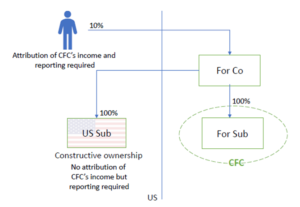
Attribution and Constructive Ownership

Constructive ownership refers to deemed ownership by a person that is not a company. In summary, if the person does not own stock directly, he could be considered to own the stock by way of constructive ownership.

  1. Generally, an individual shall be considered as owning stock, directly or indirectly, for his spouse; and (ii) his children, grandchildren, and parents. 
  2. Effect of adoption. A legally adopted child of an individual will be treated the same as their biological child.  
  3. Stock owned by a non-resident alien individual. An exception to the constructive ownership rules is if an individual regarded as a non-resident alien owns the stock.

Asena advisors. We protect Wealth.

GILTI vs. Subpart F Income

Defining Subpart F and GILTI

The main difference between the definitions is that the income for purposes of Subpart F is defined initially by what it includes, while GILTI is determined initially by what it excludes.

Subpart F and GILTI: A Brief Comparative History

Before the CFC rules, foreign-sourced income generated by a CFC was not attributable or included in a U.S. shareholder’s gross income if the shareholder didn’t receive a distribution from the CFC.  

The IRC’s campaign against overseas tax deferral dates back to the 1960s with the enactment of the Revenue Act of 1962. This enactment added Subpart F to the IRC. 

More recently, the TCJA added a new layer to the taxation of certain CFC income, which was done by codifying the GILTI regime. 

Applying Subpart F and GILTI: The Case of Distributions of Appreciated Property

The difference in the definitions could have severe implications in the case of distributing appreciated property. 

GILTI’s definition is sufficient to clarify how this should be applied. Due to GILTI first and foremost including all gross income, the gain should initially fall within the definition of GILTI. There are rules and regulations (reg) still being considered to make sure U.S. persons are not overtaxed.

Common Subpart F Income Questions & Answers

  1. What is income for purposes of Subpart F?
    1. It is income earned within a Controlled Foreign Corporation that is going to be taxed to the U.S. person, irrespective of being distributed to the U.S. person. 
  2. Do I still get taxed even if I did Not Receive any Distribution?
    1. Yes
  3. Does the IRS tax the Foreign Corporations directly?
    1. No. 
  4. What is Attribution?
    1. Attribution is an artificial term where a person is deemed to have received income that is a taxable event though he never actually received anything directly. 
  5. What is included in Subpart F income?
    1. Insurance income, foreign base company income (fbci), illegal bribes, and the income derived from a certain foreign country or countries as stipulated in IRC §901(j).
  6. How do you calculate Subpart F?
    1. A CFC calculates it by adding its adjusted net foreign base company income to its adjusted net income. The two main components are adjusted net foreign base company income and adjusted net insurance income, which are determined under specific rules and a multi-step process. Amounts resulting from bad acts are also added to a CFC’s income for subpart F purposes. 
  7. What does Subpart F mean?
    1. It refers to the part of the Internal Revenue Code (IRC). Subpart F of subtitle A, chapter 1, subchapter N, part III of the IRC (subpart F) (§951§965) provides comprehensive rules for taxing U.S. shareholders of controlled foreign corporations (CFCs). The fundamental operative feature of these rules is U.S. taxation of certain undistributed amounts earned by the CFC. The amounts subject to U.S. tax fall within three main groups.
  8. Can subpart F income be a loss?
    1. No.
For more information on Subpart F, please contact one of our specialists at Asena Advisors.
We make sure that your specific needs are catered for.

Shaun Eastman

Peter Harper

Subpart F Income: The Briefer


As mentioned in the previous blog, So You Own a CFC, What Now?, we introduced the fact that controlled foreign corporations must pay U.S. tax on their Subpart F Income. Subpart F (of part III of subchapter N of chapter 1 of subtitle A) of the Code limits deferral on certain types of income. The Subpart mandates that a U.S. Shareholder of a CFC include their pro rata share of the CFC’s Subpart F Income in their gross income; this is regardless of whether the U.S. Shareholder actually receives any distributions from the CFC.

So, what exactly is Subpart F Income? Well, it is typically comprised of income that is relatively movable between taxing jurisdictions and is generally known to be subject to low tax rates in foreign jurisdictions. Subpart F Income, however is limited to the CFC’s earnings and profits for that taxable year, with earnings and profits being the measure of a corporation’s ability to pay its shareholders dividends. This means that a CFC shareholder will typically have Subpart F Income when the shareholder receives a dividend.

Asena advisors. We protect Wealth.

The Code excludes “any item of income from sources within the U.S. which is effectively connected with the conduct by such corporation of a trade or business within the U.S. unless such item is exempt from taxation to (or is subject to a reduced rate of tax) pursuant to a treaty obligation of the U.S.” from Subpart F Income.

This exclusion makes sense, because if a CFC has effectively connected income with a U.S. trade or business (ECI) then the ECI will be taxed as ordinary income instead of as Subpart F Income. We previously discussed ECI and the parameters around a U.S. trade or business in our blogs titled, Surprise! Even Nonresidents may be Taxable on their U.S.-Sourced Income, The Code fails to define a “U.S. Trade or Business,” even though You’re on the Hook for Paying Taxes on it, and Is a Nonresident Alien’s Sale of a Partnership Interest a U.S. Trade or Business?, all available for reference at asenaadvisors.com

It is important for CFC shareholders to accurately determine whether they have Subpart F Income, so they can comply with their U.S. tax reporting obligations. Shareholders should seek proper advice to not only ensure their compliance, but to also avoid overpaying or reporting. If you, or your client, has global operations or interests in foreign corporations (either directly, indirectly or constructively), then feel free to reach us at asenaadvisors.com. We specialize in helping global executives, companies, and family offices protect their assets worldwide through tax and estate planning.

What does ‘two-up’ have in common with selling Australian real estate while living in the US?


I am often asked how can a capital gain associated with your main residence that is tax-free in Australia be taxable in the U.S.? For most Australians, they think, ‘this is insane and nonsensical! How can this be!’ It may hurt to hear this but the reason is quite simple and it is very logical…

Australia actually has a very outdated approach to the taxation of real estate – when compared with other countries that are members of the OECD. The country is very long on real estate. You talk to your relatives about investments they want to talk about real estate. You talk to your best friend. He or she wants to talk about real estate. You talk to your cabi (Aussie taxi driver) he wants to talk about real estate. You know what, if you talk to me I want to talk about real estate!

Australians LOVE real estate. Actually they don’t love it, they froth over it. Who doesn’t love an asset class where capital growth is not subject to tax. For a second, forget you don’t LOVE real estate and ask yourself, how is that equitable and what is the policy basis for that? Do you think allowing something to pay no tax on a $100m capital gain associated with one asset class will distort the market and weight asset allocation in favour of the main residence to more productive assets classes? Of course it will. Do most people question it? Of course not. It is a bit like legalizing two-up for a day. Does it make any sense. Not really. Is it awesome? Yes. End of discussion!

We are the only multi-disciplinary international CPA firm in the United States that specializes in U.S.– Australia taxation.

The U.S. on the other hand, does not want to gamble with the American dream. While they support home ownership they want to cap the incentives associated with developing massive homes for personal use.

Two-up aside, why doesn’t the double tax agreement ensure an Australian capital gain associated with the sale of a main residence is not taxed in the U.S.? The answer again is very simple, double tax agreements only govern tax issues where this is alignment on tax policy. The U.S. does not believe that a $100m capital gain on a main residence should be tax-free, which to U.S. policymakers makes about as much sense as legalizing a coin toss across the country for a day!

Just so you know, I love two-up and I love tax-free outcomes but I hope you can now see how logical the U.S. tax treatment is.

If you are a U.S. tax resident and a non-resident of Australia, put away the two-up paddle and apply the U.S. tax rules.

So You Own a CFC, What Now?


In our whitepaper, The Expansion of “United States” Taxpayers: How the TCJA Drags Unassuming Foreign Companies and Individuals under its Scope, we analyze how recent U.S. tax law greatly expand who may be subject to U.S. taxation regardless of their foreign status. Additionally, in this blog series we illustrated how the Code’s definition of ownership forces many foreign companies that had not previously been classified as controlled foreign corporations, to become CFCs. The Tax Cuts and Jobs Act of 2017 not only expanded the CFC classification, but it also expanded the consequences of holding an interest in a CFC.

Prior to the TCJA

Under the Code a CFC is required to pay tax on its Supbart F Income and income derived from U.S. investment properties.

Asena advisors. We protect Wealth.

Stage Five Clinger: How the TCJA Latches onto Unassuming Foreign Persons through Constructive Ownership


In our whitepaper, The Expansion of “United States” Taxpayers: How the TCJA Drags Unassuming Foreign Companies and Individuals under its Scope, we discuss the how the Tax Cut and Jobs Act of 2017 significantly expands the number of shares a U.S. Shareholder may be deemed as owning for purposes of determining whether a foreign corporation is a CFC. In our last few blog posts, we introduced the three types of ownership (direct, indirect, and constructive), as well as the three types of attribution that give rise to constructive ownership (family attribution, upward attribution, and downward attribution). These concepts can be hard to grasp so we wanted to provide an example illustrating the interaction of all of these rules in determining whether a foreign corporation is a CFC.

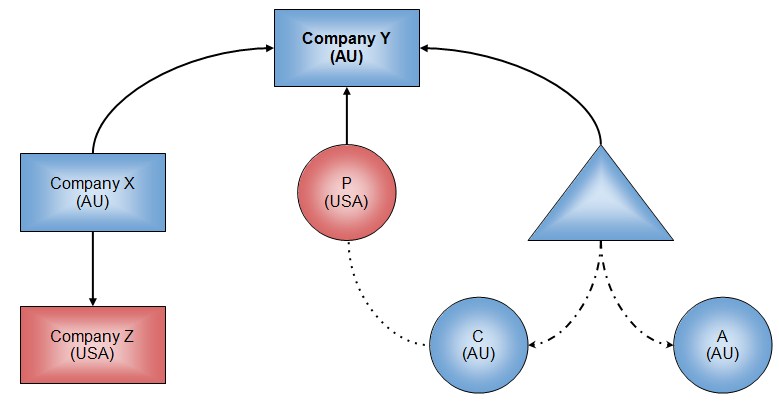
Part One: The Original </3>
In the following diagram, we are trying to determine whether Y is a CFC. Most of the diagram is self-explanatory, but there are a few items to note. First, the only U.S. Persons are P and Z, and every other individual/entity is a U.S. nonresident alien. Secondly, P is C’s parent and C is P’s child. Lastly, C and A are the only two beneficiaries of T, so they have equal shares.

Under the TCJA, Y will be classified as a CFC for U.S. tax purposes if at least 50% of the shares are owned by or controlled by U.S. Shareholders, either directly, indirectly or constructively.

Analysis of Direct Ownership

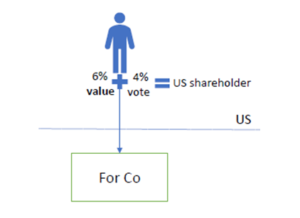
P is the only U.S. Person to directly own shares in Y, and P is a U.S. Shareholder because P owns at least 10% of Y’s total value. So, a U.S. Shareholder directly owns 20% of Y.

Analysis of Indirect Ownership

In this scenario we do not have any indirect ownership. While T is holding the shares on behalf of C and A, all of them are nonresident aliens.

Analysis of Constructive Ownership

Remember that there are three ways constructive ownership arises, either by family attribution, upward attribution, or downward attribution. Under family attribution, parent and child are deemed as constructively owning each others shares. However, where one family member is a nonresident alien then they are excluded from this attribution. P and C have a parent-child relationship so normally they would be treated as constructively owning each other’s shares, however because C is a nonresident alien, they will not be.

T is holding 20% of the shares in Y for the benefit of its beneficiaries, C and A. Under upward attribution, C and A will be treated as indirectly owning their pro rata share of T’s interest in Y. In other words, C and A both indirectly own 10% of Y.

X holds 20% of the shares of Y and owns 100% of the shares in Z. Under the downward attribution rules, Z is accordingly treated as owning X’s 20% interest in Y.

Analysis of CFC Status Under First Diagram

Under this diagram, U.S. Shareholders directly own 20% of Y and constructively own another 20%. This equals to 40% ownership of Y by U.S. Shareholders. This is lower than the 50% threshold required by the Code, so Y will not be a CFC.

Asena advisors. We protect Wealth.

Part Two: Original with a Tweak

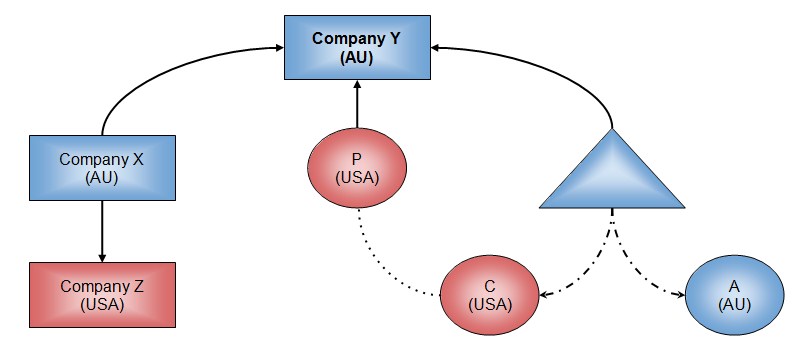
If C were a U.S. Person instead of a nonresident alien, then our analysis would change.

In particular, if C is a U.S. Person then the family attribution rules would become applicable, and P be treated as constructively owning C’s shares and vice versa. As we determined in Part one, C constructively owns 10% of Y through upward attribution. P would then constructively own this 10% through family attribution. Accordingly, U.S. Shareholders would directly own 20% and constructively own 30% of Y. This meets the 50% threshold, and as such, Y would then be a CFC and would need to comply with the U.S. tax obligations on CFCs.

Part Three of the TCJA Attribution Rules: Down the Rabbit Hole


In our blog post titled “Owning” Shares that aren’t Yours: The Code’s Confusing Definition of “Ownership”, we introduced how U.S. Shareholders of a foreign company are deemed as constructively owning shares for purposes of determining CFCs. Then, in Parts One and Two on the “TCJA Attribution Rules” we discussed two of the three attribution types: family attribution and upward attribution. Accordingly, we will discuss the final of the attribution rules: downward attribution.

Background

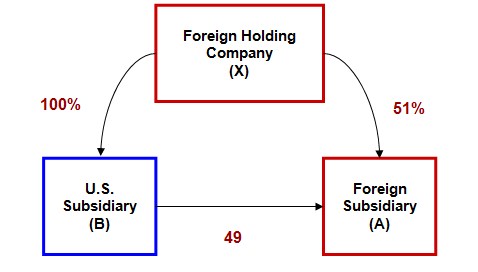
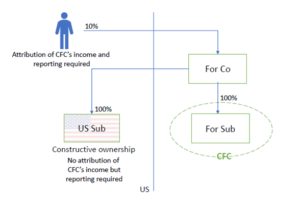
Prior to the Tax Cuts and Jobs Act of 2017, Section 958(b)(4) of the Code stated that the rules on upward attribution “shall not be applied so as to consider a U.S. Person as owning stock which is owned by a person who is not a U.S. Person.” Under this rule, if you had foreign parent company X, with one U.S. subsidiary, A, and one foreign subsidiary, B, then A would not be treated as constructively owning the stock in B through an attribution of stock from B to X and then X to A. Thus, A could hold 49% of the total value of B without B being classified as a CFC.

After the TCJA

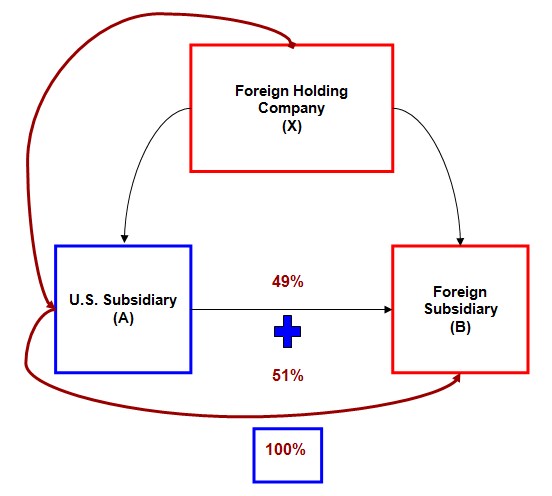
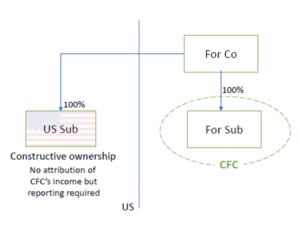
The TCJA repealed section 958(b)(4), so shares are now attributed from a foreign subsidiary to a U.S. subsidiary through its parent. Using the same example, where A owns 49% of the shares in B and X holds 51% of the shares in B, then A will be treated as directly owning 49% and constructively owning 51%. B will be classified as a CFC because A, a U.S. Shareholder, controls at least 50% of it.

If you have entities and persons that are linkedin through international structures, you may have a CFC and be subject to the CFC rules. Accordingly, you should seek guidance on whether you have a CFC, and if you do, the reporting obligations associated with it. Moreover, if you are planning to create a global structure, you should seek guidance prior to doing so as to avoid any tax surprises. For an in depth analysis on CFC and downward attribution, please refer to our whitepaper, The Expansion of “United States” Taxpayers: How the TCJA Drags Unassuming Foreign Companies and Individuals under its Scope. Please also reach out to us at asenaadvisors.com for counseling on how to protect your assets and be tax compliant worldwide.

Asena advisors. We protect Wealth.

Part Two of the TCJA Attribution Rules: The Expansion Upward


In our blog post titled “Owning” Shares that Aren’t Yours: The Code’s Confusing Definition of “Ownership”, we introduced how U.S. Shareholders may be treated as constructively owning shares of a foreign company for purposes of determining whether the company is a CFC. Then, in Part One of the TCJA Attribution Rules: Family Matters, how the family attribution rules provide one of the three ways constructive ownership may occur. Now, we are going to discuss upward attribution, which is the second way constructive ownership may arise.

Upward attribution occurs when an entity owns shares in a foreign company and the entitiy’s members or partners are treated as constructively owning the entity’s shares for purposes of determining CFC status. Under Section 318(a) of the Code, individuals and entities may be attributed stock in three scenarios:

  1. From partnerships and estates;
  2. From trusts; and
  3. From corporations

Attribution from Partnership to Partner or Estate to Beneficiary

If a partnership or estate holds stock in a foreign corporation, either directly or indirectly, then the partners or beneficiaries will be treated as constructively owning that stock. Specifically, the beneficiary or partner will be treated as constructively owning a pro rata share of the entity’s stock.

Asena advisors. We protect Wealth.

Attribution from Trusts to Beneficiaries and Grantors

If a trust holds stock in a corporation, either directly or indirectly, then the beneficiaries who are U.S. Persons will be treated as constructively owning those shares. Additionally, if a trust is a foreign grantor trust, then the grantor or other substantial owner will be treated as owning the stock the trust directly or indirectly owns, in a proportion equal to their ownership share. However, where you have a tax-exempt, employee trust, then this attribution rule will not apply. For information on grantor trusts, please refer to our page asenaadvisors.com.

Attribution from Corporations to Shareholders

If 50% or more of the value of the stock in a corporation is owned directly or indirectly, by or for any person, that that person is considered as owning the stock owned by the corporation, both directly or indirectly. The person is deemed as owning the amount of stocks proportionate to the value of stocks that they own in corporation.

These rules can get incredibly complex, especially when trying to delineate which shares the entity itself is attributed through indirect ownership rules. However, the failure to properly determine constructive ownership triggers an inability to correctly determine whether a foreign company is a CFC. The failure to comply with the CFC rules due to a lack of knowledge over whether the foreign company is a CFC is not a proper excuse, and as such it creates a large exposure of risk to foreign companies. Thus, is it vital that you seek proper counseling. Please contact us for more information at asenaadvisors.com.

Family Attribution Rules

What is Attribution?

Attribution is an artificial concept used for tax purposes to prevent tax avoidance. This artificial concept treats a person/taxpayer as the direct owner of an asset or business even though he or she has no legal ownership of the asset or business. 

What Are Attribution Rules?

It is anti-avoidance rules to prevent taxpayers from creating structures with the principle purpose of avoiding tax. Attribution rules and their application are very prevalent in family-held businesses.

Attribution of Ownership In Retirement Plans

If you own a 401(k) plan, it is of the utmost importance to ascertain and understand the plan’s ownership structure (i.e. what assets it invests in). The reason why it is important to ascertain this information is to make a determination on the control as well as who the  Highly Compensated Employee (HCE) and key employee of the plan is. The only way to make these determinations is to apply the family attribution rules correctly. 

Definition of Disqualified Persons

Section 4946 of the IRC, specifically refers to the following categories of persons as designated as disqualified persons:

    • substantial contributors;
    • foundation managers;
    • more-than-20% owners of a corporation, partnership, trust, or unincorporated enterprise that is a substantial contributor to the foundation;
    • family members of substantial contributors, foundation managers, and more-than-20% owners;
    • corporations, partnerships, trusts, or estates more than 35% of that are owned by substantial contributors, foundation managers, more-than-20% owners, and their family members.

What is a CFC?

Section 957 of the IRC defines a CFC as any foreign corporation of which more than 50% of the stock by vote or value is owned, directly, indirectly (through certain foreign entities), or constructively, by U.S. shareholders.

Asena advisors. We protect Wealth.

General Rules for Family Attribution

Non-Resident Alien Exception to Family Attribution

As an exception to the general Family Attribution rules, if any stock is owned by a non-resident alien (NRA), that NRA’s stock ownership is exempt for purposes of determining a US person’s constructive ownership. 

What Are The Rules For Attribution For Determining Parent/Subsidy & Brother/Sister Controlled Groups?

IRC 1563 sets out the attribution rules for determining Parent/Subsidy and Brother/Sister Controlled Groups. 

A parent-subsidiary controlled group involves a chain of corporations in which the common parent corporation owns 80% or more of the voting power and value of the stock of one corporation, and one of the other corporations owns 80% of the voting power or value of another.

A brother-sister group involves two or more corporations if five or fewer persons (individuals, estates, or trusts) own more than 50% of the voting power or more than 50% of the value of each (taking into account only the stock ownership that is identical with respect to each corporation.

The corporation to shareholder attribution rules apply only for the purpose of determining stock ownership in brother-sister controlled groups.

Example of Family Attribution

Chantelle and her family members are originally from South Africa but she now resides in the United States. Her parents, Leon and Elsabe own 90% of the shareholding in a South African Company. Even though Chantelle doesn’t own any direct portion of the company, under the IRS rules, she may be considered to have constructive ownership of the shares that are attributed to her through her family members (her parents).

Other Notable Attribution Rules Provisions

  • Section 1563 which relates to controlled groups.
  • Attribution applies to parents and children if the children are under 21. 
  • An exception for controlled groups in relation to the non-involvement of spouses. Minors can however reintroduce a controlled group. The minor child of the spouses would have 100% ownership of both companies and when the child turns 21, the controlled group would be broken, and most notably, the parents do not need to be married for attribution to apply.

Ownership Attribution Basics

Internal Revenue Code Section 267(c)

Used to determine those individuals or taxpayers who are prohibited from engaging in certain transactions involving plan assets.

Internal Revenue Code Section 318

The constructive stock ownership rules are set out in this section and provide rules for determining the circumstances in which stock ownership will be attributed from one person or entity to another. 

Internal Revenue Code Section 1563

Used to identify related companies that are part of a controlled group

Asena advisors. We protect Wealth.

Constructive Ownership & Attribution

1.958-2 Constructive Ownership of Stock

The IRS released final regulations 1.958-2, which limits the application of Section 318(a)(3) constructive ownership rules, as to whether a foreign corporation is a CFC.

The rules define related persons under IRC Section 954(d)(3) for certain CFCs. This definition is intended to avoid CFCs being inadvertently regarded as related persons.  The regulations also make provision that stock in a CFC owned by a non-resident alien won’t be attributed to a US shareholder in the same CFC due to downward-attribution rules. 

The final regulations impact US taxpayers who own stock in CFCs and may have previously been considered to own other CFCs through the constructive ownership rules.

They don’t have significant relationships with each other.

Form 5471

The U.S. Person Through, Which There is Constructive Ownership Files Form 5471

This basically means that the person who has an attribution/constructive ownership group must file a form 5471. 

Why Does Family Attribution Matter For Testing Purposes?

“Attributing interest to family members increases the number of Highly Compensated Employees (HCE) and key employees you will include in testing. This could increase or decrease the HCE average deferral percentage (ADP) which may impact your ADP results.”    

Attribution FAQs

  • I’m already overwhelmed. Can you give me the short version of these rules?
    • Yes. Ownership is attributable to the following family members: spouses, parents, children (adopted included), and grandparents, but not grandchildren.
  • That sounds pretty comprehensive. Are there any exceptions?
    • Yes. Family attribution does not apply to your grandchildren. 
      • There is no attribution from an individual to his or her grandchildren.
  • I don’t see brothers and sisters listed. Is there attribution between siblings?
    • Nope.
  • Are same-gender marriages subject to the spousal attribution requirement?
    • Yes. 
  • How are the spousal attribution rules impacted when a couple is going through a divorce?
    • Attribution rules apply until there is a legal separation. 
  • If I own a business and my spouse doesn’t work for the company, is he or she still attributed to my ownership?
    • In terms of the section 318 rules, there is no exception to the spousal attribution requirement, so spouses are always attributed to each other’s ownership under that section.
    • However, in terms of the section 1563 rules, attribution does not apply if certain conditions are met. 
  • Shifting gears to parent/child attribution, do the rules apply when the child is an adult?
    • Yes
  • Is there always attribution between parents and children under the age of 21?
    • Yes.
  • I think I have a headache after reading all of this. What should I do to find out how all of this applies to me?
    • For an in-depth analysis and understanding of these attribution rules, and how they may be applicable to you feel free to reach out to our specialist at Asena Advisors. Please also visit our website, to learn more about how we can help navigate you through these rules to preserve your wealth.

Asena advisors. We protect Wealth.

For more information on Family Attribution Rules, please contact one of our specialists at Asena Advisors. We make sure that your specific needs are catered for.

Shaun Eastman

Peter Harper

“Owning” Shares that aren’t Yours: The Code’s Confusing Definition of “Ownership”


The Code employs various definitions of what constitutes “ownership” in various circumstances, and with regards to the classification of foreign companies as CFCs, the definition is overwhelmingly inclusive. As outlined in our previous blog post, The “Controlled Foreign Corporation” Regime: What is a CFC Anyway?, a foreign company will be a CFC its U.S. Shareholder(s) “owns” at least 50% of the company’s total voting stock or value. Under this rule, however, ownership may be through direct, indirect, or constructive means.

Direct Ownership

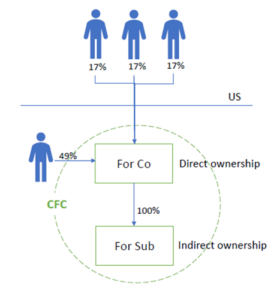
Under this direct ownership, a U.S. Shareholder will own the shares they personally hold. Thus, if U.S. Corporation X owns 80% of the voting shares in foreign Corporation Y, then Corporation X is treated as directly owning the shares in Corporation Y.

Indirect Ownership

Under indirect ownership, a U.S. Shareholder will own shares that are being held by another entity for their benefit. For example,using the same example as above, if a U.S. partnership owns 80% of the voting shares in Corporation Y, then the U.S. partners of the partnership will be treated as indirectly owning the shares in Corporation Y. Indirect ownership generally arises in scenarios where a flow-through entity holds shares in foreign company.

Asena advisors. We protect Wealth.

Constructive Ownership

Under constructive ownership, a U.S. Shareholder will own shares that are assigned to them under the Code’s attribution rules applicable to CFCs. Specifically, for purposes of determining a company’s CFC status, a U.S. Shareholder will be treated as owning shares that can be imputed to them by the family, upward, and downward attribution rules.

While direct ownership is straightforward, the indirect and constructive ownership rules have proven to be quite tricky to navigate. Thus, if you have a foreign company that is either entering the U.S. market or has shareholders relocating to the U.S., then you will need to be very careful about how you make the CFC determination. Remember, the company need only meet the requirements of a CFC for one day for it to be classified as a CFC for the entire tax year. Any failure to oblige with the CFC tax obligations comes with high punishment, both civil and criminal, so be sure to seek proper advice.

For an in-depth discussion on CFCs and the corresponding ownership rules, please refer to our whitepaper, The Expansion of “United States” Taxpayers: How the TCJA Drags Unassuming Foreign Companies and Individuals under its Scope. Please also visit our website, AsrenaAdvisors.com to learn more about how we can help navigate you through these rules to preserve your wealth.

The “Controlled Foreign Corporation” Regime: What is a CFC Anyway?


While the U.S. tax system appears to be federal in nature, the U.S. uses the Internal Revenue Code to cast a wide web and bring international persons and entities under its taxing power. Not only does this web capture foreign persons physically present in the U.S. but it also captures foreign companies statutorily deemed as being controlled by U.S. Shareholders; in the tax world, these companies are called controlled foreign companies, or CFCs. The Code focuses on a few highly complex provisions on tax laws applicable only to CFCs and their shareholders, and failure to comply with them is likely to result in high punishments, both civil and criminal. Thus, it is critical that you, whether you own a foreign company or have a client who owns a foreign company (either directly, indirectly, or constructively), understand if that company will be classified as a CFC under the Code.

What Is a Controlled Foreign Corporation (CFC)?

A foreign corporation will be classified as a CFC if more than 50% of the total combined voting power of all classes of stock is owned directly, indirectly, or constructively, by a U.S shareholder on any day during the taxable year. 

Controlled Foreign Corporation Examples

John is a U.S. person who owns 100% of Foreign Company A (A). Due to John owning more than 50% and at least 10% A will be a CFC. 

John (same as above) owns 51% of Foreign Company B (B). Due to John owning more than 50% and at least 10% B will be a CFC. 

John owns 11% of Foreign Company C (C), Peter and his wife who are both U.S. persons, own 20% each of C. C will therefore be a CFC as it exceeds the 50% threshold. 

John owns 49% in Foreign company D and the only U.S. shareholder. An exemption applicable to John and the CFC rules can’t apply. 

Controlled Foreign Corporation Fundamentals

CFC rules aren’t unique to the US. Many countries around the world have CFC legislation. The CFC rules were developed by the IRS in order to prevent taxpayers from hiding their money in foreign businesses and therefore have a lower tax rate. Section 957 defines the rules and who may be subject to tax. 

How Does a Controlled Foreign Corporation Work?

Only non-US companies that are classified as corporations by the Internal Revenue Services can be regarded as CFCs.

Typically, shareholders pay taxes on the income of the corporation only when they take dividends. If a shareholder of a US domestic corporation takes dividends, they must be reported each year, using form 1099-DIV. However, should these taxpayers take dividends or other forms of income from a foreign corporation, they assume they don’t have to report that income or pay taxes on it. And this is where the CFC rules come into play as a way to charge taxpayers on their income from foreign corporations. 

Motivations

The tax law in many countries, including the US, does not normally tax a shareholder of a corporation on the corporation’s income until the income is distributed as a dividend. 

The CFC rules of Subpart F, and later of other countries’ tax laws, were intended to cause current taxation to the shareholder where income was of a sort that could be artificially shifted or was made available to the shareholder. At the same time, such rules were intended not to interfere with active business income or transactions with unrelated parties.

What is Attribution and Constructive Ownership?

The Tax Cuts and Jobs Act (TCJA) was enacted in December 2017 and changed a constructive ownership rule that determines whether a foreign corporation is a CFC for federal income tax purposes. 

With the new law, a U.S. corporation, U.S. partnership, or U.S. trust in which a foreign taxpayer is a shareholder, partner, or beneficiary is now considered to own the stock in a foreign entity that the foreign person owns directly. The foreign person must own more than 50% of the U.S. corporation before the U.S. corporation is considered to own the foreign corporation’s stock.

Basic Mechanisms

The basic mechanisms of CFC rules are that a U.S. person who is regarded as a U.S. shareholder of a CFC must include in their income that person’s share of the CFC’s income. The includible income generally includes income received by the CFC…

  1. From investment or passive sources, including:
    1. Interest and dividends from unrelated parties,
    2. Rents from unrelated parties, and
    3. Royalties from unrelated parties;
  2. From purchasing goods from related parties or selling goods to related parties where the goods are both produced and for use outside the CFC’s country;
  3. From performing services outside the CFC’s country for related parties;
  4. From non-operating, insubstantial, or passive businesses, or of a similar nature through lower-tier partnerships and/or corporations.

What is the Basic Structure of CFC Rules?

Firstly, the rules contain an ownership threshold to determine if a foreign entity is sufficiently controlled by domestic shareholders to be considered a CFC. 

Secondly, there is a taxation condition that can include a rule to determine whether the income of the CFC has already been taxed at a minimum level by the foreign country. 

Thirdly, CFC rules identify the type of income to which the rules are applicable, whether only passive income (that is, interest or capital gains) or all income that is received by the CFC. 

U.S. Code: Controlled Foreign Corporations

General Rule

The general rule regarding Controlled Foreign Corporations can be found in the Internal Revenue Code §957(a)(1-2) 

For purposes of this title, the term “controlled foreign corporation means any foreign corporation if more than 50 percent of—

(1) the total combined voting power of all classes of stock of such corporation entitled to vote, or

(2) the total value of the stock of such corporation, is owned (within the meaning of section 958(a)),or is considered as owned by applying the rules of ownership of section 958(b), by United States shareholders on any day during the taxable year of such foreign corporation.

Special Rule for Insurance

IRC §957(b) includes a special rule for insurance. 

For purposes only of taking into account income described in section 953(a) (relating to insurance income), the term “controlled foreign corporation” includes not only a foreign corporation as defined by subsection (a) but also one of which more than 25 percent of the total combined voting power of all classes of stock (or more than 25 percent of the total value of stock) is owned (within the meaning of section 958(a)), or is considered as owned by applying the rules of ownership of section 958(b), by United States shareholders on any day during the taxable year of such corporation, if the gross amount of premiums or other consideration in respect of the reinsurance or the issuing of insurance or annuity contracts not described in section 953(e)(2) exceeds 75 percent of the gross amount of all premiums or other consideration in respect of all risks.

United States Person

IRC §957(c) stipulates the following – 

For purposes of this subpart, the term “United States person” has the meaning assigned to it by section 7701(a)(30) with certain exceptions applicable.

Asena advisors. We protect Wealth.

Purpose

The purpose of the CFC regime is to reduce and eliminate the deferral of certain CFC income. With the CFC regime, the IRS has authority over U.S. shareholders to prevent the deferral of tax. 

Avoiding CFC Status

For federal income tax purposes, a foreign entity may be classified as a corporation or flow-through entity. In terms of the check-the-box rules, shareholders may be able to elect to treat their shares of gross income, deductions, and taxes of a foreign corporation as earned and paid by themselves (i.e. as a flow-through). This enables the U.S shareholders to obtain credits for foreign taxes paid by the entities they own, which credits might otherwise not be available. 

Special Considerations

U.S. shareholders of CFCs are subject to specific anti-deferral rules under the U.S. tax code, which may require a U.S. shareholder of a CFC to report and pay U.S. tax on undistributed earnings of the foreign corporation.

U.S. shareholders with controlling interests in foreign corporations must report their share of income from a CFC and their share of earnings and profits of that CFC, which are invested in United States property. 

How is a CFC Taxed?

The CFC tax rules in accordance with Subpart F allow the IRS to tax certain income of the CFC, even though the corporation is foreign, and the U.S. would have no direct authority over the foreign corporation. 

If there is current year earnings and profit, a U.S. shareholder may be subject to tax on his share of income, whether distributed or not. 

The CFC tax rules are extremely complex. The introduction of the new international tax rules referred to as Global Intangible Low-Taxed Income (GILTI) just added to the complexity. 

Even though GILTI is not the same as Subpart F income, it is equally complex. 

Who is a U.S. Shareholder?

The IRS stipulates that:

A U.S. shareholder is a U.S. person (defined in IRC 957(c)) who owns directly, indirectly, or constructively 10 percent or more of the total combined voting power of stock entitled to vote or 10 percent or more of the total value of all classes of stock entitled to vote in a foreign corporation. Internal Revenue Code 958(a) provides rules for determining direct and indirect stock ownership of a corporation.

How are CFCs Reported?

The CFC must file an annual report on IRS Form 5471, “Information Return of U.S. Persons With Respect to Certain Foreign Corporations.” This form is completed and attached to the corporation’s income tax return.

Controlled Foreign Corporation Penalties for Not Reporting

The penalties for not properly reporting these forms can be brutal.  But, the Internal Revenue Service has developed various offshore voluntary disclosure programs such as the streamline program, delinquency procedures, and Post-OVDP to assist you.

Common Controlled Foreign Corporation FAQs

What is IRC Section 957?

It’s the section of the internal revenue code dealing with the general rule of what is a CFC and a U.S. person. 

What is CFC IRS?

CFC IRS is just an abbreviation for Controlled Foreign Corporations (CFC) and Internal Revenue Services (IRS).

Foreign Corporation Tax Reform

With the introduction of TCJA, GILTI, and updated Form 5471 reporting requirements, the landscape for reporting Controlled Foreign Corporations has intensified.

Dividends

Dividends are generally taxed in the year they are received. In addition, there may be some Subpart F income for the controlled foreign corporation — even in years when no income was distributed.

More Than 50% U.S. Ownership

In order for a Foreign Corporation to be considered a Controlled Foreign Corporation, it must be owned more than 50% by U.S. Persons.

10% Ownership

Secondary to the 50% requirement, it must also be that each of the U.S. shareholders within that +50% each own at least a 10% share. 

What is Attribution IRC (958)?

Attribution is the idea that one person is considered to constructively own stock that another person owns – only due to the relationship between the two individuals. The main purpose of attribution is to avoid artificially low tax reductions strategies by making sales or transfers between “related” parties. 

What is Subpart F Income (IRC 951)

It is income that is earned within a Controlled Foreign Corporation that is going to be taxed to the U.S. person, irrespective of being distributed to the U.S. person. 

But I Did Not Receive any Subpart F Income Distribution?

It is irrelevant whether the U.S. shareholder of a CFC received any of the money.

There are certain other factors that are important regarding subpart F income such as whether there is any current earnings and profits (E&P), whether taxes have been paid, and whether dividends have also been issued.

What is Form 8938?

Form 8938 (Statement of Specified Foreign Financial Assets) is an IRS Form associated with Foreign Account Tax Compliance Act (FATCA). The IRS has made Foreign Financial Reporting a key enforcement priority.

The failure to file this FATCA Form can lead to extensive Fines and Penalties.

CFC Penalties Will Flow Through 8938

There are many penalties a person may be subject to if they have a controlled foreign corporation but did not file properly. These include penalties for not filing an FBAR or 8938. 

The Form 8938 Penalties range from a warning letter, all the way up to +$50,000. This does not include other potential penalties, such as FBAR Penalties.

You may be subject to penalties if you fail to timely file a correct Form 8938 or if you have an understatement of tax relating to an undisclosed specified foreign financial asset.

If you are required to file Form 8938 but do not file a complete and correct Form 8938 by the due date (including extensions), you may be subject to a penalty of $10,000.

The maximum additional penalty for a continuing failure to file Form 8938 is $50,000.

For more information on CFCs, please contact one of our specialists at Asena Advisors. We make sure that your specific needs are catered for.


Shaun Eastman

Is a Nonresident Alien’s Sale of a Partnership Interest a U.S. Trade or Business?


Our previous post, The Code Fails to Define a “U.S. Trade or Business,” even though You’re Still on the Hook for Paying Taxes on It, we discussed the broad terminology behind what classifies as a U.S. trade or business. In particular, we discussed how there is no bright line definition for the term and how it instead requires an analysis of the nonresident alien’s facts and circumstances. Recently, however, one question has come to the forefront of this discussion: is a nonresident alien’s sale of a partnership interest in a partnership conducting a U.S. trade or business itself a U.S. trade or business? Under the new Tax Cuts and Jobs Act of 2017, the answer is yes. Be sure to remember here, that a nonresident alien is either an individual or entity who has not fulfilled one of the U.S. residency tests discussed in our blog titled U.S. Residents are Taxable, U.S. Persons: So, What is a “U.S. Resident”?

Section 864(c)(8) of the Code specifically deals with the “Gain or Loss of Foreign Persons from Sale or Exchange of Certain Partnership Interests.” In particular, it states that “if a nonresident alien individual or foreign corporation owns, directly or indirectly, an interest in a partnership which is engaged in any trade or business within the United States, gain or loss on the sale or exchange of all (or any portion of) such interest shall be treated as effectively connected with the conduct of such trade or business to the extent such gain or loss does not exceed the amount determined under subparagraph (B).”

To summarize this section, if a nonresident alien sells either part or whole of their interest in a partnership engaged in a U.S. trade or business, then the gain or loss will be treated as taxable ECI. However, the amount of ECI realized from this sale is limited to “an amount determined under subparagraph (B).”

Asena advisors. We protect Wealth.

Under 864(c)(8)(b), ECI is limited to the portion of the partner’s distributive share of the gain or loss which would have been considered ECI if the partnership had sold all of its assets at their fair market value on the date of sale. If no loss or gain on this hypothetical sale of all of the partnership’s assets would be ECI, then no amount will be considered as ECI, and the nonresident alien will not be taxed on the sale.

If you need help delineating whether these sections may be applicable to your or your client’s proposed sale of partnership interest, then please contact us at asenaadvisors.com. Please note, that this blog provides an overarching discussion of the relevant sections, and that other sections may be applicable to you or your client’s scenario; for example, if the partnership holds an interest in U.S. real property, then a further analysis must be conducted to determine the amount and nature of your or your client’s U.S. tax obligation.

The Code Fails To Define A “U.S. Trade Or Business,” Even Though You’re On The Hook For Paying Taxes On It


As mentioned in our prior post, Even Nonresident Aliens may be Taxable in their U.S.-Sourced Income, a nonresident alien will be liable for U.S. tax if they have income that is effectively connected to a U.S. trade or business (“ECI”). In that post we discussed what ECI is and how it may be generated, but we held off on defining what qualifies as a U.S. trade or business. Unfortunately, the Internal Revenue Code fails to provide us with any real guidance as it does not provide a statutory definition of a U.S. trade or business. Moreover, the Internal Revenue Service has proactively avoided defining the term, as the IRS has stated that they will not make any revenue rulings on the matter. For those of you who are unfamiliar with what a revenue ruling is, it is an administrative ruling that applies the tax code to particular factual situations and may be relied on as law by all taxpayers.

Luckily, however, the Supreme Court of the United States has provided some guidance on the matter. Specifically, the Supreme Court has previously held that a U.S. trade or business is broadly defined as to include practically any regular and consistent activity that is actively executed with a goal of making a profit. The key concept of this definition is that the activity must be profit motivated and some type of economic activity must be involved, as opposed to an activity engaged in urely for personal satisfaction, such as a hobby.

Typically, Courts will use the following factors to determine whether a particular operation rises to the level of a U.S. trade or business; remember, however, that this is generally a low threshold as the term is construed broadly.

  1. The nature and purpose of the acquisition of any property and the duration of ownership;
  2. The extent and nature of sales efforts;
  3. The number, continuity, and regularity of sales;
  4. The extent to which the taxpayer attempts to increase sales by improving the property and advertising;
  5. The use of a business office to facilitate sales; and
  6. The time and effort devoted to sales by the taxpayer.

Asena advisors. We protect Wealth.

One thing to note here is that courts have routinely weighed the third factor, of continuity and regularity of sales, the heaviest in making their decision as to whether activities rise to the level of a U.S. trade or business. Nevertheless, this factor may be outweighed by one or more of the other factors.

If you need assistance in determining whether you, your client, or your family business has a U.S. trade or business, and as such is liable for fulfilling U.S. tax obligations, please reach out to us at asenaadvisors.com. We work extensively with global executives, high net worth individuals and global companies in determining their tax obligations and composing beneficial tax plans.

Even Nonresident Aliens may be Taxable on their U.S.-Sourced Income


A nonresident alien of the United States will be subject to U.S. taxation if they have income that is “effectively connected” with a U.S. trade or business (“ECI”). This applies to both nonresident individuals and entities alike, as they can both have ECI.

Remember here, that if an individual is either a resident alien or a nonresident citizen, then they will be taxable on their worldwide income, from whatever source derived. Accordingly, this rule pulls in persons and entities who would not normally be subject to taxation in the U.S. and makes them taxable on the U.S. sourced profits arising from their trade or business operations in America.

So, what exactly counts as ECI? Well, under the Internal Revenue Code, ECI will be generated where income is produced by U.S. assets in, or held for use in, the conduct of the U.S. trade or business. Thus, a retailer will generate ECI if they hold inventory within the U.S. inventory for the purposes of selling or leasing them to customers within the U.S. ECI may also be produced where a retailer sells a part interest or whole interest in their U.S. business. Additionally, income will be effectively connected with a U.S. trade or business even if the trade or business is service-based, as it is U.S. profit that is tied to the performance of personal services within the U.S.

Asena advisors. We protect Wealth.

Luckily ECI is limited to the earnings and profits of the U.S. trade or business. So, for example, if a foreign company has $1,000,000 of earnings and profits and $2,000,000 of ECI, then they will only be liable to pay and report U.S. tax on $1,000,000 of the ECI under this limitation.

While this analysis seems quite simple, it can actually be quite complex as the Code does not provide a definition of what entails a “U.S. trade or business.” We will dive into this concept, however, in our next blog post so be sure to check back.


For more information, please contact:
Head of US-India Tax Desk

U.S. Residents are taxable, U.S. Persons: So, What is a “U.S. Resident”?


Under the Internal Revenue Code a Person is liable for fulfilling their U.S. tax obligations if they are a “resident” of the United States. This begs the question, what is a resident, and does the Code’s definition stray from our common sense definition of it? The term “resident” is generally defined as a person who lives somewhere on a long-term basis. It would be hard to legally determine who to tax based upon a subjective idea of what classifies as long-term, so instead, the Code turns the definition to an objective one by codifying three residency tests. As such, the Code’s definition doesn’t stray too far away from the general definition, but it requires a person to undertake a thorough analysis of whether their status under each resident test.

Green Card Test

Under the green card test, if a person has a U.S. green card then they are automatically a U.S. resident. This applies even if you do not have your primary residence in the U.S.

Substantial Presence Test

Under the Substantial Presence Test (SPT) a person is a resident if they are physically present in the U.S. for at least 183 days; accordingly, the SPT is also commonly known as the 183-day rule. However, to be a resident under this test, the 183 day count must be fulfilled in the following manner:

  1. 31 days in the current year; and
  2. 183 days in the three year period that includes the current year and the two years immediately prior, counting:
  • All of the days present in the current year,
  • ⅓ of the days present in the first year prior to the current year; and
  • ⅙ of the days present in the second year prior to the current year.

The SPT also outlines a few exceptions to the day count, including days that a person is present in the U.S. for less than 24-hours and days that a person is with an exempt individual. Accordingly, this day count can get quite complicated, especially if a person has failed to keep track of their U.S. travels.

Asena advisors. We protect Wealth.

Election Test

Under this test, a person may elect to be a U.S. resident if, for the taxable year for which the election is being made:

  1. The person is a nonresident alien; and
  2. Either, the person is married to a:
  • U.S. Citizen, or
  • Resident alien.

To make the election, the person must attach a statement of residency election to their joint federal income tax return and do so in a timely manner. A person will not be able to elect U.S. residency, however, if they had previously made an election and it was later terminated by either spouse.


For more information, please contact:
Head of US-India Tax Desk

The U.S. Tax Terms You Need to Know


By way of introduction, the following blogs series is on the various tax topics found in our article, The Expansion of “United States” Taxpayers: How the TCJA Drags Unassuming Foreign Companies and Individuals under its Scope, which explains the Tax Cuts and Jobs Act of 2017’s modification of the Internal Revenue Code. However, before we dive into the critical topics, I wanted to provide a briefer on terms that will be consistently used throughout. Accordingly, please use this blog as an overarching reference for this series. Furthermore, please direct any complex questions to us at asenaadvisors.com, as we specialize in the analysis of these provisions and their global implications for persons and companies trying to protect their wealth.

When going through the blog series, be careful not to confuse society’s common sense notion of these terms with the United States’ definition of these terms for tax purposes.

So, without further adieu, here are the critical terms of the series and their respective “definitions”:

  1. The “Code”
    In the tax world, the “Code” is the nickname given to the Internal Revenue Code. The Internal Revenue Code is Chapter 26 of the United States Code; and the U.S. Code is a compilation of all of the federal statutes. Remember here, that the U.S. legal system is segregated into State and Federal laws, but that the federal tax laws apply to every state. Each state has their own tax laws, but this blog series is solely focused on the federal ones.
  2. “IRS”
    IRS stands for the Internal Revenue Service, which is the federal agency that administers the Code. Section 7801 of the Code gives ther IRS to carry out the responsibility of the U.S. Treasury Secretary, of whom has the full authority to effect and enforce tax laws and regulations. If you are a taxpayer then you will submit any reporting obligations and tax payments to the IRS. These tax obligations are typically due on an annual basis; nevertheless, some organizations have a duty to report more frequently based on their classification status.
  3. The “TCJA”
    The Tax Cut and Jobs Act of 2017, or “TCJA,” is the latest legislative amendment to the tax Code. It was signed into law by President Trump in 2017, and has had large ramifications for individuals and businesses alike, both foreign and domestic.
  4. A “Person”
    Under the Code, “the term ‘Person’ shall be construed to mean and include an individual, a trust, estate, partnership, association, company, or corporation.” This can be a hard definition to remember, so whenever this series uses the Code’s definition of Person, it will be capitalized.
  5. “Resident”
    Under most tax codes, including the U.S.’s, residency is defined through the usage of tests, and if you pass one of the tests, then you are designated a resident. Accordingly, a Person will be a U.S. Resident if they pass the green-card test, the substantial presence test, or the election test. However, for a person to be classified as a resident under the election test, they must meet the test requirements and elect resident status on their tax return.
  6. “Alien”
    An Alien is any Person who is not a U.S. Citizen. Accordingly, an alien can either be a resident alien or a nonresident alien. A Person is a resident alien if they are not a U.S. citizen but are a resident, whereas a Person is a nonresident alien if they are neither a U.S. citizen nor a U.S. resident. Just as the tax implications differ with being a resident vs. a nonresident, the tax implications also differ whether you are a resident alien or a nonresident alien.
  7. “Taxpayer”
    Under the Code, “the term ‘taxpayer’ means any person subject to any internal revenue tax.” This definition is broad as a person may become a subject to internal revenue tax through various ways.
  8. “Gross Income”
    In the U.S., taxpayers must determine their gross income prior to determining their taxable income. Gross income is defined as any income from whatever source derived, including, but not limited to, compensation for services, interest, rents, dividends, and trust distributions.
  9. “Taxable Income”
    While gross income is the sum of all income from whatever source derived, taxable income is that income after applicable deductions and credits have been applied. This is the portion of the taxpayer’s income that they must pay tax on.
  10. “Marginal Tax Rates”
    The U.S. determines how much federal income tax a taxpayer must pay on their taxable income through the use of tax tables. The tax tables specify different income brackets, with each bracket having a different applicable tax rate. These tax rates are marginal because as a taxpayer’s taxable income increases, their tax rate does as well.

Asena advisors. We protect Wealth.

The U.S. Tax System: The TCJA’s attempt to move from Worldwide to Territorial


I wanted to take the chance to break down some of the big picture topics mentioned in the article, The Expansion of “United States” Taxpayers: How the TCJA Drags Unassuming Foreign Companies and Individuals under its Scope. However, to set the stage, it is important to understand how the US has historically operated as a worldwide tax system and its recent move towards a territorial one. So, this blog post will introduce you to these two variations of tax systems used internationally and give you an overview on how the new US regime fits into the mix. Please note that both of these systems apply only to income tax structures, and not to other tax arrangements such as a consumption tax structure.

Worldwide Taxation

In a traditional worldwide tax regime, the country to which you are a resident of applies a tax to all of your income regardless of where it was sourced. For example, if you are a US resident and have income from the US and from Australia, then under this system, the US would tax you on both your US-sourced and your Australia-sourced income. One thing to note here is that the term “resident” may not align with your common sense understanding of the word. Instead, most tax regimes base residency on whether you qualify as that country’s resident under statutory tests; which, as you could guess, can get quite complicated depending on the country and your particular living circumstances.

Territorial Taxation

On the other hand, a country using a traditional territorial tax system will only tax you on income sourced from operations located within its geographical boundary, or “territory.” So, using the previous example, if you are a US resident and have both US and Australian income, then the US would only tax you on your US income. While this appears to be the more attractive option for taxpayers, it is important to note that most countries with this system have other taxes in place to “make up for” the decrease in income, such as a supplementary consumption tax.

The U.S.’s New “Territorial” System

Under the Tax Cuts and Jobs Act (TCJA), the overarching system of US taxation has shifted from a worldwide one to territorial one. However, this is not a complete shift as the TCJA still allows the government to tax foreign-derived income of US residents in certain scenarios. One scenario is where a US resident is a shareholder of a controlled foreign corporation (CFCs). Thus, the US’s tax system might be said to hit somewhat of a middle ground between worldwide and territorial taxation. A middle ground that can weigh more heavily in one direction based on your particular circumstances.

Asena advisors. We protect Wealth.

Stay up to date with our blog posts as we navigate through this shift and be sure to read our article for a comprehensive outlook on the Tax Cuts and Jobs Act of 2017.


For more information, please contact:
Head of US-India Tax Desk

Introduction on the United States Federal Income System


In our whitepaper, The Expansion of “United States” Taxpayers: How the TCJA Drags Unassuming Foreign Companies and Individuals under its Scope, we discuss the Tax Cuts and Jobs Act of 2017’s impact on the U.S. tax system, as it heavily expands the U.S.’s ability to tax foreign persons through the operation of rules on constructive ownership and controlled foreign corporations. The following blogs will discuss different aspects of our whitepaper and other Code sections relevant to foreign persons to make sure non-U.S. residents or citizens are aware of their possible U.S. tax reporting obligations. Additionally, please visit our website asenaadvisors.com for information on how the U.S. tax code interacts with tax laws of other countries on our website, and how we can help you protect your global wealth.
It is important to understand how the U.S. federal income tax works prior to diving into an analysis of whether you are subject to U.S. reporting obligations. As an overarching concept, the U.S. taxes individuals and entities based on their status as either a U.S. Person or a nonresident alien.

U.S. Persons

Under the U.S. tax code, U.S. Persons are taxed on their worldwide income. A U.S. Person is any U.S. citizen or U.S. resident, regardless of whether the applicable Person is an individual or entity. For a discussion on the tests used to determine residency status, please look for a later post titled, U.S. Residents are Taxable, U.S. Persons: So, What is a “U.S. Resident”?

Nonresident Aliens

Alternatively, the U.S. taxes nonresident aliens on income sourced within the U.S. To classify as a nonresident alien, an individual or entity must not be a U.S. citizen nor a U.S. resident.

Asena advisors. We protect Wealth.

Tax Exposure: Payment & Reporting

There are various ways for an individual or entity to be subject to U.S. tax laws, and under these laws, the individual or entity may be liable for the payment of taxes, for the reporting of information, or both. This tax obligation is annual, with the fiscal year in the U.S. being from January 1st to December 31st. While most individuals and entities are required to file their taxes using this fiscal year, foreign persons may elect to use the fiscal year of their home country.

Typically, if a person is subject to pay tax on their income then they must report that income to the Internal Revenue Service; this is true even if the individual or entity has no taxable income. For individuals with global assets or cross-border companies, the U.S. is strict about the information that must be reported regarding assets in foreign countries, and those reportings have only become more stringent under the Tax Cuts and Jobs Act of 2017. Accordingly, please refer to this blog series so you can stay aware and compliant of your U.S. tax obligations, as failure to comply comes with large civil and criminal liability. Please also contact us at asenaadvisors.com so we can provide you with the tax planning you need to avoid any global tax surprises.

IRS programs to get into compliance for misreported foreign assets


Members of wealthy Australian families who relocate to the US, or members of US-based families moving to Australia, are often doing so without being fully aware of, or advised about, the stringent reporting and filing requirements on foreign assets, financial accounts and holdings they will be subject to on becoming a US person for tax purposes. This invariably results in the taxpayer seeking to enter into a remediation program to limit or mitigate penalty exposure on misreporting and non-compliance with the IRS.

Deciding which program is best for a taxpayer is imperative and can now result in further penalty exposure where a lack of analysis of the facts and circumstances surrounding the non-compliance is conducted. Prior to entering into a remediation program, a taxpayer should seek a comprehensive analysis of their particular circumstances and an analysis of which program is the most appropriate for them.

The remediation options include following procedures/program:

  • Streamlined Procedures – including the Streamlined Domestic Offshore Procedures (SDOP) and the Streamlined Foreign Offshore Procedures (SFOP); and
  • Updated Voluntary Disclosure Program (UVDP).

A taxpayer will be ineligible for any of the remediation options if:

  • the taxpayer is already under examination or investigation by the IRS or a law enforcement agency; or
  • the taxpayer has been notified by the IRS of its intent to examine or investigate.

In our earlier blog post “What is the new voluntary disclosure program” we discussed the UVDP and when this option would be best suited to a taxpayer.

The Streamlined Procedures provide an avenue for compliance with the IRS in circumstances where the taxpayer has been non-wilful in failing to file or disclose information with respect to foreign assets, bank accounts and interests. Under the Streamline Procedures, the penalties associated with failing to file can be completely eliminated to substantially reduced.

Asena advisors. We protect Wealth.

Whether a taxpayer falls within the SDOP or the SFOP is dependent on (amongst other things) how much time they have spent in the US over the most recent 3-year period and if they satisfy the non-residency requirement.

If you believe that you or one of your clients have misreported information or income from foreign assets, reach out to the team at Asena Advisors to determine whether you are eligible for the IRS remediation options and determine which option is best for you.


For more information, please contact:
Head of US-India Tax Desk

How does the new era of information exchange impact your tax filing?


With the new wave of global information exchange, governments are placing international tax compliance on the forefront. Nations across the globe have made very intentional and continuous efforts to ensure compliance and reporting for global businesses, high net worth individuals (HNWIs) and family offices with global asset holdings.

The Organization for Economic Co-operation and Development (OECD) is pushing the issue with the creation of a new global standard of information reporting through the development of the Common Reporting Standard (CRS) which was framed off of the US Foreign Account Tax Compliance Act (FATCA). The CRS is supplemented with a range of initiatives designed to take a calculated approach. This is being achieved through the implementation of International Exchange of Information (EOI) which is facilitated by Governments participating in OECD programs such as the Joint International Taskforce on Shared Information & Collaboration (JITSIC), the introduction of the Multilateral Instruments (MLI) implemented under the OECD Base Erosion and Profit Shifting (BEPS) initiatives, and more recently and separate to the OECD initiatives is the J5 alliance entered into by the US, UK, Canada, Australia and the Netherlands.

The aim of each of the new programs and intergovernmental agreements is to combat tax evasion, compliance and misreporting or failing to report assets for tax purposes previously achieved because of policy and legislative mismatch between global jurisdictions.

The initiatives allow governments to automatically exchange financial information between countries in which assets and bank accounts are held to the country of residence of taxpayers. Taxpayers around the globe are now realizing that income that may have inadvertently been misreported may be subject to compliance and tax reporting.

Asena advisors. We protect Wealth.

In our experience, Australian families and expatriates that become US persons for tax purposes are inadvertently misreporting or failing to report assets, bank accounts and certain holdings due to being unaware of filing requirements.

Historically, taxpayers were able to “fly under the radar” due to lack of information exchange. This is no longer the case.

If you believe that you or one of your clients may have misreported Australian asset holdings or financial accounts from a US compliance perspective, please feel free to reach out to the team at Asena Advisors for an initial consultation to determine the filing requirements and discuss the potential remediation options.


For more information, please contact:
Head of US-India Tax Desk

Do you have unreported foreign assets or bank accounts?


The new wave of information reporting is shaping the way global economies work together to tackle tax avoidance and financial crimes. As a residual effect of this, internationally mobile executives and wealthy family groups with a U.S. taxpayer presence are increasingly and unwittingly coming afoul of information and reporting disclosure requirement with respect to non-US assets and financial accounts.

To address this issue, the Internal Revenue Service (IRS) has released a number of voluntary disclosure programs over the years to allow taxpayers that have failed to file tax returns, misreported global income or have unreported foreign assets, to get into compliance and limit or eliminate associated penalties. A key feature of these programs is that the IRS is able to close the programs at any time, which can leave taxpayers without any opportunity to mitigate penalties for non-compliance.

Members of wealthy Australian family offices that relocate to Australia or members of U.S based families moving to Australia, are often doing so without being fully aware of or advised about the stringent reporting and filing requirements on foreign assets, financial accounts and holdings they will be subject to upon becoming a U.S. person for tax purposes. This invariably results in the taxpayer seeking to enter into a remediation program to limit or mitigate penalty exposure on misreporting and non-compliance with the IRS.

In our previous article titled “Voluntary disclosure options for US taxpayers with Australian assets” posted in the The Tax Specialist in February 2017, we discussed the remediation programs available for U.S. taxpayers with Australian assets and the ability for the IRS to close the Offshore Voluntary Disclosure Program (OVDP) at any time. The OVDP was a voluntary disclosure program for taxpayers that do not meet the “non-wilful” requirement to be eligible for the Streamline Procedures and allowed taxpayers to come into compliance whilst avoiding criminal liability and limiting their penalty exposure. This program has since been closed by the IRS.

This IRS has since released an updated version of the program with some significant operational and procedural changes that can impact taxpayers both positively and negatively. The key question is determining which remediation process is right for a taxpayer remains: have you been willful?

There are some significant differences between the process involved with the UVDP and the OVDP. Importantly, the memorandum procedures allow for significant discretion to the IRS case agent with respect to penalties, so those with significant penalty exposure should consider a timely voluntary disclosure to mitigate potential penalties. The memorandum specifically states “Proper penalty consideration is important in these cases. A timely voluntary disclosure may mitigate exposure to civil penalties. Civil penalty mitigation occurs by focusing on a specific disclosure period and the application of examiner discretion based on all relevant facts and circumstances including prompt and full cooperation during the civil examination of a voluntary disclosure.”

Asena advisors. We protect Wealth.

What next?

The introduction of the UVDP provides a welcomed avenue for compliance in circumstances where the fact and circumstances of as particular taxpayer may be complex and determining willfulness is not straightforward.

Determination as to whether a taxpayer should file under the streamline procedures or the UVDP is an extremely important assessment and should be undertaken by an experienced international tax attorney. The professional fees, penalties and exposure to potential criminal liability of getting the application wrong far outweigh the cost of an initial assessment by an experienced advisor. An initial assessment should be undertaken to take a deep dive into a taxpayer’s particular fact pattern and circumstances to determine their eligibility to the various programs assist with the compliance.


For more information, please contact:
Head of US-India Tax Desk

What is the New Voluntary Disclosure Program?


The IRS released a memorandum containing procedures for the Updated Voluntary Disclosure Practice (UVDP) on November 29, 2018. Similar to the OVDP, the UVDP provides taxpayers concerned that their conduct is wilful with a program to make voluntary disclosures and avoid criminal prosecution. The UVDP allows the voluntary disclosures for both domestic and offshore disclosures, whereas the OVDP provided for offshore disclosures only.

There are some significant differences between the UVDP and the OVDP. Importantly, the memorandum procedures allow for significant discretion to the IRS case agent with respect to penalties, so those with significant penalty exposure should consider a timely voluntary disclosure to mitigate potential penalties. The memorandum specifically states “Proper penalty consideration is important in these cases. A timely voluntary disclosure may mitigate exposure to civil penalties. Civil penalty mitigation occurs by focusing on a specific disclosure period and the application of examiner discretion based on all relevant facts and circumstances including prompt and full cooperation during the civil examination of a voluntary disclosure.”

The memorandum steps out the procedural framework of the program summarized as follows:

  1. All taxpayers seeking to enter the program must first seek pre-clearance from IRS Criminal Investigations (CI). A pre-clearance request is made using IRS Form 14457 which will serve as the basis for determining eligibility.
  2. Once pre-clearance has been granted the taxpayer must submit and disclose all required information to CI relating to non-compliance. The information must be accompanied by a comprehensive narrative of the facts and circumstances, assets, entities, related parties and also professional advisors involved.
  3. Preliminary acceptance is then provided by CI and CI will forward all information to the IRS’s Large Business and International division (LB&I) for preparation.
  4. LB&I will route the case for assignment and examination.
  5. The relevant IRS Business Operating Division will take the assignment and will follow standard examination procedures. On the assumption the taxpayer fully cooperates, the voluntary disclosure will be resolved by agreement and payment of full taxes, interest and penalties associated with the disclosure period.
  6. Taxpayers that disagree with the assessment of the exam retain the right to go to appeal.

Asena advisors. We protect Wealth.

What next?

The introduction of the UVDP provides a welcomed avenue for compliance in circumstances where the fact and circumstances of a particular taxpayer may be complex and determining willfulness is not straightforward.

Determination as to whether a taxpayer should file under the streamline procedures or the UVDP is an extremely important assessment and should be undertaken by an experienced international tax attorney. The professional fees, penalties and exposure to potential criminal liability of getting the application wrong far outweigh the cost of an initial assessment by an experienced advisor. An initial assessment should be undertaken to take a deep dive into a taxpayer’s particular fact pattern and circumstances to determine their eligibility to the various programs assist with the compliance.


For more information, please contact:
Head of US-India Tax Desk

FATCA Has Covered You!


In our whitepaper, Interaction of Indian and U.S. Tax Laws, we examined and explained the interaction of Indian and U.S. laws. In doing so, an underlying goal of ours was to make readers, such as high net-worthIndians and business owners, aware of their compliance requirements as they move from home country to another host country. While it may be difficult for high net worth Indians to imagine how the changes to both Indian and U.S. tax return filings are going to play out, they should take the Black Money (Undisclosed Foreign Income and Assets) and the Imposition of Tax Act, 2015 (Black Money Act) seriously.; especially given how effective the Foreign Account Tax Compliance Act (FATCA) has been in ensuring compliance of U.S. citizens.

FATCA requires financial institutions, like banks, to report the relevant information to the Internal Revenue Service, i.e. a tax administering authority in the U.S. Under FACTA, relevant information includes the details of all accounts held directly or indirectly by U.S. Persons (i.e. U.S. citizens or residents). It is important to note here, that the U.S. has entered into Inter-Governmental Agreement with various countries, including India. As such, Indian financial institutions are required to report certain tax relation information for U.S. Persons to the Indian tax authorities; they are also periodically required to transmit this information to the U.S. authorities.

Asena advisors. We protect Wealth.

Indian financial institutions who fail to collect such information can be levied a 30% withholding tax on any U.S. sourced income. For additional information, please reference the whitepaper titled, Interaction of Indian and U.S. Tax Laws, as it emphasizes the need for HNW individuals and business owners to become more aware of their tax and information reporting obligations in their home and host countries. The paper also highlights additional reporting obligation,such as the obligation to file a Report of Foreign Bank and Financial Accounts (FBAR) in the U.S. Under FBAR, U.S. citizens and residents must report their interest in, or signature or other authority over, foreign financial accounts with an aggregate value exceeding $10,000 at any time during the U.S. calendar year.


For more information, please contact:
Head of US-India Tax Desk

Foreign Trusts in the U.S.


Under the U.S. tax laws, foreign trusts (i.e., non-U.S. trusts) may be classified as grantor or nongrantor trusts. Generally, nongrantor trusts are not taxable in the U.S. absent any U.S. sourced income. On the other hand, grantor trusts are taxable in the U.S. since all of the trust income is attributed to the grantor for federal income tax purposes. The U.S. grantor will also be under an obligation to comply with the U.S. information reporting and tax filing requirements.

A foreign trust may be considered as a grantor trust where the grantor:

  • retains a certain degree of dominion and control over the trust’s income, credit and deductions, as to classify the grantor as the owner of the trust; or
  • makes a gratuitous transfer of property to a foreign trust with one or more U.S. beneficiaries, or potential U.S. beneficiaries.

Our whitepaper, Interaction of Indian and U.S. Tax Laws, discusses the U.S. tax implications of Indian families, or Indian family-business owners, who are moving to the U.S. with assets in India.

Asena advisors. We protect Wealth.

It is important to consider the U.S. tax implications of the grantor trust rules if you are in the process of a high net worth individual in the process of tax and estate planning before immigrating to the U.S. Our whitepaper titled Interaction of Indian and U.S. Tax Laws discusses the interaction of the U.S. tax rules on grantor trusts with the Indian tax rules on the taxation of contributions made by a settlor to a trust and subsequent distributions of trust income and trust property. Through this discussion, our whitepaper aims to provide you with an understanding behind why using a trust structure in an estate or tax plans may be beneficial.


For more information, please contact:
Head of US-India Tax Desk

U.S. Shareholders and Recharacterization of Income


Generally, under U.S. tax law, a foreign corporation may be classified a controlled foreign corporation (CFC) where it has U.S. shareholders. Additionally, a foreign business owner who has recently relocated to the U.S. is likely to be considered a U.S. shareholder of a CFC. Unfortunately, the U.S.’s latestreforms on the taxation of CFCs have failed toprovide these business owners with enough time to perform their newly imposed tax obligations. As such, these business owners must either struggle to quickly come into compliance, or face a punishment for failing to do so.

Additionally, foreign business owners may become reluctant to relocate to the U.S. due to the widening scope of foreign entities being classified as CFCs under the last tax reforms in the U.S. The issues such as taxation of their profits under GILTI provisions (i.e. a formula to tax profits of foreign enterprises which have not been not included under Subpart F income) and the retrospective tax on profits parked in offshore subsidiaries are game changing as global effective tax rates may rise. These provisions mean that it will be very easy to see a situation in which GILTI and Subpart F income derived by Indian-owned CFCs will be attributed to and taxable to high net worth Indians who own a minority stake in non-U.S. corporate groups.

Asena advisors. We protect Wealth.

Our whitepaper titled Interaction of Indian and U.S. Tax Laws describesthe interaction of U.S. and Indian tax laws through an application of the U.S. CFC provisions. In doing so, it provides an analysis on various questions, including whether an Indian corporation with Indian and U.S. subsidiaries will be classified as a CFC and, with regards to Indians who have relocated or plan to relocate to the U.S., and which Indian and U.S. reporting and tax requirements they will be subject to.


For more information, please contact:
Head of US-India Tax Desk

Distribution from Trust to Beneficiaries


Trusts or foundations have been the most widely used entity form to pool, protect and administer assets. Our whitepaper, Interaction of Indian and U.S. Tax Laws, discusses the various forms of trusts and tax treatment of foreign and Indian trusts.

The different parties in a trust are settlor, trustee and beneficiaries. A trust distributing capital or corpus settled in by a high net worth Indian settlor is not taxed in India. However, income distribution by a trust is taxable in India in the below manner:

Income distribution
by an Indian trust to an Indian resident or nonresident beneficiary by a foreign trust to an Indian resident or nonresident beneficiary
  • if settlor settles the assets in a revocable trust, the Indian resident settlor will be taxable during his lifetime as the trust is a flow through entity.
  • if settlor settles the assets in an Indian irrevocable (discretionary) trust, the trustee will be taxable on the trust income, in a representative capacity. However, a trustee will not be taxable where there is a nonresident Indian beneficiary who falls into a benefit category of an international tax treaty.Income will not be taxable to the beneficiaries at the time of distribution if the trust income is taxable to the trustee.
  • if all beneficiaries are Indian residents, then the trustee will be taxable, in representative capacity in India. However, the tax event will only arise when the foreign trust makes an actual distribution to Indianresident beneficiaries.
  • if beneficiaries are Indian nonresidents, there is no income to be taxed in India.

Asena advisors. We protect Wealth.

For more information, please contact:
Head of US-India Tax Desk

Trusts for Transitioning Assets to Next Generation in India


Trust structures offer asset protection and beneficial governance mechanisms to Indian families with Indian residents and nonresidents members. However, foreign trusts should be mindful of their tax residence in India where such trusts are wholly or partially managed by Indian residents in India. . Our whitepaper, Interaction of Indian and U.S. Tax Laws, covers the taxation of Indian family assets and businesses held through Indian and foreign trust structures.

Under Indian laws, a trust is an unincorporated entity and may be public or private in its form. The various aspects in relation to Indian and foreign trusts and tax implications in Indiaare covered in our whitepaper, Interaction of Indian and U.S. Tax Laws.

To summarize, a public trust is a trust that has been registered under the Indian Trust Act, 1882, and is typically set up to fulfill a charitable purpose. Subject to certain conditions, a public trust that is registered under Indian tax law is exempt from Indian tax. A private trust is a trust that has not be registered under the Indian Trust Act, 1882. Instead, the trust’s deed may be registered in the state where the trust is created. This trust deed lays out the details of the private trust’s form, the settlor, the trustee, and the beneficiaries; it also lays out the settlor’s duties to perform acts on behalf of the trust.

Asena advisors. We protect Wealth.

For more information, please contact:
Head of US-India Tax Desk

Tax Reporting Considerations in India


As I have stated in my other blogs that India lays out reporting requirements based on the residence of the taxpayer. The U.S. states reporting requirements on the basis of citizenship in addition to residence. This means a natural person who is a U.S. citizen and an Indian resident will be covered under reporting requirements for both the countries.

The blogs on Black Money Act and FATCA precisely cover the reporting requirements that are applicable in India and the U.S.Further efforts by the Indian government including its support of the OECD/G-20 lead Base Erosion Profit Shifting (BEPS) project and the objective shows its idea to foster transparency.

In demystifying the erosion of income and wealth out of India, it has been constantly working on extending the application of reporting requirements to certain nonresidents in India. This does not give room to defaulters to evade tax in the home and host jurisdictions. Out whitepaper titled Interaction of Indian and U.S. Tax Laws covers the various measures taken by the Indian government that are aligned to ensure that high net worth individuals migrating to other countries continue to make sure that their compliance is up to date.

With coordinated efforts undertaken by various countries joining hands under FATCA, BEPS project and exchange of information agreements, there will be a time when territory restrictions to obtain data on a taxpayer will have no significance.

As consultants / advisors for our clients, we have been constantly making our clients aware of the reporting obligations and assisting them to get back into compliance.


For more information, please contact:
Head of US-India Tax Desk
Asena advisors. We protect Wealth.

Capital Gains on Transfer of Capital Assets (Part 2)


Continuing from the last blog on capital gains, this blog specifically addresses how capital gains are to be taxed in case of nonresident Indians under the Indian tax law.This blog covers key capital gains tax issues for nonresident Indians.

Capital gains taxable in India

After reading our whitepaper titled Interaction of Indian and U.S. Tax Laws and blogs on Residence, and Basis of taxation in India, readers would now understand that nonresidents are taxable in relation to their income received, accrued or earned in India. In addition, a deeming provision taxing capital gains arising to a nonresident on transfer of capital asset located in India even when the transfer and income arises outside India. For example, capital gains on transfer between nonresidents of a residential house property located in India is to be taxed in India as the capital asset is located in India.

Another deeming provision taxing capital gain arising on indirect transfer of a capital asset between nonresidents even when capital asset is located outside India, but the value of such capital asset is derived from capital asset(s) situated in India. This clause was retrospectively inserted to tax indirect transfers in India to outweigh the decision of the Supreme Court of India in the case of Vodafone that held that transfer of shares of foreign entity is decided not to tax such capital gains in India as there is no Indian nexus.

Inflation index benefit

Unlike the resident Indians, nonresident Indians do not get indexation benefit for computing capital gains on transfer of certain capital assets which were bought in foreign currency. These assets include shares in an Indian corporation (whether public or closely held), debentures of an Indian public corporation, deposits with Indian banks and public companies, any security issued by the Indian federal government or other assets specified by the federal government.

An exemption of capital gains (in proportion to is allowed if the capital gains are reinvested in the above assets) is available to nonresidents. However, the exemption is withdrawn if thenew asset is sold within three years from the date of its purchase.

Asena advisors. We protect Wealth.

Capital gains tax rate

Nonresidents can opt for special tax rates under the Indian tax law for certain capital gains. If the tax treaty rate is more beneficial, then the individual has the option to choose such tax rate.

Nonresidents may plan and structure their investments in India from tax perspective. Capital gains on transfer of assets depend on the nature, term of holding, applicable tax rate and exemption available.


For more information, please contact:
Head of US-India Tax Desk

Capital Gains on Transfer of Capital Assets in India (part 1)


Our whitepaper titled Interaction of Indian and U.S. Tax Laws lays out a brief outline on capital gains tax in India. A resident or non-resident Indian is taxed on capital gains derived from transferring, selling or exchanging capital assets in India unless those gains are specifically excluded from taxation. Gifts or bequests under a will are specifically excluded from the definition of transfer of a capital asset.

In determining the capital gains tax impact on transfer of a capital assets following questions have to be answered:

  • who is the taxpayer – natural person, corporation or any other?
  • what is the period of holding the capital asset?
  • what is the nature of the capital asset?
  • what will the taxpayer do with capital gains or processed received on transfer?
  • what is the residential status of the taxpayer?

The first four questions set out the computation of capital gains and determine if any exemption is available. The last question largely impacts the capital gain tax rate to be applied. In this blog we are scoping the first four questions and the last question will be addressed in the following blog.

The Indian tax law prescribes certain capital gains to be exempt to tax if proceeds are invested in specific ventures by certain taxpayers. This also covers the question regarding the taxpayer’s intention to invest the capital gains. For example, following capital gains are exempt to tax for individuals, subject to satisfaction of conditions.

Capital gain on Investment into Conditions
Capital gain arising from transfer of a long-term residential house Capital gain is invested for purchase or construction of a new residential house in India within one year before or two years from the transfer date Capital gain is withdrawn where the taxpayer sold the new residential house within 3 years of date of purchase
Capital gain arising from transfer of any long-term capital asset except residential house Net consideration is invested in purchase or construction of a new residential house in India within one year before or two years from the transfer date
Capital gain arising from transfer of an agricultural land used for 2 years for agricultural purposes Capital gain is invested in purchase of new agricultural land (rural or urban) within 3 years from the date of transfer Capital gain exemption is withdrawn if the new urban agricultural land is sold within 3 years of date of purchase
Capital gain arising on transfer of any long-term capital asset Proceeds are invested in bonds issued by National Highway Authority of India and Rural Electrical Corporation Limited Capital gain exemption is available only if the bonds are not redeemed within 5 years of their acquisition
Capital gain arising on transfer of long-term residential house Proceeds are invested to purchase equity shares of eligible Indian corporations Capital gains exemption is withdrawn if the shares are sold within 5 years from their purchase

In computing capital gains the nature and period of holding of the capital asset are important. A capital asset held for not more than 36 months is a short-term capital asset. The term is reduced to 24 months for certain capital assets and is further reduced to 12 months in case of certain specific assets. Below is a table of capital assets with their period of holding.

Asset Period of holding Short term / long term
36 months
Debt mutual funds not more than 36 months short term
Other than assets specifically stated in this table 36 months or more long term
24 months
Immovable property not more than 24 months short term
Unlisted shares 24 months or more long term
12 months
Listed equity shares not more than 12 months short term
Equity oriented mutual funds 12 months or more long term
Zero coupon bonds, whether quoted or unquoted

The computation of capital gain is generally the difference between net consideration and acquisition cost (including improvement cost). For capital assets held for long term, the acquisition and improvement costs have to be indexed to cover the effect of inflation. But A capital asset means property of any kind held by a taxpayer with few exceptions like stock-in-trade, personal effects, agricultural land in India.


For more information, please contact:
Head of US-India Tax Desk
Asena advisors. We protect Wealth.

Foreign Exchange Control Considerations


The Indian currency is restricted, that is, remittance in or outside India are regulated under the Indian exchange control law. Foreign Exchange Management Act, 1999 (FEMA) is an important legislation governing trade and remittance of funds in or outside India. The federal bank, i.e., the Reserve Bank of India (RBI) administers foreign exchange regulations in consultation with the Government of India to set out exchange-control policy and issues rules and regulations.

FEMA applies to citizens of India, associate branches or subsidiaries of corporations registered or incorporated in India, all branches, offices and agencies outside India owned or controlled by a person who is a resident of India. FEMA classifies foreign exchange transactions into two:

  • Capital account transaction: A transaction that alters the assets or liabilities, including contingent liabilities, in or outside India of a person resident outside or in India, respectively. RBI in consultation with the Government of India has listed out permissible capital transactions, for example, an investment in foreign securities outside India by a person resident in India, transfer of immovable property outside India by a person resident in India or in India by a person resident outside India subject to conditionalities.
  • Current account transaction: A transaction other than a capital account transaction is a current account transaction.

The RBI regulations may place conditions or have limitation with regards to the nature, amount or nationality of the individual carrying out a transaction. It is therefore important that correct forms and right approvals are sought from the RBI on the inward or outward remittances for the above transactions as FEMA sets out rigorous penalty(ies) for an offence.

The term under the foreign exchange law cannot mean the same as under Indian tax law unless specifically mentioned. As I have discussed the term “resident” under the Indian tax law earlier, but the definition is not same as under the foreign exchange law. The later places an additional test of “intent” of the individual. Under FEMA, a person will be a nonresident if such person is leaving India for the purposes of taking an employment outside India, carrying on any business outside India or where the intention to stay outside India is uncertain during the financial year. Similarly, a person is an Indian resident where he comes to India for the purpose of employment in India, carrying on business in India or where the intention to stay in India is uncertain. However, under the Indian tax law, a person moving out of India for the purpose of employment will be an Indian resident if he resides in India for 182 days or more. Refer to our whitepaper titled Interaction of Indian and U.S. Tax Laws to understand in further detail the application of foreign exchange law to funds flowing in and out of India with sections on RBI.


For more information, please contact:
Head of US-India Tax Desk
Asena advisors. We protect Wealth.

Black Money Act in India


India has entered into information sharing agreement with the United States (U.S.) under the Foreign Account Tax Compliance Act (FATCA). This has been in place since 2014.

A widely publicized manifesto item that the current government has been highlighting is the eradication of corruption from India. In light of this, Black Money (Undisclosed Foreign Income and Assets) and the Imposition of Tax Act (2015) (Black Money Act) was enacted. Black Money Act deals with the problem of black money by levying tax on the undisclosed income and assets held by Indian residents abroad and Indian-sourced income of non-resident Indians invested in assets abroad.

From April 1, 2016 a tax of 30% is charged of the total undisclosed foreign income and asset in a previous year. A penalty of up to 90% and a rigorous imprisonment is given if there a person is found guilty of non-disclosure. In general, the terms whether specifically defined or not under the Black Money Act are assigned the same meaning as under the Income-tax Act, 1961, i.e. the Indian income tax law.

Circular nos. 13 of 2015 dated July 6, 2015 and 15 of 2015 dated September 3, 2015 has set out questions to exemplify situations where an Indian resident is or is not required to declare foreign income and assets in India. The questions set out in these circulars have given certain relief to the taxpayers who were anxious on the applicability of the wide scope of the Black Money Act. The Indian government has been proactively making efforts to deal with the menace of black money by various efforts in addition to the Black Money Act, like constituting Special Investigation Team on Black Money, information from the financial scandals abroad and using Locational Banking Statistics in collaboration with Bank for International Settlements. The taxpayers who are currently covered or may be covered under the Black Money Act should be careful in complying with the reporting requirements as there is a huge cost of tax and penalty that may apply consequently.

Asena advisors. We protect Wealth.

Our whitepaper titled Interaction of Indian and U.S. Tax Laws covers a section on Black Money Act at the beginning of the paper to highlight the measures taken by the Indian government to change the behavior of high net worth individuals from being discreate to disclosing information of their assets around the world. The government has been proposing to take measures that stops the menace of corruption and eroding money out of India to foreign banks. In addition to resident Indians required to comply with reporting their worldwide assets in India, nonresident Indians with taxable income of more than INR5 million (approx. USD77,000) are required to report certain movable or immovable assets in India.

The leak of confidential financial information as part of various scandals have alarmed governments around the world to keep a check on the wealth that its residents / citizens are enjoying vs. reporting. The efforts to coordinate with other countries have been a boon as it eases the task to trace the defaulters. Accordingly, high net worth individuals and global businesses have to be compliant with the law and its ignorance can be no excuse as streamline procedures generally require a non-willful or non-reckless excuse to not file the tax and information returns in a country.


For more information, please contact:
Head of US-India Tax Desk

Dividend Repatriation from India


An entity incorporation in India depends on the long-term objective of the business founders, viz. to earn profits or secure gains from selling the business. A repatriation of dividend does not require permission from the federal bank, i.e. Reserve Bank of India (RBI) subject to compliance with certain other conditions like payment of dividend distribution tax (DDT), discussed below.

A foreign entity may set up either a branch office (BO), liaison office (LO), wholly owned subsidiary corporation (WOSC) or a limited liability partnership (LLP) depending on the activities to be carried out in India. These entities are taxable in India for their operations in India.

In setting up a LO or BO, the foreign entity should obtain a permission from the RBI. Further, a LO or BO can be set up only to carry out certain permissible activities. A LO cannot remit any income to its parent from Indian operations. A BO is allowed to remitits income to foreign parent entity after paying taxes in India. It is to be noted that RBI regulates the term of an entity to function as an LO or BO in India.

Where foreign parent sets up either a WOSC in India, dividends received by the shareholders from Indian resident corporations are not taxable. There is no withholding tax on dividends but WOSC must pay dividend distribution tax (DDT) at the rate of 20.36%. In essence, the Indian corporation pays around 45% tax on its profits before distributing to its shareholders (i.e. considering lowest base tax rate of 25% and additional 20.36%). It is for this reason most foreign investors consider to set up an LLP in India as there is no DDT.

In case of a deemed dividend (i.e. amount given to the shareholders in the form of loan or any other payment that may be deemed to be a dividend), the base rate is 30%. There is an additional tax to DDT at the base rate of 10%that the Indian company is required to if dividend is received by another Indian company, individual, or firm. Effectively, if a foreign individual owner is paid dividend by an Indian company, the base tax rate may be 25%. However, in case of buy-back of shares, the corporation pays an additional income tax at the rate of 10%, of such amount is more than INR 1million (approx. USD 15,000). Additionally, the owner should pay capital gains on surrender of shares. Thus, buy-back of shares may seem a more tax effective system than paying out dividends but if yearly return is expected and complying with Indian corporate law conditions to buy-back shares may seem a burden than dividend.

In the U.S., the latest tax reforms have substantially reduced base corporate tax rate to 21% and exempted U.S. corporations to be taxed for dividend received from foreign subsidiaries.

Asena advisors. We protect Wealth.

Our whitepaper titled Interaction of Indian and U.S. Tax Laws captures the interaction of Indian and the U.S. tax laws. The dividend repatriation from an Indian subsidiary corporation to a corporation in the U.S. implies higher tax in India compared to having an LLP in India. The effective tax liability is further increased if the owner of the Indian entity is an individual as the dividend deduction is only available for corporate entities in the U.S. Therefore, the effective base tax rate increases to 65.71% (45.36% in India and 20.35%, assuming taxed in the U.S. in the highest tax slab). More importantly, the latest tax reforms taxes profits of foreign subsidiaries classified as controlled foreign corporations in the U.S. even if there no actual distribution of profits. This additional tax cost if ignored may result in huge costs to the parent entity.


For more information, please contact:
Head of US-India Tax Desk

Foreign Businesses Entering India


A wide tax rate differential between foreign and Indian resident corporations in India may allure external businesses to operate in India either by setting a branch office, liaison office, wholly owned subsidiary corporation or a limited liability partnership. We have discussed the different forms of entities set up in India in our whitepaper titled Interaction of Indian and U.S. Tax Laws and an earlier blog [#insert link India Blog 13.Establishing an Indian base].

Drawing an acceptance to foreign investment in India with favorable policy measures, foreign investors are funding information technology start-ups in India. Mostly foreign parent entities licenses know-how to group entities that allows it to penetrate markets worldwide. The group entities are generally required to withhold tax on royalty payments to the parent entity. This may result in parent entity to submit tax returns in various jurisdictions of the group entities. For instance, the entity is required to file tax return in India to claim refund of the tax withheld in India. This administrative process to claim refund may take time but a checklist item for foreign entities to comply and it serves as a proof for tax paid in India.


For more information, please contact:
Head of US-India Tax Desk
Asena advisors. We protect Wealth.

Permanent Establishment in India


A foreign (non-resident entity) in India may carry out business activities with Indian resident related or third parties. Where it does business with a third party, then the third party is to be taxed for the income from such business. However, doing business with a related party may require the transaction to be at arm’s length and requires analyzing if the related Indian party a permanent establishment (PE) of such foreign non-resident entity.

As the name suggests a PE is a fixed place of business. The term has been defined in further detail under the tax treaties. The Indian domestic tax law nomenclatures the PE concept as “business connection” of the foreign entity in India. The recent amendments has expanded the scope to specifically include entities in the digital economy if they have an economic presence. This economic presence test has been added in the last budget for entities that could escape being taxed in India as there was no physical presence. Perhaps, the Indian domestic law allows a taxpayer to take the advantage of either the treaty or domestic law provision that may be more beneficial, but it could not rule out the chaos to design a tax framework for such digital entities globally to determine its taxability in a specific jurisdiction.

I had written in an earlier blog that residential status is key determinant when computing individual income tax liability in a jurisdiction. So, what is means if a foreign entity has a PE in India?

A double tax avoidance agreement (Tax Treaty) between two countries sets out the rules of different forms of PE along with list of conditions and exceptions. The concept of PE generally lays out a country’s taxing right in relation to a foreign entity’s business operations in a specific jurisdiction either because of the existence of a fixed place, an agency or a service PE. A tax treaty also lays out the rules in relation to allocation and attribute the profits to PE and establish the taxing right to such jurisdiction where the PE exists.

  • PE should obtain tax and other registration number, as applicable;
  • appropriate profits of the entity attributable to the Indian PE should be taxed in India;
  • PE’s profits should be determined at arm’s length;
  • PE’s profits are taxable at the base rate of 40% of the profits after claiming deduction for expenses allowed as per the Indian tax law;
  • PE should maintain proper books of accounts as per the law.

Our whitepaper titled Interaction of Indian and U.S. Tax Laws discusses that the recent amendments under the Indian domestic law has widened the scope of foreign entities to be taxable as PE, which shows India’s strong support to uproot the erosion of profit shifting between countries by taxpayers. The G-20/OECD Base Erosion Profit Shifting (BEPS) initiative has scaled the PE aspect in three action plans viz. addressing the challenges of the digital economy (Action Plan 1), preventing the artificial avoidance of permanent establishment status (Action Plan 7) and multilateral instruments (Action Plan 15). A change in tax policy will be helpful to put at rest the quantum of pending cases in India that seem to be overburdening the tax tribunals and courts on the interpretation and application of PE concept. The foreign entities have an option to seek advance ruling to provide a reasonable certainty on tax issues before any assessment proceedings have been initiated by the revenue authorities in India. This may however be an expensive route and a discussion with an advisor is preferable.

Asena advisors. We protect Wealth.

It is to be noted that the anti-avoidance rules generally give wide powers to revenue authorities in many countries to initiate tax proceedings under thedomestic tax laws questioning a transaction that had the principal objective of evading tax. A taxpayer taxable in say two countries,say India and the U.S.,may have to be vigilant of the tax compliances in both countries. The interaction of the tax laws between two countries may offer tax credits but compliances cannot be ignored which may result in additional tax, interest and penalties.


For more information, please contact:
Head of US-India Tax Desk

Establishing an Indian Base


An ideal form of entity depends on the purpose of the entity. For example, an ideal entity to pool assets of a high net worth individual would be trust in comparison to corporation or limited liability partnership. The boarder constitution can be outlined in two forms: corporate entities and unincorporated entities. Corporate entities are generally corporations formed and registered under the Indian corporate law like a C Corp in the U.S. Unincorporated entities generally include limited liability partnership (LLP), partnership firm, trust and Hindu Undivided Family (HUF).

Key features of a corporation, LLP and trust are listed below:

Criteria Corporation LLP Trust
Governing Law Companies Act, 2013 (CA 2013) and the rules framed thereunder Limited Liability Partnership Act, 2008 (LLP Act) and the rules framed thereunder. Registered under the Societies Registration Act, 1860 or the Registration Act, 1908. Certain states have state enacted laws laying the rules in relation to public trusts.
Meaning An incorporated entity formed and registered under the provisions of the CA 2013. It is a legal entity distinct from its shareholders. LLP is a body corporate formed and incorporated under the provisions of LLP Act. It is a legal entity separate from that of its partners. A trust is an obligation annexed to the ownership of property, and arising out of a confidence reposed in and accepted by the owner, or declared and accepted by him for the benefit of another, or of another and the owner.
Minimum capital to set up There is no requirement of minimum capital to form a corporation. There is no requirement of minimum capital to form an LLP. There is no requirement of minimum capital to form a trust.
Approving authorities Foreign Direct Investment (FDI) policy allows 100%investment in India under automatic route in general for all sectors except where there is an express restriction. FDI policy allows 100% investment in India under the automatic route in LLPs operating in sectors/activities through the automatic route and there is no FDI linked performance conditions. Foreign contribution from sources outside India requires prior permission from the Ministry of Home Affairs.
Activities allowed A corporation can be set up for carrying out lawful business activities. Certain companies can be set up for promoting art, science, commerce, religion, charity or any other useful object but are not allowed to distribute profits as dividends to its members and apply such profits for the purpose it is set up. An LLC can be set up for carrying out lawful business activities. Trusts are generally set up for religious, charitable or private administering of assets.
Management The board of directors will manage the day to day operations of a corporation. The partners will manage the day to day operations of the LLP. The trustees will manage the day to day operations of the trust.
Meetings Per the provisions of CA 2013 and rules made thereunder a corporation must conduct board and other meetings. There are no specific requirements for meetings of partners. The trust deed may lay out the requirements for any meetings.
Closure A corporation may be wound up voluntarily or at the option of the court under CA 2013. It is a time-consuming process. There are no specific requirements for meetings of partners.An LLP can be wound up by as per the procedures as under LLP Act. The process is much simpler as compared to a corporation. The trust deed can provide for the manner of dissolution of the trust.

The above chart presents few features of the entities but in deciding the form of an entity to carry on Indian operations or pooling Indian assets, global investors or high net worth individuals must consider the objective and activities of such entity. Further, the restriction of funds to be invested in and out of India are governed under the Foreign Exchange Management Act, 1999, notifications and circulars issued by the Reserve Bank of India and foreign policy issued and updated from time to time. Our whitepaper titled Interaction of Indian and U.S. Tax Laws configures the tax and foreign exchange requirements in a manner that the readers will be able to understand their significance.


For more information, please contact:
Head of US-India Tax Desk
Asena advisors. We protect Wealth.

When Foreign Residents Become US Shareholders…


The latest tax reforms under the Trump administration seem to despise the global entrepreneurs. The increasing disclosure requirements, allocation and attribution of profits of foreign entities in the U.S. irrespective of their actual distribution, retrospective tax of profits of foreign holdings have given small room for tax planning to the owners of foreign entities who are looking to become the U.S. residents. The blog apprises the readers to be aware of the consequences and reconsider their decision to move to the U.S. unless you are ready to bear the additional tax costs.

The controlled foreign corporation (CFC) regime has been there for quiet sometime. To put it in simple words, the CFC regimes taxes profits of a foreign entities profits if there is a direct, indirect or construction ownership of a U.S. person (i.e., a U.S. citizen or a U.S. resident. The recent tax reforms have expanded the rules of including entities to be qualified as a CFC under constructive ownership test and part of profits which were not previously covered are now included to be taxed. Our whitepaper titled Interaction of Indian and U.S. Tax Laws, discusses the tax exposure that global business owners may face as a consequence of moving to the U.S. This clearly does not disintegrate the movement to the U.S. But analysis to streamline and mitigate tax costs would be helpful before taking the decision.

The whitepaper titled Interaction of Indian and U.S. Tax Laws also highlights the consequent reporting requirements for the Indian residents pursuant to the Black Money Act in the India and the U.S. residents in the U.S. have been covered in detail in two separate blogs (link). It is important for residents to comply with the compliance requirements as the penalties are huge and the governments are extensively working to coordinate the efforts with other governments to trace the undisclosed funds that have not been reported by the resident taxpayers of a country.


For more information, please contact:
Head of US-India Tax Desk
Asena advisors. We protect Wealth.

US Tax Residence Rules for Natural Persons


There has been an increase in the movement of high net worth individuals from India to the U.S. Having covered the residence rules under Indian tax law, it is important to shed some light on the residence rules under the U.S. tax law. In this blog, the readers will find that the residence test under the U.S. tax law is as objective under the Indian tax law. The U.S. taxes a U.S. person on a worldwide basis and non-residents on their U.S. sourced income. A U.S. person means a U.S. citizen or a U.S. resident. A natural persons is considered as a U.S. resident if he is a green card holder or meets the requirements of the substantial purpose test (SPT) or elects to be taxed as a U.S. person.

An individual meeting all requirements under SPT is a U.S. person, i.e. such individual must be in the US for at least:

  1. 31 days of the current tax year; and
  2. 183 days during the three years including the current year and immediately preceding two tax years determined as below:
    • 1/3rd of days in the year before the current tax year; and
    • 1/6th of days in the two years before the current tax year.

For ease, the above SPT requirements have been presented in a time graph below:

2 years before 1 year before Current tax year
Condition 1: 31 days 31 days
Condition 2: 183 days 1/6th days 1/3rd days all days

There are exceptions and exemptions from the above SPT rule. Few examples of exceptions to count the number of days to determine SPT are: days a person commutes to work in the US from a residence in Canada or Mexico (if a regular commute from Canada or Mexico), days a person who is in the U.S. for less than 24 hours (when in transit between two places outside the US), days a person is in the U.S. as a crew member of a foreign vessel, and days a person who is unable to leave the US because of a medical condition that develops while you are in the US.

Few examples of exemptions to calculate the day count to determine SPT include following individuals who are temporarily present in the US:

  • a foreign government-related individual under an “A” or “G” visa, other than individuals holding “A-3” or “G-5” class visas;
  • a teacher or trainee under a “J” or “Q” visa, who substantially complies with the requirements of the visa;
  • a student under an “F,” “J,” “M,” or “Q” visa, who substantially complies with the requirements of the visa;
  • a professional athlete competing in a charitable sports event.

Please note that the above exemption list may not rule out the requirement of not filing tax return in the US.

Asena advisors. We protect Wealth.

The rules clarify the first day of residence and may be useful in determining residence start day in certain cases. For example, when a person is granted green card, the first day is the date such person enters the US.

The interaction between the tax residencyrules of two countries like U.S. and India clearly show how two democracies cover the taxpayers under its tax territory with the day count test. However, the U.S. steps ahead to tax its citizens irrespective of their stay in the U.S. This implies that once a high net worth individual moves from India to the U.S. and receives U.S. citizenship after surrendering Indian citizenship, then such individual is taxable in the U.S. irrespective of the fact that he wants to move anywhere in the world. Our whitepaper titled Interaction of Indian and U.S. Tax Laws covers important tax implications that high net worth individuals and global entrepreneurs need to note on becoming U.S. tax residents.


For more information, please contact:
Head of US-India Tax Desk

Indian Tax Residence of Unincorporated Entities


In addition to individual and corporate taxation, unincorporated entities are also taxable in India. Few examples of unincorporated entities are limited liability partnerships (LLP), partnership firms and association of persons. Entities such as LLPs and firms are governed under the Indian law on LLPs and partnerships. The residence is determined on similar basis as of a trust, i.e. an unincorporated entity is an Indian resident where the management and control of the operations is located wholly or partly in India.

LLPs havebeen a preferred choice where foreign entities have a subsidiary or presence in India. The flexibility in its administration and remittance of profits is more attractivechoice than a corporate form of subsidiary with a comparatively lower cost of establishment and maintaining

Foreign entities investing in India should do a comparative analysis of the pros and cons of the various types of entities to determine the ideal structurefor their business in India. But the choice of entity may be restricted where the specific regulatory requirements or tax benefits are restricted to a specific form of entity.


For more information, please contact:
Head of US-India Tax Desk
Asena advisors. We protect Wealth.

Indian Tax Residence of Onshore and Offshore Trusts


A trust is considered an Indian resident where the control and management are wholly or partially located in India. The use of Indian trust structures for global citizens is often used to house particular assets to mitigate tax and provide asset protection.

India recognizes offshore trusts and places no restrictions on it having non-resident trustees or beneficiaries in an Indian trust. In the case of revocable offshore trusts where the settlor has a power to resume assets, any income derived by the trust is taxable to the settlor as if directly arisen to him. In case of an irrevocable trust certain considerations in case of an irrevocable trusts are outlined below:

  • a trustee of an offshore trust is taxed in a representative capacity and comply with tax and reporting requirements if all beneficiaries are Indian residents.
  • a mix of resident and nonresident Indian beneficiaries results in only Indian beneficiaries taxable for their distributions received from an offshore trust and the trustee has no representative role in India.
  • an offshore trust partly having control and management in India may be taxed as an association of person in India.

The nuances with regards to trusts taxation are primarily based on the residence of the settlor, trustee or beneficiaries. The residence is an important determinant not only to calculate the tax liability but also to comply with the reporting obligations. Our whitepaper titled Interaction of Indian and U.S. Tax Laws discusses in further details regarding the use of trusts structure by high net worth individuals and how it helps in tax planning.


For more information, please contact:
Head of US-India Tax Desk
Asena advisors. We protect Wealth.

Forms of Trusts in India


In our whitepaper titled Interaction of Indian and U.S. Tax Laws, I had discussed different forms of trusts in India. Basic forms include public or private trusts. In India, there are generally three parties in a trust, settlor, trustee and beneficiary.

A public trust is generally categorized for charitable or religious purposes and may be exempt from tax in India, provided it carries out specific activities, adheres to specific conditions and registered under the provisions of Indian tax law.

Private trusts are set up under the Indian Trust Act and are required to be registered under the Registration Act, 1908. A private trust, as the name suggests, is generally used as a family trust. A private trust may be set up as a revocable trust, i.e. the settlor sets up trust with the intention of revoking the trust after the purpose for it which has been created will be fulfilled. A private trust may also be an irrevocable trust, i.e., settlor sets up the trust for lifetime without a power to revoke the trust. A trustee of a discretionary (irrevocable) trust that isestablished in India will be taxed as a representative taxpayer of the beneficiaries of such trust. However, if it’s a foreign trust, then a trustee may be a representative taxpayer of the beneficiaries if all the beneficiaries are Indian residents. A determinant (irrevocable) trust is a fiscally transparent entity but a trustee may be assessed to tax in a representative capacity.

The interplay between the US and Indian trust taxation rules are important, whether before or after the trusts have been created in India. The form of the trust, regulatory permission to remit the money outside India and tax implications under the Indian and US tax laws have to be considered in deciding the efficacyof creating a trust. When transitioning assets into the trusts with family members both in and outside India, the primary decision of where the trust should be created rests on the decision of the family members with respect to use or sale of assets and long-term intention to stay in or outside India.


For more information, please contact:
Head of US-India Tax Desk
Asena advisors. We protect Wealth.

Trusts in India


Oliver Wendell Holmes said, “Put not your trust in money, but put your money in trust.”

Trusts or foundations are common forms of entities that are used for protecting family or business assets and proper administration. Global families often use trusts or foundations as models to insulate Indian family assets. This is because India doesn’t have a controlled foreign corporations (CFCs) regime or similar provisions such as transferor trust or grantor trust regime as under the U.S. tax law.

The global movement of Indians around the world with assets situated in India does not void the need to protect and efficiently administer the assets which is achieved and managed with trusts created in India. There are various forms of trusts and the tax treatment depends on the creation of trust as a revocable or an irrevocable trust.

While a trust structure offers protection of assets and good governance mechanisms, there’s a real risk that any foreign structure will be classified as an Indian resident entity if it’s managed and controlled by people in India. Understanding and managing the risk associated with foreign assets to ensure they do not fall into the Indian tax net is imperative with the new age of foreign information exchange.

Our whitepaper titled Interaction of Indian and U.S. Tax Laws covers the different forms of trusts in India and taxation of Indian and foreign trusts in India.


For more information, please contact:
Head of US-India Tax Desk
Asena advisors. We protect Wealth.

The MLI’s Principal Purpose Test: The Concept & India’s Position


On November 24, 2016, the OCED/G-20 lead Base Erosion Profit Shifting (“BEPS“) introduced the formulation of Multilateral Instruments (“MLI“) in an effort to close gaps in international tax laws. In doing so, MLI incorporates key tax issues such as hybrid mismatch, treaty abuse, permanent establishment, and dispute resolution.

The MLI went into force on July 1, 2018. Accordingly, where two countries have a double tax avoidance agreement (“DTAA“) and both are signatories to the MLI, the MLI supplements their DTAA, and their DTAA becomes a Covered Tax Agreement (“CTA“).

The MLI

When addressing the residency status of foreign corporations, the MLI suggests that tax treaties should incorporate one of three residency rules in an effort to address treaty abuse.

Countries that are signatories to the MLI are to implement one of the following three minimum standards:

    1. A principal purpose test (“PPT”);
    2. A PPT supplemented with either a simplified or a detailed limitation on benefits (“LOB”) provision; or
    3. A detailed LOB provision, supplemented by a mutually negotiated mechanism to deal with conduit arrangements not already dealt with in tax treaties.

The PPT sets out as a default test, providing that no benefit under the CTA shall be granted if it is reasonable to conclude that obtaining that benefit was one of the principal purposes of any arrangement or transaction that resulted directly or indirectly in that benefit.

India’s Position

On June  2, 2017, India signed the MLI Convention. Typically, to determine whether a foreign company is a resident of India, India’s rules on the place of effective management (“POEM”) apply. (click here to learn about India’s application of POEM rules to foreign companies). Now, however, where the foreign company is a citizen of a signatory country, the MLI minimum standard will apply to determine the application of benefits of the tax treaty with India. Under this analysis, India has decided to utilize the minimum standard of utilizing a simplified LOB provision in its CTA. India has also considered supplementing the LOB provision with the PPT, and because India is one of 12 countries to apply a simplified LOB, it is likely that India will do so.

Asena advisors. We protect Wealth.

Notes 

Note, however, that the residency tie-breaker rules found in international tax treaties will remain applicable for countries who are signatories to the MLI, but reserve its application to its CTAs, such as Singapore, France, and Luxemburg. Additionally, the MLI rules will be inapplicable to countries that are not signatories, such as the US. Accordingly, when determining benefits under US tax treaties, the mutual agreement procedures will still apply.


Whitepaper: The Interaction of Indian and US Tax Laws

To learn more, please read our whitepaper titled, Interaction of Indian and U.S. Tax Laws, which highlights the interaction of U.S. and Indian tax obligations for ultra-wealthy Indians in the US, Indian businesses expanding into the US, and vice versa.


For more information, please contact:
Head of US-India Tax Desk

Rules of POEM


The last blog discussed the determination of residential status of a corporate entity in India. A corporate entity is considered an Indian tax resident if either:

  • it was formed and registered under the Companies Act, 2013; or
  • its place of effective management (POEM) is in India at any time during the financial year.

The concept of POEM states that an entity has POEM in India where its key management and commercial decisions that are necessary for the conduct of its business as a whole are, in substance made in India. The key principles outlining this concept are:

  • POEM is presumed to be outside India where a corporation is engaged in active business outside India and majority of its board meetings are held outside India. However, where an Indian holding corporation or a person resident in India is makingthe decision instead of the directors or management, then POEM is likely to be in India. In determining the active business outside India, the corporation needs to analyze assets, employees and other aspects for consecutive three years including the current financial year.
  • POEM is analyzed for corporations other than covered above on the basis of two prong test, i.e., identification of the persons who actually make the key management and commercial decision for the corporation’s business as a whole and the place where such decisions are made. This determination is not on isolated facts and illustrated with examples in the documents issued by the CBDT.

The POEM analysis is therefore factual and depends on the facts and circumstances of each case. The corporation therefore should have clarity in its active business operations carried out inside or outside India for application of POEM. This annual determination of a corporate entity having a POEM in India, however, does not apply to corporations having turnover less than INR500 million (approx. USD 7 million) in a tax year.

Our whitepaper titled Interaction of Indian and U.S. Tax Laws brings out the differential tax rates for resident and foreign corporations in India. An Indian domestic corporation is an Indian tax resident entity and taxed depending on its turnover from base rates of 25% or 30%. But a foreign corporate entity with POEM in India is taxed at base rate of 40%.


For more information, please contact:
Head of US-India Tax Desk
Asena advisors. We protect Wealth.

Corporate Entity: Indian Tax Residence Rules


The tax residential status in India of a corporate entity that the individuals collaborate to form is different from such individual owners. The Indian tax residence rules for corporate entities have been under scrutiny and amendments have expanded its scope.

Under Indian tax code, a corporate entity includes a company formed and registered under the Companies Act, 2013, company formed under corporate laws of another country, or an institution, association or body declared by general or special order of the Indian tax department i.e. Central Board of Direct Tax (CBDT).

The residential status of a corporate entity directly affects basis and rate of tax. Generally, a nonresident corporate entity is taxable at the rate of 40% and resident company at the rate of 30% (which varies based on the turnover of the entity).

A corporate entity is an Indian tax resident if it is formed and registered under the Companies Act, 2013, or its place of effective management (POEM) is in India at any time during the current tax year. Broadly, POEM means the place where key management and commercial decisions necessary for the business as a whole, are in substance made. The CBDT has also issued guiding principles for determining POEM of a foreign company in 2017.

Our whitepaper titled Interaction of Indian and U.S. Tax Laws discusses how often directors, shareholders, or partners who reside out of India, but continuing to exercise control and management with no physical presence in India, results in corporate entity being an Indian tax resident and taxed in India. It further highlights the difference in the base tax rates, for example, a foreign corporate entity considered as a nonresident is taxable at a base tax rate of 40%%compared to a resident corporate entity with base starting tax rate of 25%.

Under Indian tax law, foreign entities having a “business connection” in India are taxable in India. The term is defined to include agency relationship where the agent habitually plays a principal role leading to the conclusion of contracts. This recent amendment to the definition reflects the definition adopted for the Multilateral Instruments (MLI) the G-20 and Organization for Economic Co-operation (OECD) lead Base Erosion Profit Shifting (BEPS) initiative to include digitized business environment. This growing physical presence vs. significant economic presence test will impact the determination of permanent establishment as countries like the U.S. have not adopted it.


For more information, please contact:
Head of US-India Tax Desk
Asena advisors. We protect Wealth.

Individual: Basis of Taxation in India


Our readers would now know that India follows residence-basedtaxation. Our whitepaper titled Interaction of Indian and U.S. Tax Laws further illustrates the broad basis of income taxable to a resident, not ordinarily resident and nonresident in India.

Broadly, an Indian tax resident, not ordinarily resident and nonresident are taxable as under:

  • resident is taxable on worldwide income;
  • not ordinarily resident is taxable on income received or accrued or arisen in India; and
  • nonresident is taxable on income sourced in India.

Individuals exiting India (who become nonresidents) may still be taxable on income in India even after moving out of India. Similarly, individuals entering India (who become an Indian resident)are taxable on their worldwide income. In both these situations, tax planning will help in mitigating taxes and meeting the compliance requirements specifically required by residents, not ordinarily residents and nonresidents. So, when to start planning?

An individual who is coming to India (assuming he has never resided in India) will be a nonresident Indian unless he resides in India for more than 181 days. Where such individual continues to be in India for less than 182 days in a year such that his day count is less than 365 days in four years, he will continue to be a nonresident. In essence, this gives such nonresident individual four years to plan his Indian tax implication on his worldwide income if he is considering to stay or return to India in long-term.

Similarly, an individual planning to exit India will continue to be taxable on his worldwide income unless he resides in India for less than 182 days. Consequently, when leaving India, such individual should plan whether to transfer or contribute assets in India in a manner that the tax is mitigated and converged with tax implications that may arise after moving to another country.

Asena advisors. We protect Wealth.

In our whitepaper titled Interaction of Indian and U.S. Tax Laws we have covered how tax planning for high net worth individuals and global investors is important. A word for thought for high net worth individuals is to consolidate the list of assets including business interest to plan whether they would like to distribute their Indian assets by transferring or contribute in a trust as income from such assets will be taxable in India and may further be taxed in the country where they may choose to move. For global investors, it is important to plan their business interests in Indian entities as they may become taxable on profits of the Indian company upon becoming a U.S. resident whether or not the entity is making actual distributions.

Though tax treaties between countries often prescribe the taxing rights to one of the countries, however the compliance under domestic law cannot be ignored. With changing tax regulations to congruent tax policies around the world, it is important that high net worth individuals and global investors do their tax planning before outrightly moving to another country as the stakes may be high and so the increasing compliance costs to streamline into the system after the offence has been committed.


For more information, please contact:
Head of US-India Tax Desk

Individual: Indian Residence Rules


Out whitepaper titled Interaction of Indian and U.S. Tax Laws discusses the residence rules in India and the U.S. In this blog, I will cover the individual residence rules in India.

The tax code in India, like in the United States, sets out objective determination of the tax residence of an individual based on the number of days such individual resides in India. But this determination may be complex and requires facts to be analyzed in further detail in accordance with the rule or regulations that elaborate the main legal provision. .

An individual residential status is to be determined for each tax year separately. The annual tax year in India is called the assessment year and generally follows the financial year beginning from April 1 to March 31 in the next year. An individual may either be a resident, nonresident or not ordinarily resident in India during a tax year. In principal the fundamental residence rules are:

  1. An individual is an Indian tax resident if he resides in India:
    • for 182 days or more during the current tax year; or
    • for 60 days or more in India during the current tax year and for 365 days or more during 4 tax years preceding the current tax year. The period of 60 days is replaced by 182 days where an Indian citizen or a person of Indian origin (i.e., a person who’s either parents or grand-parents were born in undivided India) comes on a visit to India, but not for a permanent stay.
  2. An individual is a not ordinarily resident in India if he:
    • has been a nonresident in India for 9 out of 10 tax years preceding the current tax year; or
    • has been in India for 729 days or less during 7 years preceding the current tax year.
  3. An individual is a nonresident Indian is he does not satisfy any of the above requirements during the tax year.

Asena advisors. We protect Wealth.

India follows residence-based taxation, i.e. the income is taxable in India based on the residence. Taxation is not based on citizenship as is the casein the U.S. An Indian resident is taxable on his worldwide income like a U.S. citizen or resident. However, a nonresident Indian is only taxable for the income received, accrued or derived from India, unlike in the U.S. where even if the U.S. citizen even if residingoutside the U.S., he will still be considered as a US resident and taxable on his worldwide income.

Indian residents who are moving to the U.S. should take into consideration that the income from Indian sources will be taxable in India. Further, if they become US residents, then such income is also taxable in the US. The US tax authorities have been making constant efforts to educate taxpayers to be compliant with tax filing and reporting requirements.


For more information, please contact:
Head of US-India Tax Desk

Why is Residence an Important Question?


The mobility of individuals has been in high concentration as students, expats and business owners and investors are increasingly relocating from their home country to another country. I have experienced this myself as I moved from India to pursue graduate course at Georgetown University Law Center and became an expat to work at Asena Advisors. It was not only an offer to gain an exhilarating experience to study tax laws beyond Indian borders but also to personally connect with people from around the world.

With good opportunities in the expat world, there is a greater need to plan taxes as no two countries have same tax laws. For example, In India, an Indian resident (irrespective of his citizenship) is taxable on his worldwide income from April 1st to March 31st of the following year. In the U.S., a U.S. citizen, whether or not residing in the U.S. is taxable on his worldwide income from Jan 1st to Dec 31st. The fact the basis of taxation of an individual change from one country to the other, I have been making it a priority question in my meetings with senior executives and global investors – what is your residential status or day count in a country?

So, if I miss this question, it means there is missing analysis. This further means you may rake over the coals for not meeting the compliance requirements had you known your residence in a country which otherwise may result in huge tax, interest and penalties. For example, the number of Indians holding green cards in the U.S. by 2014 was estimated to be 13.2 million.1 Generally, green card holders are considered U.S. tax residents and required to comply with annual tax and information tax returns reporting their worldwide income, foreign bank and financial accounts. How many of the 13.2 million actually report their worldwide income, accounts and assets? I may not have number with me, but U.S. tax authorities under the Foreign Account Tax Compliance Act closely work with governments of other countries in a targeted effort to combat failure to report foreign assets and income.

Asena advisors. We protect Wealth.

A residential status is therefore an underlying derivative specifically when taxing rights are invoked in a jurisdiction based on your residence. The rules for determining residence may be either objective (similar to countries like India and US) or subjective (like Australia).

Our whitepaper titled Interaction of Indian and U.S. Tax Laws sets out the rules for determining residence in India and the U.S. The interaction of the U.S. and Indian will offer an insight to high net worth individuals, global business owners and senior executives about the key issues to be looked into before planning a move from their home country to the host country.


For more information, please contact:
Head of US-India Tax Desk

Trump Tax Reform Puts Domestic Business First and Foreign Founders Last


Written by: Peter Harper and Janpriya Rooprai
Illustrations by: Janpriya Rooprai

Peter heads Asena Advisors in North America and a member of the global executive of Asena International. Janpriya is the head of the US-India practice and US Operations Head with Asena Advisors.They can be reached directly at [email protected] and [email protected].

ABSTRACT

The Tax Cuts and Jobs Act, 2017 (Tax Reforms) is being marketed as tax reform that is moving the United States (US) corporate tax system away from worldwide taxation towards territorial taxation. This is supposedly being achieved by slashing the corporate tax rate and introducing a non-portfolio dividend exemption. How do we pay for such a boon you may ask? A one-time Robin Hood style transition tax that taxes foreign held retained profits. But wait there is a catch, while we are no longer going to tax foreign sourced dividends repatriated to US companies, we are going to attribute any income to US shareholders to be taxed in the US if we think it is low tax income, under a little mechanism we call global intangible low tax income or GILTI. Does it still sound like a good deal?

This article provides an overview of the sweeping changes to the US domestic tax law and rules on cross-border transactions involving US corporations. It is important for stakeholders of global middle market companies and family businesses to evaluate the impact of these changes on their operations and consider whether structural changes need to be made to their global value chain to ensure they are not paying punitive tax unnecessarily in the US.

Tax Reforms brought in by the Trump administration has introduced sweeping tax reforms for individuals, corporates and pass-through entities.The impact of the US Tax Reforms on individuals has been described as “turbocharge inequality in America” and making the US “more and more like a rentier society.”1 The tax policy changes for foreign corporate entities is also supportive of this position. With certain key amendments having retroactive effect, the policy makers have undeniably rung the bell on foreign corporations leaving foreign businesses and multinational corporations with no time to consider the impact of the reforms and make sound tax planning decisions to address the changes.

In a quest to understand the consequences that the Tax Reforms will have on the international business landscape, in this article we will focus our analysis on two key questions: what do the Tax Reforms mean for foreign corporations planning to enter US markets, and what is in store for existing corporate entities?

Initial analysis that we have undertaken for our clients has shown that the Tax Reforms can result in burdensome and costly compliance requirements even in situations where no further tax may be due. Careful and diligent planning should be undertaken with respect to the Tax Reforms when addressing international tax planning for foreign business owners and investors to avoid unintended and costly results. Foreign investors who are in the process of exploring US markets should be vigilant of the possible tax exposures that can impact their global business.

Concepts underpinning the Tax Reforms

In order to understand the intentions and impact of the Tax Reforms it is perhaps best to first define the underpinning concepts and how they have changed.

Controlled foreign corporation (CFC)2 : A CFC is a foreign corporation with US shareholders owning more than 50% of the stock value or voting power.

The definition of CFC has been expanded via the concept of constructive ownership so that a US person who owns 10% or more of the total combined stock value or voting either directly, indirectly or constructively of all classes of stock of a foreign corporation can be a CFC. This is because foreign subsidiaries of a foreign parent can be considered to be constructively owned by a US subsidiary.

Subpart F income3 :The earnings of a foreign corporation are not taxed in the US until dividends are paid from the foreign corporation to US shareholders. Where the foreign corporation is a CFC for US purposes, Subpart F provides an exception to this “deferral” of tax by attributing certain income of the foreign company to the US shareholders.

Generally, Subpart F income consists of categories of “passive” income such as interest, rent, dividends, royalties etc.

Although the Tax Reforms have not directly changed the definition of Subpart F income, by broadening the scope of who is considered a US shareholder and therefore subject to attribution under the CFC rules and expanding the definition of CFC to include certain foreign corporations, more US taxpayers and foreign corporations will therefore be subject to Subpart F.

Asena advisors. We protect Wealth.

Global Intangible Low Tax Income (GILTI)4 : GILTI is defined as a CFC’s income that exceeds 10% of qualified business asset investment excluding intangible assets. GILTI is computed by a CFC’s net tested income (NTI) that exceeds 10% of qualified business asset investment (QBAI). GILTI is computed in the same manner as subpart F income.The formulae of GILTI unlike its name does not include the intangibles owned by business.The tested income of a CFC generally includes CFC’s income not included as subpart F income.

Foreign Derived Intangible Income (FDII)5 : FDII is the portion of intangible income determined on a formulaic basis that is derived from a CFC. This is indeed the intangible component in GILTI which is excluded from its computational provisions.

Dividend Received Deduction (DRD)6 : DRD is a deduction for dividends received from foreign corporations(and other specified 10% owned foreign corporations) after December 31, 2017.

With the introduction of the DRD allowing US corporate shareholders of foreign business to deduct dividends received, Base Erosion and Anti-Abuse Tax7 (BEAT) was introduced to deter US corporations from eroding the US tax base by paying tax-deductible expenses to foreign affiliates then distributing profits tax-free. BEAT is essentially a form of “alternative minimum tax” and applies to US companies with annual average gross receipts of US$500 million for the past 3 years and with a base erosion percentage of 3%.

Key changes of the Tax Reforms

President Trump in a tax reform rally on December 5, 2017 said, “our tax plan is anti-offshoring and 100 percent worker…100 percent pro-America.” But with an economy that fosters large volumes of international trade and encourages business to come to the US, the Tax Reforms appears to be an expensive vaccine shot that is unlikely to encourage a pro-America approach.

Expanded scope of enterprises classified as CFC

Prior to the Tax Reforms, a US shareholder of a CFC was defined as a US person owning at least 10% of a foreign corporation’s voting stock. This definition has expanded its scope to include a US person owning at least 10% in voting stock or value of a foreign corporation.

The expanded scope not only broadens the net for who is considered a US shareholder of a CFC but also checks foreign entities that may be considered CFCs for US tax purposes with the inclusion of indirect ownership. This is an important change in which those with multinational structures should err with caution and carefully manage.

For a foreign corporation to be a CFC,its US owners may be direct, indirect or constructive owners. A direct or indirect ownership is simple flow of ownership from top to bottom as exhibited below:

The laws that determine constructive ownership of a CFC by a US shareholder of a foreign corporation twirls like a snake (refer paragraph above) and creates ownership where there is no direct or indirect flow of ownership. A constructive ownerwith no US shareholder is exhibited below:

This constructive ownership rules of a foreign subsidiary have been extended.8 Prior to the Tax Reform, the provisions specifically excluded a foreign subsidiary held by a foreign holding corporation from being considered a CFC. The expanded definition now includes hybrid indirect ownership. Per the diagram above, we have a situation where a foreign parent company (For Co) has a foreign subsidiary company (For Sub) and a US subsidiarycompany (US Sub).Under the expanded definition, For Sub is now considered a CFC of US Sub with applicationbeginning January 1, 2018.

The retroactive application of these changes highlights the draconian nature of the rules that apply tocompanies and corporate groups for which these rules will apply.

In effect, the number of entities in a structure designated as a CFC will increase considerably. As will the quantum of income that may be included in the US shareholder’s income. It is however, important to note constructive rules of ownership are limited to the determination of a CFC and that attribution of income to a US shareholder requires ownership in CFC.

This is seen in the above diagram. The For Sub is a CFC because it is constructively owned by the US Sub and 10% of its GILTI or subpart F income will be attributable to the shareholder who is a US shareholder.

As well as potentially increasing the Subpart F income attributable to US shareholders, the Tax Reform increases reporting compliance requirements for direct, indirect or constructive shareholders of a CFC, even if no income is included on a US shareholder’s tax return. A US shareholder of a CFC is required to report9 its Subpart F inclusions and certain information concerning CFCs. The Tax Reforms further requires a US person who is an officer or director of a foreign corporation in which a US person owns more than 10% of the total combined voting power of all classes of stock of such corporation entitled to vote or total value of stock of such corporation to comply with reporting requirements on form 5471.

It is important to analyze the application for CFC rules now as the foreign corporation is not given 30 days at the end of the year to determine how it should be classified. Now the CFC rules apply to foreign corporation if its owned either directly, indirectly or constructively “on any day during the taxable year” of such foreign corporation.10

Transition tax and moving to territorial regime for corporations

Prior to the Tax Reforms being introduced, US based multinational enterprises could be taxed only on profits distributed from their foreign subsidiaries. Post these reforms, foreign corporations repatriating dividends to US parent companies are exempt from US corporate tax on profits derived after 1986.

As part of the transactional measures from the old rules to the new rules, a territorial tax system to cover undistributed profits including cash and earnings of a deferred foreign income corporation (DFIC) to be taxable to a US shareholder.11 DFIC is either a CFC or a foreign corporation that has a US corporation (thus is not a passive foreign investment company) as a US shareholder.12 Foreign earnings of a DFIC held in the form of cash and cash equivalents are taxed at 15.5%, and the remaining earnings are taxed at 8%, which may be paid in installments over the prescribed period.13 A US shareholder of DFIC includesits pro-rata share of the income in sub-part F income for the DFIC’s last taxable year beginning before January 1, 2018.14

Interplay between Sub-part F Income and GILTI

Sub-part F income generally includes foreign base company and insurance income. GILTI is an additional tax for US shareholders on CFC’s income and included in the same manner as subpart F income.

Unlike an individual or flow-through entity who is a shareholder of a CFC, a corporate shareholder can claim a deduction of 50% of GILTI and 37.5% of FDII.15 A 50% deduction results in reducing the effective tax rate to 10.5%. A 37.5% deduction for FDII for deemed intangible deduction reduces the effective tax rate to 13.125%. The effective tax rates may reduce further for US corporate shareholders who can claim foreign tax credits in addition to the deductions.

The computational provisions of GILTI exclude prescribed percentages of specified tangible property. In a way it excludes tangible assets of a CFC which seems unnecessary. It supports the Trump administration’s story that this is a tax on foreign owned intellectual property.

As a general rule, GILTI taxes any low tax income that is not caught under subpart F income. For example, subpart F income excluding profits which are taxed in a foreign country not classified within the definition of subpart F income and taxed at a rate greater than 90% of the maximum US corporate tax rate, they are included in GILTI basket.16 This means that any foreign income is effectively taxed to US corporate shareholders at a minimum rate of 10.5% and taxed at rates as high as 37% which is attributed to US individual shareholders.

The engaging discussion for foreign founders here is to evaluate how they continue to own foreign corporations and what form of entity they should consider for doing business in the US.With a temporary reduction of personal tax rates from 39.6% to 37%and a deduction of up to 20% for income derived by individuals directly or through flow through entities, individuals entering US with no foreign business interests may find the tax reform alluring. But individuals owning foreign corporations and coming to the US have to be watchful of the applicability of subpart F and GILTI.

Way forward

As the OECD/G-20 lead Base Erosion Profit Shifting (BEPS) initiative is gaining more traction worldwide and strongly supported with participation from both developed and developing countries like Australia and India, the USis making its domestic tax reporting system more robust with additional reporting compliances of a CFC. The scope of reporting requirements for direct, indirect and constructive US shareholder and inclusive list of anti-avoidance conditions is vicarious to the idea of doing business for global entrepreneurs.

The Tax Reforms are promoted as atransition from worldwide taxation to territorial taxation system for domestic corporations. These reforms are effectively capturing the income of foreign corporations classified as CFCs under different baskets, namely GILTI and transition tax in addition to what was already included as Subpart F income. For large US and foreign corporations, BEAT adds to an already burdensome tax cost for doing business in the US. With this approach, scrutinizing foreign corporations under downward attribution CFC rules will be dissuading US subsidiaries in foreign business structures.

It is therefore imperative for foreign founders moving to the US and becoming US residents to be cautious of their move if they hold interests in foreign businesses. There may be additional costs that their move can place on the business as there is no set off against the income attributable under CFC rules – no deduction and no foreign tax credit. This calls for foreign founders to reexamine their existing structures and undertake diligent planning before entering the US market as the Tax Reforms may result inadditional tax and reporting for a US shareholder.The Tax Reforms in my opinion are likely designed to affect the US business adversely rather than positively.

________________________________________________
1 https://www.newyorker.com/news/our-columnists/the-final-gop-tax-bill-is-a-recipe-for-even-more-inequality
2Section 957
3Section 952
4Section 951A
5Section 250
6Section 245A
7Section 59A
8 Repealed section 958(b)(4)
9Section 6038(a)(4)
10 Section 957
11Section 965
12Section 965(d)(1)
13Section 965(c)(2)
14Section 965(f)
15Section 250
16Section 954 read with section 951A(c)(2)(III)

US Market Entry Guide: Top 3 business drivers that should impact entity choice


If you have a specific US market entry tax question please complete the ‘Have a tax question?’ form on the right hand of the page and subscribe to our mailing list. The first 100 subscribers will get a copy of our US Market Entry e-book!

Choosing between a corporation and a LLC is a difficult task because it requires business owners to trade off benefits.

To quote Simon Sinek, ‘you need to start with the why?’ What is your need? Are you setting up the entity because you have immediate needs like opening an office and employing local people, or are you setting up the entity to bill local customers?

Immediate need in many cases will trump tax planning because without revenue you have no tax and I cannot argue with that logic! If you fall into this category acknowledge this, get your entity formed, and accept there may be some expensive pain down the track when you are forced to restructure your business prior to a transaction.

Understand, what success looks like for you!  Are you building a global business to create long term cash flow or are you trying to create capital value that gives you an asset to sell. You can have start with the former and move to the latter but in our experience people tend to be focused on one or the other. Be real about your goals and make structural choices with this in mind.

Finally, think about your stakeholders (owners of the business). Where are they tax resident and what does the after tax return look like for them? Some choices may benefit stakeholders that are resident of country A more than those in country B. You need to ask yourself if that is ok? You need to be aware of the fact that a future buyer of your business may dictate the deal structure so you will want to be comfortable that the choice you make today will be the right one in 3, 5 or 10 years down the track.

So when other lawyers say that LLCs are better choices than corporations it is important that you understand the context of such a statement. Yes – they are simpler if you are solely considering US corporate law. Comparatively, there is nothing simple about an LLC taxed on a flow through basis that has owners in multiple countries whereas there is something inherently simple about owners based in multiple countries owning shares in a corporation that can retain profit.

Asena advisors. We protect Wealth.

US Market Entry Guide: What are my entity options?


If you have a specific US market entry tax question please complete the ‘Have a tax question?’ form on the right hand of the page and subscribe to our mailing list. The first 100 subscribers will get a copy of our US Market Entry e-book!

Each year hundreds of thousands of foreign businesses establish US operations. While entity choice may require consideration of corporations, Limited Liability Company’s (LLCs), Limited Liability Partnerships, Limited Partnerships, Professional Corporations and S Corporations, in our experience the two most relevant entity choices for foreign business are corporations and LLCs.

We often find that clients proceed with the establishment of an LLC because there is a perception that they are more cost effective and simpler to establish and manage than corporations. In many cases this is this not the case. Below we have summarized the differences between the two and why corporations can often be a superior choice for foreign business owners.
What is a LLC?

A LLC is an innovation of US law that is governed by state based legislation. It resulted because of the complex and expensive nature of partnership taxation in the US. Partnerships were costly to set up and administer and easy for taxpayers to abuse.

The government wanted to give all taxpayers access to flow through taxation and so LLCs were created and state legislators introduced laws to govern their existence.
LLCs are often referred to as a simpler than corporations from a corporate law perspective because the corporate formalities that govern US corporations do not apply to LLCs. Examples of the formalities are: the requirement to hold annual meetings; take minutes; and sign director resolutions.
The single biggest legal difference between LLCs and corporations is the different level of legal responsibility that a director has over a manager. A director of a corporation owes far more onerous fiduciary obligations to its shareholders than the manager of a LLC owes to its members.

How is a LLC taxed?

The default tax status of a LLC is as follows:

1. for a LLC that has one member it is to be taxed as a disregarded entity (ie sole proprietorship); and

2. for a LLC that has two members it is to be taxed as a partnership.

Disregarded entities and partnerships are taxed on a flow through basis. Alternatively, the owners of a LLC can elect for the LLC to be taxed as a corporation. This will result in the profit of the entity being taxed as corporate tax rates and to the extent that profit is distributed to the members, such profit being taxed as dividends.

Asena advisors. We protect Wealth.

US Market Entry Guide: Top 10 issues to consider


For many international business owners, the US market is the holy grail of consumer markets. Technology is making it easier than ever to incorporate and start operating in the US.
Every day we are approached by foreign business owners who have established US entities without a proper understanding of that tax, legal and compliance issues associated with operating in the US. Getting it wrong can result in substantial unforeseen costs and penalties.
Based on this experience we have collated a list of our top 10 tax questions to ask and obtain answers to when you are looking to expand into the US. They are a list of things to do, not do, or just be aware of:

1. When forming an entity which state should I choose? All states have their own corporate laws. Delaware is the gold standard when it comes to corporate law in the US. The selection of which state is best should not be a decision that is based solely on whether state income tax or sales tax is payable on your business and should also take into account the corporate laws that best suit your needs and which state is the most geographically relevant to your business;

2. How is my entity taxed? Despite being a complex business tax system, the US system is also a flexible one. For example, in most countries you cannot choose your tax status, whereas in the US if you are an ‘eligible entity’ you can choose to be taxed as a sole proprietor or company if you have one shareholder or a partnership or company if you have two or more. Make sure you choose a status that interacts in a tax effective manner with the tax rules of the country in which your parent company or major shareholders are located;

3. How has have the Trump tax changes made the US more attractive? With the introduction of the trump tax changes the US has become an attractive holding company jurisdiction. This is because the US will no longer tax foreign sourced profits derived by US companies (that are not GILTI) that are repatriated to the US and because the corporate tax rate has been reduced to a flat rate of 21%;

4. Does my entity need a resident director? While US entities do not require resident directors whereas most other countries do, we always recommend that you appoint one as it may be difficult to get a bank account opened;

5. Do all entities need to file income tax returns? Entities that are active or dormant need to file tax returns. Be sure you are on top of tax preparation and compliance deadlines as failure to timely file returns can result in significant penalties;

6. What is the tax year in the US? The tax year in the US is the calendar year so make sure your global tax plan accommodates this if it is different for the tax year in your home country;

7. How do I repatriate US sourced profit? Form a repatriation plan. You need to know how the US tax rules are going to interact with the tax rules of the country in which your parent company is located and have a strategy for repatriation of US sourced profit to the country of your parent company. Profit can be repatriated through a combination of dividends or related party payments such as service fees, interest or royalties;

8. I have formed a repatriation plan does it need to be documented? Ensure your related party dealings are documented. If foreign companies are assisting your US operations in the US you need to document and appropriately price the related party transactions. Failure to do so can trigger costly penalties under US transfer pricing regulations.

9. Can my US entity be a resident in a second country? Understand the tax residency of your US entity. While a corporation can only be a resident of the US if it is incorporated in the US that is not the case in a lot of other countries. You need to ensure that any actions being undertaken by your US entity do not result in it being a resident in another country.

10. I have an independent contractor in the US do I have payroll tax obligations? You need to understand the difference between an independent contractor and employee. In many states in the US an independent contractor can be classified as a common law employee and as a result you will be liable for payroll tax.

Asena advisors. We protect Wealth.

Entity Classification Of Foreign Companies And Trusts In The US And Penalties Associated With Getting It Wrong!


In our experience the area that carries the most risk is the failure of a taxpayer to properly classify an Australian entity under US law.

By way of example:

  • a discretionary trust that is controlled by a US taxpayer will, in many cases, be classified as a grantor trust, and income derived by it will be attributed to the US taxpayer;
  • a unit trust in which a US taxpayer is an owner may be classified as a corporation, and therefore possibly a controlled foreign corporation (CFC) or a passive foreign investment company (PFIC). It follows that there may be circumstances in which income derived by a unit trust could be attributed to a US taxpayer; and
  • a self-managed superannuation fund can be classified as a grantor trust or a non-exempt employee trust, again the outcome being that income derived by the fund would be currently attributed to a US taxpayer.

Asena advisors. We protect Wealth.

The impact of this is that investment structures that are tax effective under Australian law are tax neutral or defective under US law. Income that can be distributed to a broad range of beneficiaries under Australian law may be attributable to a single US taxpayer (with or without a credit for the tax paid in Australia) under US law. Furthermore, if you are a grantor or owner of any of the abovementioned entities, you will be required to complete information returns on which you report the income and activities of such entities. These forms are in addition to the FBAR and the IRS Form 8938 and failure to properly complete them can result in substantial financial penalties (see our blog post Penalties for non-disclosure of foreign financial assets.)

Far too often we see foreign individuals living in the US fail to properly classify and report their foreign companies, trusts and superannuation. This leads to hefty penalties from the IRS and increase in professional services fees with the need for tax attorneys and experienced tax advisors to rectify the misreporting.

If you have any questions about how your foreign assets or holdings should be treated for US purposes please reach out to someone in our team today!

Penalties For Non-Disclosure Of Foreign Financial Assets


The FBAR, together with the FATCA regime, requires U.S. taxpayers to disclose foreign financial assets subject to certain threshold requirements. Due to the cross boarder complexities, we often see tax professionals and clients alike misunderstand the requirements.

The FBAR was born as part of an anti-money laundering initiative and was codified under the Bank Secrecy Act 1970 (BSA). Under the administration of the US Treasury, the penalties for any breach or non-compliance of the FBAR provisions were relatively minor. In 2003, the Secretary of the Treasury delegated civil enforcement authority of the FBAR as part of a crackdown on tax evasion and abusive offshore transactions.

The FBAR is required to be filed by all US taxpayers (citizens, green card holders and non-immigrant aliens classified as residents under the substantial presence test) with foreign accounts, or signatory authority over foreign accounts, that have an annual aggregate balance of over US$10,000 at any time during the calendar year. The key here is that it does not apply on a per account basis; rather, it is a combined total value across all foreign bank accounts, financial accounts and certain insurance policies. Where non-disclosure is wilful, the penalty may be up to US$100,000 or 50% of the value of the non-disclosed account at the time of the violation.

Asena advisors. We protect Wealth.

The FATCA Form 8938 filing requirements do not replace or otherwise affect a US taxpayer’s obligation to file an FBAR. In many cases, the same accounts are reported on both Form 8938 and the FBAR with the Internal Revenue Code (Code) imposing a $10,000 penalty for failure to disclose the required information on Form 8938.

If a taxpayer does not correct non-compliance within 90 days of receiving an IRS mail notice, the penalty increases by $10,000 for each 30-day period of non-compliance, with the penalty being capped at $50,000.

FATCA Form 8938 is required by US taxpayers with a total value of specified foreign assets exceeding the thresholds outlined below. Where a US taxpayer lives outside of the US, the financial threshold is higher than that of a US taxpayer residing within the US.

US taxpayer in the US Living abroad
Year end During the year Year end During the year
Married filing joint US$100,000 150,000 US$400,000 600,000
Single US$50,000 75,000 US$200,000 300,000

If you believe that you may have an obligation to report your foreign financial assets and have not being doing so, there are remediation programs offered by the IRS that you may be able to enter which will reduce the penalties above. Get in touch with a member of our team to discuss your options.

OVDP to end – If you have intentionally been non compliant with US taxes the time to act is now!


In the publication featuring the Tax Specialist in February 2017 titled “Nowhere to Hide – An Update on Remediation Options for U.S. Taxpayers with Australian Assets” Click here to read our paper, I stepped through the tax amnesty programs offered in the U.S. for taxpayers that have failed to disclose foreign income and asset. One of which was the Offshore Voluntary Disclosure Program (OVDP).

The IRS has announced that it will close the 2014 OVDP effective September 28, 2018. With the impending closure of the program in mind, taxpayers that are in noncompliance and have undisclosed foreign assets should consider whether what their options are and whether they should be making an application under the OVDP before its closure. The alternative avenues of coming into compliance is under the streamlined procedures. It is imperative that you apply for the best program available to you in the first instance because if you are not accepted into one program, you become ineligible for relief under any of the programs offered.

Clients with foreign holdings, financial assets and business interests are often unaware of the stringent disclosure requirements in the US. In our experience, it is very commonplace for taxpayers to enter into compliance procedures as these were designed to provide avenues for compliance.

Why should I consider an amnesty program?

The importance of getting this right and the choice of program hinges on the severity of the associated penalties for non-disclosure. Taxpayers with an interest in, or signature or other authority over, foreign financial accounts whose aggregate value exceeded US$10,000 at any time during a calendar year generally must file an FBAR. This is an information return disclosing the highest aggregate account balances of foreign financial accounts held.

Failing to file an FBAR can carry a civil penalty of US$10,000 for each non-willful violation. But if your violation is found to be willful, the penalty is the greater of US$100,000 or 50% of the amount in the account for each violation with each year of non-disclosure being a separate violation. For expats with foreign retirement and investment funds, you can see how the penalty itself can be huge.

The different programs offered by the IRS each have different eligibility requirements for acceptance into the programs and offer different reduced penalties.

Asena advisors. We protect Wealth.

Which program is best for me?

The OVDP was designed for taxpayers that are knowingly or ‘willfully’ failing to disclose foreign financial assets and are in non-compliance with the IRS reporting requirements. to bring US taxpayers into compliance where there was willful noncompliance with the foreign offshore disclosure rules as they relate to foreign financial assets.

The important difference between OVDP and streamlined procedures is conduct of a taxpayer. Where a taxpayer has willfully failed to disclose his or her foreign income or financial assets, they are ineligible to file under the streamlined procedures as it is a requirement that the taxpayer’s non-compliance was due to non-willfulness.

A taxpayer will be found to be ‘wilful’ if they knew of the requirement to disclose but chose not to. This can often include circumstances in which you display “willful blindness”, so to speak. This is important to understand when decided the best course of action for you as you are required to sign a form with the IRS under the penalty of perjury. Where a taxpayer was completely unaware of their reporting obligations, they may be more suited to the streamlined procedures.

How can Asena help you?

If you are in non-compliance with the foreign asset disclosure requirements and are unsure as to which program is the best course of action for you, please contact our office to discuss the different avenues available to you.

The Multilateral Instrument and The Changing Framework of Permanent Establishment


On November 2016 over 100 jurisdictions concluded negotiations on the multilateral convention to implement tax treaty related measures to prevent base erosion and profit shifting.

The effect of the MLI is that it will overhaul over 1000 treaties within a 2 year period rather than 20 years if the changes were negotiated unilaterally. It does not override the terms of existing treaties and the terms of the MLI should be read in conjunction with any existing treaties.

Furthermore, in the event that foreign subsidiaries of US controlled multinationals engage in treaty shopping activities those activities will be captured by the MLI.

The MLI was one of the end products of the OECD’s BEPS project. Called for under Action 15 of the BEPS project, the MLO incorporates the treaty changes from four other actions: (1) Action 2, which was designated to eliminate the use of “hybrid mismatch arrangements”(where a payment creates a tax deduction in one jurisdiction without a corresponding increase in income in another or where a deduction can be claimed on both ends of a transaction); (2) Action 6, which was intended to prevent treaty shopping; (3) Action 7, which revised the definition of permanent establishment; and (4) Action 14, which was intended to improve the process governments use to resolve their overlapping tax claims on multinational’s income.

Asena advisors. We protect Wealth.

While it is important to note that the US was not a party to the MLI it was instrumental in its negotiation. The view of the US Department of Treasury at the time was that the existing ‘limitation of benefits’ article contained in most modern bilateral treaties is sufficient to address any treaty shopping by US taxpayers whereas the treaty networks for many countries that are parties to the MLI do not have sufficient mechanisms to address treaty shopping.

Regardless of this it will be interesting to see how the US seeks to address the current limitations that exist in its own treaty network when it comes to the definition of permanent establishment. In the MLI activities that would have previously have been considered preparatory in nature (such as a marketing function) will be considered sufficient to establish a permanent establishment.

For any US corporate group that have regional operations need to understand that the actions of those companies may be created a permanent establishment and effectively connected income in other countries.

For foreign owned business that operate in multiple countries you may be forced to adjust your global value chain to address adjustments to tax rules that are reflected in the MLI and while those same changes may not apply to the US tax system today, it is only a matter of time before similar changes are introduced on a bilateral basis. It would to be ahead of the curve.

Wine, Wine, I need more Wine: While Trump’s Tax Reform is Delivering on The Election Promises Made to his Base, the Tax Reform has a Biting Impact on Foreign Businesses!


In my Whitepaper “United States Entity Considerations in the Trump Era”I discussed the opportunities that will exist for companies that wish to headquarter themselves in the US and in my last two blogs I addressed how the recent changes to the CFCs rules and the introduction of GILTI were reshaping corporate groups. I also flagged the preposterous possibility that that the tax profession may now recommend that a client establishes a US company as a holding company for a global operating business. Reflecting on that view in July some short 4 months later has me asking myself whether I had consumed two much fine Australian wine in Q1 2018.

One of the biggest selling points of the Trump Tax Changes was the cut to the corporate tax rate to a flat rate of 21% and the removal of US taxation on the repatriation of foreign sourced profits by way of dividend to the US. This was hailed as the movement of the US tax system from an extra-territorial tax system to a territorial tax system. The argument being that the US should not tax foreign sourced profits twice by taxing foreign sourced dividends paid to US corporations and by making this adjustment the US tax system would join a significant part of the developed world by not taxing the repatriation of foreign sourced profits.

Asena advisors. We protect Wealth.

What the foreign business owners did not expect was the one two punch of cutting the corporate tax rate, moving to a territorial tax system, and subjecting anything else to attribution under the CFC rules through the classification of GILTI.

What is GILTI and how does it impact you? GILTI stands for Global Intangible Low Tax Income. The measures target CFCs and the income that will be subject to tax is non Subpart F net income of the CFC in excess of a 10% return on depreciable tangible assets. A deduction of up to 50% is generally allowed (until 2026) and may reduce the effective US tax rate on GILTI to 10.5% if the GILTI is being attributed to a US Corporation. The rate of tax would be higher than that if it was being attributed to a US Shareholder.

If GILTI is heads FDII is tales. GILTI is an increase in tax on items of income that were not previously taxed or taxed at low rates and FDII is a limit on deductibility on expenses associated with income that has not be taxed or been taxed at low rates. FDII or foreign-derived income attributable to intangibles is a limitation on a US Shareholders deductions associated with payments made with respect to foreign intangibles. Ie, if you are trying to reduce you US tax via foreign deductions, you may be capped under the FDII rules. Again it only applies to taxable income in excess of a 10% return. The rules apply a deduction of 37.% from income (until 2026) meaning that the end result is an effective tax rate of 13.125%.

Global Innovators Are Paying For Trumps Tax Reform? Have You Received The Invoice For Your Share?


In the Whitepaper “United States Entity Considerations in the Trump Era” we discussed headline tax reform but we did not discuss the deep issues, like the impact of GILTI on global innovators that wish to make the US their Home. It seems that it is these innovators that are the ones who are footing the bill for flat corporate tax rate of 21% and a territorial tax system.

In our last post we discussed the way in which the changes to the Controlled Foreign Corporation rules (CFC) have impacted founders and wealthy families. These same rules will similarly impact global operating businesses but possibly on a more dramatic basis.

To recap there have been structural changes made to the definition of CFCs to address the perceived abuses caused by corporate inversions. To address these abuses the Trump team extended the definition of CFC so that US subsidiaries that have no direct or indirect ownership of other foreign subsidiaries in the same group are deemed to be a constructive owner of such subsidiaries by virtue of their relationship with the parent company.

Asena advisors. We protect Wealth.

In practical terms this means that a company can be a CFC if it has one US Shareholder. Again to recap a US shareholder is someone that owns more than 10% of the voting stock or value of a company.

So prior to these changes you needed more than 50% direct or indirect ownership to create a CFC now you only need more than 10% direct or indirect ownership to create a CFC.

Where to from here? For any multinational business (public or private) they need to strongly consider the value in operating through a consolidated operating structure and whether governance is more important than attribution under the tax rules.

The effect of these changes is that a global operating company that has more than 10% of its shares held by US Persons would have any low taxed profits (profits taxed as less than 90% of the US corporate tax rate of 21%) of foreign subsidiaries subject to attribution under Subpart F (by virtue of the new GILTI tax).

And in case you had not heard the Global Intangible Low Tax Income (GILTI) does not only apply to income derived from intangibles.

So much for the US becoming a holding company jurisdiction of choice. It seems the reduced corporate tax rate came accompanied with a poison pill. For foreign operating business they need to trade off operational simplicity with tax Armageddon and get ready for the invoice for their share of the costs.

The US will not be my 1st Choice as a holding company jurisdiction, will it be yours?


In a whitepaper, that I had published in the Tax Specialist in April of 2018, I made the bold assertion that people may start looking at the US as a holding company jurisdiction of choice. Today I am a little less bullish about the prospect of this occurring. Founders moving to the US need to be aware of the unexpected corporate tax consequences of the Trump Tax Reforms and why, in my opinion, this US tax system is still at the back of the bus.

One of the cornerstone international tax reforms was the amendment to the definition of Controlled Foreign Corporation to address perceived abuses associated with corporate inversions. These transactions previously allowed US parent companies to acquire foreign subsidiaries and invert them so that the US parent company became a subsidiary of a foreign holding company. The tax consequence that followed resulted in all foreign subsidiaries ceasing to be CFCs because they were no longer directly owned by a US resident company.

The so called fix has had a dramatic impact on group structures that are owned by foreign families and founders that have migrated to the US.

In circumstances where a US shareholder (the US shareholder could have previously been a non resident)owns 11% of a foreign company that has a US subsidiary, other non US subsidiaries can become CFCs and their income attributed to the US Shareholder in the US because of the way in which the US rules now track direct, indirect and constructive ownership.

Asena advisors. We protect Wealth.

A quick recap of the key classification elements of the CFC rules is as follows. A foreign company is a CFC if more than 50% of the voting rights or value of its stock is held by US Shareholders. US Shareholders are US Persons that own 10% or more of the foreign company’s stock (again by voting or value). If a company is a CFC and income it derives is classified as Subpart F income it will be attributed to the US Shareholder and taxable to them.

In the above example, the Singapore and UK Subsidiaries are, due to the recent changes considered to be constructively owned by the US company as to 100%,making them CFCs. As a US Shareholder then indirectly owns more than 10% of the stock in those companies the income of those companies that is subpart F income is then attributable to the US shareholder on a proportionate basis (ie proportionately to its share of the total company).

This is a crazy outcome. It means for foreign holding companies that have US owners and US operations they need to consider whether there is any benefit in segregating holding structures. ie, is there value to having an operating structure for the world and a separate one for the US.

Founders and members of wealthy families that have assets or businesses in multiple countries need to review their structures and determine whether any changes need to be made to their existing structures.

What Is A Check The Box Election And Should A Foreign Corporation Make One?


Our whitepaper, “United States Entity Considerations In The Trump Era” outlined how the check the box regime can impact Australian businesses. While that paper specifically addressed Australian corporate groups, the issues discussed have direct relevance to any global business. Let’s dive into the basics of a Check The Box Election:

What Is A “Check-The-Box” Election (IRS Form 8832)?

In short, a “check-the-box” election (sometimes referred to as check the box form as well) is an entity classification election that is made on Internal Revenue Services (IRS) Form 8832, Entity Classification Election. The procedure to make a check-the-box election is quite easy.  You simply check the appropriate box, specify the date that the election is to be effective, sign and file form 8832.

Eligibility To Make An Election

The IRS stipulates that only “eligible entities” can make check-the-box elections. To be classified as an Eligible Entity for US Federal Tax Purposes the following requirements must be met:

  1. The entity cannot be an individual.
  2. The entity should not be automatically classified as a corporation And
  3. The entity must be a business entity. 

History Of Entity Classification Election

Prior to 1996, whether domestic and foreign entities were classified as corporations were based on a six-factor test which the IRS looked at: 

  1. limited liability;
  2. continuity of life;
  3. free transferability of interests;
  4. centralized management;
  5. associates;
  6. objective to carry on business for joint profit

Asena advisors. We protect Wealth.

Check The Box Classifications

Per Se Corporations

Treasury Regulation §301.7701-2(b) contains a list of the types of entities that are not eligible entities. These non-eligible entities must be treated as corporations and are often referred to as “per se” corporations by the IRS. In the domestic context, an entity organized as a “corporation” or as “incorporated” under a federal or state statute would be a per se corporation. For foreign entities, a country-by-country list is provided in the regulations that specifies the per se corporations for each country.  

Default Entity Classifications

The regulations provide default rules for eligible entities that do not make check-the-box elections.

A U.S. domestic eligible entity is by default treated as a partnership if the entity has more than one owner and as a disregarded entity if the entity has only one owner 

For non-U.S. entities, the default classification is treated differently by the IRS.  

The default classification for a foreign eligible entity is that it will default to be treated as:

    1. a corporation if all of its owners have limited liability,
    2. a partnership if it has two or more owners and at least one owner does not have limited liability, and
    3. a disregarded entity if it has a single owner that does not have limited liability.
Initial Classification

When dealing with the CTB regulations, it is of utmost importance to understand the difference between an election that produces an initial classification and an election that produces a change in classification. 

A CTB election that produces an initial classification does not carry with it any of the deemed transactions that attach to a change in classification, and the entity is free to change its classification at any time thereafter.

An election made on Form 8832 can specify an effective date not more than 75 days prior to the date of the filing of the form and not more than 12 months subsequent; if no effective date is specified, the election is effective as of the date the form is filed. 

Change In Classification

A change in classification, basically means that an entity is electing to change the way it was previously classified under the entity classification rules. Most importantly, an election to change an entity’s classification will deem certain transactions to occur for US Federal Income Tax purposes. It should also be noted that once an entity changes its classification for U.S. federal tax purposes, it cannot change its classification again for 60 months. 

In terms of the regulations, an elective change is treated as triggering one or more deemed transactions, which differ depending upon the reclassification that takes place. The tax implications and treatment of an elective change is determined under all relevant provisions of the Internal Revenue Code. This includes the step-transaction doctrine. The step-transaction doctrine ensures that the tax consequences of an elective change will be “identical” to the tax consequences if taxpayers had actually taken the steps described in the regulations. 

It is therefore important for the taxpayer to understand the tax implications of changes in an entity’s classification. If an entity changes its classification from a corporation to either a partnership or a disregarded entity, the transaction will often be a taxable liquidation.  

For a foreign entity, gain at the corporate level can trigger Subpart F Income and gain at the shareholder level is often taxed as ordinary income.

Classifying Business Entities Under the Check-the-Box Regulations

A business entity that is recognized for federal tax purposes as an entity separate from its owners can potentially be classified as: 

  1. an association taxed as a corporation, 
  2. a partnership, 
  3. a disregarded entity, or 
  4. a trust. 
Determining if a Separate Entity Exists

Federal tax law determines whether a business entity will be treated as a separate entity apart from its owner(s) for federal tax purposes. Domestic law is not the deciding factor. A business entity that has more than one member, all the participants carry on a trade, business, or venture and the resulting profits are divided, a separate entity will exist. 

However the mere co-ownership of an asset does not create a separate entity for tax law. 

Automatic Classification as Corporation

The following entities are automatically classified as corporations:

    1. A business entity organized under a federal or state statute (or under the statute of a federally recognized Indian tribe), if the statute describes or refers to the entity as incorporated or as a corporation, body corporate, or body politic. Under this definition, any entity classified as a corporation under state law is automatically treated as a corporation for federal tax purposes.
    2. An association as determined under Regs. Sec. 301.7701-3. 
    3. A business entity organized under a state statute, if the statute describes or refers to the entity as a joint-stock company or joint-stock association.
    4. A business entity taxable as an insurance company under Subchapter L, Chapter 1, of the Code.
    5. A state-chartered business entity conducting banking activities, if any of its deposits are insured under the Federal Deposit Insurance Act, as amended, or a similar federal statute.
    6. A business entity wholly owned by a state or any political subdivision thereof. Also, a business entity wholly owned by a foreign government.
    7. A business entity taxable as a corporation under a provision of the Code other than Sec. 7701(a)(3), such as a publicly traded partnership, real estate investment trust, regulated investment company, or tax-exempt entity.
    8. A foreign entity specifically designated as a corporation.
    9. A business entity with multiple charters that is treated as a corporation in any one of the jurisdiction
Classifying Unincorporated Domestic Single Owner Entities

A newly formed domestic single owner entity that is not automatically classified as a corporation will be classified by default as a disregarded entity. 

Classifying Unincorporated Domestic Multi-Owner Entities

A newly formed domestic entity with two or more owners that is not automatically classified as a corporation is classified by default as a partnership. An election can also be made to classify it as a corporation.

When You Should Make A Check The Box Election

You should consider making the check-the-box election if you meet all of the following conditions:

  1. you own a foreign corporation;
  2. the US tax system is relevant for your corporation
  3. you need to apply foreign tax credits against your US corporate tax regime; and
  4. you wish to avoid applying the CFC or PFIC rules.

Timing-wise, check-the-box elections can generally only be retroactive 75 days from the date of filing (certain late elections may also be allowed). Thus, if no election is made within 75 days of establishing an entity, the default classification will apply.

In the foreign context, this can be problematic where the entity defaults to be treated as a corporation (the typical situation) and the owners would prefer that the entity be treated as a partnership or a disregarded entity, but the owners did not in advance seek the advice of a tax advisor knowledgeable in this area.

The election is effective on the date specified on Form 8832. If the date is not specified on the form, then the election is effective from the day that the form was filed. The effective date of the election cannot be:

  1. more than 75 days before the date the election is filed
  2. more than 12 months after the date the election is filed

What Is A Foreign Eligible Entity?

This is an entity that is defined by whether a member has limited liability (for example a Foreign LLP) or not. Under the check-the-box regulations this is a default tax classification. 

If all the members of the corporation have limited liability the US taxes the foreign eligible entity as a corporation and when at least one member does not have limited liability the entity is not a foreign eligible entity.

An eligible entity may also make a check-the-box election to opt out of the default classifications.

When Will A Foreign Corporation Be A CFC?

When US shareholders own more than 50% of the shares in a foreign corporation, either directly or indirectly. To be considered a ‘US shareholder’ the person must own more than 10% of the voting rights or stock value of the foreign company.

When Is A Foreign Corporation A PFIC?

A passive foreign investment company (PFIC) exists when one of the following two conditions are satisfied:

  1. Passive investments generate at least 75% of a corporation’s gross income (Income Test); or
  2. At least 50% of the corporation’s assets create passive income (Asset test). 

Use In International Tax Planning

The check-the-box regulations created various new tax avoidance and tax deferral strategies. Specifically, they expanded the opportunity for “hybrid branch” or “hybrid entity” strategies, which take advantage of differences in the classification of an entity as a corporation or not in multiple jurisdictions, in order to engage in cross-border tax arbitrage. 

Electing Another Classification Change After An Earlier Election

Once an entity elects to change its classification, it cannot make another classification change election during the 60 months after the effective date of the first election. However, this restriction does not apply after a newly formed entity elects to change its default classification upon inception. If a more-than-50% change in ownership occurs within the 60-month period, the IRS has the discretion to approve an otherwise-prohibited classification change election.

Late Election Relief

Rev. Proc. 2009-41 provides relief from a late entity-classification election without having to obtain a letter ruling. To obtain relief, the entity must have timely filed all income tax returns consistent with the requested classification (unless those due dates have not yet passed); the entity must have reasonable cause for the failure to file; and the request for relief must be made before three years and 75 days from the requested effective date of the classification election. Reasonable cause might be that the taxpayers were relying on their tax preparer to file Form 8832, but the tax preparer missed the filing deadline. The request for relief can be made on Part II of Form 8832.

Tax Consequences

Taxpayers should consider carefully when making a check-the-box election, especially a change in classification that has significant income tax implications. 

The choice of entity should always be driven by the commercial objectives of a client. The commercial objectives are therefore looked at first and this could be then structured in the most tax efficient manner. Which could be either by using a flow through entity or corporation for income tax

At Asena Advisors we make sure that your specific needs are catered for and that our recommendations on choosing a structure is family/business specific. Choosing between a flow through or corporations will therefore depend on the client’s needs and optimizing long term growth for the client. 

Planning Opportunities

The regulations offer businesses planning opportunities for income tax, but also raises questions. 

The area where the greatest planning opportunities exist is with foreign entities. For example:

  1. minimizing subpart F income,
  2. avoiding the 10-50 foreign tax credit basket, and
  3. avoiding IRC sections 367 and 1491 by using a single owner Limited liability company (LLC), which is disregarded for U.S. tax purposes. 
For more information on Check-in-the-box Elections, please contact one of our specialists at Asena Advisors. We make sure that your specific needs are catered for.


Shaun Eastman

I have an online business selling products to US customers – am I required to pay tax in the US?


In our US Market Entry Guide we talked about the timing and drivers for establishing an entity in the US. We are often asked by clients when is the right to incorporate. The right time is the time when your actions are going to result in a foreign entity having US sourced income.

As the world is getting smaller with the rise of online businesses and internet sales, businesses are beginning to sell their products to customers in all corners of the globe. Along with the benefits of allowing a business to cast a broad net, we have seen the rise of online sales cause a number of tax, legal and compliance complexities, particularly with online businesses selling their products to US customers.

In this blog post we will run through the framework of how international businesses are taxed in the US and whether a US tax liability is created.

US taxation basics

Generally, a foreign corporation will be taxed in the US on two categories of income:

a. Income that is effectively connected with the conduct of a US trade or business (ECI); and

b. Certain fixed and determinable annual or periodic (FDAP) income that is not ECI to a U.S. trade or business. These include (but are not limited to) interest, dividends, rents etc.

The key difference in taxation between ECI and FDAP income is that ECI is taxed at graduating corporate tax rates on a net basis and FDAP income is taxed at a fixed rate of 30% on a gross basis. For the purposes of this blog we will focus on ECI to a US trade or business with respect to active businesses.

It is important to first establish whether your business activities constitute being engaged in a US trade or business, and if so, whether income will be regarded as ECI.

Asena advisors. We protect Wealth.

Engaged in a US trade or business

Neither the US tax code nor the regulations define what it means to be engaged in a US trade or business. Whether a foreign person or entity is engaged in US trade or business is a question of fact. You usually are considered to be engaged in a U.S. trade or business when you perform personal services in the US, however in certain circumstances Whether you are engaged in a trade or business in the US depends on the nature of your activities.

As a general rule, the US activities must have a profit motive, be regular, continuous and substantial in order to have sufficient presence in the US to be considered engaged in a trade or business. Where a sufficient presence does not exist, any income will not be ECI as there is no business to be ‘effectively connected’ to.

A foreign taxpayer deriving income from the sale of inventory property through regular and sustained activities conducted within the US is engaged in a trade or business within the US. Inventory property is generally defined to be property sold by the taxpayer in the ordinary course of its business. It is important to point out that the abovementioned activities refer to activities conducted within the US.

As such, you are unlikely to have a US income tax liability where your business has no, or very little US presence, and you are selling direct to US customers on an online platform. This is because your business activities do not amount to a US trade or business.

As the threshold for establishing a US trade or business is fact based, it is important to be clear about what activities you have undertaken (i.e. procuring sales whilst in the US, warehousing, trade shows etc.) to determine whether your activities are enough to substantiate a US trade or business.

Important note!

In my previous blog post I covered about state and sales tax requirements for foreign sellers. A foreign online seller may create a tax obligation in the US where their activities have triggered a state or sales tax nexus.

Caution should be exercised for foreign businesses doing business on Amazon FBA or using third party warehousing services in the US. Merely having products stored in a warehouse in state A before being sent to the customer in state B is often sufficient to cause a state tax obligation in state A. Each state in the US has different rules dictating sales and state tax nexus. It is important to understand whether a taxable nexus has been created to ensure compliance with the US tax regime to avoid substantial penalties and fees.

Should I fund my US subsidiary with debt or equity?


In our US market entry guide we talked about flow through taxation and how it can be positively or adversely impact a foreign owned business. We specifically talked about the art of repatriation, being how to tax effectively repatriate US sourced profit to your home country.

Foreign businesses looking to expand operations to the US are faced with having to make several important decisions with respect to their US and global structure when considering repatriation. One of the most important decisions is deciding how best to fund the US business operations. As a practical matter, a newly formed US entity will often find it difficult to source funding from banks and commercial lenders. In our experience, the subsidiary operations are commonly funded through debt, equity, or a combination of both from the foreign parent entity. The way in which the US subsidiary is funded can also have implications with repatriating funds back to the foreign parent.

Funding a US subsidiary using debt from the foreign parent is generally the preferred method from a US tax perspective subject to certain limitations. The three key advantages of capitalizing the US subsidiary with debt can be summarized as follows:

  • interest payments from the US subsidiary to the foreign parent are deductible (this is not the case for dividend payment in the case of equity funding);
  • repayment of debt principal to the foreign parent can be made tax free;
  • if the foreign parent is located in a country that has entered into a tax treaty with the US, withholding tax may be reduced from 30% to the applicable rate under the treaty.

Asena advisors. We protect Wealth.

In order to ensure access to the benefits of debt funding, is important to ensure that the classification as ‘debt’ is made with careful consideration to ensure it will not be re-characterized as equity by the IRS. Broadly, characteristics of a debt arrangement include a requirement to repay the loan on maturity and that the loan bears interest payable over the life of the loan.

A re-characterization to equity may result denial of interest deductions and the interest payments being treated as equity distributions (amongst other implications). This will also result in the US subsidiary being required to withhold tax at the dividend withholding tax rate.

Given the substantial tax benefits that can result from debt funding, making sure the funding instrument is correctly characterized is extremely important. Even where debt is properly characterized, there are several limitations on the allowable interest expense deductions, namely the earnings stripping rules, thin capitalization, and limitation on accrued but unpaid interest.

Understanding your options and the implications of each option when capitalizing your US subsidiary is an important step in ensuring your US operations are being structured efficiently and not causing unintended tax consequences or leakages. If you would like further information on your capitalization options or global structuring consideration, please contact someone from our team for a consultation.

Understanding Sales Tax in the US


If you have a specific US market entry tax question please complete the ‘Have a tax question?’ form on the right hand of the page and subscribe to our mailing list. The first 100 subscribers will get a copy of our US Market Entry e-book!

In our US market entry guide we discuss entity choice and how those choice may benefit or adversely impact you as you grow. Understanding state sales tax is just as critical. Expanding into all US states at once can be a compliance nightmare. There can be sense in choosing to launch initially in a limited number of states.

This is because one of the most complex and burdensome issues that face international businesses entering the US market is the application of sales tax. The first thing to understand is that sales tax is the responsibility of each individual state, with each state having its own tax code. This means that each individual state governs how it levies sales tax. For businesses with customers and operations spanning across multiple states, it is important that you are aware of the application of the rules in each state to ensure that you are compliant.

In this post, we will try to break down the basics of understanding sales tax in the US to help you determine whether your business will need to collect sales tax on its operations in the US.

What is sales tax?

Sales tax is a tax imposed by states on retailers selling tangible property in such state. The onus is generally on the seller to collect and remit sales tax to the relevant state authority. The general rule is that a business that has created a “sales tax nexus” in a state it is responsible to charge and collect sales tax.

We note that Alaska, Delaware, Montana, New Hampshire, and Oregon do not have sales tax. This means that even if your business has created a sales tax nexus in these states, you won’t be required to collect sales tax.

What is sales tax nexus?

Put simply, sales tax nexus is where your business has a substantial enough presence in a state for the state authorities to deem that you are taxable in such state. It is important to note that as each individual state governs their own application of sales tax, what will create a sales tax nexus in one state will not necessarily create a sales tax nexus in another.

General examples of what will create a sales tax nexus includes:

  • Having a physical presence in a state (including offices, warehouses, stores)
  • Having staff or personnel resident in a state (including salespeople and in some cases contractors)
  • Fulfillment warehouses (for online retailers it is important to understand where the product is fulfilled and warehoused)
  • Selling products at trade shows
  • Holding inventory in a state

International sellers that are selling products to US based customers should first consider whether they have created a sales tax nexus. In certain circumstances, foreign businesses that do not create a sales tax nexus will not be required to register for sales tax permits or need to collect sales tax from its customers.

Asena advisors. We protect Wealth.

I think my business has a sales tax nexus, what next?

If your business has created a sales tax nexus in a particular state pursuant to the sales tax rules of such state, you will be required to register for a state sales tax permit and collect sales tax from all buyers in that state. The sales tax permit is obtained from the relevant state tax department.

Upon receiving the sales tax permit you will be assigned a sales tax filing ‘frequency’ requiring sales tax filing to be made monthly, quarterly or annually. Again, each state has its own requirements and criteria in determining the filing frequency.

It is important to note that the process of determining whether your business has created a sales tax nexus and therefore is required to register for a sales tax permit, is of particular importance as failing to obtain a sales tax permit is deemed as criminal fraud.

What sales tax rate does my business charge?

To add to the already complex and cumbersome framework for sales tax, the rate at which sales tax must be charged is determined by whether a state is an “origin-based” state or a “destination based” state.

In an origin-based state, sales tax should be collected based on the sales tax rate where the seller is located. In a destination-based state, the sales tax rate will be that of the state in which the customer made the purchase.

How we can help

Navigating through the sales tax rules can become an overwhelming process when trying to focus on the growth of your business in a new market. If you need assistance in analyzing whether your business has a sales tax nexus in a state and whether you are required to be sales tax compliant, please don’t hesitate to get in contact with a member of our team.

Part 3 –Market Entry Guide: What is better choice for foreign businesses, Corporations or LLCs? How do I choose?


Choosing between a corporation and a LLC is a difficult task because it requires business owners to trade off benefits.

To quote Simon Sinek ‘you need to start with the why?’What is your need? Are you setting up the entity because you have immediate needs like opening an office and employing local people, or are you setting up the entity to bill local customers?

Immediate need in many cases will trump tax planning because without revenue you have no tax and I cannot argue with that logic! If you fall into this category acknowledge this, get your entity formed, and accept there may be some expensive pain down the track when you are forced to restructure your business prior to a transaction.

Understand, what success looks like for you! Are you building a global business to create long term cash flow or are you trying to create capital value that gives you an asset to sell. You can have start with the former and move to the latter but in our experience people tend to be focused on one or the other. Be real about your goals and make structural choices with this in mind.

Finally, think about your stakeholders (owners of the business). Where are they tax resident and what does the after tax return look like for them? Some choices may benefit stakeholders that are resident of country A more than those in country B. You need to ask yourself if that is ok? You need to be aware of the fact that a future buyer of your business may dictate the deal structure so you will want to be comfortable that the choice you make today will be the right one in 3, 5 or 10 years down the track.

So whenother lawyers say that LLCs are better choices than corporationsit is important that you understand the context of such a statement. Yes – they are simpler if you are solely considering US corporate law.Comparatively, there is nothing simple about anLLC taxed on a flow through basis that has owners in multiple countries whereas there is something inherently simple about owners based in multiple countries owning shares in a corporation that can retain profit.

Asena advisors. We protect Wealth.

Part 2 – Expanding into the US – Market Entry Guide: What are the entity options?


Each year hundreds of thousands of foreign businesses establish US operations. While entity choice may require consideration of corporations, Limited Liability Company’s (LLCs), Limited Liability Partnerships, Limited Partnerships, Professional Corporations and S Corporations, in our experience the two most relevant entity choices for foreign business are corporations and LLCs.

We often find that clients proceed with the establishment of an LLC because there is a perception that they are more cost effective and simpler to establish and manage than corporations. In many cases this is this not the case. Below we have summarized the differences between the two and why corporations can often be a superior choice for foreign business owners.

What is a LLC?

A LLC is an innovation of US law that is governed by state based legislation. It resulted because of the complex and expensive nature of partnership taxation in the US. Partnerships were costly to set up and administer and easy for taxpayers to abuse.

The government wanted to give all taxpayers access to flow through taxation and so LLCs were created and state legislators introduced laws to govern their existence.

LLCs are often referred to as a simpler than corporations from a corporate law perspective because the corporate formalities that govern US corporations do not apply to LLCs. Examples of the formalities are: the requirement to hold annual meetings; take minutes; and sign director resolutions.

The single biggest legal difference between LLCs and corporations is the different level of legal responsibility that a director has over a manager. A director of a corporation owes far more onerous fiduciary obligations to its shareholders than the manager of a LLC owes to its members.

Asena advisors. We protect Wealth.

How is a LLC taxed?

The default tax status of a LLC is as follows:

  1. for a LLC that has one member it is to be taxed as a disregarded entity (ie sole proprietorship); and
  2. for a LLC that has two members it is to be taxed as a partnership.

Disregarded entities and partnerships are taxed on a flow through basis. Alternatively, the owners of a LLC can elect for the LLC to be taxed as a corporation. This will result in the profit of the entity being taxed as corporate tax rates and to the extent that profit is distributed to the members, such profit being taxed as dividends.

Part 1 – Expanding into the US – Market Entry Guide: Top 10 issues to consider


For many international business owners, the US market is the holy grail of consumer markets. Technology is making it easier than ever to incorporate and start operating in the US.

Every day we are approached by foreign business owners who have established US entities without a proper understanding of that tax, legal and compliance issues associated with operating in the US. Getting it wrong can result in substantial unforeseen costs and penalties.

Based on this experience we have collated a list of our top 10 tax questions to ask and obtain answers to when you are looking to expand into the US. They are a list of things to do, not do, or just be aware of:

  1. When forming an entity which state should I choose? All states have their own corporate laws. Delaware is the gold standard when it comes to corporate law in the US. The selection of which state is best should not be a decision that is based solely on whether state income tax or sales tax is payable on your business and should also take into account the corporate laws that best suit your needs and which state is the most geographically relevant to your business;
  2. How is my entity taxed? Despite being a complex business tax system, the US system is also a flexible one. For example, in most countries you cannot choose your tax status, whereas in the US if you are an ‘eligible entity’ you can choose to be taxed as a sole proprietor or company if you have one shareholder or a partnership or company if you have two or more. Make sure you choose a status that interacts in a tax effective manner with the tax rules of the country in which your parent company or major shareholdersare located;
  3. How has have the Trump tax changes made the US more attractive? With the introduction of the trump tax changes the US has become an attractive holding company jurisdiction. This is because the US will no longer tax foreign sourced profits derived by US companies (that are not GILTI) that are repatriated to the US and because the corporate tax rate has been reduced to a flat rate of 21%;
  4. Does my entity need a resident director? While US entities do not require resident directors whereas most other countries do, we always recommend that you appoint one as it may be difficult to get a bank account opened;
  5. Do all entities need to file income tax returns? Entities that are active or dormant need to file tax returns. Be sure you are on top of tax preparation and compliance deadlines as failure to timely file returns can result in significant penalties;
  6. What is the tax year in the US? The tax year in the US is the calendar year so make sure your global tax plan accommodates this if it is different for the tax year in your home country;
  7. How do I repatriate US sourced profit? Form a repatriation plan. You need to know how the US tax rules are going to interact with the tax rules of the country in which your parent company is located and have a strategy for repatriation of US sourced profit to the country of your parent company. Profit can be repatriated through a combination of dividends or related party payments such as service fees, interest or royalties;
  8. I have formed a repatriation plan does it need to be documented? Ensure your related party dealings are documented. If foreign companies are assisting your US operations in the US you need to document and appropriately price the related party transactions. Failure to do so can trigger costly penalties under US transfer pricing regulations.
  9. Can my US entity be a resident in a second country? Understand the tax residency of your US entity. While a corporation can only be a resident of the US if it is incorporated in the US that is not the case in a lot of other countries. You need to ensure that any actions being undertaken by your US entity do not result in it being a resident in another country.
  10. I have an independent contractor in the US do I have payroll tax obligations? You need to understand the difference between an independent contractor and employee. In many states in the US an independent contractor can be classified as a common law employee and as a result you will be liable for payroll tax.

Asena advisors. We protect Wealth.

We will be funding out US expansion with debt funding from our parent entity – are there any restrictions for claiming interest expenses as a deduction against income?

The difference between debt and equity funding

Opening a United States-based corporation to expand your business can provide an excellent revenue stream and worth the investment of the parent company. When a new business opens in the United States there are limited external funding options available. Subsequently, when a subsidiary opens in the US, it is typically funded through either equity or debt from the parent company.

The difference between the two comes down to how and when those funds are repaid. Equity lending is funding supplied in exchange for a share of the business’ future profits. The funds are not paid back per se, but instead the companies or individuals who provide the money to start the business receive shares and are paid dividends on those shares until when or if those shares are sold in the future.

Debt funding is structured like traditional loans, where the business is lent a certain amount of funding with an agreed repayment schedule. While some might argue that starting your business out with debt before it has an opportunity to become profitable, there are some advantages. For the new US-based business, the opportunity to claim any paid interest as a deduction against income for tax purposes. There are rules around claiming this deduction, and the United States IRS has the authority to re-characterize debt as equity and vice versa.

Benefits for the US-based subsidiary to have debt related deductible interest

In general, you can deduct all interest you paid or accrued during a tax year from your income to reduce your tax liability. In order to be eligible, the interest generating debts must be used for the explicit purposes of doing business or trade. The collateral used to secure the loan, if any does not matter and the three criteria for claiming the loan interest as a tax deduction include:

  • You are legally liable for that debt
  • Both you and the lender intend that the debt be repaid
  • You and the lender have a true debtor-creditor relationship

Benefits for the parent company to provide a subsidiary with debt funding

It is also possible for a multinational corporation to lower its corporate tax payments by making the loan to the US-based subsidiary through another affiliate in a country with a lower tax rate. When the income from the interest on the debt is taxed in a country with a lower tax rate, the income is shifted from the US to a lower tax county, reducing the overall tax payments.

This does not apply to multinationals incorporated in the United States, because the business typically pays the full US statutory corporate tax rate on interest payments received by their low-tax foreign subsidiaries during the year that the payments are made. However, for multinationals incorporated outside of the United States, such payments are not taxed by the United States.

Asena advisors. We protect Wealth.

Restrictions on claiming interest as a deduction against income

The IRS applies certain criteria to control the amount of interest that can be claimed against US-based income.

The restrictions that apply to non-US multinationals on opportunities to lower tax payments through interest are limited by the deduction of interest expense. Currently, the restriction on a U.S. company’s deduction of interest expense is based on the earnings of the U.S. business in relation to the companies to which it pays interest. The interest must be paid to a related party that is either partially or entirely exempt from US taxation. It is important that there is a written promissory note for the US subsidiary to repay the loan either on demand or on a specific repayment plan including the amount due and due dates.

There are also limitations on the deduction of interest against income for tax purposes related to the US-based company’s debt-to-equity ratio. This figure is determined by dividing the company’s total liabilities by its stockholders’ equity and shows how much debt the company is using to finance its assets in comparison to the value represented by the shareholders’ equity. For a US based business, if the company’s debt-to-equity ratio exceeds 1.5 to 1 and the amount of interest paid minus the amount of interest received exceeds 50% of the company’s adjusted taxable income, then the interest expense over that 50-percent limit cannot be deducted.

Timing is also a consideration and potential restriction for US-subsidiaries using interest payments as a deduction against income. A company can carry forward disallowed interest expense indefinitely to reduce tax liability in future years by not using that interest expense as a deduction until a future year. The company can also carry forward its excess limitation, which is the gap between the company’s level of net interest expense and the allowable level, if the company’s net interest expense is below the allowable level to increase the allowable level of interest expense in any of the three following years.

Another consideration is whether or not the corporation’s stock is convertible. The reason debt funding is an attractive option for parent companies is that it changes the finances to tax deductible interest instead of non-deductible dividends. However, the IRS can re-characterize the interest payments, especially if the corporation can convert its stock.

There are many factors to take into consideration when funding an expansion in the US markets with a US-based subsidiary when it comes to financing and tax liability. Asena offers extensive experience in navigating international tax regulations and can help your company to make the most tax efficient decisions. Consider getting advice from our experienced specialists to help mitigate your tax burden at home and abroad.

Download our eBook “Moving To The US”

Disclaimer:
This document is intended as an information source only. The comments and references to legislation and other sources in this publication do not constitute legal advice and should not be relied upon as such. You should seek advice from a professional adviser regarding the application of any of the comments in this document to your fact scenario. Information in this publication does not take into account any person’s personal objectives, needs or financial situations. Accordingly, you should consider the appropriateness of any information, having regard to your own objectives, financial situation and needs and seek professional advice before acting on it. Asena Advisors exclude all liability (including liability for negligence) in relation to your reliance in this publication.

I Want to Start a Business in the United States. What the Are Best States for business?


Expanding and diversifying your business interests in the United States is a great way to take advantage of one of the biggest markets in the world. The US is a huge place and each state offers different benefits and drawbacks, so how do you decide on the best location to set up shop?

With some research and practical advice from an accountant that specializes in international tax issues with a focus on the US, you can narrow down your list before jumping in. There are a number of points to consider when expanding or starting a company in the United States. From visas and the cost of living to taxes and business regulations, the autonomy afforded to each individual states means that from a business perspective, not all states are created equal.

Taxes

Taxes are one of the most important and diverse details you need to be aware of and consider when you are scouting a location for your business. Companies operating in the United States are subject to both federal and state corporate taxation. However, each state sets its own corporate tax rates, and some states do not tax businesses at all.

The Tax Foundation’s 2017 State Business Tax Climate Index, ranks the states on the quality of their tax structures. A quality shared by most of the states in the top 10 of their list is an absence of state tax. Their top 10 best states for 2017 include:

  • Wyoming
  • South Dakota
  • Alaska
  • Florida
  • Nevada
  • Montana
  • New Hampshire
  • Indiana
  • Utah
  • Oregon

A lack of state tax on the corporate or personal level is not the only qualifying factor. Indiana and Utah levy taxes on individuals and businesses, but do so at a low rate. Interestingly, three states, which may seem appealing, California, New York, and New Jersey, rank 48, 49, and 50 respectively.

Wyoming, South Dakota, Alaska, and Nevada have no state level corporate or individual income tax. Florida doesn’t levy a tax on individuals. Montana, Oregon, and New Hampshire don’t have sales tax, which may not affect your business, but decreases the cost to consumers and saves you time and money on your annual business tax returns.

In addition state level corporate taxation rates, you might also want to consider property tax rates, as these also vary from state to state and can contribute to the cost of doing business in any given location.

Asena advisors. We protect Wealth.

Other considerations for business friendly states

Taxes are not the only thing to consider when choosing a location for your business. While important, the state’s business regulations, employment laws, minimum wage, the cost of living, and the availability of a quality work force also need to be taken into account to ensure that you build the best foundation to lead to a successful future in America.

Every year, Chief Executive magazine runs a survey of chief executive officers from across the country on the four best and four worst states in which to do business. The chief executives are asked to consider taxation, regulations, work force quality, and living environment when making their choices. Texas and Florida have topped this list every year since it began. Texas is included because of the economic reforms introduced by the state. Florida on the other hand, is getting stronger each year. Since 2011 it has added over a million jobs, cut taxes 50 times, and purged over 4,000 regulations.

Forbes magazine also publishes an annual Best States for Business List which identifies the states poised for business success. Utah has consistently ranked on top for the past three years because of its regulatory climate and growth prospects. The governor of the state, Gary Herbert, has eliminated or changed approximately 400 regulations since he was first elected. Utah is enjoying a growing tech sector as companies like Oracle, Microsoft, and Ebay expand operations here to avoid the high costs of the West Coast, while some privately held tech firms like Domo Technologies and PluralSight have made Utah their home from day one. These lists often take into consideration the amount of startup activity in the state, as well as the availability of an educated workforce. For example, Vermont has a favorable climate for business and very low levels of unemployment, which means that a smaller portion of the population will be looking for work at any given time. New Jersey also offers some great opportunities for business, but with some of the highest corporate, personal, and property taxes in the country, it’s attractiveness wanes.

Across many publication’s lists of the best states to do business, Wyoming consistently comes out on top. There is no state level corporate, personal, or gross receipts tax and it has a favorable sales tax rate. In addition to its favorable tax environment, it has the fourth highest numbers of new entrepreneurs and high business survival rates. Nevada also ranks high on these lists due to its lack of corporate and personal tax and low property taxes. Nevada also has the highest density of startups in the country and the highest level of available employees in the country.

Deciding where to open your business is a serious decision that shouldn’t be taken lightly. As tempting as it is, don’t get blinded by the glamour of California or New York, dig a little deeper into the benefits of other states. You’ll ultimately save money and give your business the best foundation to support success.

If you have questions about the tax rates and laws in different states, contact us at Asena Advisors. Our accountants have years of experience in helping globally mobile entrepreneurs and business leaders to navigate the complicated tax and business decisions necessary to a successful international business. We can help you develop your business in a foreign country, including the United States, from startup to sale.

Download our eBook “Moving To The US”

Disclaimer:
This document is intended as an information source only. The comments and references to legislation and other sources in this publication do not constitute legal advice and should not be relied upon as such. You should seek advice from a professional adviser regarding the application of any of the comments in this document to your fact scenario. Information in this publication does not take into account any person’s personal objectives, needs or financial situations. Accordingly, you should consider the appropriateness of any information, having regard to your own objectives, financial situation and needs and seek professional advice before acting on it. Asena Advisors exclude all liability (including liability for negligence) in relation to your reliance in this publication.

When I move to the U.S. when do I become a tax resident? Is my U.S. visa important?


Like many countries, United States tax law is complicated, especially for non-citizens who live and/or work in the country. Expats in the United States need to be aware of the regulations around taxation and seek expert advice to ensure that they limit their tax burden and mitigate double taxation risks.

The primary deciding factor on whether or not a person must pay US taxes is his or her residency status. The US government and the IRS (Internal Revenue Service) use one of two tests to determine a person’s residency status; the green card test and the substantial presence test. This ensures that the difference between people who travel in and out of the United States regularly for business purposes and those who spend significant time working here, either as a resident alien or for more than 183 days in a consecutive three-year period, is as clear as possible. Only resident aliens (also called lawful permanent residents or green card holders) and those who spend a specific amount of time living and working in the country are required to file US tax returns. Once you are a tax resident, it is important to note that you must report your worldwide earnings to the IRS, even though the US government may not tax all of your income. It is also possible that if you are paying taxes in your home country that those taxes will negate any taxes that might be collected by the IRS.

What are the tax resident tests?

The IRS uses two tests to determine an individual’s tax resident status, the green card test and the substantial presence test. The green card test is relatively straightforward while the substantial presence test applies to those who hold non-immigrant visas and spend significant time in the United States.

Green Card Test

When a person receives a green card, he or she is automatically considered a US resident from the year the green card is provided. This is the most obvious visa status that affects your tax responsibility. If you meet the green card test, but do not meet the substantial presence test in a given year, your residency begins on the day you are present as a Lawful Permanent Resident and your tax returns will reflect that date. While uncommon, this situation typically occurs during the year that you are awarded a green card and become a lawful permanent resident.

Substantial Presence Test

The sustainable presence test determines the tax residency status of people in the United States on non-immigrant visas by the amount of time that they spend in the country. To meet the requirements for this test, you must be present in the US for at least 31 days of the current year and at least 183 days in the three year period including the current year and the two preceding.

It is entirely possible that during the course of a year that you may be both resident and non-resident. This is common during years when people move into or out of the United States. When this occurs, your taxes may be filed based on the dates that you are present and resident in the United States.

How do I calculate how many days I’ve spent in the US for business?

Any day that you spend in the US counts towards your significant presence, however, some days are excluded. These exclusion days include:

  • A regular commute to the US from Canada or Mexico
  • Layovers of less than 24 hours while traveling
  • Any time you spend in the country, unable to leave due to an illness or medical condition that precludes travel

If you are able to exclude days you must file IRS form 8843 to demonstrate that a tax return needn’t be filed for a particular year.

Asena advisors. We protect Wealth.

Why is my residency or visa status so important?

The United States does not just tax eligible US based income. Tax residents must report all of their income including funds of $10,000 or more saved in foreign accounts, investment income, trusts, and property located outside of the United States. You may not be required to pay tax on all of it, but you must report it. Also, even if you lose or relinquish a Green Card, you will have to file US tax returns for 10 years. Some visas include exemptions from the substantial presence test, although these visas (beginning with letters F, J, M, and Q) typically apply to students, teachers, and trainees, although they also apply to diplomats, foreign government employees, and professional athletes who make short visits to the United States to participate in a charitable sports event. Eligibility may depend on the visa and factors including income and whether or not a person meets the substantial presence test.

What is a tax treaty?

It is also possible that the United States has a tax treaty with your home country. A tax treaty is an agreement between two governments where both agree to modify or limit the application of domestic taxes to help individuals avoid double taxation of income, in effect paying tax on the same income in two countries. The IRS publishes a list of countries however, the details of each treaty are unique and you will be best served by working with a trusted accountant to determine your tax burden and to take advantage of any exemptions or relief available.

The tax advisors at Asena have years of experience in helping expats to navigate the US tax system. Our experts can help to make sure that you are able to make the most of your available exemptions and tax credits to ensure that you are not overburdened by taxes. Contact us today for advice and assistance on US tax returns.

Download our eBook “Moving To The US”

Disclaimer:
This document is intended as an information source only. The comments and references to legislation and other sources in this publication do not constitute legal advice and should not be relied upon as such. You should seek advice from a professional adviser regarding the application of any of the comments in this document to your fact scenario. Information in this publication does not take into account any person’s personal objectives, needs or financial situations. Accordingly, you should consider the appropriateness of any information, having regard to your own objectives, financial situation and needs and seek professional advice before acting on it. Asena Advisors exclude all liability (including liability for negligence) in relation to your reliance in this publication.

I don’t live in the US – why am I subject to US tax?


Author: Peter Harper

How can the US tax me – doesn’t the tax treaty stop me from being subjected to Double Tax?

In my last post, I outlined the circumstances pursuant to which an individual taxpayer will be subject to U.S. Income taxation on a worldwide basis.

I am regularly asked, ‘how can the US tax me when I am a resident of Australia, and I have closer connections to Australia. Doesn’t the treaty ensure that I am only taxed once.’

Unfortunately, the answer is yes and no!

The US-Australia Income Tax Treaty contains a savings clause in Article 1. This Article allows the U.S. to tax its citizens and green card holders on a worldwide basis as though the treaty does not exist. Yes, there are some exceptions to this rule but given that the treaty was entered in 1983, some of them are outdated and of little practical significance.

What this means is that if you are citizen or you hold a green card, and you are also a resident of Australia, that the U.S. can still tax you on a worldwide basis.

Asena advisors. We protect Wealth.

Let’s look at a couple of simple examples.

This is the most clear cut example of double tax – let’s say you earn a $1 of fully franked Australian sourced dividend income. Regardless of the treaty U.S. law says that you do not gross up the dividend and that you are really receiving a 70 cent dividend because you did not pay the tax – i.e. the company paid the tax. It follows that you do not get credit for the tax paid in Australia – even though you would (via your franking credits) in Australia.

If the dividend you receive in Australia is qualified dividend under U.S. law, you would likely pay another 16.6 cents to the IRS. If it is not qualified, the dividend could be another 27.7 cents.

Comparatively, if the income had been salary, because you had paid the tax in Australia, you would get a credit for the tax you had paid, and would only be liable for further tax in the U.S. in the event of a foreign tax credit shortfall.

But just to be clear, the rules that govern the final outcome of how you are taxed under these scenario are for the most part governed by U.S. Domestic law.

In my next blog, I will consider how these outcomes adversely impact Australian discretionary and unit trusts.

Download our eBook “Moving To The US”

Disclaimer:
This document is intended as an information source only. The comments and references to legislation and other sources in this publication do not constitute legal advice and should not be relied upon as such. You should seek advice from a professional adviser regarding the application of any of the comments in this document to your fact scenario. Information in this publication does not take into account any person’s personal objectives, needs or financial situations. Accordingly, you should consider the appropriateness of any information, having regard to your own objectives, financial situation and needs and seek professional advice before acting on it. Asena Advisors exclude all liability (including liability for negligence) in relation to your reliance in this publication.

When will an Australian Trust be a Grantor Trust Under the Internal Revenue Code of 1986 (Code)?


Author: Peter Harper

In many countries outside of the U.S. discretionary forms of trusts are used as both business planning and estate planning tools because they facilitate flow through tax treatment of income they derive.

To the extent that a trust settled in Australia:

  1. is funded by a person who is a U.S. resident taxpayer or who becomes a U.S. resident taxpayer at a later date; or
  2. is controlled by a person who is U.S. resident taxpayer (through the trustee or via the role of the appointor) or by a person becomes a U.S. resident taxpayer at a later date,

it is likely that the trust will be a grantor trust.

Asena Advisors is the only multi-disciplinary (Accounting and Legal) international CPA firm in the United States that specializes in U.S. -Australia taxation.

Australian trusts that allow trustees to distribute income on a discretionary basis that have U.S. grantors will, under the grantor trust rules contained in Code sections 671-679 be ignored, and income will be attributed to such U.S. resident taxpayers (citizens, green card holders, and substantial presence test aliens).

Failure to properly attribute the income derived by the trustee of the Australian trust to the person known as the grantor, and report it on form 3520-A or 3520, can result in substantial financial penalties.

If you have any question regarding treatment of your Australian Trust in the U.S., please contact one of our specialists today.

Download our eBook “Moving To The US”

Disclaimer:
This document is intended as an information source only. The comments and references to legislation and other sources in this publication do not constitute legal advice and should not be relied upon as such. You should seek advice from a professional adviser regarding the application of any of the comments in this document to your fact scenario. Information in this publication does not take into account any person’s personal objectives, needs or financial situations. Accordingly, you should consider the appropriateness of any information, having regard to your own objectives, financial situation and needs and seek professional advice before acting on it. Asena Advisors exclude all liability (including liability for negligence) in relation to your reliance in this publication.

Are You a U.S Tax Resident?


Author: Peter Harper

The U.S. imposes its income taxes on U.S. Persons[1] (i.e. U.S. tax residents) on a worldwide basis and non-residents on U.S. sourced income.  A taxpayer is a U.S. Person if they are Citizens or a ‘resident of the United States’ [2].  A taxpayer is a resident of the U.S. if they are a Green Card holder, meet the requirements of the ‘substantial presence test’, or elect to be taxed as a U.S. Person.

A taxpayer will meet the requirements of the substantial presence test if (i) they are physically present in the U.S. in the current year and spend more than 183 days in the U.S. in a calendar year; or (ii) have spent at least 31 days in the U.S. in the current year and are calculated to have spent more than 183 days in the U.S. by the following formula:

a. Days in the U.S. in current year x 1; plus

b. Days in the U.S. in year immediately preceding the current year x 1/3; plus

c. Days in the U.S. in the year immediately preceding the year referenced in paragraph 8.b. x 1/6.

Asena advisors. We protect Wealth.

By way of example if you spend 150 days in the U.S. in 2016, 150 days in the US in 2015 and 140 days in the U.S. in 2014 you will be a resident of the U.S. in the 2016 year because you will have been calculated to have spent more than 223 days in the U.S.

If you have any questions about U.S. residency feel free to contact one of our specialists today.


[1] Section 7701(a)(30) Internal Revenue Code of 1986.

[1] Section 7701(a)(30) Internal Revenue Code of 1986.

Download our eBook “Moving To The US”

Disclaimer:
This document is intended as an information source only. The comments and references to legislation and other sources in this publication do not constitute legal advice and should not be relied upon as such. You should seek advice from a professional adviser regarding the application of any of the comments in this document to your fact scenario. Information in this publication does not take into account any person’s personal objectives, needs or financial situations. Accordingly, you should consider the appropriateness of any information, having regard to your own objectives, financial situation and needs and seek professional advice before acting on it. Asena Advisors exclude all liability (including liability for negligence) in relation to your reliance in this publication.

1 2 3